 Calc
Charge Acceleration Calculator – a = qE/m and Speed After Time or Distance
 Created by Thomas Becker · Physics Writer · Electricity & Magnetism · Last updated: November 2026
Use this free Charge Acceleration Calculator to find how fast a charged particle accelerates in an electric field, a = qE/m, and the speed it reaches — either after a given time or after travelling a given distance, starting from rest. Pick an electron, a proton or an alpha particle, or enter a custom charge and mass in scientific notation.
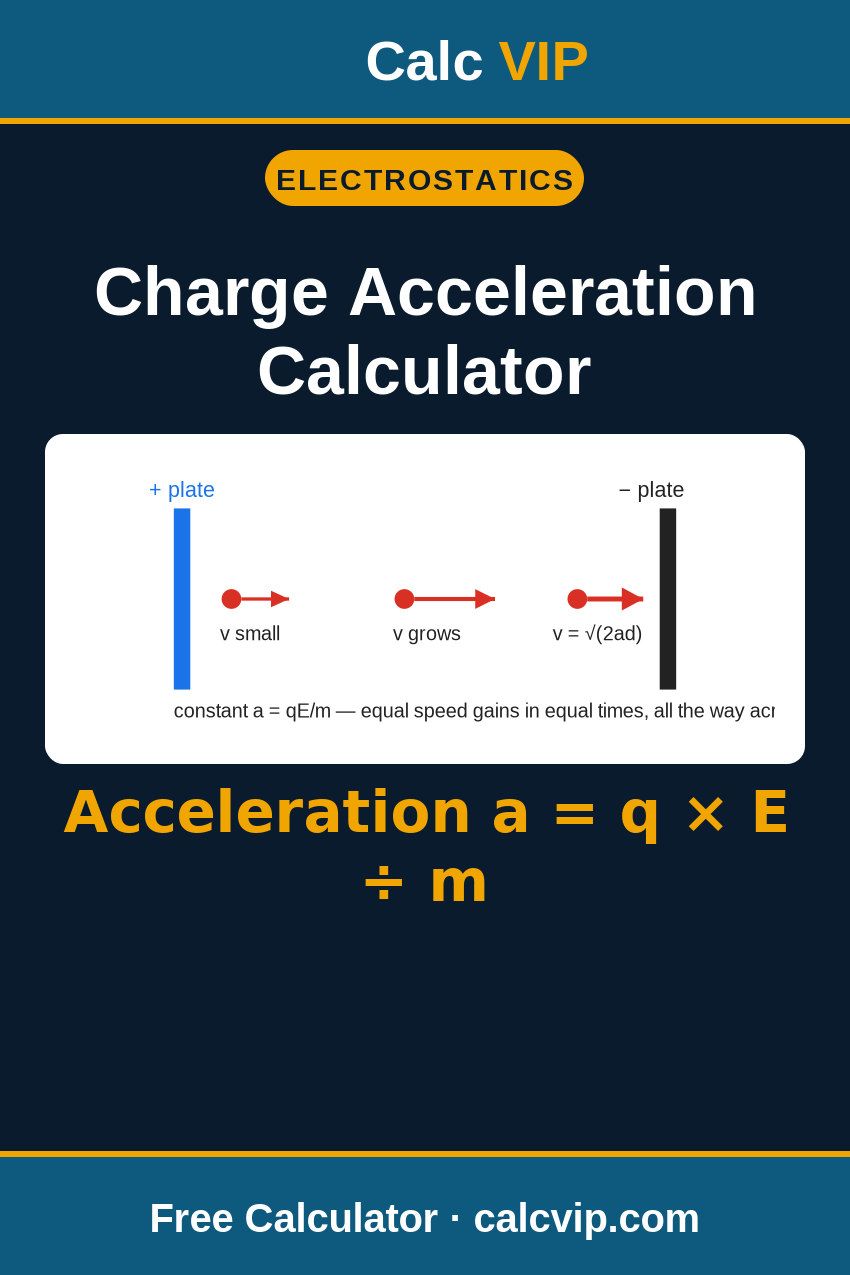
Put a charged particle in an electric field and Newton's second law does the rest: the force qE, divided by the particle's mass, is its acceleration. Because particle masses are so small, the accelerations are astronomical by everyday standards — a proton in a modest 1,000 N/C field accelerates at nearly 10¹¹ m/s², and an electron in the same field at 1.76 × 10¹⁴ m/s². This calculator finds that acceleration for an electron, proton or alpha particle (or your own charge and mass), then follows it to the speed reached either after a chosen time, v = at, or after a chosen distance from rest, v = √(2ad).
The two speed modes are the two natural questions. Time mode suits pulsed devices — how fast is the particle after a nanosecond in the field? Distance mode suits accelerators, where the field region has a physical length: the particle enters at rest (or slowly) and leaves with whatever speed the length bought it. Distance mode hides the deeper truth — multiply qE by d and you have the work done, so ½mv² = qEd, which is the energy statement that accelerator physicists actually use, quoting particle energies in electron-volts. The calculator's kinematics and the energy view are the same physics wearing two coats.
Presets matter because charge-to-mass ratio is destiny. The electron's q/m is 1.76 × 10¹¹ C/kg; the proton's, 9.58 × 10⁷; the alpha particle, with twice the charge but nearly four times the mass, manages only about half the proton's acceleration in the same field. Choose a preset and the calculator fills in q and m; choose custom for ions, charged dust, or droplets, whose ratios are smaller by many orders of magnitude and whose accelerations are correspondingly tame. Either way, the direction is the field's for positive charge and against it for negative — the calculator reports sizes, and the sign of q supplies the arrow.
Formula
Acceleration a = q × E ÷ m • Speed after time t (from rest) v = a × t • Speed after distance d (from rest) v = √(2 × a × d) • Energy form ½mv² = q × E × d
Everything descends from F = qE meeting F = ma. The energy form deserves its place in the table: since the field between plates is E = ΔV/d, the product Ed is just the voltage fallen through, and ½mv² = qΔV — the reason a particle's energy after crossing a voltage is quoted as q times that voltage, and why "electron-volt" is a unit of energy at all. Use whichever pair the problem hands you: time questions want v = at; length-of-device questions want the square-root form; energy questions skip speed entirely. All three assume the field is uniform and the start is from rest; a particle entering with speed u generalises to v² = u² + 2ad, of which the calculator's version is the common special case.
| Symbol | Meaning | Units |
|---|---|---|
| a | acceleration of the particle | m/s² |
| q | particle's charge (magnitude used for a) | coulombs (C) |
| m | particle's mass | kilograms (kg) |
| E | field strength | N/C |
| t / d | time spent / distance travelled in the field | s / m |
Charge-to-mass ratio: the number that sorts the particles
Divide a = qE/m by E and what remains, q/m, is a property of the particle alone — and it varies over a range that structures whole industries. The electron: 1.602 × 10⁻¹⁹ ÷ 9.11 × 10⁻³¹ = 1.76 × 10¹¹ C/kg. The proton: 9.58 × 10⁷ C/kg, smaller by a factor of 1,836 — the mass ratio, since their charges are equal. The alpha particle: double charge, roughly quadruple mass, q/m = 4.82 × 10⁷ C/kg, about half the proton's — which is why, in the same field, alphas accelerate at 0.504 times the proton's rate, a ratio this calculator reproduces exactly (Example 3 uses it).
J. J. Thomson measured the electron's q/m in 1897 by balancing electric and magnetic deflections, and the largeness of the number was the clue that the electron was a new kind of object — thousands of times lighter than any atom. Mass spectrometry is the same measurement industrialised: accelerate ions through a field, and their q/m values sort them into separate beams. When you pick a preset in this calculator you are choosing a q/m, and everything else follows from it.
How to use
- Pick the particle: electron, proton, alpha particle, or "custom" and type a charge and mass in scientific notation (e.g. q = 1.602e-19, m = 9.11e-31).
- Enter the field strength E in N/C.
- Choose the speed mode: "after a time" and enter t in seconds, or "after a distance" and enter d in metres. Times for particles are usually nanoseconds to microseconds — 1e-9, 1e-6.
- Click "Calculate" to get the acceleration and the speed reached, both from rest.
- Keep one eye on the speed of light: if v comes out anywhere near 3 × 10⁸ m/s, the Newtonian formulas are overpromising and the relativistic correction matters — see the depth section before quoting the number.
Worked examples
Example 1 — the reference proton. A proton in E = 1,000 N/C.
a = qE/m = 1.602 × 10⁻¹⁹ × 1,000 ÷ 1.673 × 10⁻²⁷ = 9.58 × 10¹⁰ m/s². After t = 1 × 10⁻⁶ s: v = at = 95,756 m/s. After d = 0.05 m: v = √(2ad) = √(2 × 9.58 × 10¹⁰ × 0.05) = 97,855 m/s. A microsecond or five centimetres — either buys a proton a hundred kilometres per second.
Example 2 — the same field, an electron. E = 1,000 N/C.
a = 1.602 × 10⁻¹⁹ × 1,000 ÷ 9.11 × 10⁻³¹ = 1.76 × 10¹⁴ m/s² — the proton's acceleration multiplied by the mass ratio 1,836, as the FAQ below promised. In just t = 1 × 10⁻⁹ s the electron reaches v = 175,851 m/s. Electron devices live in nanoseconds because electrons do.
Example 3 — an alpha particle. E = 5,000 N/C, q = 3.204 × 10⁻¹⁹ C, m = 6.645 × 10⁻²⁷ kg.
a = 3.204 × 10⁻¹⁹ × 5,000 ÷ 6.645 × 10⁻²⁷ = 2.41 × 10¹¹ m/s². After d = 0.01 m: v = √(2 × 2.41 × 10¹¹ × 0.01) = 69,438 m/s. Note the alpha out-accelerates the proton here only because the field is five times stronger; at equal fields it would manage half the proton's a.
Example 4 — the electron gun. An electron crosses a field of 1 × 10⁴ N/C over d = 0.05 m (a 500 V plate gap, in energy terms).
a = 1.76 × 10¹⁵ m/s², and v = √(2 × 1.76 × 10¹⁵ × 0.05) = 1.33 × 10⁷ m/s — about 4.4% of light speed, the working velocity inside every cathode-ray tube and electron microscope column.
Example 5 — a custom charged grain. A dust grain with q = 1 × 10⁻¹⁵ C and m = 1 × 10⁻¹² kg in a precipitator field of 1 × 10⁵ N/C.
a = 1 × 10⁻¹⁵ × 1 × 10⁵ ÷ 1 × 10⁻¹² = 100 m/s², reaching v = 10 m/s after 0.1 s. Custom mode's natural habitat: q/m so small that the motion is almost everyday — ten gravities, not ten trillion.
Example 6 — a proton in a strong field. E = 1 × 10⁵ N/C for t = 1 × 10⁻⁷ s.
a = 9.58 × 10¹² m/s², so v = 9.58 × 10¹² × 1 × 10⁻⁷ = 957,561 m/s — nearly a thousand kilometres per second from a tenth of a microsecond. Accelerator designers chain thousands of such pushes; this is the atom of their arithmetic.
Accelerated charges in real life
Particle accelerators. From a hospital linac to the LHC, every accelerator is this calculator repeated: fields push, q/m decides the response, and stages are chained because one field region gives only √(2qEd/m) of speed. The LHC's protons end at 0.99999999c — deep in the relativistic regime this page warns about — but they start here.
Electron microscopes. Electrons accelerated through tens or hundreds of kilovolts reach a substantial fraction of light speed with wavelengths far below light's — the resolution advantage of the instrument is bought entirely with qEd of kinetic energy.
Mass spectrometry and time-of-flight. Ions accelerated through the same field and distance leave with speeds set by √(2qΔV/m); timing their flight down a tube reads out their masses. Airport swab detectors and proteomics labs run on Example-style arithmetic.
Ion thrusters. Spacecraft like Dawn accelerated xenon ions through kilovolt grids: modest force per ion, but the exhaust speeds — tens of km/s from exactly this formula — make the propulsion supremely fuel-efficient over years of thrusting.
Cathode-ray tubes and X-ray tubes. The CRT's electron gun is Example 4 in glass. In an X-ray tube the same electrons, at higher voltage, slam into a metal target and their sudden stop produces X-rays — the acceleration here is what the radiation budget is spent from.
Electrostatic chucks and wafer handling. Semiconductor fabs hold wafers with fields acting on induced charges; the forces are the custom-mode regime of Example 5, engineered so the acceleration of anything loose is either useful or negligible by design.
When Newton gives up: the relativistic ceiling
The formulas here assume mass is constant and speed can grow without bound. Einstein disagrees, and the disagreement becomes measurable sooner than intuition suggests. In a 1,000 N/C field an electron's Newtonian speed reaches 0.1c (3 × 10⁷ m/s) after just t = 3 × 10⁷ ÷ 1.76 × 10¹⁴ = 1.71 × 10⁻⁷ s — beyond that, the true speed falls increasingly behind at, because added energy goes partly into relativistic inertia. The energy bookkeeping stays clean, though: ½mv² = qEd is replaced by (γ − 1)mc² = qEd, with the same right-hand side. An electron through 100 V has 100 eV of energy either way; Newton predicts v = 5.93 × 10⁶ m/s (about 0.02c, accurate to a hair), while at 500 kV the Newtonian answer would be embarrassingly fast and the true speed is 0.86c. Rule of thumb: trust this calculator while v stays under about 0.1c, and reach for relativity above it.
One more relativistic subtlety is worth filing away: a very fast particle radiates when it is accelerated, shedding energy as synchrotron radiation in machines where beams are bent, and even in a straight field the radiation reaction is, in principle, a tiny extra drag. At the fields and speeds of this calculator's examples the effect is utterly negligible — but it is the reason the largest accelerators are built as straight lines for electrons (linacs) or accept enormous energy losses per turn in rings. Even the exceptions to Newton, pursued far enough, become engineering.
Quick reference: the three presets at E = 1,000 N/C
| Particle | q (C) | m (kg) | q/m (C/kg) | a at 1,000 N/C |
|---|---|---|---|---|
| electron | −1.602 × 10⁻¹⁹ | 9.11 × 10⁻³¹ | 1.76 × 10¹¹ | 1.76 × 10¹⁴ m/s² |
| proton | +1.602 × 10⁻¹⁹ | 1.673 × 10⁻²⁷ | 9.58 × 10⁷ | 9.58 × 10¹⁰ m/s² |
| alpha particle | +3.204 × 10⁻¹⁹ | 6.645 × 10⁻²⁷ | 4.82 × 10⁷ | 4.82 × 10¹⁰ m/s² |
Every row scales linearly with E: at 1 × 10⁵ N/C multiply the last column by 100. The q/m column is the whole story — the field merely turns it up or down.
Common mistakes
- Feeding in milliseconds and metres interchangeably. Particle times are nanoseconds and microseconds; entering 1 (meaning a microsecond, or a second?) without the exponent inflates v by 10⁶ or more. Write times as 1e-6 and distances in plain metres.
- Using atomic mass units as kilograms. A proton is 1.007 u but 1.673 × 10⁻²⁷ kg. Custom mode wants kilograms — the presets exist partly to spare you this conversion.
- Swapping the two speed formulas. v = at grows linearly; v = √(2ad) grows as a square root. Using the time formula with a distance (or vice versa) is dimensionally wrong and gives absurd numbers — check the units of what you typed.
- Forgetting the start-from-rest assumption. Both speed formulas assume u = 0. A particle injected with speed needs v² = u² + 2ad; at high injection speeds the field's contribution may be a small correction, not the whole answer.
- Trusting Newtonian speeds near c. If the calculator returns anything above ~3 × 10⁷ m/s, treat it as an overestimate: relativity caps the true speed below 3 × 10⁸ m/s no matter how long the field acts. The energy form, qEd, remains your reliable guide.
FAQ
Why is the acceleration so enormous?
Because the mass of a single particle is incredibly small. The same 1,000 N/C field gives an electron a = 1.76 × 10¹⁴ m/s² — nearly 2,000 times the proton's value, because the electron is about 1,836 times lighter.
Which way does the particle accelerate?
A positive charge accelerates along the field; a negative charge (like the electron) accelerates against it. This calculator reports the size of the acceleration and speed.
Does the speed keep growing forever?
In this simple model, yes — but as a particle approaches the speed of light, relativity takes over and the speed levels off below c. For the fields and times in most textbook problems the simple formulas are accurate.
What is the electron-volt, and where does it come from?
One electron-volt is the kinetic energy an electron gains crossing a potential difference of 1 V: 1.602 × 10⁻¹⁹ J. Because Ed over a plate gap is the voltage crossed, distance mode in this calculator is secretly an energy calculator — cross 500 V and any singly charged particle gains 500 eV, whatever its mass; mass only decides how fast that energy makes it travel.
Why do accelerators use alternating fields?
A static field can only push a particle across the voltage that insulation can hold — a few million volts at most. Radio-frequency cavities let the particle surf a fresh push in each successive gap, the field flipping as it crosses, so the energy accumulates over thousands of stages without any single gap holding the full voltage.
Does the particle's speed depend on the field's direction?
The acceleration points along E for positive charges and against it for negative ones. An electron released between plates runs towards the positive plate — opposite to the field arrows — which is why electron beams are described as flowing against the conventional field direction.
What if the field is not uniform?
Then a varies from place to place and the tidy formulas become averages at best. The energy route survives intact, though: the total kinetic energy gained still equals q times the total voltage fallen through, however the field was distributed along the path.
How fast is too fast for this calculator?
Up to about 0.1c (3 × 10⁷ m/s) the Newtonian answers are within about half a percent. Example 4's electron at 0.044c is safely inside. Beyond 0.1c, switch to the relativistic energy relation (γ − 1)mc² = qΔV and solve for v.
Can a field decelerate a particle?
Yes — send a positive charge against the field (or an electron along it) and the same formulas describe slowing: the particle trades kinetic energy back to potential energy, stopping after a distance ½mv² ÷ qE. Electron lenses and retarding-field analysers work exactly this way, measuring energies by the voltage that just stops the beam.
Why is gravity never in these formulas?
Because for electrons and ions it is ten-plus orders of magnitude too weak to matter, as the force calculator's proton-weight comparison shows. Gravity enters only for heavy, weakly charged objects — droplets, dust, grains — whose q/m is tiny; custom mode plus a mg comparison handles those honestly.