 Calc
Capacitor Charge Calculator – Q = CV Solve for Charge, Capacitance or Voltage
 Created by Thomas Becker · Physics Writer · Electricity & Magnetism · Last updated: November 2026
Use this free Capacitor Charge Calculator to solve Q = CV in any direction: find the charge stored from capacitance and voltage, the capacitance from charge and voltage, or the voltage from charge and capacitance. The stored energy is shown every time. Capacitance can be entered in farads, microfarads, nanofarads or picofarads, and charges in scientific notation — for example 1.2e-4.
Q = CV is the capacitor's whole personality in three symbols. It says the charge a capacitor stores is strictly proportional to the voltage across it, and the constant of proportionality — the capacitance C — is fixed by the device's geometry and materials: bigger plates, closer together, with a better dielectric, store more charge per volt. Nothing else about the capacitor matters for this relation. It holds while charging, while discharging, in a camera flash and in a power station, which is why a single solver for its three rearrangements covers so much practical ground.
The energy deserves its own attention, because it refuses to be QV. Charge a capacitor and the first trickle of charge arrives against no voltage at all; only the last trickle fights the full V. The average opposition is V/2, so the stored energy is ½QV — equivalently ½CV² or Q²/(2C). That factor of a half is the signature of every "fill against a rising push" system in physics, from springs (½kx²) to inductors (½LI²), and this calculator reports the energy alongside whichever variable you solve for, because in most real designs the energy — the joules that will come back out as a flash, a spark or a shock — is the number that actually matters.
Units are where capacitor arithmetic goes to die, so the calculator helps: capacitance can be entered in farads, microfarads, nanofarads or picofarads, and it converts for you. Real-world capacitances span an almost comic range — a few picofarads for a radio tuning capacitor, thousands of microfarads in a power supply, whole farads in a supercapacitor — while the farad itself is so large that no ordinary component reaches it. Keep the prefixes straight and Q = CV will never surprise you.
Formula
Charge Q = C × V • Capacitance C = Q ÷ V • Voltage V = Q ÷ C • Stored energy U = ½ × C × V² = ½ × Q × V = Q² ÷ (2C)
Three forms of the energy are worth keeping because different problems hand you different pairs of variables — but they are one fact, not three: substitute Q = CV into any of them and the others appear. The V² form carries the practical punch. Doubling the voltage doubles the charge and doubles the energy per charge, so the stored energy quadruples; this is why high-voltage capacitors are dangerous out of proportion to their size, and why a supercapacitor's modest 2.7 V ceiling matters more than its enormous farads. Unit discipline: Q in coulombs, C in farads, V in volts, U in joules — the calculator's unit selector exists because 10 µF entered as 10 F inflates every answer a millionfold.
| Symbol | Meaning | Units |
|---|---|---|
| Q | charge on one plate (the other holds −Q) | coulombs (C) |
| C | capacitance — charge stored per volt | farads (F) |
| V | voltage across the capacitor | volts (V) |
| U | energy stored in the field between the plates | joules (J) |
Why the energy is a half: charging against a rising voltage
Picture charging as carrying buckets of charge across a growing voltage. The first bucket crosses for free — the capacitor is empty and offers no opposition. Each later bucket must be pushed against the voltage built up by all the buckets before it, and the final bucket fights the full V. Plot voltage against charge delivered and you get a straight line from (0, 0) to (Q, V); the work done is the area under that line — a triangle, base Q, height V, area ½QV. The half is geometry, not fudge.
This picture also explains the famous charging loss. Connect an empty capacitor to a battery through any resistor and the battery does QV of work while the capacitor stores ½QV; the other half warms the resistor, whatever its value. Halve the resistance and the same energy is lost, just faster. (Superconducting leads and clever resonant charging schemes dodge this; ordinary circuits cannot.) When the capacitor discharges, though, the full ½QV comes back out — into a flash tube, a defibrillator's paddles, or an unwary fingertip.
How to use
- Choose what to find: the charge Q, the capacitance C, or the voltage V.
- Enter the two known values. When a capacitance is needed, type its number and pick its unit (µF, nF, pF or F) from the selector — the calculator converts to farads for you.
- Charges can be typed in scientific notation, e.g. 1.2e-4 for 120 µC.
- Click "Calculate". Along with the variable you asked for, you always get the stored energy U — check it; it is often the number with safety consequences.
- Sanity-check with proportionality: at fixed C, doubling V must double Q and quadruple U. If it doesn't, a unit prefix has slipped.
Worked examples
Example 1 — the reference capacitor. C = 10 µF charged to V = 12 V.
Q = C × V = 10 × 10⁻⁶ × 12 = 1.2 × 10⁻⁴ C (120 µC), and U = ½CV² = ½ × 10 × 10⁻⁶ × 144 = 7.2 × 10⁻⁴ J. A modest component, a modest store — less than a millijoule.
Example 2 — finding capacitance. A capacitor holds Q = 470 µC at V = 25 V. What is C?
C = Q ÷ V = 470 × 10⁻⁶ ÷ 25 = 1.88 × 10⁻⁵ F = 18.8 µF. Its energy: U = ½QV = ½ × 470 × 10⁻⁶ × 25 = 5.88 × 10⁻³ J. This is how unmarked capacitors are identified on a bench: charge, measure, divide.
Example 3 — finding voltage. Q = 1 × 10⁻³ C sits on C = 100 µF.
V = Q ÷ C = 1 × 10⁻³ ÷ 100 × 10⁻⁶ = 10 V, and U = ½QV = 5 × 10⁻³ J. Note the pattern from Example 1: ten times the charge on ten times the capacitance gives a similar voltage — the ratios are what matter.
Example 4 — the camera flash. A photoflash capacitor of 300 µF is charged to 330 V.
Q = 300 × 10⁻⁶ × 330 = 0.099 C — a tenth of a coulomb, a serious charge — and U = ½ × 300 × 10⁻⁶ × 330² = 16.3 J. Released in a millisecond, that is over 16 kW of instantaneous power: the V² law turning a pocket component into a lightning bolt in miniature.
Example 5 — the supercapacitor. C = 1 F at its rated 2.7 V.
Q = 1 × 2.7 = 2.7 C, U = ½ × 1 × 2.7² = 3.65 J. A whole farad stores less energy than the flash capacitor of Example 4 — the clearest demonstration going that voltage, squared, beats capacitance in the energy stakes.
Example 6 — the defibrillator. A defibrillator's capacitor, about 32 µF, is charged to 5,000 V.
Q = 32 × 10⁻⁶ × 5,000 = 0.16 C; U = ½ × 32 × 10⁻⁶ × 25 × 10⁶ = 400 J — of which a controlled fraction is delivered to the patient's chest. The same three symbols that describe a radio component also size a life-saving machine; only the voltage changed.
Capacitor charge in real life
Power-supply smoothing. Every mains adapter holds a reservoir capacitor that charges at the peaks of the rectified waveform and discharges between them. Q = CV sizes it: the charge it must supply between peaks, at an allowed voltage sag, fixes C directly.
Touchscreens. A capacitive touchscreen senses the tiny change in plate charge when your finger — a conductor — joins the system. The sensing circuits measure charge transfers of picocoulombs, Q = CV operating at the edge of measurability.
Defibrillators and AEDs. As Example 6 shows, the therapy dose is a capacitor specification: charge to a set voltage, and ½CV² is the energy budget from which the delivered shock is drawn.
Camera flashes and strobes. The whine you hear as a flash recharges is the capacitor refilling; the recycle time is the time needed to replace Q = CV coulombs through a small charging current. Bigger C or higher V, longer wait, brighter flash.
Regenerative braking buffers. Supercapacitor banks in buses and trams swallow the energy of a stop and return it for the start. Their farads are huge and their voltage low, so banks are stacked in series-parallel arrays — a packaging exercise in keeping total Q and U where the vehicle needs them.
Condenser microphones. A charged diaphragm and backplate form a capacitor at fixed charge; sound moves the diaphragm, C changes, and V = Q/C converts the motion into an audio signal. The "find V" mode of this calculator is literally the microphone's operating principle.
Where capacitance comes from: plates, gaps and dielectrics
Q = CV treats C as a given, but C itself is geometry in disguise. For parallel plates, C = ε0εrA/d: proportional to plate area A, inversely proportional to the gap d, and multiplied by the dielectric's relative permittivity εr. Run the numbers for plates of A = 0.01 m² facing across d = 1 mm of air: C = 8.854 × 10⁻¹² × 0.01 ÷ 0.001 = 8.854 × 10⁻¹¹ F — just 88.5 pF. Charged to 100 V it holds Q = 8.85 × 10⁻⁹ C and U = 4.43 × 10⁻⁷ J. That feebleness is the whole engineering problem of capacitors in one example: air-spaced plates are hopeless, so real devices roll up square metres of foil, shrink the gap to micrometres, and fill it with a dielectric of εr in the thousands. Every farad you have ever met was manufactured by attacking all three factors of that formula at once — and once manufactured, the device hands its C back to Q = CV, which never asks how the value was achieved.
Counting electrons: how much charge is a coulomb?
Charges like 120 µC feel abstract until they are counted. One coulomb is 1 ÷ 1.602 × 10⁻¹⁹ ≈ 6.24 × 10¹⁸ electrons, so Example 1's modest 120 µC is 1.2 × 10⁻⁴ × 6.24 × 10¹⁸ ≈ 7.49 × 10¹⁴ electrons — three quarters of a million billion, moved from one plate to the other by a 12 V supply without fuss. The flash capacitor's 0.099 C is 6.18 × 10¹⁷ electrons. Numbers like these explain two things at once: why electrostatics can treat charge as a smooth fluid (the grains are unimaginably fine), and why a single coulomb at arm's length would be a violent object — nature never lets macroscopic objects keep charge measured in whole coulombs, because the fields would tear it away long before. For one more calibration, the defibrillator's 0.16 C from Example 6 is 0.16 ÷ 1.602 × 10⁻¹⁹ ≈ 1.0 × 10¹⁸ electrons — a billion billion of them, marshalled by a machine that fits in two hands and delivered in a few milliseconds.
Quick reference: charging to 12 V
| Capacitance | Charge Q at 12 V | Energy U |
|---|---|---|
| 1 µF | 12 µC | 72 µJ |
| 10 µF | 120 µC | 720 µJ |
| 100 µF | 1.2 mC | 7.2 mJ |
| 1,000 µF | 12 mC | 72 mJ |
| 1 F (supercapacitor) | 12 C | 72 J |
Both columns scale in direct proportion to C at fixed voltage — and the energy column would grow with the square of any voltage increase, which the flash and defibrillator examples exploit. The charge column, by contrast, grows only in simple proportion to voltage: it is the energy, always, that squares away.
Common mistakes
- Typing microfarads as farads. The classic. 10 µF is 1e-5 F; entering "10" with the unit set to F multiplies Q and U by a million. Use the unit selector, or write the value in scientific notation in farads.
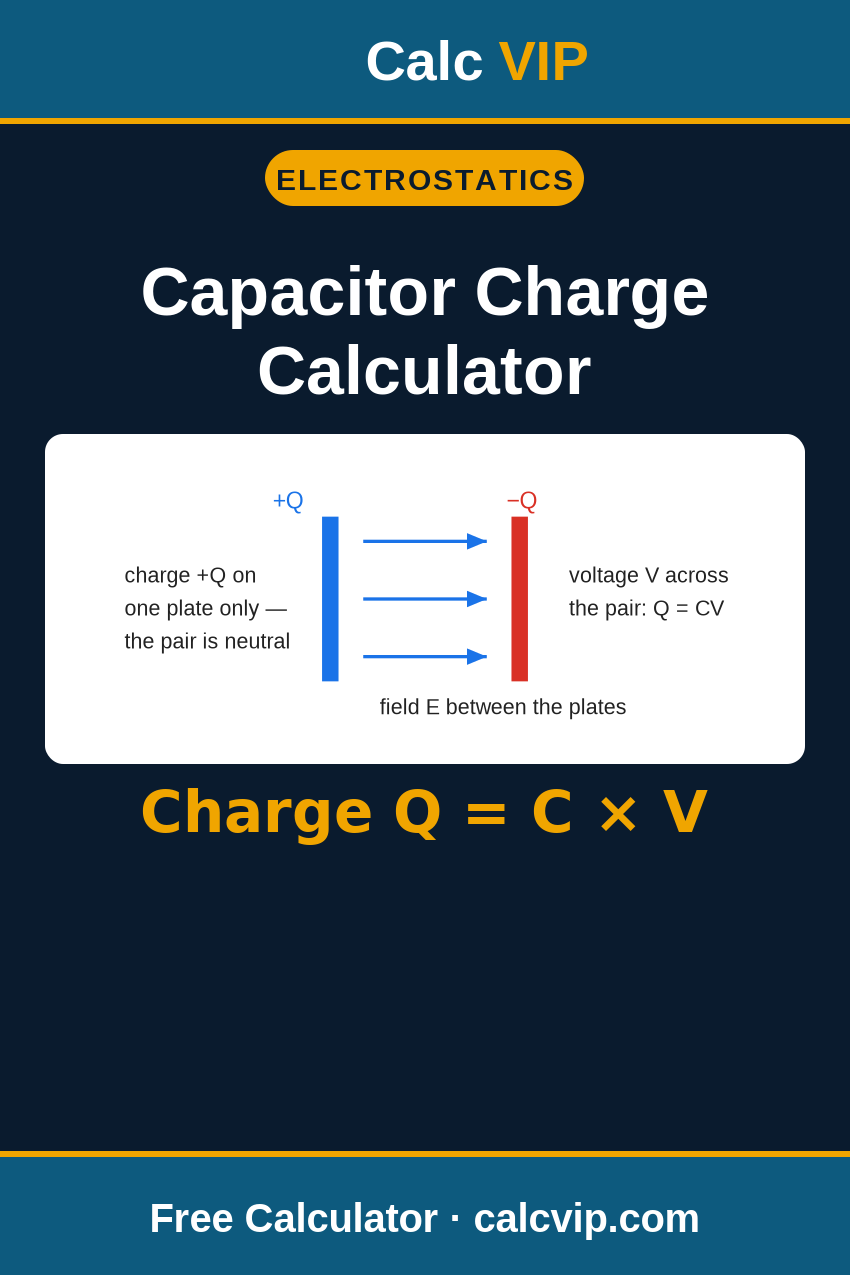
- Thinking the capacitor's net charge is Q. The pair of plates together is neutral: +Q and −Q. Q is the charge separated — the amount that flowed through the circuit — not a net surplus on the device.
- Computing the energy as QV. That double-counts: the average voltage during charging is V/2, so U = ½QV. The QV figure is the work the battery does, half of which is lost as heat in the charging resistance.
- Ignoring the voltage rating. Q = CV holds only up to the capacitor's rated voltage; beyond it the dielectric breaks down (see the dielectric-strength calculator) and the component fails, sometimes energetically. A 16 V part on a 25 V rail is a small bomb with a timer.
- Assuming C changes with voltage or charge. For ordinary capacitors C is a constant of the device — Q and V change in lockstep. (Exotic exceptions exist in some ceramic types, whose C sags at high voltage; datasheet curves, not this formula, govern those.)
FAQ
What does Q mean if the capacitor as a whole is neutral?
Q is the charge on one plate. Charging moves charge from one plate to the other, so one plate holds +Q and the other −Q, while the total stays zero.
Why is the energy ½QV and not QV?
As the capacitor charges, its voltage rises from 0 to V, so the average voltage during charging is only V/2. Moving the total charge Q against that average voltage stores ½QV.
What unit is capacitance measured in?
The farad (F). Real capacitors are usually microfarads (µF = 10⁻⁶ F), nanofarads (nF = 10⁻⁹ F) or picofarads (pF = 10⁻¹² F).
Does a bigger capacitor always store more energy?
Only at the same voltage. Energy is ½CV², so voltage usually wins: Example 5's 1 F supercapacitor at 2.7 V stores 3.65 J, while Example 4's mere 300 µF at 330 V stores 16.3 J. Compare capacitors by their ½CV², never by farads alone.
Why can't a capacitor pass a steady DC current?
Because its plates are separated by an insulator: charge accumulates until the capacitor's voltage equals the supply, and then flow stops. Current flows only while V is changing — which is why capacitors pass AC signals while blocking DC levels.
How long does charging take?
Through a resistance R, the charge grows with time constant RC: about 63% charged after one RC, 99% after five. Q = CV gives the destination, not the schedule — the schedule belongs to the circuit's resistance.
Where exactly is the energy stored?
In the electric field between the plates. The energy-density formula u = ½ε0E² multiplied by the plate volume reproduces ½CV² exactly — the plates are just the field's scaffolding.
What happens if I exceed the voltage rating?
The dielectric's breakdown field is surpassed somewhere, a conductive path punches through, and the stored energy dumps into that path at once. Small capacitors vent or short; large ones can rupture. Ratings carry margin, but they are not suggestions.
Can a capacitor hold its charge forever?
No. Real dielectrics leak slightly, so the charge — and with it V — decays over minutes to days depending on type. Film capacitors hold charge longest; electrolytics self-discharge fastest. It is also why a "dead" circuit's big capacitor deserves respect for a while after switch-off, then a cautious discharge before handling.
How do series and parallel combinations change C?
Parallel capacitors add: Ctotal = C1 + C2, one bigger plate area. Series capacitors combine reciprocally, 1/Ctotal = 1/C1 + 1/C2, giving less than the smallest — the pair behaves like one capacitor with a thicker dielectric. Compute the combined C first, then use this calculator as usual.