 Calc
Charge Density Calculator – Linear λ, Surface σ & Volume ρ
 Created by Thomas Becker · Physics Writer · Electricity & Magnetism · Last updated: November 2026
Use this free Charge Density Calculator to work out how charge is spread out — along a line (linear density λ), over a surface (surface density σ), or through a volume (volume density ρ). Pick the mode, enter the total charge and the size, and the calculator does the division. You can type values in scientific notation — for example 5e-6 means five microcoulombs.
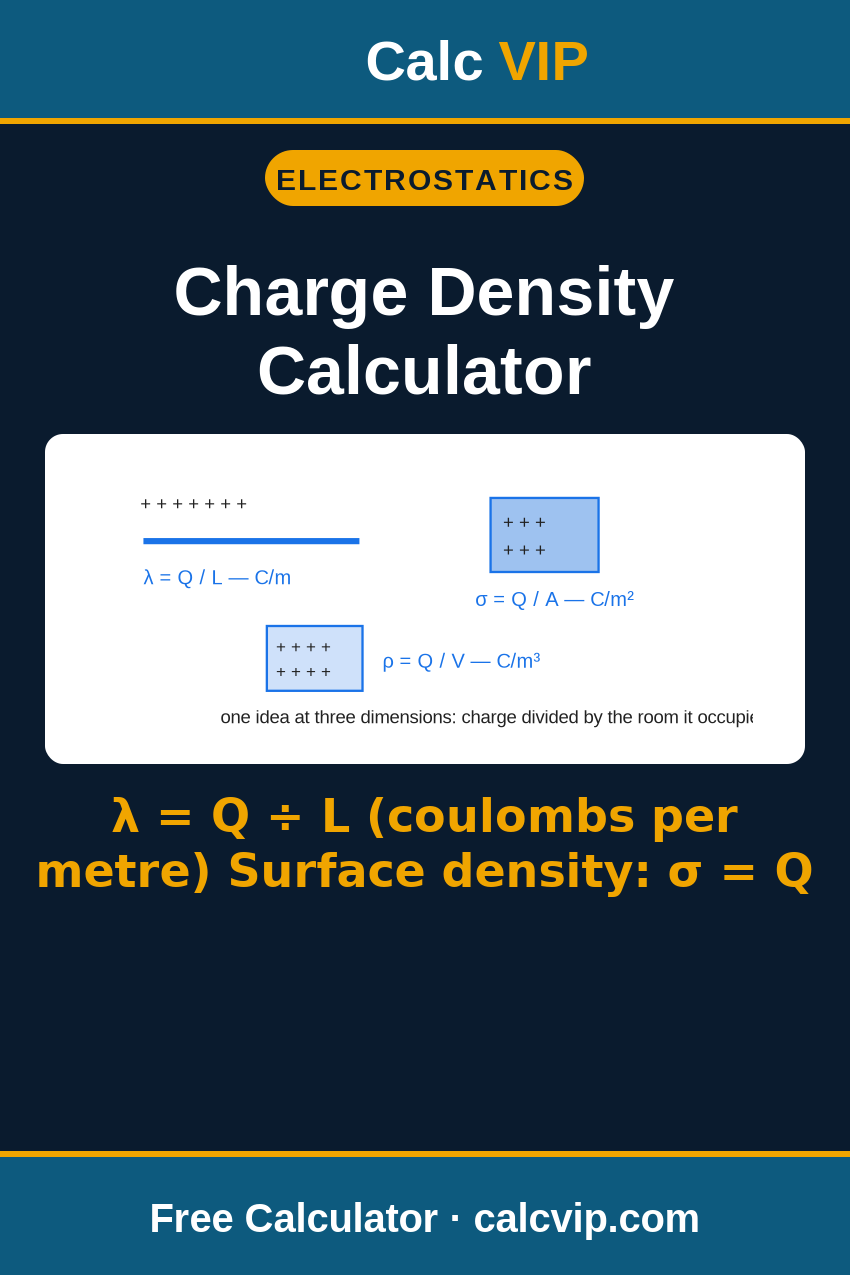
Charge rarely arrives as a neat point. It smears along wires, pools on the skins of conductors, and drifts through the volume of clouds, semiconductors and plasmas. To describe such charge you need a density — charge per unit of space — and because space comes in three flavours here, so does the density. Spread along a line it is λ, coulombs per metre. Spread over a surface it is σ, coulombs per square metre. Spread through a bulk it is ρ, coulombs per cubic metre. Each is the same idea at a different dimension: divide the total charge by the amount of room it occupies.
These densities are not bookkeeping trivia; they are the working variables of field theory. Gauss's law, the deepest statement in electrostatics, speaks density fluently: the field just outside a conductor is σ/ε0, the field of an endless charged sheet is σ/(2ε0) on each side, and the field around a long charged line is λ/(2πε0r). Feed a density into those formulas and out comes the field — which is why engineers designing everything from photocopier drums to particle detectors think in densities, not in total charges. The total Q tells you what a whole object carries; the density tells you what any small patch of it is doing.
Charge density also has limits written by nature. Air breaks down at a field of about 3 × 10⁶ N/C, which caps the surface density a bare conductor in air can hold at roughly ε0 × 3 × 10⁶ ≈ 2.7 × 10⁻⁵ C/m² — push more charge on and it leaks away in sparks and corona glow. Inside insulators and capacitors, far larger densities survive, which is why the interesting extremes of σ live inside devices. This calculator handles all three densities; the sections below connect each one to the fields it creates and the objects that carry it.
Formula
Linear density: λ = Q ÷ L (coulombs per metre)
Surface density: σ = Q ÷ A (coulombs per square metre)
Volume density: ρ = Q ÷ V (coulombs per cubic metre)
Each formula rearranges the obvious ways: Q = λ × L, Q = σ × A, Q = ρ × V recover a total charge from a density and a size, and the size follows from Q ÷ density. The densities earn their keep through the fields they create (in vacuum or air): a long straight line of charge gives E = λ ÷ (2πε0 × r) at distance r; an endless flat sheet gives E = σ ÷ (2ε0) on each side, independent of distance; and the field just outside a conductor's surface is E = σ ÷ ε0, pointing straight out. Inside a uniformly charged sphere the field grows as E = ρ × r ÷ (3ε0). These four results — all children of Gauss's law — are why a density, once known, is most of the way to the field everywhere.
| Symbol | Meaning | Units |
|---|---|---|
| λ | linear charge density — charge per length | C/m |
| σ | surface charge density — charge per area | C/m² |
| ρ | volume charge density — charge per volume | C/m³ |
| Q | total charge being spread | coulombs (C) |
| L, A, V | length, area, volume the charge occupies | m, m², m³ |
Why charge on a conductor is a surface density
Put charge on a metal object and something remarkable happens within a fraction of a second: the charge migrates entirely to the outer surface and stays there, a skin with no depth. The reason is self-defence — charges repel, the interior field must be zero in equilibrium, and the only arrangement satisfying both is all charge on the skin, distributed as a surface density σ that varies with the local curvature: sparse on flat regions, crowded at sharp points. That crowding is why lightning rods are pointed (the field σ/ε0 at a tip can exceed air's breakdown and quietly bleed charge away) and why high-voltage equipment is polished smooth and rounded.
Insulators behave oppositely, and that is where volume density lives. Charge sprayed onto plastic or trapped in a thundercloud cannot move, so it stays where it landed, a genuine ρ spread through a bulk. Semiconductors are the engineered middle case: doping plants a controlled density of ionised atoms through the crystal's volume, and the resulting ρ — positive in p-type material, negative in n-type — is quite literally what a transistor is made of. Line density, meanwhile, belongs to wires, beams and the charged filaments of detectors, anywhere one dimension dwarfs the other two. The three densities are one idea wearing the geometry of its container.
A subtlety worth carrying forward: densities are local. Nothing requires σ to be the same at two ends of a plate, or ρ uniform through a cloud, and in most real systems they are not. The calculator's division gives the average density — total charge over total size — which is exact for uniform spreads and a first approximation otherwise. When the spread is uneven, the honest description is a density function, σ(x, y) or ρ(x, y, z), and the total charge is recovered by adding up (integrating) the density over the whole object. Every formula on this page survives that upgrade unchanged; only the arithmetic grows teeth.
How to use
- Choose whether the charge is spread along a line, over a surface, or through a volume — the mode sets both the formula and the unit.
- Enter the total charge in coulombs — scientific notation like 5e-6 works fine, with a minus sign for negative charge.
- Enter the length (m), area (m²) or volume (m³) to match the mode you picked. The size label updates to remind you which is wanted.
- Click "Calculate" to get the density in the matching unit: C/m, C/m² or C/m³.
- Sanity-check against nature: surface densities on conductors in air above ~2.7 × 10⁻⁵ C/m² cannot persist (the air breaks down), while inside capacitors and insulators much larger values are routine.
Worked examples
Example 1 — the reference plate, plus its two siblings. A flat plate carries a charge of 5 × 10⁻⁶ C spread evenly over an area of 0.02 m².
σ = Q / A = 5 × 10⁻⁶ ÷ 0.02 = 2.5 × 10⁻⁴ C/m².
The same idea works for the other modes: 3 × 10⁻⁶ C along a 2 m wire gives λ = 1.5 × 10⁻⁶ C/m, and 8 × 10⁻⁶ C inside 0.004 m³ gives ρ = 0.002 C/m³.
Example 2 — a charged rod. A 3 m insulating rod sprayed with 12 × 10⁻⁶ C of charge: λ = 12 × 10⁻⁶ ÷ 3 = 4 × 10⁻⁶ C/m. At 10 cm from its middle, such a line produces E = λ/(2πε0r) ≈ 7.2 × 10⁵ N/C — strong enough to make nearby dust and hair respond, from a charge you could not feel as weight.
Example 3 — density on a real capacitor plate. Take the mica capacitor from the Plate Capacitor page: C = 531.24 pF on plates of 0.01 m². Charged to 10 V it holds Q = CV = 5.312 × 10⁻⁹ C, so σ = 5.312 × 10⁻⁹ ÷ 0.01 = 5.31 × 10⁻⁷ C/m². The field just outside each plate is σ/ε0 = 60,000 N/C — and between the plates, where the two plates' fields cooperate, that is the working field of the device.
Example 4 — a thundercloud's volume density. A storm cloud carrying 20 C of separated charge spread through about 2 km³ (2 × 10⁹ m³) of sky has ρ = 20 ÷ 2 × 10⁹ = 1 × 10⁻⁸ C/m³. A laughably small density — yet integrated over cubic kilometres and stacked over a kilometre of height, it builds the hundreds of millions of volts that lightning discharges.
Example 5 — a negative density. An acetate sheet rubbed to hold −8 × 10⁻⁶ C over 0.04 m²: σ = −8 × 10⁻⁶ ÷ 0.04 = −2 × 10⁻⁴ C/m². The minus sign is the whole story: the surface is carpeted with excess electrons, and the field above it points inwards, towards the sheet, ready to attract positive dust — the working principle of every photocopier and laser printer.
Example 6 — counting the electrons. How many electrons make Example 1's σ = 2.5 × 10⁻⁴ C/m²? Divide by the electron's charge: 2.5 × 10⁻⁴ ÷ 1.602 × 10⁻¹⁹ = 1.56 × 10¹⁵ electrons per square metre — about 1.6 million billion, yet still only a tiny fraction (roughly one in ten million) of the atoms in the surface layer. Charge densities that sound extreme are, atomically, a light dusting.
Charge density in real life
Photocopiers and laser printers. A drum is coated with a uniform σ in the dark; light erases it image by image, and toner — charged powder — sticks where σ remains. Print quality is density uniformity, which is why drums are precision-made.
Electrostatic precipitators. Power-station filters charge smoke particles and collect them on plates; the design numbers are the plates' σ and the field σ/ε0 it sustains without sparking.
Thunderstorms. Meteorologists model clouds with volume charge densities of nanocoulombs per cubic metre in separated pockets — Example 4's ρ — and track how the pockets grow until the field between them reaches breakdown.
Semiconductor doping. A silicon wafer's behaviour is set by its volume density of ionised dopants, spanning roughly 10²⁰ to 10²⁶ charges per cubic metre across device types — ρ as a manufacturing specification.
Particle detectors. Wire chambers stretch long charged filaments whose λ sets the field that avalanches ionisation into a measurable signal; the position of a passing particle is read from which wire fired.
Spray painting and crop dusting. Charged droplets with a controlled charge-to-size ratio — a flying volume density — wrap around grounded targets instead of drifting past, coating backs of objects as if the paint could turn corners.
The sheet that never fades: σ and the distance-free field
The strangest fruit of surface density is the infinite sheet: its field, σ/(2ε0), does not weaken with distance at all. Walk away from a vast charged plane and the field stays put — the 1/r² fading of each patch's contribution is exactly compensated by more patches coming into effective range, a conspiracy only an endless plane can sustain. For σ = 1 × 10⁻⁶ C/m² the field is 1 × 10⁻⁶ ÷ (2 × 8.854 × 10⁻¹²) = 56,472 N/C at a millimetre and at a metre alike. Real plates are finite, so the constancy holds only near the middle and well inside the plate's own dimensions — which is precisely the region between capacitor plates, and why the field there is so conveniently uniform.
The line has its own gentler version of the same trick: its field falls only as 1/r, not 1/r², because as you retreat from a long wire, more of its length contributes. Doubling your distance from a charged line halves the field; doubling your distance from a point charge quarters it. Geometry, once again, is destiny — and the density's dimension (per metre, per square metre, per cubic metre) is what chooses the geometry.
Quick reference: densities and the fields they make
| Situation | Field |
|---|---|
| Sheet with σ = 1 × 10⁻⁶ C/m² | 56,472 N/C each side, distance-independent |
| Conductor surface, σ = 1 × 10⁻⁶ C/m² | 112,943 N/C just outside, zero inside |
| Line with λ = 1 × 10⁻⁶ C/m, at r = 0.1 m | 179,755 N/C |
| Max σ on a conductor in air | ≈ 2.7 × 10⁻⁵ C/m² (breakdown limit) |
| Thundercloud ρ | ≈ 1 × 10⁻⁸ C/m³ |
The conductor row is exactly double the sheet row — a conductor's charge sits on one side of its skin only, and Gauss's law pays out the full σ/ε0 outside and nothing inside. That factor of two is a favourite exam trap and a real design number for high-voltage engineers.
Common mistakes
- Mixing up the three units. C/m, C/m² and C/m³ are different physical quantities, not conversions of each other. A density is meaningless until its dimension is named.
- Dividing by the wrong size. Surface mode needs the area the charge actually covers — for a plate charged on both faces, or a sphere (4πr²), that is the full spread area, not the footprint.
- Assuming charge spreads itself evenly on conductors. It spreads over the surface, yes, but σ concentrates at curves and points. A single average σ hides the tip values where breakdown starts.
- Confusing charge ρ with mass density or resistivity. The symbol ρ serves three masters. In this calculator it is always coulombs per cubic metre; check the units before using any tabulated ρ.
- Expecting a conductor to hold unlimited σ in air. Beyond ≈ 2.7 × 10⁻⁵ C/m² the surrounding air ionises and the charge leaks. Larger densities belong inside insulators, oils or vacuum.
FAQ
FAQ
Why are there three kinds of charge density?
Because charge can live on a thin wire (a line), on the skin of a conductor (a surface), or spread through a material (a volume). Each case needs its own "charge per amount of space" measure.
What are the Greek letters λ, σ and ρ?
They are the standard symbols: lambda (λ) for linear, sigma (σ) for surface, and rho (ρ) for volume charge density. You will meet the same ρ symbol later as mass density and resistivity — the context tells you which.
Is charge density ever negative?
Yes — if the total charge is negative (for example a surface covered with extra electrons), the density is negative too. The sign simply follows the sign of Q.
How do I get total charge back from a density?
Multiply: Q = λL, Q = σA or Q = ρV. A plate of 0.5 m² at σ = 2.5 × 10⁻⁴ C/m² carries 1.25 × 10⁻⁴ C in total — densities and totals convert both ways through the size.
Why does charge sit on a conductor's surface instead of spreading through its volume?
Because the charges repel and the metal lets them move. Any charge left inside would create a field that pushes it outward until the interior is field-free — which happens only when all the charge is on the skin.
What density does a lightning rod carry?
Its tip concentrates σ enormously — that is the point. The resulting local field can exceed air's breakdown near the tip, ionising a small region and bleeding the building's charge away quietly, or offering lightning a preferred path.
Can charge density be measured directly?
Indirectly but precisely: a Faraday cup measures total Q, a field mill measures E (hence σ = ε0E at a conductor), and scanning probes map σ across surfaces. Densities are inferred from fields and totals, the two things instruments read.
Is the charge on a capacitor plate a surface density?
Yes — the plates are conductors, so their charge is a skin of σ = Q/A, equal and opposite on the facing surfaces. Example 3 computes a real one: 5.31 × 10⁻⁷ C/m² at 10 V.
What is a typical volume density in a plasma?
It varies enormously — a fluorescent tube's plasma carries net ρ near zero (equal ions and electrons) with each species around 10¹⁷–10¹⁸ charges per cubic metre. Net density and particle density are different quantities; Gauss's law cares about the net.
Does a bigger object hold more charge at the same σ?
Yes — Q = σA grows with area. That is why large Van de Graaff domes and capacitor plates store more: the density is capped by breakdown, so area is the only way up.