 Calc
Spring Energy Solver Calculator – PE = ½kx² Solve for Energy, k or x
 Created by Priya Sharma · Physics Editor · Energy & Gravity · Last updated: November 2026
Use this free Spring Energy Solver to solve any one unknown in the elastic potential energy equation PE = ½kx². Find the stored energy, the spring constant k, or the stretch/compression x.
A spring is a rechargeable battery that stores work as shape. Stretch it or squeeze it and the energy you spend does not vanish — it waits, as elastic potential energy, ready to be handed back the moment the spring is released. The amount stored obeys one of the most elegant formulas in mechanics, PE = ½kx², where k measures the spring's stiffness and x how far it has been displaced from its natural length. This calculator solves the equation from any corner: the stored energy from stiffness and displacement, the stiffness from energy and displacement, or the displacement a given energy and spring require.
Two features of the formula repay a close look before any numbers are entered. The square on x means displacement is bought at escalating prices: the second centimetre of stretch costs three times what the first did, because the spring pulls back harder the further it is already stretched. And the ½ is the receipt for that escalation — the average force during loading is only half the final force, so the work stored is half of what a naive "force × distance" with the final force would suggest. Both features are derived properly in the concept section below, with the triangle of the force–displacement graph doing the explaining.
Springs are everywhere once you start looking: vehicle suspensions swallowing potholes, archers' bows and trampolines, clock mainsprings and door closers, the humble click of a ballpoint pen. In each, a designer asked one of this calculator's three questions — how much energy will it hold, how stiff must it be, how far dare we stretch it — and the answers are always this one equation read in the appropriate direction.
Formula
Elastic potential energy PE = ½ × k × x² • rearranged: k = 2PE ÷ x² and x = √(2PE ÷ k)
The spring constant k, in newtons per metre, is the force needed to stretch the spring by one metre — equivalently, the slope of its force–displacement line under Hooke's law, F = kx. The displacement x is measured from the spring's natural (unstretched) length, in metres, and it enters squared, which is why the calculator's reverse modes involve a square root and a doubling: solving for x means undoing both the ½ and the square. Units discipline matters more here than in almost any school formula, because the square amplifies errors: enter x in centimetres instead of metres and the energy comes out ten thousand times too large. The calculator expects metres throughout — 15 cm is 0.15 m — and reports energy in joules.
| Symbol | Meaning | Units |
|---|---|---|
| PE | elastic potential energy stored | J |
| k | spring constant — stiffness | N/m |
| x | stretch or compression from natural length | m |
| F | spring force at displacement x, F = kx | N |
Where the ½ comes from: the triangle under the line
Load a spring gradually and its resistance grows with every millimetre: zero force at the natural length, rising steadily to F = kx at full stretch. The work you do is the area under that force–displacement graph — a triangle, not a rectangle. Its base is x and its height is kx, so the area is ½ × x × kx = ½kx², and there is the formula, geometry and all. Example 1 makes it tangible: the 200 N/m spring at 0.15 m pulls back with a final force of 200 × 0.15 = 30 N, but the average force over the stretch was only 15 N, so the work stored is 15 × 0.15 = 2.25 J. Anyone who has drawn a bow recognises the physics in their shoulders: the last centimetre of draw is the expensive one, and the energy receipt — the triangle — is why a bow's power grows so hungrily with draw length.
The square also sets the spring's character as an energy store. Doubling x quadruples the stored energy (Example 6: the same spring at 0.30 m holds 9 J, four times the 2.25 J at 0.15 m), which tempts designers to stretch further — until the elastic limit intervenes. Beyond it, the force line bends, the triangle distorts, and the spring takes a permanent set or snaps: the formula's tidy world ends exactly where the material stops obeying Hooke's law. Every spring in service lives between those two facts — the square law's generosity and the elastic limit's veto.
How to use
- Choose what to find: the stored energy PE, the spring constant k, or the displacement x. The input labels adjust to the two values you must supply.
- Enter those two values — k in newtons per metre, x in metres (convert centimetres: 15 cm = 0.15 m), PE in joules.
- Click "Solve" for the missing quantity.
- Sanity-check with the square law: if doubling x does not quadruple PE, or a solved x is not the square root of 2PE ÷ k, an input has slipped a decimal — the most common accident with this formula.
Worked examples
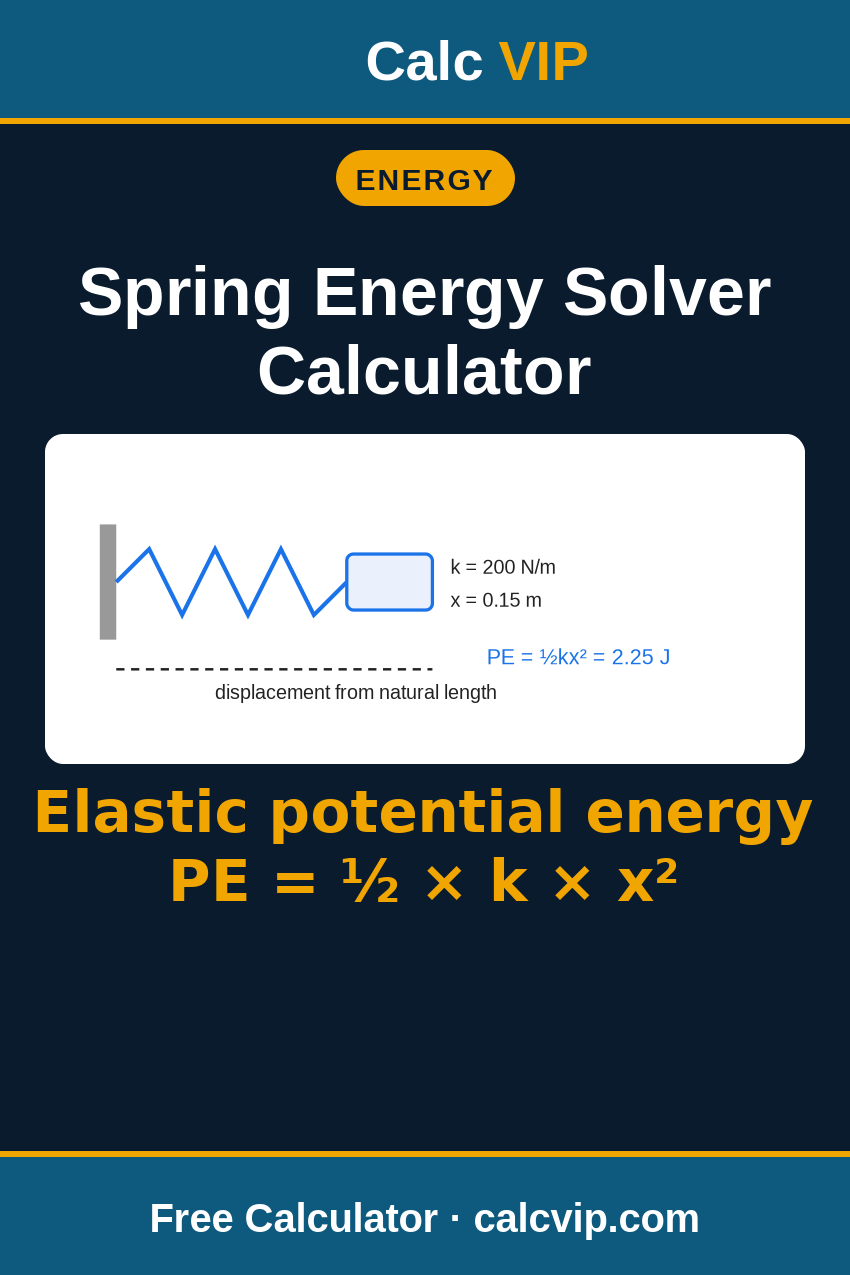
Example 1 — the bench spring (energy mode). A spring of k = 200 N/m stretched by 0.15 m: PE = ½ × 200 × 0.15² = 2.25 J. The reverse modes recover the inputs exactly: k = 2 × 2.25 ÷ 0.15² = 200 N/m and x = √(2 × 2.25 ÷ 200) = 0.15 m.
Example 2 — how stiff is it? (k mode). A test spring stores 50 J when stretched 0.5 m: k = 2 × 50 ÷ 0.5² = 100 ÷ 0.25 = 400 N/m. This is how spring catalogues are written in reverse — hang, stretch, measure the energy or the force, and the stiffness falls out of the rearranged equation.
Example 3 — how far will it stretch? (x mode). A spring of k = 80 N/m must store 10 J: x = √(2 × 10 ÷ 80) = √0.25 = 0.5 m. Door-closer and launcher designers live in this mode: the energy budget is fixed by the job, the spring is chosen from a catalogue, and the travel required is the answer.
Example 4 — a car's suspension spring. One corner spring with k = 30,000 N/m compressed by 0.08 m over a bump stores PE = ½ × 30,000 × 0.0064 = 96 J — per wheel, per bump, absorbed and mostly handed back as the wheel drops again. Four wheels over a rough road process hundreds of joules a second through this formula, which is why springs, not shock absorbers, carry the car.
Example 5 — the archery bow. Model a drawn bow as a spring of k = 800 N/m drawn 0.6 m: PE = ½ × 800 × 0.36 = 144 J waits in the limbs at full draw. Released into a 30-gram arrow, even half of that energy would mean arrow speeds competitive with the real thing — the square law at 0.6 m is a serious energy store.
Example 6 — the doubling trap, sprung. Example 1's spring stretched twice as far, to 0.30 m: PE = ½ × 200 × 0.09 = 9 J — four times the energy for twice the stretch. Every spring user eventually rediscovers this: the last stretch of a bungee, a bow or a catapult is where the energy — and the risk — concentrates.
Spring energy in real life
Vehicle suspension. Example 4's 96 J per wheel is the working currency of ride comfort: springs store the bump's energy and return it gently, while dampers bleed off just enough to stop the car bouncing on its own stored energy forever.
Trampolines and pogo sticks. A trampoline bed's springs (working together as one large effective k) store the jumper's kinetic energy at the bottom of the bounce and return nearly all of it — the closest everyday experience of ½kx² as a near-perfect battery.
Clocks and wind-up toys. A mainspring stores energy in coiling rather than stretching, but the bookkeeping is the same idea: slow, steady work goes in over many turns and comes out on demand — the formula's rotational cousin runs every mechanical watch.
Pinball and launchers. The plunger spring's stored ½kx² becomes the ball's kinetic energy at release; Example-style arithmetic — how much energy, into how much mass — sets the launch speed, exactly as the depth section computes for a toy launcher.
Door closers and hinges. Opening the door does the work of stretching or twisting the closer's spring; the stored energy then spends itself shutting the door at a governed pace. The x-mode question — how far must it wind to hold enough energy — is the design calculation.
Safety catches and mousetraps. A mousetrap is a spring held at large x by a catch, storing its ½kx² for weeks without loss until the trigger lets the displacement collapse into motion in milliseconds — stored energy's patience and suddenness in one device.
From stored energy to launch speed
The natural sequel to storing energy is spending it, and the conversion is a one-line energy balance: ½kx² becomes ½mv². Release Example 1's spring (2.25 J) against a ball of 0.05 kg and the ball leaves at v = √(2 × 2.25 ÷ 0.05) = √90 ≈ 9.49 m/s — about 34 km/h from a spring you could stretch with two fingers. Real launchers lose a share to the spring's own mass, friction and sound, but the ceiling is set by this exchange, and it explains the pecking order of spring-powered devices: energy grows with the square of stretch, so a modest increase in draw beats a large increase in stiffness for reaching power — at the price of travel. It also explains spring-mass oscillators: left attached, the mass trades kinetic for potential energy and back twice per cycle, forever in the ideal case, which is why the same ½kx² anchors the theory of vibration from engine mounts to skyscraper dampers.
Weighing stiffness with a stopwatch
There is a second, dynamic way to interrogate a spring, and it doubles as this formula's most beautiful application. Attach a mass m and the system oscillates with period T = 2π√(m ÷ k) — the stiffer the spring or the lighter the mass, the faster the bounce. Hang 0.5 kg on Example 1's 200 N/m spring and the period is T = 2π√(0.5 ÷ 200) = 2π × 0.05 ≈ 0.314 s, about 3.18 oscillations per second — countable with a phone timer over ten swings. Rearranged, the relation measures k from a stopwatch and a kitchen mass, no force gauge required, which is how the stiffness of everything from trampoline beds to a car's suspension (bounce the corner, count the rhythm) is estimated in practice. The energy and the oscillation are the same physics wearing two hats: ½kx² is the store, T = 2π√(m/k) is the store being emptied and refilled on schedule, and each formula can be used to audit the other.
Combinations repay a quick energy audit, because the calculator's three modes apply unchanged to the effective k. Two of Example 1's springs side by side act as one spring of k = 400 N/m, and at the same 0.15 m stretch they store ½ × 400 × 0.15² = 4.5 J — exactly double, as two springs should. Strung end to end, the pair softens to k = 100 N/m and the same stretch stores only ½ × 100 × 0.15² = 1.125 J, though the pair can now stretch twice as far overall before either spring nears its limit. Parallel for power, series for travel: the energy formula prices both arrangements without modification, which is why it, and not the force law alone, is the design tool for spring systems from mattress coils to launch rails.
Quick reference: energy stored in a 200 N/m spring
| Stretch x | Force at that stretch | Energy stored |
|---|---|---|
| 0.05 m | 10 N | 0.25 J |
| 0.10 m | 20 N | 1 J |
| 0.15 m | 30 N | 2.25 J |
| 0.20 m | 40 N | 4 J |
| 0.30 m | 60 N | 9 J |
The force column climbs evenly while the energy column accelerates away — the triangle's geometry in tabular form, and a compact warning that the top of a spring's range is where both its usefulness and its danger live.
Common mistakes
- Entering x in centimetres. The square turns a units slip into a catastrophe: 15 instead of 0.15 inflates the energy by 10,000. Convert to metres before touching the formula — no other check matters as much on this page.
- Measuring x from the wrong zero. x is displacement from the natural length, not the spring's total length and not the travel of whatever is attached if the spring started pre-loaded. A spring already stretched 0.1 m that stretches to 0.25 m stores ½k(0.25²) − ½k(0.1²), not ½k(0.15²).
- Forgetting the ½. Using the final force times the distance (kx × x) double-counts, because the force was not at its final value for most of the stretch. The triangle, not the rectangle: half the product.
- Expecting energy to grow in proportion to stretch. It grows with the square. Planning a launcher by "twice the stretch, twice the power" underestimates the energy — and the stress on the spring — by a factor of two.
- Trusting the formula past the elastic limit. Hooke's law is a material's promise with conditions. Beyond the elastic limit the force line bends, energy is lost to permanent deformation, and ½kx² overstates what the spring will give back — sometimes shortly before it gives way entirely.
FAQ
Why is the energy proportional to x²?
The spring pulls harder the further it is stretched, so each extra centimetre costs more work than the last. Doubling the stretch stores four times the energy.
Does it matter if the spring is compressed instead of stretched?
No — x is squared, so compression by the same amount stores exactly the same energy.
What is the spring constant k?
It measures stiffness: k is the force needed to stretch the spring by one metre. A car suspension spring has a huge k; a pen spring has a small one.
Does spring energy depend on gravity?
No. Unlike gravitational potential energy mgh, elastic energy is stored in the material's deformation and is the same on the Moon as on Earth. A vertical spring's equilibrium position shifts with gravity (the weight stretches it), but the ½kx² stored about any displacement is gravity-free.
Can the stored energy ever be negative?
No — x is squared and k is positive, so PE is zero at the natural length and positive for any stretch or compression. Energy stored is energy owed back; the formula keeps the account in credit by construction.
What happens when two springs are combined?
Side by side (parallel), their stiffnesses add: two 200 N/m springs behave as one 400 N/m spring. End to end (series), the combination is softer than either: two 200 N/m springs in series act as 100 N/m. Car suspensions and mattress coils exploit both arrangements.
Is a rubber band governed by the same formula?
Only approximately, and only for modest stretches. Rubber's force curve bends noticeably (it is not Hookean), so ½kx² with a single k is an estimate there, whereas a steel coil spring obeys it closely across its working range.
Where does the energy go if the spring is released with nothing attached?
Into the spring's own motion: the coils oscillate, the energy sloshing between elastic and kinetic forms, gradually leaking away as sound and internal heating until the spring settles at its natural length. Attached masses simply join that exchange, as the launch calculation shows.
How is k measured in practice?
Hang known masses, measure the stretches, and divide force by displacement — or use this calculator's k mode with a measured energy. Catalogue k values are quoted for the linear region; a spring measured near its elastic limit will report a misleading stiffness.
Why do springs "tire" with age?
Repeated cycling, especially near the elastic limit, work-hardens and micro-cracks the material; corrosion thins the wire; heat relaxes the coils. The spring constant drifts down and the natural length creeps — the formula still holds, but with an ageing k and a shifted zero, which is why precision instruments recalibrate their springs.