 Calc
Spring Calculator – Hooke's Law F = kx & Spring Energy
 Created by Priya Sharma · Physics Editor · Energy & Gravity · Last updated: November 2026
Use this free Spring Calculator (Hooke's Law) to find the force a spring exerts and the energy it stores. Enter the spring constant and how far the spring is stretched or compressed, and the calculator gives you the force in newtons (N) and the stored energy in joules (J).
Springs are the quiet workhorses of the mechanical world. They close doors, cushion cars, power clocks, launch toys, soften mattresses and measure forces in the scale at the fishmonger's stall. Every one of them obeys a law so simple it fits in three characters — F = kx — written down by Robert Hooke in 1678 and still the first thing engineers reach for when something needs to push back.
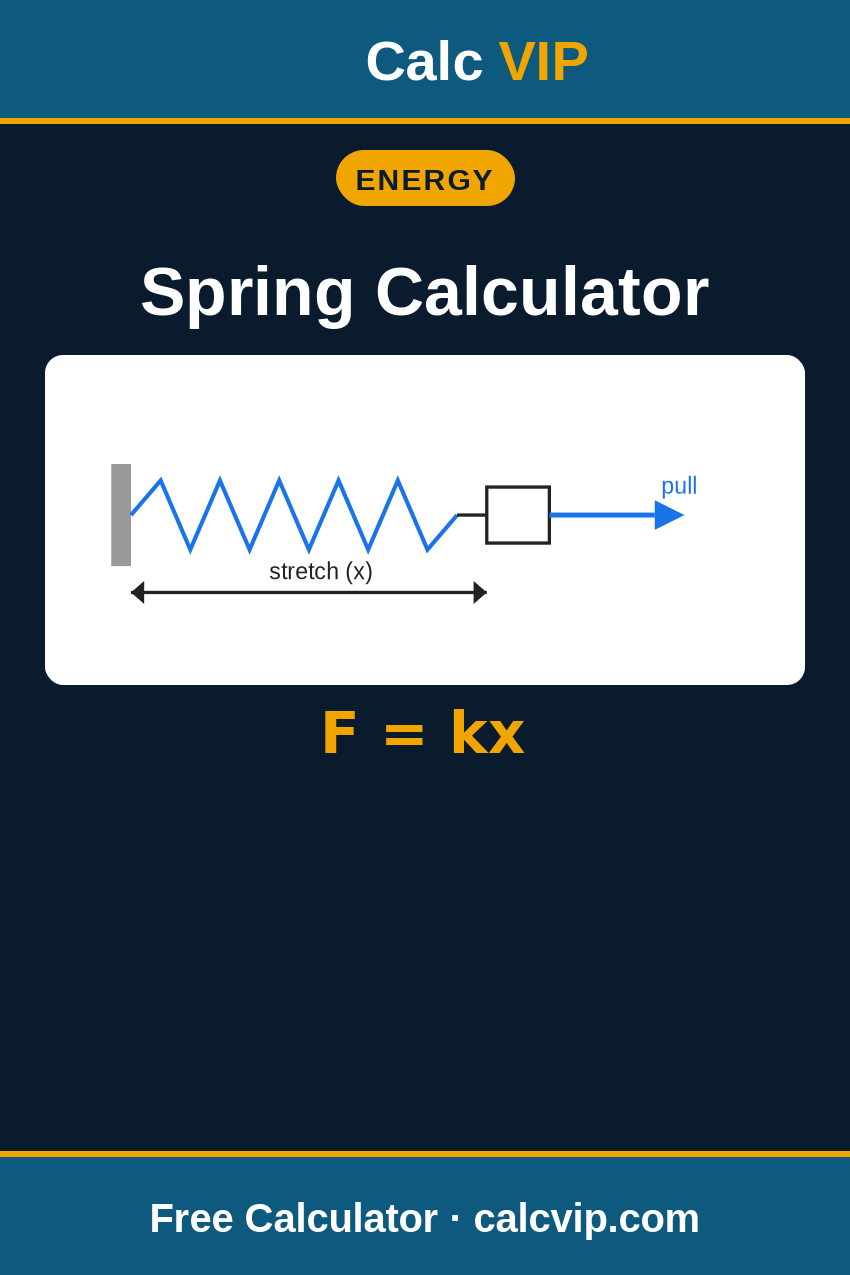
Hooke's law says that a spring fights its own deformation, in exact proportion. Stretch it a little and it pulls back a little; stretch it twice as far and it pulls back twice as hard. The spring constant k is the personality of the spring expressed as a number: how many newtons of force it answers with for every metre of stretch. A soft party-balloon spring might have k = 20 N/m; a car suspension spring, k = 30,000 N/m or more. Same law, wildly different stiffness.
A spring also stores energy as it deforms — elastic potential energy — and gives it back when released. That stored energy is what fires a pinball, snaps a mousetrap, returns a trampoline jumper to the sky and lets a wind-up toy walk across the floor. This calculator reports both sides of the spring's behaviour: the force it exerts right now, and the energy it is holding for later.
Formula
Hooke's Law: Force = Spring Constant × Extension → F = kx
Stored elastic energy = ½ × k × x² → E = ½kx²
The spring constant k measures stiffness: a bigger k means a stiffer spring that needs more force for the same stretch. Both formulas rearrange. The spring constant can be measured from any known force and stretch: k = F ÷ x — a spring stretched 0.1 m by a 20 N force has k = 20 ÷ 0.1 = 200 N/m. And the stretch from a known force is x = F ÷ k — 20 ÷ 200 = 0.1 m, the same spring understood from the other direction. Strictly, Hooke's law carries a minus sign, F = −kx, recording that the spring's force points opposite to the displacement; this calculator reports the size of the force, which is what most problems ask for.
Why does the energy carry a ½ and a square while the force does not? Because the force grows as you stretch. The first centimetre of stretch is easy, the last is hard, and the average force over the whole stretch is exactly half the final force. Energy = average force × distance = ½kx × x = ½kx². The formula is the geometry of steadily increasing effort.
| Symbol | Meaning | Units |
|---|---|---|
| F | force applied / spring's restoring force | newtons (N) |
| k | spring constant (stiffness) | N/m |
| x | stretch or compression from natural length | metres (m) |
| E | stored elastic potential energy, E = ½kx² | joules (J) |
The force–extension graph: a triangle of energy
Plot force against extension for a spring with k = 200 N/m and you get a straight line climbing through 10 N at 0.05 m, 20 N at 0.1 m and 30 N at 0.15 m — the slope of the line is k. The energy stored is the area under that line: a triangle. At x = 0.1 m the triangle's area is ½ × 0.1 × 20 = 1 J, matching the formula exactly. This picture is also the standard laboratory method for measuring an unknown spring: hang weights, plot force against extension, and read k from the slope. If the plot bends, the spring has left Hooke's law behind — the elastic limit has been passed and the spring is being damaged.
How to use
- Enter the spring constant k in newtons per metre (N/m).
- Enter how far the spring is stretched or compressed, in metres (m).
- Click "Calculate Spring Force" to see the force and the stored energy.
- Measure x from the spring's natural, unstretched length — and convert centimetres to metres (10 cm = 0.1 m) before entering.
Worked examples
Example 1 — the reference spring. A spring with k = 200 N/m is stretched by 0.1 m. Force = 200 × 0.1 = 20 N. Stored energy = ½ × 200 × 0.1² = ½ × 200 × 0.01 = 1 J.
Example 2 — a stiff spring, squeezed. A spring with k = 500 N/m is compressed by 0.04 m. Force = 500 × 0.04 = 20 N — the same force as Example 1 from a much smaller deformation, because this spring is stiffer. Stored energy = ½ × 500 × 0.04² = ½ × 500 × 0.0016 = 0.4 J.
Example 3 — a hanging mass. A mass of 2 kg hangs from the k = 200 N/m spring. Its weight is 2 × 9.81 = 19.62 N, and the spring stretches until its force matches: x = F ÷ k = 19.62 ÷ 200 = 0.0981 m, just under 10 cm. This is the entire working principle of the spring balance: read the stretch, and Hooke's law tells you the weight.
Example 5 — the bungee cord, treated as a spring. A bungee cord behaves roughly like a spring of k = 50 N/m. Stretched 10 m at the bottom of a jump, it pulls back with F = 50 × 10 = 500 N and stores E = ½ × 50 × 10² = 2500 J — the jumper's kinetic energy, banked in rubber and about to be returned as the bounce. Real cords are chosen so this exchange stays gentle.
Example 6 — identifying an unknown spring. A spring stretches 0.15 m under a force of 45 N. Its constant is k = F ÷ x = 45 ÷ 0.15 = 300 N/m, and at that stretch it stores E = ½ × 300 × 0.15² = 3.375 J. Two measurements — a force and a length — have fully characterised the spring: every future force and energy follows from them.
Springs in real life
Car suspension. Each wheel rides on a stiff spring (often tens of thousands of N/m) working with a damper. The spring absorbs the bump's energy as elastic potential energy; the damper's job is to waste that energy as heat rather than let the spring return it and bounce the car like a pogo stick. Force from the formula, comfort from the pairing.
Trampolines and divers. A trampoline bed and its springs store the jumper's kinetic energy at the bottom of the bounce and return nearly all of it — which is why you rise almost as high as you fell, minus losses. A diving board is a spring you can see bending, trading the diver's weight and bounce for stored energy and a higher launch.
Measuring the world. Spring balances weigh fish and luggage; spring mechanisms time mechanical watches through a hairspring's oscillation; retractable pens, door closers, mousetraps and archery bows all bank energy in bent or stretched material and spend it on demand. Wherever a machine must push back proportionally and remember its shape, there is a spring — or a piece of elastic material behaving as one.
Example 4 — double the stretch. Stretch the reference spring twice as far, to 0.2 m. The force doubles, as Hooke promises: 200 × 0.2 = 40 N. But the energy does not double — it quadruples: ½ × 200 × 0.2² = ½ × 200 × 0.04 = 4 J. The square in the energy formula means the last centimetres of a stretch are where the energy — and the danger of a snapping spring — concentrates.
Garage-door counterbalance springs. A garage door may weigh 500 N, yet a child can lift it — because torsion springs above the door store energy as the door closes and spend it as the door opens, cancelling most of the weight. When such a spring snaps, the door suddenly weighs its honest 500 N again, which is why the repair is a professional's job.
Bicycle shocks and pogo sticks. A mountain bike's suspension spring is chosen so that trail bumps compress it by centimetres, not millimetres — a k matched to the rider's mass. A pogo stick goes further, storing the whole landing in its spring and returning it as the next jump: the rider is a mass bouncing on Example 5's arithmetic, having fun with ½kx².
Springs in series and in parallel
Combine two springs and the pair behaves like a single spring with a new constant. Side by side in parallel, sharing the load, the constants add: two 200 N/m springs act as one of 400 N/m — this is why doubling the springs under a platform makes it twice as stiff. End to end in series, each spring feels the full force and stretches fully, so the combination is softer: two 200 N/m springs in series act as one of just 100 N/m, stretching twice as far under the same load. Engineers tune everything from vehicle suspensions to prosthetic limbs by choosing these arrangements.
The elastic limit: where the law ends
Hooke's law is a promise with conditions. Stretch a spring moderately and it returns exactly to its natural length — elastic behaviour, fully reversible. Stretch it too far and the coils themselves begin to deform permanently; release it and it stays longer than it was. That boundary is the elastic limit, and beyond it F = kx no longer describes the spring — its k has effectively changed, or the spring fails entirely. Hooke himself stated the law with the condition built in: the force holds "so long as the spring is not stretched beyond its power". Every formula in physics has a domain where it rules; knowing the border is part of knowing the law.
Springs that bounce: the natural frequency of a loaded spring
Load a spring with a mass and disturb it, and it oscillates at a frequency set by the pair of them: T = 2π√(m ÷ k). A car's corner — about 300 kg of the car's mass riding on a suspension spring of k ≈ 20,000 N/m — has T = 2π√(300 ÷ 20,000) ≈ 0.77 s, a bounce frequency of about 1.3 Hz. Suspension engineers aim exactly there: much faster and the car jitters over every stone, much slower and it wallows like a boat. Your own legs use the same tuning — the Achilles tendon is a spring whose bounce frequency matches your stride.
The formula also explains a party trick of bridges and buildings: add mass and the frequency falls; stiffen the spring and it rises. Earthquake engineers exploit both directions, mounting buildings on soft bearings (small effective k) so the ground's shaking arrives at a frequency the building barely notices.
Quick reference: one spring family, priced out
Read down the force column and then the energy column and the two shapes of Hooke's law separate cleanly: force grows in step with stretch (×2 stretch, ×2 force), while energy grows with its square (×2 stretch, ×4 energy). The last two rows are Examples 5 and 6 — a cord and a bench spring, same law, wildly different scales.
| Spring and stretch | Force | Energy stored |
|---|---|---|
| k = 200 N/m, x = 0.1 m (Ex. 1) | 20 N | 1 J |
| k = 500 N/m, x = 0.04 m (Ex. 2) | 20 N | 0.4 J |
| k = 200 N/m, x = 0.2 m (Ex. 4) | 40 N | 4 J |
| k = 300 N/m, x = 0.15 m (Ex. 6) | 45 N | 3.375 J |
| bungee cord, k = 50 N/m, x = 10 m (Ex. 5) | 500 N | 2500 J |
Two springs, one load: the series and parallel numbers
The earlier section described springs combining; here is the arithmetic. Two springs of k = 200 N/m side by side (parallel) share the load and behave as one spring of 400 N/m: a 40 N load stretches the pair by 40 ÷ 400 = 0.1 m. The same two springs end to end (series) behave as one spring of 100 N/m — each carries the full 40 N and stretches 0.2 m, for 0.4 m in total. Parallel stiffens, series softens, and the factors are exact, not approximate.
Vehicle suspension quietly uses both arrangements: a main spring for the ride and a helper spring that engages only at large compressions, a parallel partner arriving late. Mattress makers layer foams and coils for the same reason — the combined k can be sculpted across the travel in a way no single spring allows.
Common mistakes
- Entering the stretch in centimetres. x must be in metres. A 10 cm stretch is 0.1 m; entering 10 makes the force a hundred times too big and the energy ten thousand times too big.
- Using the spring's total length as x. x is the change in length from the natural, unstretched state — not the length the spring happens to be now.
- Expecting the energy to double when the stretch doubles. Force doubles, but energy quadruples, because E depends on x². This is the most common spring error of all.
- Assuming the force is constant during a stretch. The force grows from zero to kx as you pull. That growth is exactly why the energy formula carries its one-half.
- Mixing up N/m and N/cm. Spring constants are sometimes quoted per centimetre: a spring of 2 N/cm is a spring of 200 N/m, not 2 N/m. Feeding the per-centimetre figure into this calculator understates every force a hundredfold.
FAQ
Does Hooke's law work for compression too?
Yes. The same formulas apply whether the spring is stretched or squashed — x is simply how far it is from its natural length, and the spring pushes back the opposite way.
Does Hooke's law always hold?
Only up to the spring's elastic limit. Stretch a spring too far and it deforms permanently — beyond that point F = kx no longer applies.
Where is spring energy used?
Wind-up toys, trampolines, car suspension, mattresses and archery bows all store and release elastic potential energy.
What does the minus sign in F = −kx mean?
It records direction: the spring's force always points back toward the natural length, opposite to the displacement. Stretch it right and it pulls left; compress it and it pushes outward. This calculator reports the force's size.
How do I find the spring constant of an unknown spring?
Hang known weights on it and measure the stretch for each. Since k = F ÷ x, dividing any weight by its stretch gives k — better still, plot force against extension and take the slope of the straight line.
Do springs store energy when compressed as well as stretched?
Yes — E = ½kx² cares only about the size of the deformation, not its direction. A compressed spring in a mousetrap or a pen clicker is holding energy exactly as a stretched one does.
What is a spring balance?
A scale that weighs by Hooke's law: the load stretches an internal spring, and a pointer or dial converts the stretch into a force reading. Because it measures force, it would read differently on the Moon — unlike a balance scale, which compares masses.
How stiff is a car suspension spring?
Roughly 20,000 N/m per corner — it takes the weight of a small car to compress one by a metre, or, more sensibly, about 200 N per centimetre of travel. That stiffness is what sets the 1.3 Hz bounce described above.
Why do old springs sag?
Repeated loading, especially past the elastic limit or at high temperature, lets the metal's structure creep: the natural length grows and k effectively falls. A sagging spring has not forgotten Hooke's law — it is obeying it from a new, tired starting point.
Does a longer spring of the same wire stretch more easily?
Yes. Each coil contributes its own small stretch, so doubling the number of coils halves k. This is why a Slinky (many coils, thin wire) is so soft, and why cutting a spring in half makes each half stiffer — a result that surprises almost everyone the first time.