 Calc
Gyroscope Precession Calculator – Ω = mgr/(Iω) with Solid-Disk I = ½mR² Option
 Created by Rachel Novak · Senior Editor · All Topics · Last updated: November 2026
Use this free Gyroscope Precession Calculator to find how fast a spinning gyroscope's axis slowly turns (precesses): Ω = m × g × r / (I × ω). Enter the moment of inertia directly, or let the calculator work it out for a solid disk with I = ½mR².
A spinning top that refuses to fall is one of physics' best party tricks, and precession is the explanation. Lean a gyroscope's axis away from the vertical and gravity does pull on it — but instead of toppling, the axis begins a slow, stately sweep around the vertical, tracing a cone. That sweep is precession, and its rate Ω = mgr/(Iω) is one of the most counterintuitive formulas in mechanics: the harder gravity pulls (bigger m, longer r), the faster the axis turns — yet the faster the wheel spins, the slower it precesses. Spin is stiffness; torque is persuasion; precession is the compromise.
The mechanism is angular momentum bookkeeping. The wheel's angular momentum L = Iω points along its axis. Gravity exerts a torque about the pivot, τ = mgr (for a horizontal axis), and torque is the rate of change of L — but this torque points horizontally, at right angles to L. A change at right angles to a vector rotates the vector without growing it: L's tip circles, the axis follows, and the gyroscope precesses at Ω = τ/L = mgr/(Iω). Nothing about the size of L changes — only its direction, steadily, at the rate this calculator computes.
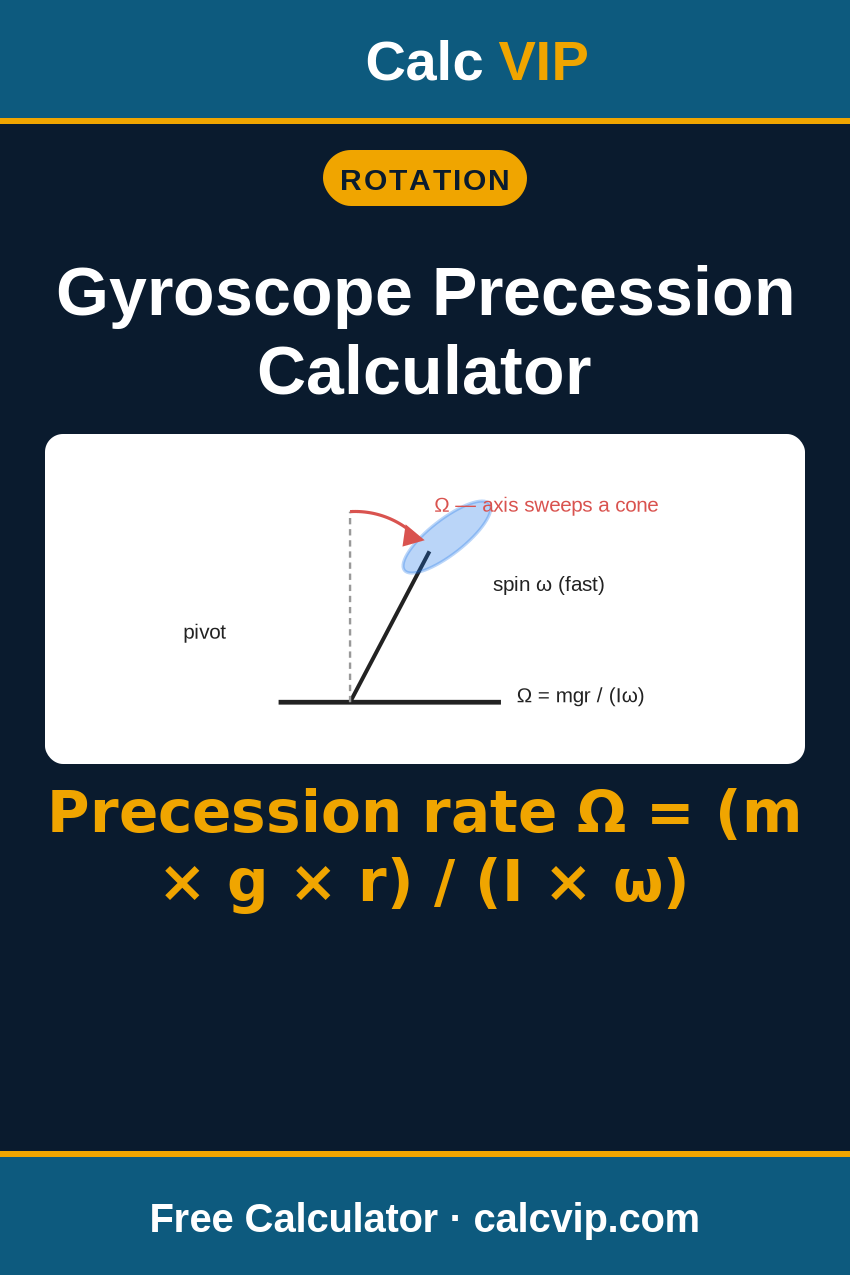
The formula on this page is the classic "fast top" approximation, excellent whenever the spin ω is much greater than the precession Ω — true for every toy top, demonstration gyroscope and stabiliser you will meet. Enter the mass, the pivot-to-centre-of-mass distance and the spin, supply I directly or through the solid-disk shortcut I = ½mR², and you get Ω plus the period of one full precession turn. Scale the same inputs up by twenty-five orders of magnitude and you are describing the Earth itself, whose axis precesses once per ~26,000 years under the Sun and Moon's torque.
Formula
Precession rate Ω = (m × g × r) / (I × ω) • precession period T = 2π / Ω • Ω in rad/s, m in kg, r in m, I in kg·m², ω in rad/s, g = 9.81 m/s²
For a solid disk the moment of inertia about its centre axis is I = ½ × m × R², which the calculator applies when you choose the disk option; for a hoop or rim-heavy wheel I ≈ mR² — twice as large, and therefore half the precession rate — so enter I directly for those. The derivation is one line: gravity's torque about the pivot is mgr sinφ (φ the tilt from vertical), the component of L that can change is L sinφ, and Ω = torque / (L sinφ) = mgr/(Iω) — the tilt cancels, which is why the precession rate, remarkably, does not depend on how far the gyroscope leans (within the fast-top approximation).
| Symbol | Meaning | Units |
|---|---|---|
| Ω | precession rate — how fast the axis circles | rad/s |
| m | mass of the gyroscope wheel | kg |
| r | distance from pivot to the wheel's centre of mass | m |
| I | moment of inertia about the spin axis | kg·m² |
| ω | spin angular speed of the wheel | rad/s |
Why the axis turns instead of falling
Stand a non-spinning gyroscope at a tilt and it falls instantly: gravity's torque angularly accelerates it downward. Spin it, and the same torque is still there — but now it acts on a large existing L. Since torque equals the rate of change of L, and the torque vector is perpendicular to L, the change it produces is a rotation of L, not an increase in the downward direction. The axis yields to gravity not by falling but by sidestepping, continuously, at 90° to the pull. Precession is sometimes described as the gyroscope "falling around" the vertical — an endless fall that never gets closer to the ground.
Two refinements complete the honest picture. First, a real gyroscope released carelessly also nutates — a small, fast nodding superimposed on the precession — which friction usually damps away within seconds, leaving the clean sweep this calculator predicts. Second, the formula assumes ω ≫ Ω. As friction bleeds the spin, Ω = mgr/(Iω) grows, the approximation frays, nutation returns, and the top's final wobble-and-collapse is the formula announcing the end of its own validity. The stately behaviour and the death spiral are the same equation at different speeds.
How to use
- Enter the gyroscope's mass m in kg, the distance r from the pivot to the centre of mass in metres, and the spin speed ω in rad/s (convert rpm with ω = rpm × 2π/60).
- Choose how to supply the moment of inertia: pick the solid-disk option and enter the disk radius R, or switch to "Enter I directly" and type I in kg·m².
- Click "Calculate Precession" to get Ω in rad/s and the time for one full precession turn.
- Check the approximation: the result is trustworthy while Ω is much smaller than ω. If your Ω comes out comparable to ω, the gyroscope is in the slow-top regime and the simple formula overstates its grace.
Worked examples
Example 1 — the demonstration gyroscope. A gyroscope disk of m = 0.5 kg and radius R = 0.05 m spins at ω = 200 rad/s, with its centre of mass r = 0.1 m from the pivot:
I = ½ × 0.5 × 0.05² = 0.000625 kg·m²
Ω = (0.5 × 9.81 × 0.1) / (0.000625 × 200) = 0.4905 / 0.125 = 3.924 rad/s
Precession period T = 2π / 3.924 = 1.6012 s per full turn of the axis — brisk, stately, and exactly what the lecture bench shows.
Example 2 — a toy top. A top of m = 0.08 kg with a disk of R = 0.03 m, centre of mass r = 0.02 m above its tip, spun to ω = 150 rad/s:
I = ½ × 0.08 × 0.03² = 0.000036 kg·m²
Ω = (0.08 × 9.81 × 0.02) / (0.000036 × 150) = 0.015696 / 0.0054 = 2.9067 rad/s, so T = 2.1616 s. Watch a real top and you will see roughly this stately circling — under the faster wobble of nutation.
Example 3 — entering I directly. A gyroscope of m = 1.2 kg, r = 0.15 m, with a measured I = 0.004 kg·m², spinning at ω = 120 rad/s:
Ω = (1.2 × 9.81 × 0.15) / (0.004 × 120) = 1.7658 / 0.48 = 3.6788 rad/s, T = 1.708 s. Direct entry is the mode for any wheel that is not a solid disk — hoops, spoked wheels and built-up rotors included.
Example 4 — the dying gyroscope. Example 1's gyroscope after friction has bled its spin to ω = 50 rad/s:
Ω = 0.4905 / (0.000625 × 50) = 0.4905 / 0.03125 = 15.696 rad/s, T = 0.4003 s. Quarter the spin, quadruple the precession — the frantic wobble of a top about to fall is this arithmetic made visible.
Example 5 — the bicycle-wheel demonstration. A bicycle wheel (m = 2 kg, hoop I ≈ mR² = 2 × 0.34² = 0.2312 kg·m²) is held by an axle stub r = 0.2 m from its centre and spun to ω = 30 rad/s:
Ω = (2 × 9.81 × 0.2) / (0.2312 × 30) = 3.924 / 6.936 = 0.5657 rad/s, so the axle sweeps one full circle in T = 11.1061 s — slow enough to walk around with, which is why this is the classic lecture demonstration. Note the hoop I: the disk option would have halved I and doubled Ω, wrongly.
Example 6 — a navigation gyroscope. A compact gyro of m = 0.2 kg, disk R = 0.04 m, r = 0.03 m, spun hard to ω = 600 rad/s:
I = ½ × 0.2 × 0.04² = 0.00016 kg·m²
Ω = (0.2 × 9.81 × 0.03) / (0.00016 × 600) = 0.05886 / 0.096 = 0.6131 rad/s, T = 10.2478 s. Even at 600 rad/s of spin, gravity persuades the axis around in ten seconds — the drift that inertial navigation must constantly correct, quantified.
Precession in real life
Toy tops and gyroscopes. Every spinning top you have ever watched was solving Ω = mgr/(Iω) in public — precessing slowly when fresh and fast, frantically when tired (Examples 2 and 4). The formula predicts the whole performance from three measurements and a radius.
The gyrocompass. A ship's gyrocompass exploits precession deliberately: a constrained gyroscope, torqued by Earth's own rotation, precesses until its axis settles into the meridian — pointing true north without any magnetism. It is this calculator's physics, harnessed as an instrument.
Earth's axial precession. The Sun and Moon pull on Earth's equatorial bulge, applying a torque to a planet-sized gyroscope. The result: our axis sweeps a cone once per ~26,000 years, at Ω ≈ 7.6578 × 10⁻¹² rad/s — about 49.85 arcseconds of arc per year. The North Star changes over the millennia (Vega will hold the title in ~12,000 years), and the slow cycle paces ice-age timing through the Milankovitch mechanism.
Spacecraft control-moment gyroscopes. The International Space Station is steered by four large gyroscopes whose axes are deliberately precessed by motors: tilting a big L generates the torque that turns the station, no propellant required. The controlled precession rate is chosen with the same τ = Ω × L bookkeeping as this page's formula.
Spin-stabilised bullets and satellites. A rifled bullet's spin makes its axis precess in a tight, stable cone around its trajectory instead of tumbling; spin-stabilised satellites hold their orientation the same way. In both, the designer checks that Ω from disturbances stays small beside ω — the fast-top condition from the concept section.
Bicycle and motorcycle dynamics. A leaning bike's front wheel experiences gravitational and ground-reaction torques, and its precession response — the wheel steering into the lean — is one ingredient of self-stability. The full story includes trail and frame geometry, but the gyroscopic ingredient is Example 5's physics at road speed.
Quick reference: precession vs spin for the Example 1 gyroscope
| Spin ω (rad/s) | Ω (rad/s) | Precession period (s) |
|---|---|---|
| 50 | 15.696 | 0.4003 |
| 100 | 7.848 | 0.8006 |
| 200 | 3.924 | 1.6012 |
| 400 | 1.962 | 3.2024 |
| 1000 | 0.7848 | 8.0061 |
Read the table as the gyroscope's life story told backwards: fresh off the string at 1000 rad/s it circles sedately every eight seconds; friction walks it down the rows, and by 50 rad/s it is whirling its axis five times faster than it should, moments from collapse. Ω × ω is constant along the whole table — the signature of the inverse law.
Nutation and the two kinds of precession
The motion this calculator describes is torque-induced precession — the steady sweep under gravity. Two companions deserve naming. Nutation is the small nodding wobble superimposed when a gyroscope is released imperfectly or struck; it typically runs at a frequency near ω itself and dies under friction, which is why demonstrations settle into the clean cone. Torque-free precession is stranger: an asymmetric body (a thrown rugby ball, the Earth itself with its slightly unequal axes) wobbles even with no torque at all, because L and ω point in different directions inside it — Earth's version, the Chandler wobble, has a period of about 433 days. If your gyroscope's motion looks richer than a clean cone, one of these two is visiting; the steady Ω here remains the backbone underneath both.
Common mistakes
- Using the disk formula for a hoop. The built-in option computes I = ½mR² for a solid disk. A rim, hoop or bicycle wheel has I ≈ mR² — double. Using the disk value doubles the predicted Ω (Example 5 shows the trap). When in doubt, enter I directly.
- Expecting faster spin to mean faster precession. The law is inverse: Ω ∝ 1/ω. Quadrupling the spin quarters the precession. Intuition trained on "more motion = more of everything" fails here — trust the fraction.
- Measuring r from the wrong place. r runs from the pivot (the tip, the gimbal point, the hand's grip) to the wheel's centre of mass — not to the wheel's edge, and not along the whole axle if the wheel sits partway. A 2 cm error in r is a direct 2 cm-worth error in Ω.
- Feeding ω in rpm. The formula wants rad/s throughout. 200 rpm is 20.94 rad/s, not 200 — a mistake that shrinks Ω nearly tenfold and makes a toy top sound like a navigation gyro.
- Applying the formula to a slow top. Ω = mgr/(Iω) is the fast-top approximation. When Ω is no longer small beside ω, the true motion involves both precession roots and heavy nutation, and the simple value misleads. Check the ratio before quoting the result.
FAQ
Why does a gyroscope precess instead of falling over?
Gravity's torque acts at right angles to the angular momentum, so instead of changing the size of L it steadily rotates its direction — the axis sweeps out a cone. That turning of the axis is precession.
What happens as the gyroscope slows down?
Ω = mgr/(Iω), so as friction reduces the spin ω, the precession gets faster — a dying gyroscope wobbles around quicker and quicker before it falls.
Does the formula work for a spinning Earth?
Yes, in principle: Earth's axis precesses once every ~26,000 years because of the Sun and Moon's torque on its equatorial bulge — the same physics, on a huge scale and a very slow spin of the axis.
Does the tilt angle affect the precession rate?
In the fast-top approximation, no — the sinφ in gravity's torque cancels the sinφ in the precessing component of L. A gyroscope at 20° and at 60° (same m, r, I, ω) precesses at the same Ω. Large tilts and slow spins break the approximation, and real tops do drift somewhat with tilt.
What is the difference between precession and nutation?
Precession is the slow, steady sweep of the axis around the vertical. Nutation is a faster, smaller nodding of the axis on top of that sweep, appearing after a disturbance and usually damped by friction. This calculator gives the precession; nutation needs the full rigid-body equations.
Can precession be stopped or reversed?
Yes — apply a counter-torque, and Ω responds instantly (τ = Ω × L cuts both ways). This is exactly how control-moment gyroscopes are steered and how a gyrocompass is torqued into alignment. Reverse the spin ω instead and the precession reverses direction on its own.
Why does the formula need the centre-of-mass distance?
Because gravity's torque about the pivot is m g × (horizontal lever arm), and r sets that lever arm. A gyroscope balanced with its centre of mass exactly at the pivot (r = 0) feels no gravitational torque at all — and does not precess, however it is tilted. Perfectly balanced gyros in gimbals exploit this.
How fast does a real gyroscope precess compared with its spin?
Typically hundreds of times slower: Example 1 spins at 200 rad/s and precesses at 3.924 rad/s, a ratio of about 51; Example 6's ratio is nearly 1000. That separation of timescales is the fast-top condition, and it is why the axis sweep looks so eerily slow beside the blur of the wheel.
What is gyroscopic stiffness?
The resistance of a spinning wheel to having its axis reoriented — proportional to L = Iω. It is not a force but a bookkeeping fact: reorienting the axis means changing L's direction, which needs torque × time. Bigger I and faster ω both stiffen the wheel, which is why Example 6's small, fast gyro holds its heading so stubbornly.
Did precession really change the North Star?
Yes. As Earth's axis sweeps its 26,000-year cone, the north celestial pole traces a circle among the stars: Thuban was the pole star when the pyramids were built, Polaris holds the post now (within a degree), and Vega will take it in roughly 12,000 years. Ancient astronomers discovered precession by exactly this drift — Hipparchus measured it around 130 BC.