 Calc
Rotational Kinetic Energy Calculator – KE = ½Iω² for Spinning Objects
 Created by Rachel Novak · Senior Editor · All Topics · Last updated: November 2026
Use this free Rotational Kinetic Energy Calculator to find the energy stored in a spinning object from its moment of inertia and angular velocity, using KE = ½Iω². Enter I in kg·m² and ω in rad/s to get the rotational kinetic energy in joules.
Anything that spins is carrying energy, whether or not it is going anywhere. A flywheel bolted to the floor, a ceiling fan turning above a room, a planet rotating in the darkness of space — none of them is travelling from place to place, yet each holds kinetic energy purely because it rotates. That energy is real in the most practical sense: it had to be supplied by a motor, an engine or a collapsing cloud of gas to spin the object up, and it can be given back — as electricity from a flywheel store, as a draught from the fan, as the braking heat in a slowing machine. This calculator adds it up from the two quantities that fix it: how the object's mass is distributed, and how fast it turns.
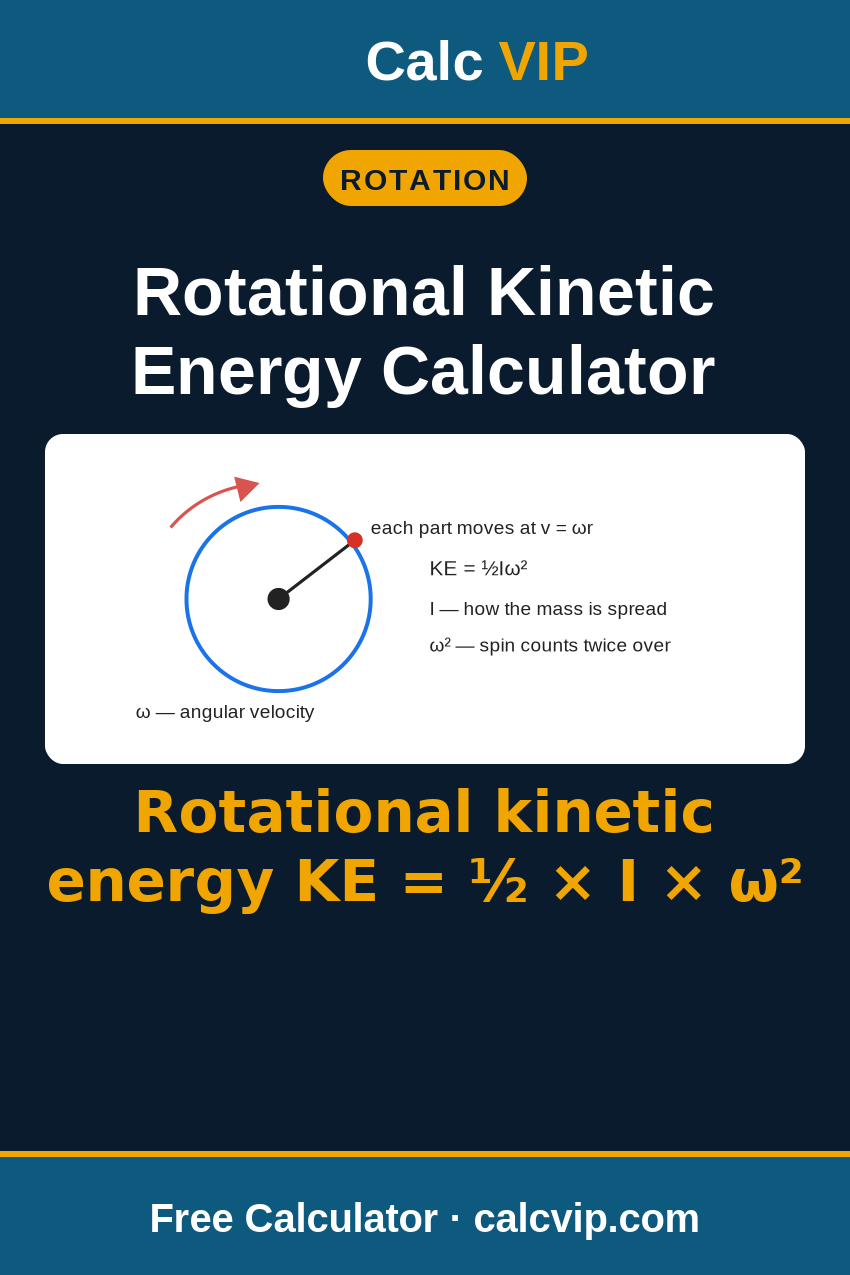
The formula, KE = ½Iω², is the rotational twin of the familiar ½mv², and every part of it has a twin. Where straight-line motion has mass m — resistance to being pushed — rotation has the moment of inertia I, the resistance to being twisted, which depends not just on how much mass there is but on how far from the axle it sits. Where straight-line motion has speed v, rotation has angular velocity ω, the rate of turning in radians per second. And just as in ½mv², the speed-like quantity is squared: double the spin rate and the stored energy does not double, it quadruples. That square is why fast-spinning machinery stores such startling amounts of energy, and why it must be treated with respect when it fails.
The range of answers this one formula covers is enormous. A toy gyroscope stores a fraction of a joule; a car wheel at motorway speed stores thousands; an industrial flywheel stores millions; and the Earth's rotation stores about 2.14 × 10²⁷ joules — roughly ten thousand years of current human energy consumption, locked into a spin so steady we never notice it. Small or vast, the bookkeeping is identical: half the moment of inertia, times the square of the angular velocity. Enter your two numbers above and the calculator does that bookkeeping for you.
Formula
Rotational kinetic energy KE = ½ × I × ω² • KE in joules (J), I in kilogram metre squared (kg·m²), ω in radians per second (rad/s)
The formula rearranges to solve for either input: ω = √(2 × KE / I) if you know the stored energy and want the spin rate, and I = 2 × KE / ω² if you know both and want the inertia. If your speed is given in revolutions per minute, convert first: ω = rpm × 2π / 60. One conversion deserves a warning: the energy depends on ω², so a conversion slip does not just nudge the answer — entering rpm where rad/s belong inflates the energy by a factor of (60/2π)² ≈ 91. This calculator works in rad/s throughout, and reports the energy in joules; divide by 3,600,000 to express it in kilowatt-hours, or by 1,000 for kilojoules.
| Symbol | Meaning | Units |
|---|---|---|
| KE | rotational kinetic energy | joules (J) |
| I | moment of inertia about the spin axis | kg·m² |
| ω | angular velocity | rad/s |
| m, r | mass and radius (inside the shape formulas for I) | kg, m |
Where ½Iω² comes from — and why ω is squared
A spinning object is not one moving thing but many: every small piece of it travels in a circle at its own speed, v = ωr, where r is that piece's distance from the axle. Pieces near the hub crawl; pieces at the rim race. The total kinetic energy is the sum of ½mv² over all the pieces. Because ω is the same for every piece of a rigid body while r differs, the sum tidies itself into ½ω² × Σ(mr²) — and the quantity Σ(mr²), the mass weighted by squared distance, is exactly the moment of inertia I. The formula is not an analogy pasted onto rotation; it is ordinary kinetic energy, added up honestly around a circle.
That derivation explains both of the formula's personalities. The ω² appears because kinetic energy always carries a v², and every piece's v is proportional to ω — so the whole sum scales with ω². Spin a wheel twice as fast and every piece moves twice as fast and carries four times the energy; the wheel as a whole quadruples. And the shape of I explains why distribution matters as much as mass: because r is squared inside I, mass at twice the distance counts four times as much. Two wheels of identical mass and radius can store very different energies at the same rpm if one is a solid disk and the other a rim-heavy ring — a fact flywheel designers exploit and this page's quick-reference table quantifies.
How to use
- Find the moment of inertia I of your object about its spin axis, in kg·m² — from a table of shape formulas (see the quick reference below), a datasheet, or one of our inertia calculators.
- Enter the angular velocity ω in radians per second. If you know the speed in rpm instead, multiply it by 2π/60 (≈ 0.1047) first.
- Click "Calculate Rotational KE" to get the stored energy in joules.
- Sanity-check the size: a bicycle wheel at riding speed stores a few hundred joules; a car wheel at motorway speed, several thousand; if your answer for a household object comes out in millions, a unit has almost certainly slipped.
Worked examples
Example 1 — the basic calculation. A wheel with moment of inertia I = 2 kg·m² spinning at ω = 10 rad/s:
KE = ½ × 2 × 10² = ½ × 2 × 100 = 100 J
Doubling the spin speed would give four times the energy (400 J), because ω is squared.
Example 2 — a heavier machine wheel. A grinding wheel with I = 4 kg·m² runs at ω = 15 rad/s:
KE = ½ × 4 × 15² = ½ × 4 × 225 = 450 J — about the energy of a 45 kg mass dropped from a metre, which is why a coasting grinder takes so long to stop and should never be slowed by hand.
Example 3 — the spinning Earth. The Earth's moment of inertia is about I = 8.04 × 10³⁷ kg·m² and it rotates at ω = 7.292 × 10⁻⁶ rad/s (one turn per sidereal day):
KE = ½ × 8.04 × 10³⁷ × (7.292 × 10⁻⁶)² ≈ 2.14 × 10²⁷ J. The Moon is slowly stealing this energy through the tides — the day lengthens by about 2.3 milliseconds per century as the spin winds down.
Example 4 — an energy-storage rotor. A steel rotor with I = 10 kg·m² spun up to ω = 100 rad/s (about 955 rpm):
KE = ½ × 10 × 100² = 50,000 J = 50 kJ. Released over ten seconds, that is a steady 5 kW — the working principle of flywheel energy storage, examined further below.
Example 5 — the square law in action. A turntable platter with I = 3 kg·m² at ω = 8 rad/s stores ½ × 3 × 64 = 96 J. Spun to ω = 16 rad/s it stores ½ × 3 × 256 = 384 J — exactly four times as much, from twice the speed. Any time an answer does not quadruple when ω doubles, an arithmetic error has crept in.
Example 6 — working backwards to the speed. A rotor is known to store KE = 200 J and has I = 4 kg·m². How fast is it turning?
ω = √(2 × KE / I) = √(400 / 4) = √100 = 10 rad/s — about 95 rpm. The rearranged formula is how engineers infer the speed of a sealed rotor from the energy it returns.
Rotational kinetic energy in real life
Flywheel energy storage. Grid-scale flywheels spin massive rotors in vacuum chambers at tens of thousands of rpm, banking megajoules as ½Iω² and returning them in milliseconds when the grid stumbles. The formula is the business plan: energy capacity is bought with inertia and with the square of speed.
Engine flywheels. A car engine delivers power in pulses — one push per cylinder firing. The flywheel's stored rotational energy carries the crankshaft smoothly through the gaps between pulses; too little I and the engine runs roughly at idle, too much and it responds sluggishly to the throttle.
KERS and hybrid vehicles. Kinetic Energy Recovery Systems harvest braking energy — some, like the system once used in Formula 1, store it in a small flywheel spinning at up to 64,000 rpm in a vacuum. The ω² term is what makes a modest rotor worth carrying: at such speeds a few kilograms store hundreds of kilojoules.
Helicopter rotors. A helicopter's rotor is a flywheel that happens to produce lift. Its stored energy is what makes autorotation possible: with the engine dead, the pilot trades the rotor's ½Iω² for a controlled descent, flaring at the last moment to spend the remaining spin on a soft landing.
Potter's wheels and lathes. The heavy wheel of a kick-powered potter's wheel stores the energy of each kick and spends it smoothly while the potter's hands are busy shaping clay — the same smoothing service, at craft scale, that an engine flywheel performs.
Amusement rides and centrifuges. A centrifuge rotor at full speed can store as much energy as a moving car, which is why laboratory centrifuges have armoured lids and why a rotor imbalance — which shifts mass outward and raises I unevenly — is treated as a serious hazard rather than a nuisance.
Tops, gyroscopes and yo-yos. A spinning top stays upright by spending its stored energy slowly: friction at the tip and in the air is a weak brake, so the ½Iω² of a well-spun top lasts minutes, and the top falls only when the account runs low. A yo-yo is the same ledger in play form — it trades rotational energy for height and back again, "sleeping" at the bottom of the string on nothing but stored spin.
Quick reference: moment of inertia of common shapes
This calculator needs I as an input, and for standard shapes I follows from the mass and size by a fixed factor. The factor — call it the shape's generosity — is what the table lists; multiply it by MR² (or ML² for a rod) to get I about the usual axis.
| Shape and axis | I | Factor |
|---|---|---|
| thin ring / hoop, centre | MR² | 1.000 |
| hollow cylinder, centre | ≈ MR² | ≈ 1.000 |
| solid sphere, centre | (2/5)MR² | 0.400 |
| solid disk / cylinder, centre | ½MR² | 0.500 |
| thin rod, centre (perpendicular) | (1/12)ML² | 0.083 |
| thin rod, about one end | (1/3)ML² | 0.333 |
Read the table as an energy league table: at equal mass, radius and rpm, a ring stores twice the energy of a disk and two and a half times that of a sphere. It is the same ranking that decides ramp races on our rolling-motion page — the shapes that hoard energy in spin are the ones that dawdle down the slope.
Spin energy and safety: why rotors burst
Every joule this calculator reports is also a joule that must go somewhere if the rotor fails. The stresses inside a spinning body grow with ω² as well, because each piece of the rim is being pulled inward by the material inside it; beyond a material-dependent rim speed, the pull wins and the rotor bursts outward — the failure mode of grinding wheels, turbine disks and over-sped flywheels. Engineers therefore quote a rotor's safe limit as a maximum rim speed (a few hundred metres per second for steel, more for carbon fibre wound in the direction of the stress), and energy-storage flywheels are deliberately built from composites that fail into harmless fibres rather than shrapnel, inside containment vessels, in vacuum chambers that also remove air drag. The innocent-looking ½Iω² is, read properly, a safety document: it tells you the size of the event you are designing against.
Common mistakes
- Entering rpm as ω. The formula needs rad/s. Using the rpm figure directly multiplies the answer by about 91 — the single most common error with this calculator. Convert with ω = rpm × 2π/60.
- Using the wrong axis for I. I depends on which line the object spins around. A rod about its centre and the same rod about its end differ by a factor of four; the energy answer inherits the whole error.
- Forgetting the ½. KE = ½Iω², not Iω². Dropping the half doubles every answer — check against Example 1: I = 2, ω = 10 must give 100 J, not 200 J.
- Expecting double speed to mean double energy. The square forbids it: twice the spin, four times the energy. Any estimate that scales linearly with ω is wrong before it starts.
- Mixing diameter and radius inside I. Shape formulas use the radius. Feeding in the diameter quadruples I (r is squared) and quadruples the reported energy with it.
FAQ
Is rotational KE the same as regular kinetic energy?
It is the same kind of energy, just for rotation instead of straight-line motion. A rolling object has both: ½mv² for its movement plus ½Iω² for its spin.
Why is ω squared in the formula?
Every part of the spinning body moves at speed v = ωr, and kinetic energy depends on v², so the total ends up depending on ω². Spin twice as fast and the energy goes up four times.
What units should I use?
Use kg·m² for I and rad/s for ω, and the answer comes out in joules (J), the standard unit of energy.
How do I find I if I don't know it?
For standard shapes, use the quick-reference table above: a disk is ½MR², a ring MR², a sphere (2/5)MR². For a rod, use our rod inertia calculator; for off-centre axes, the parallel axis calculator. Manufacturers of motors and wheels often print I (sometimes as GD²) in the datasheet.
What is the rotational KE of a car wheel?
Roughly: a wheel and tyre of 15 kg with radius 0.32 m has I ≈ ½ × 15 × 0.32² ≈ 0.77 kg·m². At 100 km/h the wheel turns at ω = 27.8/0.32 ≈ 86.8 rad/s, so KE ≈ ½ × 0.77 × 86.8² ≈ 2,900 J per wheel — a real slice of the car's total kinetic energy, and one reason wheel weight matters to engineers.
Does a rolling object have rotational KE as well as ordinary KE?
Yes, both at once: ½mv² for the travel of its centre plus ½Iω² for the spin, with ω = v/r when it rolls without slipping. Our rolling motion calculator adds the two together for disks, spheres and hoops.
Why do flywheel cars and buses spin the wheel so fast instead of making it heavier?
Because energy grows with ω² but only in proportion to I. Doubling the speed buys four times the energy; doubling the mass buys two — and adds weight the vehicle must carry. Speed is the cheaper currency, paid for in stronger materials instead.
Can rotational KE be converted back to useful work?
Completely, in principle — it is ordinary energy in storage. A flywheel coupled to a generator returns it as electricity; a spinning top spends it against friction; a helicopter rotor spends it on lift in autorotation. Losses are practical (bearings, air drag), not fundamental.
What is the moment of inertia, in plain words?
It is rotational mass: a measure of how stubbornly an object resists being spun up or slowed down. It grows with the object's mass and, much more strongly, with how far that mass sits from the axle — which is why a figure skater spins faster with arms pulled in.
How much energy does a ceiling fan store?
Very little: three light blades might total I ≈ 0.05 kg·m², and at ω ≈ 20 rad/s the energy is ½ × 0.05 × 400 = 10 J — the energy of an apple dropped from a table. It still takes seconds to coast to a stop because friction is also small; low energy and low loss balance out.