 Calc
RPM Converter – RPM to rad/s, Hz & Rim Speed Calculator
 Created by Rachel Novak · Senior Editor · All Topics · Last updated: November 2026
Use this free RPM Converter to translate a rotation speed between revolutions per minute (rpm), radians per second (rad/s) and hertz (Hz) — and, if you give it a radius, to find the rim speed of the spinning object. Enter the value, its unit, and optionally the radius.
Rotation speaks three languages, and fluency in all of them is not optional. The workshop speaks rpm: motor nameplates, drill settings, engine redlines and washing-machine programmes are all quoted in revolutions per minute, because a human can picture a turn and count a minute. Physics speaks rad/s: every formula in rotational mechanics — rim speed v = ωr, rotational energy ½Iω², centripetal acceleration ω²r — works in radians per second and quietly gives wrong answers in anything else. And electronics speaks Hz, turns per second, the natural unit when rotation becomes a signal, a vibration or an alternating current. This converter is the interpreter: give it a speed in any of the three, and it returns the other two, with the rim speed thrown in if you supply a radius.
The translations rest on two facts. A minute holds 60 seconds, which is where every 60 in this topic lives: Hz = rpm/60, because a turn per second is simply the per-minute count shared over the minute. And a full turn holds 2π radians — the circumference of a unit circle — which is where every 2π lives: ω = 2π × Hz = rpm × 2π/60. That last factor, 2π/60 ≈ 0.1047, is worth memorising outright; it converts any nameplate in the world into physics units in one multiplication. Its inverse, ≈ 9.549, converts back. Most rotation errors in student work and workshop practice are one of these two factors, forgotten or inverted — the examples below drill both directions until they are reflexes.
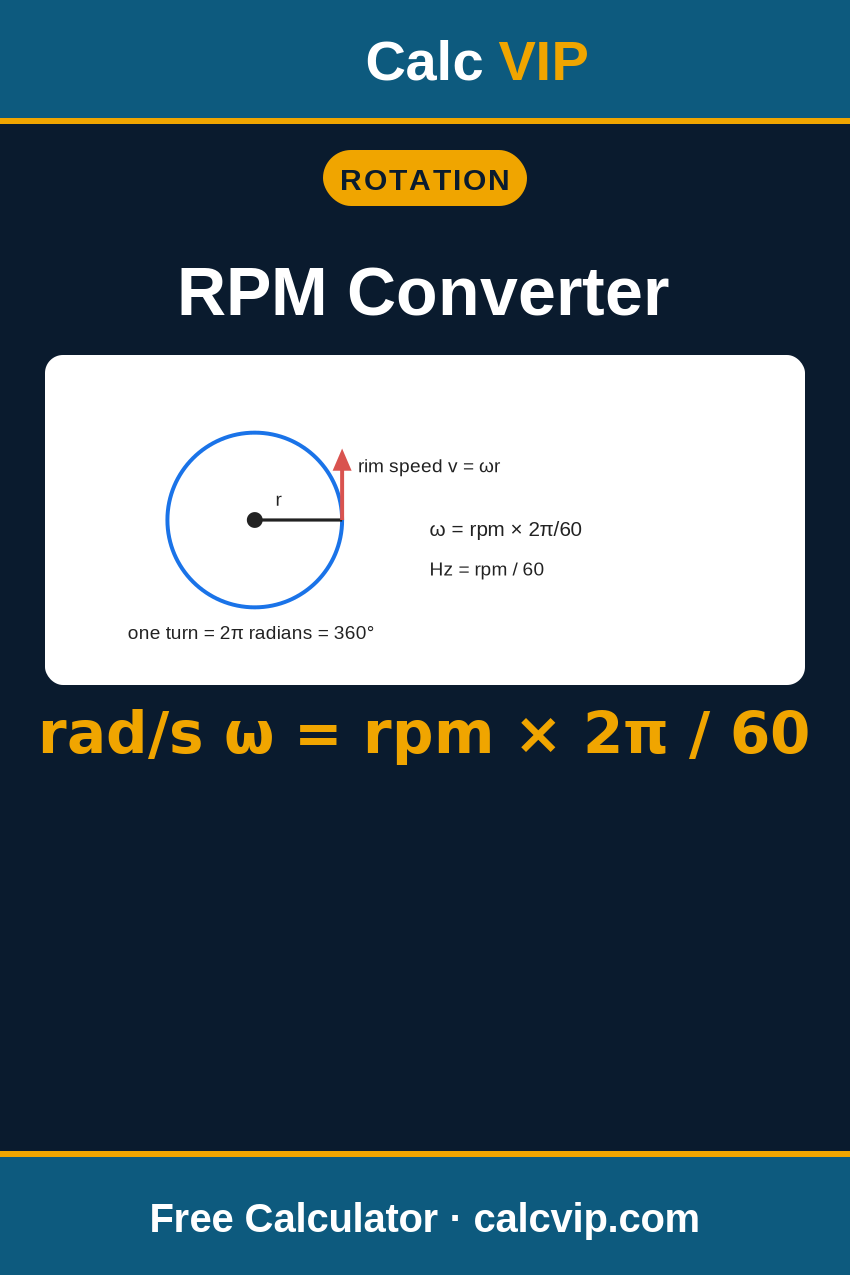
The rim speed deserves its place on the page, because it is where rotation meets the road — literally, for a wheel, where v = ωr converts spin into travel. It is the speed of the blade tip, the belt surface, the grinding wheel's edge: the speed at which the spinning object touches the world. Two objects at the same rpm can have wildly different rim speeds if their radii differ, which is why a huge flywheel turning sedately can have a faster rim than a tiny drill spinning furiously — and why safety limits for rotating machinery are written in metres per second at the rim, not in rpm. Convert the speed, add the radius, and this page gives you the number that actually bites.
Formula
rpm → rad/s ω = rpm × 2π / 60 • rpm → Hz f = rpm / 60 • rad/s → rpm rpm = ω × 60 / 2π • Rim speed v = ω × r • ω in rad/s, f in Hz, r in metres, v in m/s
Every conversion on this page is a combination of the two master facts — 60 seconds in a minute, 2π radians in a turn — so the whole family can be rebuilt from memory: ω = 2πf links the two physics units directly, and the period of one turn is T = 1/f = 60/rpm seconds. Degrees, if you meet them, convert at 360° per turn: a speed in degrees per second divides by 360 to give Hz. The rim speed formula is the one with physical teeth: v = ωr is exact for the surface of the spinning object, and combined with the conversion it becomes v = rpm × 2π × r / 60 — nameplate to road speed in a single line, as Example 5's washing machine demonstrates at a startling 132 km/h.
| Symbol | Meaning | Units |
|---|---|---|
| rpm | revolutions per minute | rev/min |
| ω | angular velocity | rad/s |
| f | frequency — turns per second | hertz (Hz) |
| T | period — time for one turn, T = 1/f | s |
| r, v | radius and rim (tangential) speed | m, m/s |
Why radians? The unit that makes rotation honest
It is fair to ask why physics insists on the radian when revolutions are so much easier to picture. The answer is that the radian is not really a unit at all — it is a ratio, arc length divided by radius, and that is exactly why it makes formulas true instead of merely fitted. The rim of a wheel travels one circumference, 2πr, per turn. Describe the turn as 2π radians and the distance falls out as r × θ with no correction factor. Describe it as 1 revolution or 360 degrees and every formula grows a conversion wart: v = ωr works only in rad/s, arc = rθ only in radians, and the energy ½Iω² only with ω in rad/s. Degrees and revolutions are counting units, splendid for humans; the radian is geometry's own measure, and the formulas are written in geometry's language.
The hertz has a different personality: it counts cycles of anything — turns, oscillations, waves — per second, and so it is the bridge between rotation and the world of signals. A two-pole generator spinning at 3,000 rpm produces 50 Hz mains electricity precisely because it completes 50 turns per second, one cycle per turn: the grid's hum is an rpm in disguise. Vibration analysts live on the same bridge, reporting a machine's shake in Hz and tracing a 25 Hz peak back to a shaft at 1,500 rpm with something wrong on it. Learn the three units as one quantity wearing three coats — count per minute, count per second, radians per second — and conversions stop being formulas and become changes of coat.
How to use
- Type the rotation speed you know into the value box — any size, in whichever unit you have it.
- Select that value's unit from the menu: rpm, rad/s or Hz. This step is the whole conversion; the calculator treats the chosen unit as the truth.
- Optionally enter a radius in metres if you also want the rim speed v = ωr — the surface speed at that distance from the axle.
- Click "Convert" to see the speed in all three units, plus the rim speed if a radius was given. To sanity-check: the rad/s figure should be about a tenth of the rpm figure, and the Hz figure exactly the rpm divided by 60.
Worked examples
Example 1 — the reference fan. A fan spinning at 1200 rpm with blade radius 0.15 m:
ω = 1200 × 2π/60 = 125.6637 rad/s
f = 1200 / 60 = 20 Hz
Rim speed v = 125.6637 × 0.15 = 18.8496 m/s — the blade tips move at nearly 68 km/h.
Example 2 — a car engine at cruise. An engine turning at 3,000 rpm:
f = 3000 / 60 = 50 Hz; ω = 3000 × 2π/60 = 314.1593 rad/s. Fifty turns every second — and, not coincidentally, the frequency of European mains electricity, whose generators are this example wearing a power station.
Example 3 — a vinyl record. An LP turns at 33⅓ rpm:
f = 33.333 / 60 = 0.5556 Hz; ω = 33.333 × 2π/60 = 3.4907 rad/s; one turn takes T = 1/f = 1.8 s. At the outer groove (r = 0.146 m) the surface passes the needle at v = 3.4907 × 0.146 ≈ 0.51 m/s — the stately pace that analog audio is read at.
Example 4 — converting backwards. A physics problem states ω = 100 rad/s. What is that on a tachometer?
rpm = 100 × 60 / 2π = 954.9297 rpm, and f = 100 / 2π = 15.9155 Hz. The ×9.549 factor (60/2π) is the one to reach for whenever a formula hands you rad/s and a human asks "how fast is it spinning?"
Example 5 — the washing machine's hidden speed. A spin cycle at 1,400 rpm with drum radius 0.25 m:
ω = 1400 × 2π/60 = 146.6077 rad/s; rim speed v = 146.6077 × 0.25 = 36.6519 m/s ≈ 132 km/h. The drum's edge is doing motorway speed in your utility room — which is why the door locks, and why an unbalanced load at full spin is so violent.
Example 6 — the slowest machine of all. The Earth turns once per sidereal day (86,164 s):
f = 1 / 86,164 ≈ 1.1606 × 10⁻⁵ Hz; ω = 2π / 86,164 = 7.2921 × 10⁻⁵ rad/s. Yet at the equator (r = 6.371 × 10⁶ m) the rim speed is v = ωr ≈ 465 m/s — faster than the speed of sound in air, delivered by the slowest ω on this page. Radius is a powerful lever.
Rotation speeds in real life
Motor nameplates. The rpm on a motor's plate is the contract everything downstream is designed around — pump flow, fan pressure, belt speeds. Converting it to rad/s is the first step of any calculation that uses the motor, and the ×0.1047 factor is the most-used number in rotating machinery engineering.
Vehicle wheels and speedometers. A speedometer is an rpm meter in disguise: it counts wheel turns and multiplies by the tyre's circumference — v = ωr with the tyre radius as r. Fit non-standard tyres and r changes, the true rim speed changes, and the speedometer's reading quietly lies by the same percentage.
Grinding and cutting safety. Abrasive wheels carry a maximum rpm and a maximum surface speed, because the rim is where the wheel flies apart if oversped. A wheel rated at 6,600 rpm on a 115 mm grinder is a different proposition on a larger machine: the converter's rim-speed output is the figure the safety case is written in.
Audio and turntables. Records at 33⅓ and 45 rpm, CDs spinning between about 200 and 500 rpm depending on which track is playing — audio history is a catalogue of chosen rpms, each converted by the player's motor controller into the steady ω the pickup needs.
Medical and laboratory centrifuges. Protocols quote rpm, but the physics that sediments a sample depends on ω²r — so two centrifuges at the same rpm with different rotor radii do different work. The conversion chain on this page, rpm → ω → ω²r, is how protocols are honestly transferred between machines.
Wind turbines and generators. A large turbine turns at perhaps 15 rpm — ω ≈ 1.57 rad/s — yet its blade tips, at r = 60 m, travel at about 94 m/s. The gearbox then multiplies the shaft speed roughly a hundredfold so the generator can work at a convenient 1,500 rpm and 50 Hz. Every stage of that chain is this page's arithmetic.
Seconds per turn: the period view
Every speed on this page has a shadow quantity, the period T — the time a single turn takes, T = 1/f = 60/rpm. Engineers reach for it whenever rotation meets timing. A camera photographing a fan needs an exposure compared against T to freeze or blur the blades deliberately. A stroboscope measures rpm by flashing at a rate close to f and watching the apparent crawl of the mark — a period measurement wearing a speed costume. A balancing machine, a PLC controlling a rotary table, a musician's metronome wheel: all are programmed in seconds per turn as naturally as in turns per minute. The two views are one fact read from opposite ends, and fluency means holding both: 1,400 rpm is 23.3 turns each second, and equally it is 43 milliseconds apiece. When a process feels too fast to think about, switch to the period — the milliseconds are often where the design actually lives. The converter's three answers imply the period automatically: invert the Hz figure and you are holding it.
Quick reference: familiar speeds in all three units
| Object | rpm | Hz | rad/s |
|---|---|---|---|
| Earth (sidereal day) | 0.000696 | 1.16 × 10⁻⁵ | 7.29 × 10⁻⁵ |
| LP record | 33⅓ | 0.556 | 3.49 |
| car wheel at 100 km/h (r = 0.32 m) | 829 | 13.8 | 86.8 |
| washing machine spin | 1,400 | 23.3 | 146.6 |
| car engine cruise | 3,000 | 50 | 314.2 |
| hard drive | 7,200 | 120 | 754.0 |
| dentist's drill | 300,000 | 5,000 | 31,416 |
Read the rad/s column as the formula-ready version of the world: each figure there can be dropped straight into v = ωr, ½Iω² or ω²r without further ceremony. The car-wheel row is worth verifying once by hand — 100 km/h is 27.78 m/s, divided by r = 0.32 m gives ω = 86.8 rad/s, times 9.549 gives 829 rpm — because a conversion you have checked once is a conversion you will trust forever.
Common mistakes
- Inverting the conversion. rad/s is the smaller number: ω ≈ rpm × 0.1047, roughly a tenth. If your rad/s figure comes out larger than the rpm, you have multiplied by 9.549 instead — the classic slip, and the reason for the sanity check in the How to use steps.
- Using diameter in v = ωr. Rim speed wants the radius. A diameter doubles the computed surface speed — and with it, any stress or safety conclusion drawn from it.
- Treating Hz and rpm as interchangeable. They differ by the factor 60. A "50 Hz motor" in the rotational sense means 3,000 rpm; confusing the two mis-specifies a machine by sixtyfold.
- Feeding rpm into physics formulas. ½Iω², ω²r and τ = Iα all demand rad/s. The energy error is the worst: because ω is squared there, using rpm inflates the energy about 91-fold.
- Rounding 2π/60 to 0.1 and forgetting it was rounded. Fine for a corridor estimate (it reads about 4.5% low), not fine for a tachometer calibration or a balancing specification. Use 0.10472 when the answer will be built, balanced or bought.
FAQ
Is Hz the same as revolutions per second?
Yes. For rotation, 1 Hz means one full turn per second, so Hz = rpm ÷ 60.
Why do physics formulas use rad/s instead of rpm?
Because the radian links rotation directly to distance: arc length = rθ and rim speed = ωr only work neatly when angles are in radians.
How fast is a car engine at 3000 rpm?
ω = 3000 × 2π/60 ≈ 314.16 rad/s, or 50 turns per second (50 Hz).
How do I convert degrees per second to rpm?
One turn is 360°, so divide by 360 to get turns per second (Hz), then multiply by 60: rpm = (°/s ÷ 360) × 60 = (°/s) ÷ 6. A gyroscope drifting at 15°/s, for instance, is turning at 2.5 rpm — the ÷6 shortcut is worth keeping.
What is the period at a given rpm?
T = 60/rpm seconds per turn. At 1,400 rpm, T = 60/1400 ≈ 0.0429 s — each turn of the washing machine drum takes about 43 milliseconds. At 33⅓ rpm, T = 1.8 s, the leisurely revolution of Example 3.
Why do some datasheets quote ω in rev/s?
Revolutions per second is just Hz under another name — turns counted per second. Multiply by 2π for rad/s, by 60 for rpm. It appears on older European datasheets and in bearing catalogues, and it converts exactly like Hz because it is Hz.
Is a higher rpm always a faster rim?
No — the radius decides. Example 6's Earth turns at a laughable 7.29 × 10⁻⁵ rad/s yet its equator moves at 465 m/s, while a dentist's drill at 300,000 rpm with a 1 mm burr has a rim speed of only 31,416 × 0.001 ≈ 31 m/s. Compare rim speeds, not rpms, when the question is about surfaces.
How accurate is the ×0.1047 shortcut?
2π/60 = 0.1047198…, so 0.1047 is accurate to about 0.02% — plenty for engineering estimates. The rougher ×0.1 shortcut reads about 4.5% low by comparison: fine for triage, not for specifications.
What rpm is 1 rad/s?
1 × 60/2π = 9.5493 rpm — call it nine and a half. It is a useful anchor: rad/s figures are roughly a tenth of the rpm figures, and 1 rad/s ≈ 9.55 rpm is the exact hinge between the two scales.
Does the converter work for negative speeds?
Physically, a negative ω simply means the opposite sense of rotation (clockwise instead of anticlockwise, by the right-hand rule). The magnitudes convert exactly as positive ones do; the sign is bookkeeping about direction, and the rim speed's size is unchanged.