 Calc
Rolling Motion Calculator – Total KE of a Rolling Disk, Sphere or Hoop
 Created by Rachel Novak · Senior Editor · All Topics · Last updated: November 2026
Use this free Rolling Motion Calculator to find the total kinetic energy of a rolling disk, sphere or hoop — its forward-motion energy and its spin energy added together. Enter the shape, mass, speed and radius.
A rolling wheel is doing two things at once, and paying for both. Its centre travels forward, which costs the ordinary kinetic energy ½mv² of anything that moves. And it spins as it goes, which costs the rotational energy ½Iω² of anything that turns. Forget either half and you undercount the energy — in the case of a hoop, you miss half of it entirely. This calculator keeps both halves of the ledger. Choose the shape (which fixes how the mass is distributed), enter the mass, the rolling speed and the radius, and it returns the spin rate ω, the moment of inertia I, and the two energies separately and added, so you can see exactly how the total divides.
The division is the interesting part, because it is decided entirely by shape. For any rolling body the moment of inertia can be written I = k × mr², where k is a pure number set by geometry: ½ for a solid disk or cylinder, 2/5 for a solid sphere, 1 for a hoop or thin ring. Since rolling without slipping locks the spin to the travel by ω = v/r, the total energy tidies into a single line: KE = ½mv²(1 + k). The disk carries half as much spin energy as travel energy; the sphere, two fifths as much; the hoop, exactly as much again. Same mass, same speed, same road — three different energy bills, itemised by one letter.
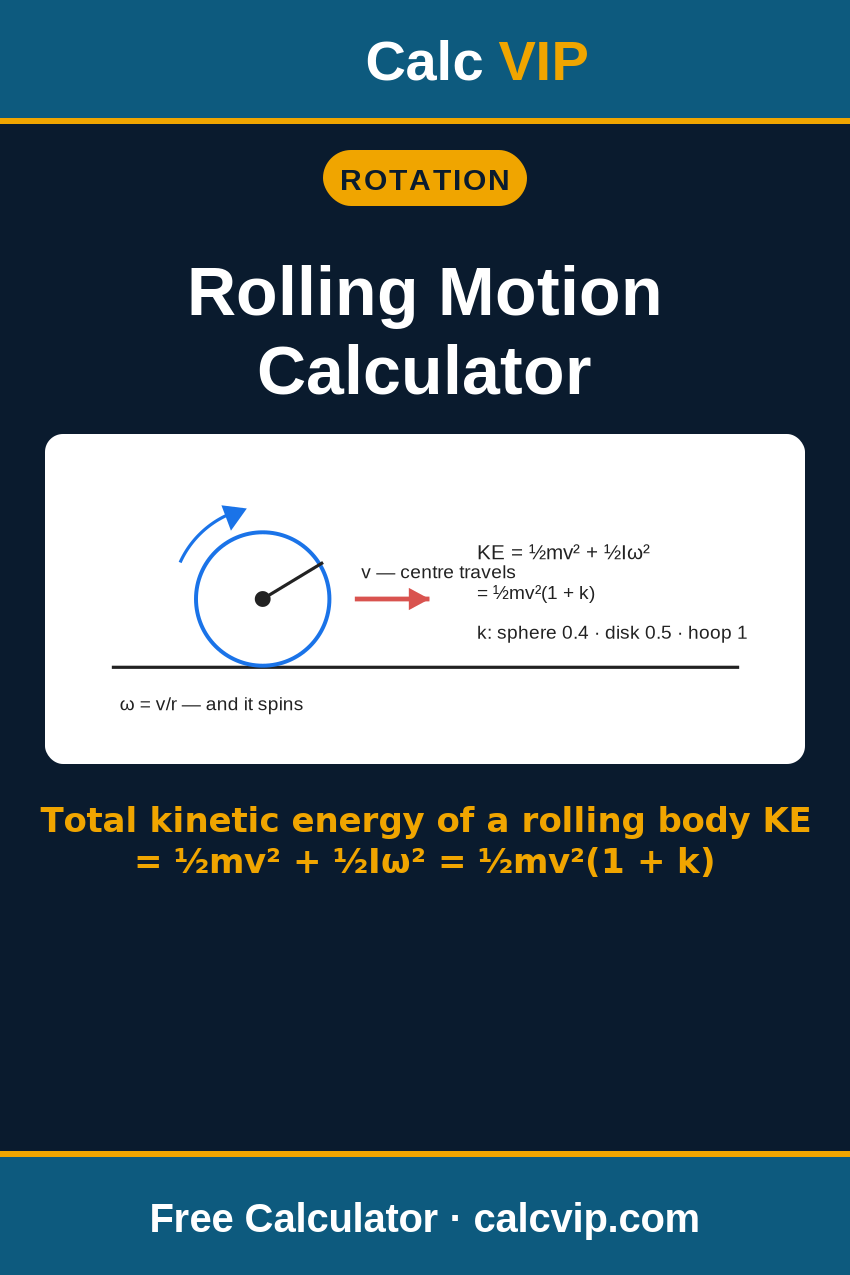
That letter also settles one of physics' favourite races. Roll a disk, a sphere and a hoop down the same ramp and the sphere wins, the disk follows, and the hoop trails — every time, regardless of mass or size. The reason is written in the formula above: gravity gives each body the same energy per kilogram at the bottom, but the hoop must spend the largest share of it on spinning, leaving the least for forward speed. This page's worked examples run the race in numbers. Whether you are analysing a bowling ball, a bicycle wheel or a barrel rolling off a truck, the accounting starts here.
Formula
Total kinetic energy of a rolling body KE = ½mv² + ½Iω² = ½mv²(1 + k) • with ω = v / r and I = k × mr² • KE in joules (J), m in kg, v in m/s, r in m, ω in rad/s
Each piece rearranges for its own questions: the spin rate follows the no-slip condition ω = v/r alone; the spin energy alone is ½Iω²; and the speed a body reaches after falling a height h down a ramp — gravity's energy mgh converted entirely into rolling KE — is v = √(2gh / (1 + k)). Unit discipline matters most at the radius: ω = v/r needs r in metres, and a diameter slipped in its place halves ω and quarters the spin energy. This calculator reports ω, I and both energies, so the split between travelling and spinning is visible in every result, not buried inside the total.
| Symbol | Meaning | Units |
|---|---|---|
| KE | total kinetic energy (travel + spin) | joules (J) |
| m, v | mass and speed of the centre | kg, m/s |
| I, ω | moment of inertia and angular velocity | kg·m², rad/s |
| r | radius of the rolling body | m |
| k | shape factor in I = kmr² | — (pure number) |
Rolling without slipping: the contract between spin and travel
Everything on this page rests on one condition: the body rolls without slipping. That phrase has a precise meaning — the point of the wheel touching the ground is, at that instant, perfectly at rest. The centre moves forward at v; the contact point's share of the spin moves it backward at ωr; and the two cancel exactly when ω = v/r. It sounds paradoxical — a moving wheel with a stationary point — but it is what your eyes confirm every day: a rolling tyre does not smear along the road. Static friction at the contact patch enforces the contract, quietly adjusting the spin to match the travel. Break the contract — on ice, in a skid, in a wheelspin start — and ω and v go their separate ways, the formulas here stop applying, and the missing energy leaves as heat and noise in the sliding contact.
The contract has a beautiful consequence for the energy split. Because ω is chained to v, the spin energy ½Iω² becomes ½(kmr²)(v/r)² — and the radius cancels. A big wheel and a small wheel of the same shape, mass and speed store exactly the same total energy, even though the small one spins furiously and the big one turns in a stately way. The radius decides how the energy is described (ω versus I) but not how much there is. What decides that is the shape factor k alone — which is why the ramp race is so ruthlessly fair: neither mass nor size can buy a win, only geometry can.
How to use
- Choose the rolling shape from the menu — solid disk/cylinder, solid sphere, or hoop/thin ring. This sets the shape factor k in I = kmr².
- Enter the mass m in kilograms and the rolling speed v in metres per second (divide km/h by 3.6 if needed).
- Enter the radius r in metres — the radius, not the diameter.
- Click "Calculate Rolling KE" to see ω, I, the translational and rotational energies separately, and their total.
Worked examples
Example 1 — the standard disk. A solid disk of mass 2 kg and radius 0.3 m rolling at 6 m/s:
ω = 6 / 0.3 = 20 rad/s, and I = ½ × 2 × 0.3² = 0.09 kg·m²
Translational KE = ½ × 2 × 6² = 36 J
Rotational KE = ½ × 0.09 × 20² = 18 J
Total KE = 36 + 18 = 54 J (a sphere would total 50.4 J, a hoop 72 J)
Example 2 — a rolling sphere. A solid ball of m = 5 kg, r = 0.2 m, rolling at v = 4 m/s:
ω = 4 / 0.2 = 20 rad/s; I = (2/5) × 5 × 0.2² = 0.08 kg·m²
Travel KE = ½ × 5 × 4² = 40 J; spin KE = ½ × 0.08 × 20² = 16 J; total = 56 J — five sevenths travelling, two sevenths spinning, exactly the sphere's k = 0.4 split.
Example 3 — the hoop pays double. A hoop of m = 1.5 kg, r = 0.25 m, at v = 8 m/s:
ω = 8 / 0.25 = 32 rad/s; I = 1.5 × 0.25² = 0.09375 kg·m²
Travel KE = ½ × 1.5 × 64 = 48 J; spin KE = ½ × 0.09375 × 32² = 48 J; total = 96 J. Half the energy is locked in spin — no other common shape is so extravagant.
Example 4 — the radius cancels. A solid cylinder of m = 10 kg rolling at v = 10 m/s: total KE = ½mv²(1 + k) = ½ × 10 × 100 × 1.5 = 750 J, whether its radius is 0.1 m or 1 m. The small cylinder spins at 100 rad/s with I = 0.05 kg·m²; the large one at 10 rad/s with I = 5 kg·m² — different descriptions, identical energy, as the cancellation promises.
Example 5 — the ramp race, in numbers. Three bodies roll down a ramp dropping h = 1.4 m, starting from rest. Each reaches v = √(2gh/(1 + k)) with 2gh = 27.44:
Sphere: √(27.44/1.4) = 4.43 m/s · Disk: √(27.44/1.5) = 4.28 m/s · Hoop: √(27.44/2) = 3.70 m/s. The order never changes, and neither mass nor radius appears anywhere in it.
Example 6 — a bowling ball. A bowling ball (m = 7 kg) released at v = 8 m/s down the lane carries ½ × 7 × 64 × 1.4 = 313.6 J — 224 J of travel and 89.6 J of spin. That is the energy the pins are about to negotiate with, and it is noticeably more than the 224 J a sliding (non-rolling) ball of the same speed would bring.
Rolling motion in real life
Bicycle wheels. A bicycle wheel is nearly a hoop — rim, tyre and spokes with a light hub — so it stores roughly as much energy in spin as in travel. That is a real cost when accelerating away from lights, and it is why racing wheels are obsessed with rim weight: grams at the rim are paid for twice, once in each half of this page's formula.
Trains and steel wheels. A train's wheels are solid disks of steel, and a moving train's rotational wheel energy adds several percent to its total kinetic energy — energy the brakes must eventually remove as heat. Regenerative braking on electric trains recovers the travel and spin energy together, since the wheels' rotation is what drives the motors-turned-generators.
Rolling luggage and trolleys. The wobble of a two-wheeled suitcase at speed is a rolling-energy story: the wheels store spin energy, and a sideways nudge couples that spin into a rocking oscillation. Four-wheeled cases and wider stances tame it by geometry, not by slowing the wheels.
Barrels, kegs and gas bottles. A rolling cylinder is the warehouse's oldest transport trick precisely because rolling is cheap: the energy goes into motion, not into fighting sliding friction. The same formula warns the handler — a full 50 kg drum rolling at walking pace carries hundreds of joules, quite enough to crush a foot that tries to stop it socially.
Planetary rovers. Rover wheels on Mars roll slowly, but every joule is budgeted from a small battery. Their designers choose wheel diameter and mass with this page open: the spin energy is small at rover speeds, yet the no-slip condition ω = v/r against loose regolith — where the contract keeps breaking — dominates the traction calculations.
The classic classroom race. Two cans roll down a ramp: one full of water, one of frozen ice. The liquid can wins — its contents barely rotate, so its effective k is tiny and nearly all the energy becomes travel. It is this calculator's shape factor, discovered by every student who has ever bet on the wrong can.
Acceleration down a ramp: the race explained
The finishing order of Example 5 can be read off before anyone rolls anything, because the same k governs the acceleration all the way down: a = g sin θ / (1 + k), where θ is the ramp's angle. On a 20° slope (g sin θ ≈ 3.35 m/s²) the sphere accelerates at 3.35/1.4 ≈ 2.39 m/s², the disk at 3.35/1.5 ≈ 2.23 m/s² and the hoop at 3.35/2 ≈ 1.68 m/s². The hoop is not slower because it is heavier or bigger — the formula contains neither m nor r — but because at every instant a larger share of gravity's work must be diverted into spinning it up. Static friction at the contact is what performs this diversion, gripping the surface and converting some of the slide into roll; on a frictionless ramp, astonishingly, all three would simply slide down together at g sin θ without rotating at all, and the race would be a tie.
Quick reference: the shape factors
| Shape | k in I = kmr² | Total KE | Spin share |
|---|---|---|---|
| solid sphere | 0.4 | 0.70 mv² | 2/7 ≈ 29% |
| solid disk / cylinder | 0.5 | 0.75 mv² | 1/3 ≈ 33% |
| hollow sphere (thin shell) | 2/3 | 0.83 mv² | 40% |
| hoop / thin ring | 1.0 | 1.00 mv² | 50% |
The calculator's menu offers the three classic cases; the hollow sphere row is included so a thin-walled ball can be estimated by hand with the same (1 + k) pattern. In every row the total is just ½mv² scaled by (1 + k) — one of the tidiest results in mechanics, and a reliable check on any rolling-energy answer: if your total is less than ½mv² or more than mv² for a solid body, something has gone wrong.
Common mistakes
- Counting only the travel energy. ½mv² alone undercounts every rolling body — by a third for a disk, by half for a hoop. If a wheel is rolling, the spin half of the ledger is always open.
- Entering the diameter as r. ω = v/r and I = kmr² both want the radius. A diameter in their place halves ω and quarters I, and the two errors do not cancel — the spin energy comes out four times too small.
- Applying the formulas while the body slips. Burnouts, skids and icy patches break ω = v/r. During a slip the spin and travel must be measured separately, and ½Iω² uses the actual ω, not v/r.
- Choosing the wrong shape. A bicycle wheel is a hoop, not a disk; a bowling ball is a solid sphere, not a shell. The shape menu sets k, and k sets the split — picking by looks ("it is round") instead of by mass distribution skews the total by up to 40%.
- Expecting the heavier body to win the ramp race. Mass cancels out of both the acceleration and the finishing speed. The race is decided by k alone; a marble-sized sphere beats a barrel-sized hoop every time.
FAQ
Why does a hoop roll slower down a ramp than a disk?
All of a hoop's mass sits at the rim, so more of its energy must go into spinning (k = 1). Less is left for forward motion, so it accelerates more slowly than a disk or sphere.
Does the radius change the total energy?
For a given mass and speed, no: the r² in I cancels the 1/r² in ω². The radius changes ω and I separately, but the total KE = ½mv²(1 + k) stays the same.
What if the object slips instead of rolling?
Then ω ≠ v/r and this formula no longer applies — it assumes rolling without slipping, so the spin and the travel stay locked together.
What about a hollow ball, like a football?
A thin-walled hollow sphere has k = 2/3, so its total is ½mv² × (1 + 2/3) = 0.83mv². It is not on the calculator's menu, but the pattern lets you estimate it by hand — or scale the solid sphere's answer by 1.667/1.4 ≈ 1.19.
Why is the contact point of a rolling wheel stationary?
Because two motions cancel there: the whole wheel is carried forward at v, while the spin carries the contact point backward at ωr = v. Forward v plus backward v is zero — for that instant only. A moment later a different point of the rim takes its turn being the still one.
Does friction waste the rolling energy?
Static friction at the contact does no work — the point it acts on is not moving — so in ideal rolling no energy is lost to it. Real wheels lose a little to rolling resistance (the tyre and ground deforming), which is a different, smaller effect, and the reason a ball eventually stops on the flat.
How fast is the top of a rolling wheel moving?
Twice the centre speed: 2v. The top point gets the centre's forward v plus the spin's forward ωr = v. The rim of a car wheel at 100 km/h has its top moving at 200 km/h through the air — and its bottom at zero, which is why mud leaves the top of the wheel so enthusiastically.
Can I use this for a car?
For the wheels, yes — each tyre-and-wheel is roughly a disk-to-hoop case, and their combined rolling KE is a few percent of the car's ½mv². The car's body, of course, only translates. Engineers add the wheels' spin energy when sizing brakes and estimating acceleration precisely.
What if the object rolls up a ramp?
The same ledger runs in reverse: total KE is spent climbing, mgh at a time, and the body stops rising when the account is empty. Because the hoop banks the most energy in spin, it climbs highest for a given starting speed — the ramp race run backwards has the opposite flavour.
Why do racing cyclists care about wheel weight more than frame weight?
A gram on the rim must be accelerated twice — once as travelling mass, once as spinning mass at the full radius — while a gram on the frame is accelerated once. This page's (1 + k) with k ≈ 1 for a wheel is the exact statement of the cyclist's rule that rotating weight counts double.