 Calc
Rod Moment of Inertia Calculator – About End, Centre & Any Point
 Created by Rachel Novak · Senior Editor · All Topics · Last updated: November 2026
Use this free Rod Moment of Inertia Calculator to find the inertia of a uniform rod about its centre, about one end, and about any point in between. Enter the mass and length, and optionally the axis distance from the centre.
Few objects in physics earn their keep like the humble rod. It is a metre ruler, a door's edge, a baseball bat simplified, a rotor blade, a pendulum — and its moment of inertia is the first one students meet that cannot be guessed from mass alone, because everything depends on where the axis sits. About its centre, a rod's inertia is (1/12)ML². About its end, (1/3)ML² — exactly four times larger, from nothing but moving the pivot half a length. About any point in between, the parallel axis theorem interpolates: (1/12)ML² + Md². This calculator reports all three landmarks at once — centre, end, and your chosen point — so you can watch the inertia grow as the axis walks outward.
The numbers 1/12 and 1/3 are worth a moment's respect, because they encode the whole philosophy of moment of inertia. Mass near the axis contributes almost nothing (its distance, squared, is tiny); mass at the far end contributes enormously. Averaged over a uniform rod, the squared distance from the centre works out to L²/12 — a twelfth, not the sixth or quarter intuition might suggest — because so much of the rod lives at modest distances. Move the axis to the end and every piece's distance grows; the average squared distance becomes L²/3. Same rod, same mass, four times the stubbornness: the cleanest demonstration in mechanics that inertia is about distribution, not quantity.
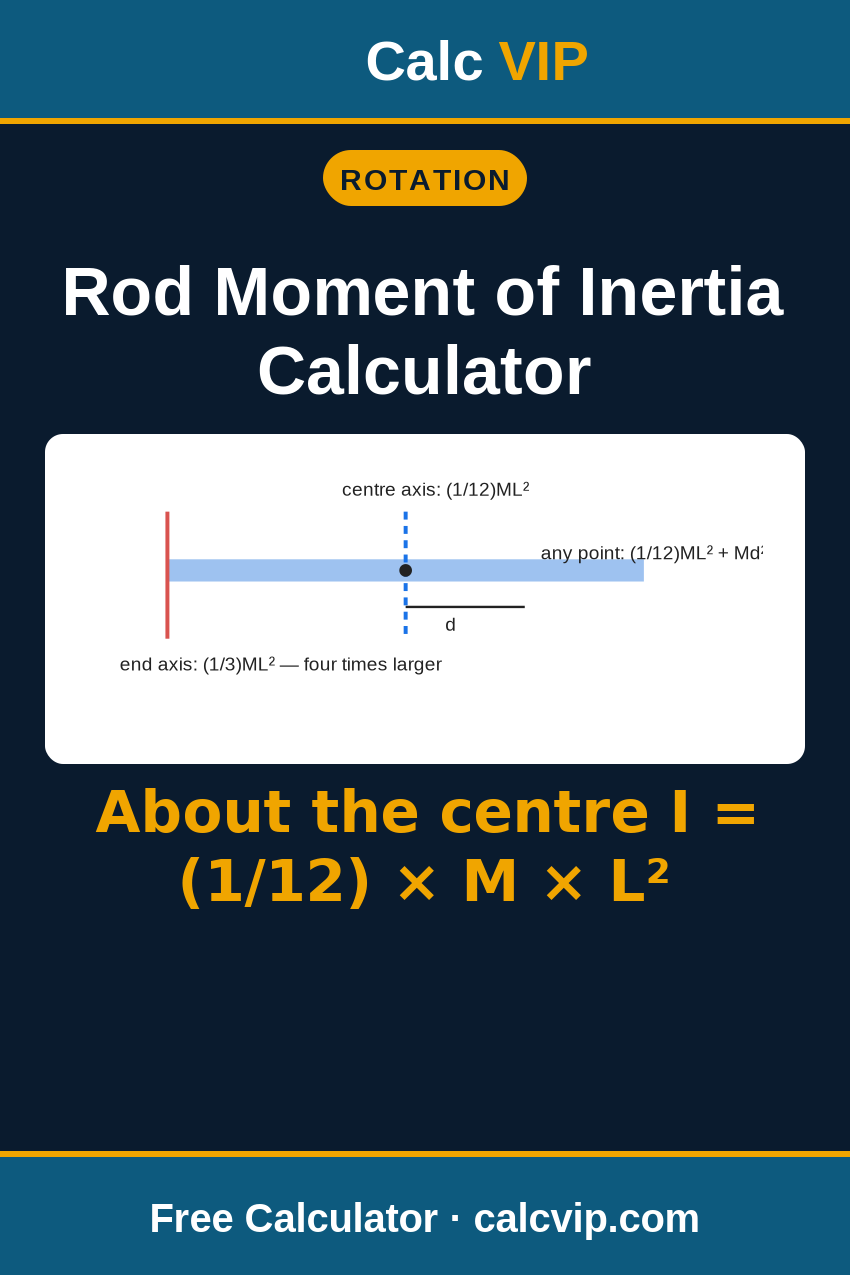
The rod is also the gateway to everything else. Its centre formula is the answer for batons, axles and propeller blades; its end formula governs pendulums, swinging doors modelled as rods, and the falling chimney problem that has entertained physicists for a century (a tall chimney, tipping, can snap in mid-fall because its own angular acceleration stresses it — the rod's inertia is the first line of that analysis). And its general formula, with the optional d in this calculator, is the parallel axis theorem in its most-used costume. Enter M and L, add a d if your pivot is off-centre, and all three values are yours.
Formula
About the centre I = (1/12) × M × L² • About one end I = (1/3) × M × L² • About a point d from the centre I = (1/12)ML² + M × d² • I in kg·m², M in kg, L and d in metres
The three formulas are one formula in three places: the third is the parallel axis theorem applied to the first, and setting d = L/2 in it returns the second exactly — (1/12)ML² + M(L/2)² = (1/12 + 1/4)ML² = (1/3)ML² — a built-in consistency check this calculator passes on every run. The radius of gyration form is sometimes handier: k = √(I/M), giving k = L/√12 ≈ 0.289L about the centre and k = L/√3 ≈ 0.577L about the end — the distances at which the rod's whole mass could be concentrated without changing I. All three formulas assume a thin, uniform rod and an axis perpendicular to it; the thickness correction and the along-the-rod axis are handled in the depth section below. Units: metres throughout — a length in centimetres inflates L², and with it the answer, a hundredfold.
| Symbol | Meaning | Units |
|---|---|---|
| I | moment of inertia of the rod | kg·m² |
| M | mass of the rod | kg |
| L | length of the rod | m |
| d | distance of the axis from the rod's centre | m |
| k | radius of gyration, √(I/M) | m |
Where 1/12 comes from — the average of a square
Slice the rod mentally into many small pieces. A piece at distance x from the centre contributes its mass times x² to the inertia, so the total is the mass per unit length multiplied by the sum of x² along the rod — in the limit, the integral of x² from −L/2 to +L/2, which equals L³/12. Multiply by the linear density M/L and the L³ becomes ML²/12. The 12 is thus not a fudge but the honest average of a square: the mean of x² over a length is L²/12, pulled down by the many pieces near the centre whose x² is nearly nothing, against the few at the ends whose x² is (L/2)². This is also why the end value is exactly four times bigger, not twice: about the end, distances run from 0 to L instead of −L/2 to L/2, the mean of x² over that span is L²/3, and (L²/3) ÷ (L²/12) = 4. Doubling every distance quadruples every contribution — the square in mr² collects its debt in full.
The same slicing argument scales to the rod's cousins, which is why this one derivation is worth learning properly. A rectangular plate about its centre gives (1/12)M(a² + b²) — two rod-like averages added, one for each direction. A disk can be built from concentric rings; a solid cylinder from disks. In each case the fraction in front (1/12, 1/3, 1/2, 2/5) is the fingerprint of the shape's average squared distance, and the parallel axis theorem then transports the result to any pivot. Master the rod and the rest of the inertia table stops being a table and becomes a family you recognise.
How to use
- Enter the rod's mass M in kilograms and its length L in metres. The rod is assumed uniform — same thickness and material end to end.
- Optionally enter d, the distance in metres from the rod's centre to your actual axis (leave it blank if you only need the centre and end values). d may be anything from 0 to L/2 for a pivot on the rod itself.
- Click "Calculate Rod Inertia" to get all three: about the centre, about one end, and about your point d.
- Check the relationship before trusting the numbers: the end value must be exactly four times the centre value, and the d value must lie between them. If either fails, a unit has slipped.
Worked examples
Example 1 — the reference rod. A uniform rod of mass M = 3 kg and length L = 2 m, axis d = 0.5 m from the centre:
About the centre: I = (1/12) × 3 × 2² = 1 kg·m²
About one end: I = (1/3) × 3 × 2² = 4 kg·m²
About the point: I = 1 + 3 × 0.5² = 1 + 0.75 = 1.75 kg·m²
Example 2 — a baseball bat, idealised. Treat a bat as a uniform rod of M = 0.9 kg, L = 0.85 m:
About the centre: (1/12) × 0.9 × 0.85² = 0.0542 kg·m². About the end (the hands): (1/3) × 0.9 × 0.85² = 0.2167 kg·m². Real bats concentrate mass toward the barrel, so their true end value is higher — the rod is the honest first estimate, and the difference is a lesson in what "uniform" assumes.
Example 3 — a metre ruler. A light ruler of M = 0.1 kg, L = 1 m:
About the centre: (1/12) × 0.1 × 1² = 0.008333 kg·m². About one end: (1/3) × 0.1 × 1² = 0.03333 kg·m². Small numbers, but they are why a ruler twirled about its middle feels nimble and the same ruler swung from its end feels deliberate.
Example 4 — a long pole. A scaffolding pole of M = 6 kg, L = 4 m:
About the centre: (1/12) × 6 × 16 = 8 kg·m². About one end: (1/3) × 6 × 16 = 32 kg·m². About a grip 1 m from the centre: 8 + 6 × 1² = 14 kg·m². Anyone who has carried a long pole on a shoulder has felt these numbers in their neck.
Example 5 — the rod as a pendulum. Example 1's rod, hung from one end and swung, is a physical pendulum with period T = 2π√(I/(Mgdcm)), where dcm = 1 m is the pivot-to-centre distance:
T = 2π√(4 / (3 × 9.81 × 1)) = 2π√0.13595 ≈ 2.32 s. A two-metre rod swinging in a stately 2.3-second period — the inertia from this calculator, cashed out as time.
Example 6 — checking the theorem against itself. A rod of M = 2 kg, L = 1.2 m: centre value (1/12) × 2 × 1.44 = 0.24 kg·m². At d = 0.3 m (the quarter point): 0.24 + 2 × 0.09 = 0.42 kg·m². Now push d to the end, d = 0.6 m: 0.24 + 2 × 0.36 = 0.96 kg·m² — and the direct end formula gives (1/3) × 2 × 1.44 = 0.96 kg·m². The two routes agree to the last digit, as they must.
Rods in real life
Batons, drumsticks and conductors' wands. A baton twirled about its centre lives on the (1/12)ML² value; the twirler's art is keeping the axis at the balance point where the inertia — and the effort — is least. Drumsticks pivot near one end in the fingers, and their (1/3)-style inertia sets how a stroke rebounds.
Swinging doors and gates. A uniform door is a wide rod about its hinge — the end formula with the width as L, refined by the parallel-axis treatment in this batch. The fourfold jump from centre to end is why a gate's swing feels so much grander than its mass suggests.
Helicopter and propeller blades. A blade is a rod that spins about one end, and its (1/3)ML²-class inertia sets both the spool-up time of the rotor and the centrifugal loads at the hub. Blade designers taper the rod — breaking uniformity deliberately — to trim the inertia where it costs most.
The falling chimney. A tall chimney, demolished at its base, tips as a rod about its end — but the far end must accelerate faster than gravity alone allows once the tilt grows, and the internal stresses can snap the stack in mid-air. The analysis begins with exactly this page's end formula.
Pendulum clocks and metronomes. The classic pendulum bob-on-a-rod is a compound pendulum whose period blends the rod's own (1/3)ML² with the bob's Md². Clockmakers adjusted the bob's position — d, in this calculator's language — to tune the period, which is the parallel axis theorem keeping time.
Walking and running legs. Biomechanics models a leg as a rod swinging about the hip — near its end — and the metabolic cost of walking scales with the leg's moment of inertia about that hip axis. It is why shoes matter more than socks: mass at the far end of the rod is taxed by the square of its distance, in energy as in inertia.
When the rod is not thin, and other honest corrections
The thin-rod formulas ignore the rod's own thickness, and for most rods that is a fine bargain — but the correction is known and occasionally matters. For a solid cylinder of radius r swung about a perpendicular axis through its centre, the exact result is I = (1/12)M(3r² + L²): the thin-rod value plus a small term in r². For a rod with r = L/20 the correction is under 1% — negligible. For a short, fat bar with r = L/4 it reaches about 19% of the length term's neighbourhood and can no longer be waved away. The other axis worth knowing is along the rod itself: spinning a rod like a drill bit about its own length gives I = ½Mr², a completely different (and much smaller) value governed by the radius alone. This calculator's formulas are the perpendicular-axis family — the swinging, twirling, pendulum family — and the FAQ's thickness answer marks the border where the thin idealisation ends.
Quick reference: one rod, many pivots
| Axis position | I | Multiple of centre value |
|---|---|---|
| centre (d = 0) | (1/12)ML² = 0.0833ML² | 1.00× |
| quarter point (d = L/4) | (7/48)ML² ≈ 0.1458ML² | 1.75× |
| third point (d = L/3) | (7/36)ML² ≈ 0.1944ML² | 2.33× |
| end (d = L/2) | (1/3)ML² ≈ 0.3333ML² | 4.00× |
| beyond the end (d = L) | (13/12)ML² ≈ 1.0833ML² | 13.00× |
The last row is the theorem with the leash slipped: an axis a full length from the centre — a rod swung from the end of an equal-length weightless arm — costs thirteen times the centre inertia. The growth is all in the Md² term, and it is why pivot placement is the cheapest design variable in any swinging machine.
Common mistakes
- Using the centre formula for an end pivot. The most consequential slip on this page: it under-reports the inertia fourfold, and every torque, period and energy computed downstream inherits the error. Ask where the axis is before choosing the fraction.
- Measuring d from the end instead of the centre. In I = (1/12)ML² + Md², d is the distance from the rod's centre. A pivot at the quarter point is d = L/4, not 3L/4 — measuring from the wrong landmark quietly moves the answer most of the way to the end value.
- Entering L in centimetres. L is squared, so a cm-for-m slip inflates the result ten-thousandfold in the squared term's arithmetic — the answer's sheer size is the tell. Metres, always.
- Treating a tapered or loaded rod as uniform. Bats, blades and oars concentrate mass toward one end; their true inertia about the grip exceeds the uniform estimate. The rod value is a floor and a first approximation, not a promise.
- Using these formulas for spin about the rod's own length. A rod twisted about its long axis obeys I = ½Mr² — the radius, not the length, is in charge, and the answer is typically a hundred times smaller. Check which way your rod actually turns.
FAQ
Why is the end value four times the centre value?
(1/3) ÷ (1/12) = 4. About the end, every part of the rod is further from the axis on average, and distance counts squared — so the same rod feels four times harder to swing.
Does the rod's thickness matter?
For a thin rod it is ignored. A thick cylinder spinning about a perpendicular axis needs a small correction term, but for rods and bars the thin-rod formulas are the standard ones.
What if my axis is not in the plane of the swing?
These formulas are for a perpendicular axis (like a door hinge line at the end, or a baton twirl about its middle). An axis along the rod itself gives a much smaller I based on the rod's radius.
What if the rod is vertical, like a falling chimney?
The inertia formulas do not care about orientation — gravity does not enter I at all. Orientation matters for the motion that follows (the torque gravity applies depends on the tilt), but the rod's (1/3)ML² about its base is the same number standing, falling or floating in space.
How do I handle a rod with a mass on the end — a pendulum bob or a hammer?
Add the pieces: total I = rod's I about the pivot + bob's I about the pivot, with the bob treated as a point mass, I = mbob × (distance)². This "compound pendulum" sum is how real hammers, mallets and clock pendulums are calculated — the rod formula supplies the handle's share.
What is the radius of gyration of a rod?
k = √(I/M): about the centre, L/√12 ≈ 0.289L; about the end, L/√3 ≈ 0.577L. It is the distance from the axis at which the rod's entire mass could be concentrated (as a ring) without changing the inertia — a compact way to compare rods of different sizes.
Does the material matter?
Only through the mass. A steel rod and a wooden rod of the same M and L have identical moments of inertia about the same axis — inertia reads the distribution of mass, not its chemistry. (Their strengths, of course, differ wildly; that is a different chapter.)
Why do tightrope walkers carry a long pole?
The pole is a rod held near its centre, and its (1/12)ML² — made large by the length squared — resists the walker's own tipping rotations, slowing any fall's angular acceleration enough to correct it. The drooping ends also lower the combined centre of mass. It is this page's centre formula, employed as life insurance.
Can I use the end formula for a door?
As a first estimate, yes — a uniform door of width w behaves like a rod of length w about its edge: I ≈ (1/3)Mw². The exact flat-plate value about its edge is the same expression, because a plate's width is the only dimension the hinge axis sees. Handles and glazing shift it slightly; the rod answer is the working figure.
What if my pivot is beyond the end of the rod?
The general formula still holds — d is simply larger than L/2. At d = L the table above gives (13/12)ML². Pendulums with the rod mounted on an arm, and counterweighted mechanisms, live in this territory, and the calculator's d field accepts the value without complaint.