 Calc
Torque & Angular Acceleration Calculator – α = τ/I Solver
 Created by Rachel Novak · Senior Editor · All Topics · Last updated: November 2026
Use this free Torque & Angular Acceleration Calculator to find α = τ/I — how fast a torque spins an object up — and the angular velocity it reaches after a given time. Enter the torque, the moment of inertia, the starting spin and the time.
Every spin has to start somewhere. A motor does not teleport its shaft to full speed; a merry-go-round does not jump from rest to dizzying. Between rest and full speed there is a climb, and the rate of that climb — the angular acceleration α — is decided by a tug of war between the twisting effort applied and the object's reluctance to be twisted. That reluctance is the moment of inertia I; the effort is the torque τ; and the whole contest is settled by one of the cleanest equations in mechanics, α = τ/I, the rotational form of Newton's second law. This calculator works both ends of it: it finds α from your torque and inertia, then follows the spin forward in time to the angular velocity the object reaches.
The parallel with straight-line motion is exact, and worth memorising because it lets you reuse everything you already know. Force becomes torque, mass becomes moment of inertia, and acceleration becomes angular acceleration: α = τ/I mirrors a = F/m term for term. Push a heavy door and a light door with the same force and the light one accelerates faster; twist a rim-heavy flywheel and a compact rotor with the same motor torque and the compact one leaps ahead the same way. Doubling the torque doubles α; doubling I halves it. Nothing else hides in the equation — which is also its warning: it uses the net torque, after friction and load have taken their share.
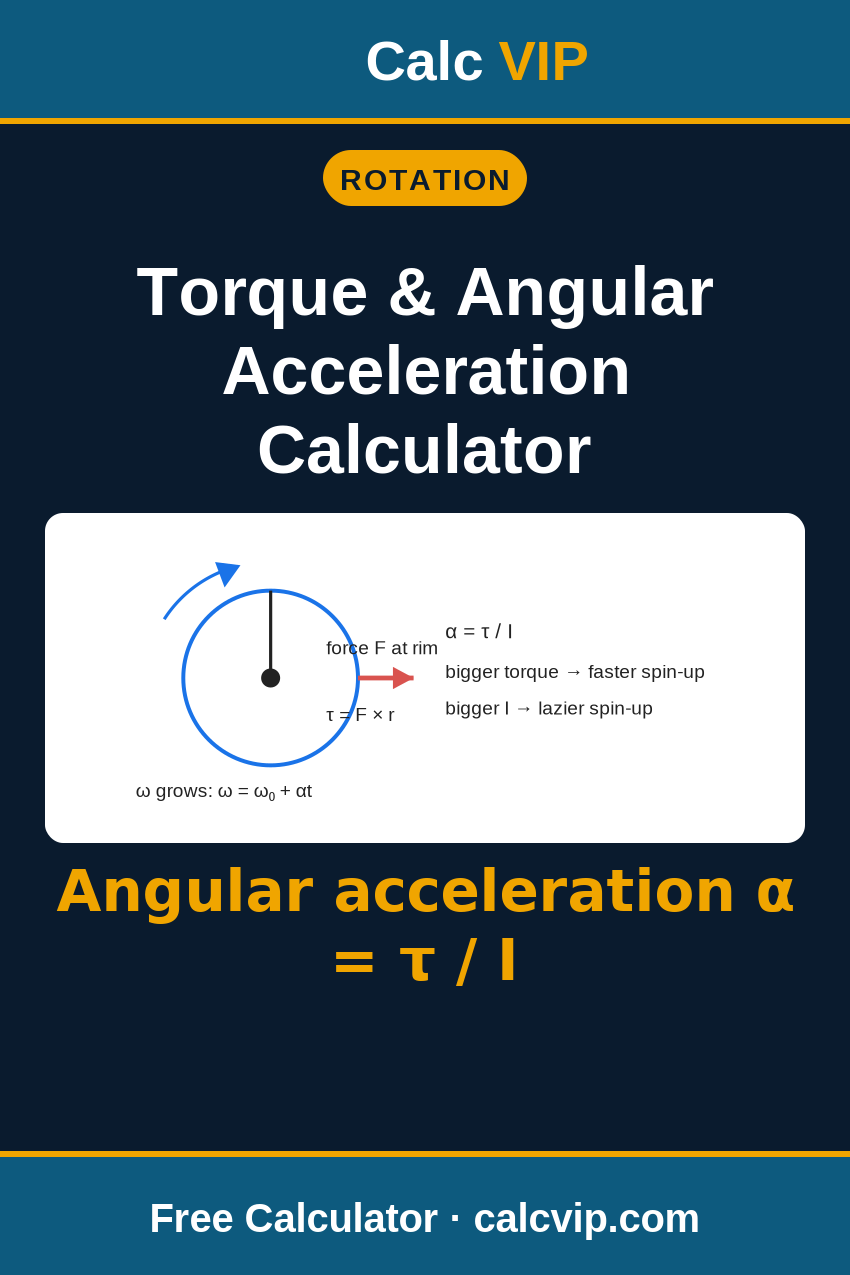
The second half of the calculator, ω = ω₀ + αt, answers the question everyone actually asks: not "how hard is it accelerating?" but "how fast will it be going?" A drill bit, a centrifuge, a vehicle wheel pulling away from lights — each is a story of α acting over t. Multiply the two and add the starting spin and you have the final speed, in rad/s, ready to convert to rpm if you think in turns per minute. Between the two formulas on this page you can size a motor, predict a spin-up time, or work out why a loaded machine takes so long to get going.
Formula
Angular acceleration α = τ / I • Angular velocity after time t ω = ω₀ + α × t • α in rad/s², τ in newton metres (N·m), I in kg·m², ω in rad/s, t in seconds
The pair rearranges for design work: τ = I × α gives the torque a motor must supply to achieve a wanted spin-up, and I = τ / α infers an unknown inertia from a measured response. The time question inverts too: t = (ω − ω₀) / α. Torque itself is built from a force and a lever arm, τ = F × r for a force applied at right angles to the arm — push at an angle and only the perpendicular component counts, τ = F r sin θ. And while the torque acts, the object sweeps an angle θ = ω₀t + ½αt², the rotational twin of the familiar distance formula. All four quantities on this page — α, ω, θ, t — are bound together by these relations, the rotational kinematics set explored further below.
| Symbol | Meaning | Units |
|---|---|---|
| α | angular acceleration | rad/s² |
| τ | net torque about the axis | N·m |
| I | moment of inertia about the axis | kg·m² |
| ω₀, ω | angular velocity at the start and after time t | rad/s |
| t | time the torque acts | s |
Newton's second law, wearing a twist
The linear law a = F/m says an object's acceleration is the applied force shared out over its mass. The rotational law on this page is the same sentence translated: α = τ/I says an object's angular acceleration is the applied twist shared out over its rotational mass. The translation is not cosmetic — it is forced by geometry. A force applied to a spinning body only twists it to the extent that it acts at a distance from the axle and at an angle to the arm; bundle those two facts into torque, and bundle the body's mass distribution into I, and Newton's law re-emerges exactly. This is why the equation never needs empirical fudge factors: it is not fitted to experiments, it is derived, and every experiment since has agreed with it.
One consequence deserves emphasis, because it runs machinery design: α is set by the ratio of torque to inertia, so there are always two levers to pull. A sluggish spin-up can be cured by a stronger motor (more τ) or by lightening the rotor or pulling its mass inward (less I) — and the second lever is often cheaper, since I punishes mass at the rim with a square. It also explains a familiar frustration: add a heavy chuck, a full drum or a loaded trailer wheel and the same motor suddenly takes far longer to reach speed. The torque did not change. The denominator did.
How to use
- Enter the net torque τ in newton metres — the driving torque minus anything resisting it, such as friction or a load torque.
- Enter the moment of inertia I in kg·m² for the object about the axis it actually spins on.
- Enter the starting angular velocity ω₀ in rad/s (0 if it starts from rest) and the time t in seconds for which the torque acts.
- Click "Calculate Angular Acceleration" to get α in rad/s² and the final angular velocity ω. To think in rpm, divide ω by 2π and multiply by 60.
Worked examples
Example 1 — the standard case. A torque of τ = 50 N·m acts on a wheel with I = 10 kg·m², starting from rest (ω₀ = 0) for t = 4 s:
α = 50 / 10 = 5 rad/s²
ω = 0 + 5 × 4 = 20 rad/s — about 191 rpm, reached in four seconds.
Example 2 — already spinning. A torque of τ = 12 N·m acts on a rotor with I = 3 kg·m² that is already turning at ω₀ = 2 rad/s, for t = 5 s:
α = 12 / 3 = 4 rad/s², and ω = 2 + 4 × 5 = 22 rad/s. The starting spin simply carries through — α adds to whatever motion already exists.
Example 3 — braking to a stop. A flywheel turning at ω₀ = 40 rad/s with I = 6 kg·m² meets a net braking torque of τ = −30 N·m:
α = −30 / 6 = −5 rad/s². Time to stop: t = (0 − 40) / (−5) = 8 s. The negative signs are not decoration — they are the equation reporting that the spin is dying, and how fast.
Example 4 — from a push at the rim. You push a playground roundabout with a force of 15 N at its rim, r = 0.8 m from the axle, at right angles: τ = F × r = 15 × 0.8 = 12 N·m. With the roundabout's I = 2.4 kg·m²:
α = 12 / 2.4 = 5 rad/s² — a brisk spin-up, which is why a rim push works so much better than a push near the hub: the same force buys more torque.
Example 5 — how far does it turn while speeding up? For Example 1's wheel (α = 5 rad/s² from rest, t = 4 s), the angle swept is θ = ω₀t + ½αt² = 0 + ½ × 5 × 16 = 40 rad ≈ 6.37 revolutions. The calculator reports α and ω; this companion formula adds the missing third fact, how much turning happened along the way.
Example 6 — measuring an unknown inertia. A test rig applies τ = 80 N·m to an unmarked rotor and measures α = 2 rad/s²:
I = τ / α = 80 / 2 = 40 kg·m². This is a genuine laboratory technique — when an object is too irregular to calculate, you twist it with a known torque and let α = τ/I confess its inertia.
Torque and angular acceleration in real life
Electric motors and EVs. An electric motor delivers its torque almost instantly, and the car's α = τ/I at the wheels is what passengers feel as the famous EV shove. Because the torque arrives without waiting for revs to build, even modest motors produce startling angular acceleration of the drivetrain.
Spin-up times in industry. A large fan, pump or compressor may take minutes to reach full speed: its I is huge, the motor's spare torque modest, and α therefore small. Soft starters and variable-speed drives exist largely to manage this equation — ramping torque gently so the small α does not stress couplings and belts.
Drills, grinders and saws. A power tool's bit has tiny I, so even a small motor's torque produces enormous α and the bit is at full speed in a blink. The same smallness is a hazard in reverse: when a saw blade binds, the torque reaction twists the tool in the operator's hands — kickback is α = τ/I applied to the tool body.
Figure skating and diving. A skater who pulls in her arms shrinks I mid-spin; with no external torque, angular momentum Iω is conserved, so ω must rise — the visible burst of speed is this page's variables rearranging themselves. Divers do the same arithmetic with tucks and layouts.
Spacecraft attitude control. A satellite is re-aimed by reaction wheels: small rotors whose motors apply torque to the wheel one way and, by Newton's third law, to the satellite the other. The satellite's α is tiny because its I is large — reorientation is a slow, patient application of exactly this formula.
Washing machines. A loaded drum has far more I than an empty one, so the same motor torque gives a smaller α and a longer climb to spin speed — and an unbalanced load, with its mass pushed to one side, makes I vary around the turn, which the machine detects as vibration.
The rotational kinematics set
When α is constant — the assumption throughout this page — four equations describe everything about the motion, and each is a translation of a straight-line formula you may already know. The set: ω = ω₀ + αt (speed after time t); θ = ω₀t + ½αt² (angle turned); ω² = ω₀² + 2αθ (speed after turning through an angle, with time eliminated); and θ = ½(ω₀ + ω)t (angle from the average speed). With these, any spin-up problem yields: given any three of ω₀, ω, α, θ, t, the rest follow. Example 5 used the second of them; Example 3 used the first rearranged. Notice the third equation's family resemblance to energy: multiply it through by ½I and it becomes the work–energy theorem, τθ = ½Iω² − ½Iω₀² — the torque's work over the angle turned equals the change in rotational kinetic energy, which ties this page directly to the energy calculator in this batch.
Net torque: the word that does the heavy lifting
Nearly every disappointing real-world result from α = τ/I traces back to one word: net. The τ in the formula is the sum of all torques about the axis — the motor's drive, minus bearing friction, minus air drag on the spinning parts, minus whatever load the machine is working against. A motor rated at 50 N·m coupled to a load that resists with 42 N·m leaves only 8 N·m to accelerate the rotor, and the spin-up takes six times longer than the naive calculation promised. Friction is slyer still: static friction must be overcome before anything moves at all, and drag grows with speed, so α is often largest at the start and fades as the machine approaches its running speed — the constant-α picture of this page is the idealised first chapter of a longer story, accurate whenever one steady net torque dominates.
Common mistakes
- Using the motor's rated torque instead of the net torque. Friction and the load subtract from the drive before anything accelerates. If the spin-up is slower than predicted, an uncounted resisting torque is almost always why.
- Quoting ω in rpm inside ω = ω₀ + αt. α is in rad/s², so ω and ω₀ must be in rad/s. Convert rpm by multiplying by 2π/60 before using the time formula, or the final speed will be out by a factor of about 9.5.
- Taking I about the wrong axis. The inertia must be about the axis the torque twists around. A rotor's I about its own shaft is the one that matters — values about other axes, however official they look, give the wrong α.
- Forgetting that α can be negative. A braking or friction torque gives negative α and a falling ω. Dropping the sign turns a stopping time into nonsense; keep it, and t = (0 − ω₀)/α comes out positive and meaningful.
- Assuming the torque from a force is just F. Torque needs the lever arm: τ = F × r, and only the part of the force perpendicular to the arm counts. A strong push near the axle, or along it, may produce almost no twist at all.
FAQ
What is the difference between torque and force?
A force pushes in a straight line; a torque twists around an axis. The same force makes a bigger torque when it acts further from the axle.
Why does a larger I give a smaller α?
α = τ/I, so for the same torque, an object with more rotational inertia speeds up more slowly — just as a heavier object accelerates less under the same force.
Does friction change the answer?
Yes. τ here should be the net torque: driving torque minus any friction or load torque acting against it.
How long will my motor take to reach full speed?
Rearrange the time formula: t = (ω − ω₀) / α, with α = τ/I from your net torque and inertia. From rest to 3,000 rpm (314.16 rad/s) at α = 5 rad/s², for instance, t = 314.16 / 5 ≈ 62.8 s — a reminder that big machines climb slowly even with healthy torque.
What torque do I need for a target spin-up?
Work backwards: choose the α your schedule needs (α = Δω/t), then τ = I × α, and add an allowance for friction and load torque on top. That sum, not the bare I × α, is the motor size to buy.
Is angular acceleration the same as centripetal acceleration?
No — they are different quantities that happen to share a surname. Angular acceleration α (rad/s²) is how fast the spin rate itself changes. Centripetal acceleration (m/s²) is the inward acceleration each point of the rim experiences because its direction keeps changing, a = ω²r. A wheel at perfectly steady speed has α = 0 but plenty of centripetal acceleration at its rim.
Why does the same motor spin an empty drum faster than a full one?
The full drum has a larger I — more mass, much of it far from the axle — so α = τ/I is smaller and the climb to any given speed takes longer. The motor's torque did not change; the denominator did.
Can α change during the spin-up?
Yes, whenever the net torque changes — and it usually does. Motor torque varies with speed, drag rises with speed, and loads engage and disengage. This calculator treats the steady average; for a fading α, apply it in slices, using each slice's final ω as the next slice's ω₀.
What is a typical α for everyday machines?
Orders of magnitude: a car wheel pulling away, a few rad/s²; a washing machine drum, around 5–20 rad/s²; a small drill bit, hundreds to thousands of rad/s², because its I is minuscule. The spread is almost entirely a story about I.
How is angular momentum involved?
Torque is the rate of change of angular momentum: τ = Δ(Iω)/Δt. For fixed I that is exactly τ = Iα, this page's law in another dress. When I itself changes — the skater pulling in her arms — the momentum form is the one that explains what happens.