 Calc
Telescope Magnification Calculator – Power & Exit Pupil
 Created by Rachel Novak · Senior Editor · All Topics · Last updated: November 2026
Use this free Telescope Magnification Calculator to find the magnifying power of any telescope and eyepiece combination. Magnification is simply the objective's focal length divided by the eyepiece's focal length — and if you add the aperture, it also works out the exit pupil, the width of the light beam that reaches your eye.
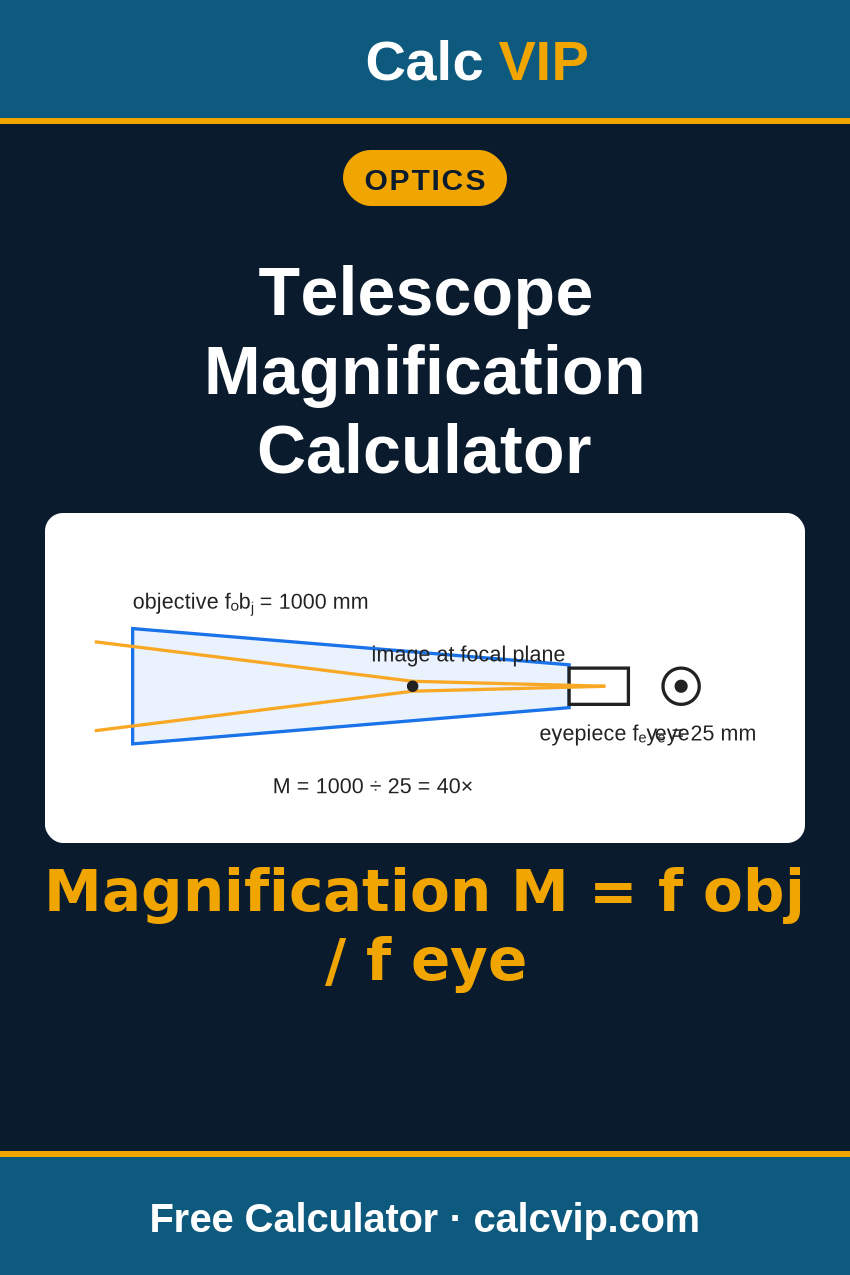
A telescope has no magnification of its own. The number belongs to a partnership: the objective — lens or mirror — builds a real image at its focal plane, and the eyepiece, acting as a magnifying glass, presents that image to your eye enlarged. Change the eyepiece and the same telescope becomes a wide-field finder at 25×, a general-purpose instrument at 40×, or a planetary specialist at 170×. The division M = fobj/feye is the whole mechanism, and the eyepiece case in an observer's kit is really a gearbox for one telescope.
But magnification is the most misunderstood number in amateur astronomy, because more is not better — it is merely bigger. The telescope collects a fixed ration of light set by its aperture, and magnification spreads that ration ever thinner while magnifying the atmosphere's shimmer and the optics' imperfections along with the view. The companion quantity, the exit pupil — the width of the light beam leaving the eyepiece, D/M — tells you whether the partnership is balanced: match it to your eye's pupil and every photon counts; shrink it too far and you are enlarging blur. This calculator reports both numbers together, the way experienced observers think about them.
That pairing is why the calculator asks for the aperture as an optional third input. With D it can flag the two failure modes: an exit pupil wider than your dark-adapted eye (about 7 mm), where light literally spills past your iris and aperture is wasted, and one below about 0.5 mm, where the image is dim, floaters in your eye become boulders, and no extra detail exists to be magnified. Between those fences lies the useful range of any telescope — and every eyepiece you own can be checked against it before you buy the next one.
Formula
Magnification M = fobj / feye • exit pupil = D / M • rearranged: feye = fobj / M and M = D / exit pupil
The rearrangements are the shopping forms of the formula. feye = fobj/M answers "which eyepiece gives me 150× for Saturn?" before you spend money. M = D ÷ exit pupil answers the same question from the eye's side: decide the exit pupil you want — 2 mm for general observing, 5 mm for faint nebulae — and the magnification, hence the eyepiece, follows. Both focal lengths must be in the same unit (millimetres, universally, in this trade) and the aperture D in that same unit for the exit pupil to emerge in millimetres.
| Symbol | Meaning | Units |
|---|---|---|
| fobj | objective (or primary mirror) focal length | mm |
| feye | eyepiece focal length (engraved on the barrel) | mm |
| M | angular magnification ("power") | × (no units) |
| D | aperture — clear diameter of the objective | mm |
| exit pupil | width of the beam entering the eye, D/M | mm |
The exit pupil: where the telescope meets your eye
Hold a telescope eyepiece up to a bright wall and you will see a small bright disc floating just behind the eye lens — the exit pupil, a real image of the objective itself, formed by the eyepiece. All the light the telescope collected is funnelled through that disc. Your eye's pupil must swallow it whole: if the disc is wider than your iris opening, the overflow is wasted and the telescope behaves like a smaller one; if it is much narrower, the image dims and the eye's own defects loom large. The disc's size is D/M, so every magnification choice is simultaneously an exit-pupil choice — the two numbers are one decision seen from opposite ends.
Your side of the bargain changes with age and darkness. A young, fully dark-adapted eye opens to about 7 mm; by middle age 5–6 mm is typical. That is why the classic advice — lowest useful magnification ≈ D ÷ 7 — quietly assumes young eyes under dark skies, and why an exit pupil of 5 mm (this page's worked example) is such a sweet spot for deep-sky observing: bright, wide, and forgiving. At the other end, planetary observers deliberately work near 1 mm and below, trading brightness for scale on the few nights the atmosphere allows it.
The exit pupil also has a position, not just a size: it floats a short distance behind the eyepiece's eye lens, and that distance — the eye relief — is where your eye's pupil must sit to take in the whole field. Short-focal-length eyepieces traditionally offer painfully short eye relief, which is why long-eye-relief designs (and Barlows, which preserve the longer eyepiece's relief while borrowing its partner's power) are more than comforts: for glasses wearers, who need roughly 20 mm of relief to keep their full field, they are the difference between seeing the edge of the field and not.
How to use
- Enter the telescope's focal length (printed on the tube or in its specs) in millimetres.
- Enter the eyepiece focal length — it is engraved on the eyepiece barrel (e.g. 25 mm, 10 mm).
- Optionally enter the aperture D to get the exit pupil as well.
- Click "Calculate Magnification". With a Barlow lens in the train, multiply fobj by the Barlow factor first (a 2× Barlow turns 1000 mm into 2000 mm).
Worked examples
Example 1 — the standard kit. A telescope with a 1000 mm focal length is used with a 25 mm eyepiece, and its aperture is 200 mm.
M = 1000 ÷ 25 = 40×.
Exit pupil = D ÷ M = 200 ÷ 40 = 5 mm — nicely matched to a dark-adapted eye, so none of the collected light is wasted.
Example 2 — swapping to the 10 mm eyepiece. Same telescope, shorter eyepiece.
M = 1000 ÷ 10 = 100×, exit pupil = 200 ÷ 100 = 2 mm. The all-round combination: the Moon fills the field, Jupiter shows its belts, and the image is still bright. Most observers spend most nights near a 2 mm exit pupil.
Example 3 — pushing to the planetary limit. A 6 mm eyepiece in the same 200 mm telescope.
M = 1000 ÷ 6 = 166.67×, exit pupil = 200 ÷ 166.67 = 1.2 mm. Legitimate high power for planets and double stars — but note how far we still are from the telescope's theoretical ceiling of about 2× per millimetre of aperture, 400×.
Example 4 — a small starter scope. A 70 mm refractor of 700 mm focal length with its 20 mm eyepiece.
M = 700 ÷ 20 = 35×, exit pupil = 70 ÷ 35 = 2 mm. Modest numbers, superb views: at 35× the Pleiades fit in one field and the Moon is crisp — aperture, not magnification, is what a small scope lacks, and 35× asks nothing it cannot give.
Example 5 — adding a 2× Barlow. The Example 1 telescope with a Barlow doubling the effective focal length to 2000 mm, still with the 25 mm eyepiece.
M = 2000 ÷ 25 = 80×, exit pupil = 200 ÷ 80 = 2.5 mm. One accessory has doubled every eyepiece in the case — which is why Barlows are the cheapest "second eyepiece set" in astronomy.
Example 6 — choosing an eyepiece for a target power. You want 50× on a 900 mm telescope of 150 mm aperture. Which eyepiece?
feye = 900 ÷ 50 = 18 mm, and the exit pupil will be 150 ÷ 50 = 3 mm. An 18 mm eyepiece it is — the formula run in its shopping direction.
Telescope magnification in real life
Deep-sky observing. Nebulae and galaxies are faint and extended; they reward low power and fat exit pupils (5–7 mm) that maximise surface brightness. The 40× of Example 1, not the 167× of Example 3, is the nebula hunter's setting — magnification spreads such objects into invisibility.
Planetary and lunar work. Bright, small, detailed targets invert the logic: 1 mm exit pupils and 150–250× on steady nights tease out Cassini's division and lunar rilles. The limit is usually the atmosphere's seeing, not the telescope.
Terrestrial spotting scopes. Birders use the same division with zoom eyepieces, typically 20–60× on 60–80 mm objectives. Heat shimmer over land caps useful power far below the astronomical ceiling — the same atmospheric lesson in daylight dress.
Binoculars. A "10×50" binocular is this calculator frozen at the factory: M = 10, D = 50 mm, exit pupil 5 mm. The second number exists precisely because the exit pupil — 50 ÷ 10 — is the figure that predicts low-light performance.
Department-store telescopes. Boxes advertising "675×!" for a 60 mm telescope are arithmetically honest (a tiny eyepiece and Barlow can reach it) and practically fraudulent: the ceiling for 60 mm is about 120×, beyond which the image is an empty, dim blur. This calculator plus the 2×-per-millimetre rule is the antidote.
Finder scopes. The little telescope riding on the main tube is this calculator at minimum settings: a typical 6×30 finder (M = 6, D = 30 mm, exit pupil 5 mm) trades power for a field several degrees wide, because finding is a field-of-view problem, not a magnification problem — the main instrument then takes over at the powers in the table below.
Astrophotography. Cameras replace eyepieces, and "magnification" gives way to image scale set by fobj alone — but the exit-pupil idea survives as the focal ratio, fobj/D, the photographer's version of the same brightness bargain.
Quick reference: one telescope, five eyepieces (fobj = 1000 mm, D = 200 mm)
| Eyepiece | Magnification | Exit pupil | Best for |
|---|---|---|---|
| 40 mm | 25× | 8 mm | widest field — but wastes light (EP > 7 mm) |
| 25 mm | 40× | 5 mm | deep sky, sweeping |
| 15 mm | 66.67× | 3 mm | galaxies, clusters |
| 10 mm | 100× | 2 mm | all-round, Moon |
| 6 mm | 166.67× | 1.2 mm | planets, double stars |
The whole eyepiece case in one glance: five eyepieces span 25× to 167×, and the exit-pupil column — not the magnification column — is the one that predicts how each view will feel.
Resolution: the limit magnification cannot fix
A telescope's finest resolvable detail is set by aperture alone, through diffraction: the empirical Dawes limit is about 116 ÷ D(mm) arcseconds. A 200 mm telescope resolves 0.58″; a 70 mm one, 1.66″. Magnification's only job is to enlarge that fixed detail until your eye can see it — roughly 25× per arcsecond of detail is plenty — after which extra power enlarges the blur, not the information. This is the deep reason behind the 2×-per-millimetre ceiling: it is the magnification at which the eye has been shown everything the aperture captured. Buying magnification beyond it is buying a bigger envelope for the same letter.
True field of view: the eyepiece's other job
Magnification decides how big things look; the field of view decides how much sky fits in the frame, and the two are traded against each other through the eyepiece's apparent field — the angle the eyepiece itself presents, typically 52° for a Plössl design and up to 68–82° for wide-angle types. True field ≈ apparent field ÷ M. The 25 mm Plössl of Example 1 (apparent field 52°) at 40× shows 52 ÷ 40 = 1.3° of sky — about two and a half Moon-widths (the Moon spans 0.5°). A 68° wide-angle eyepiece of the same focal length widens that to 68 ÷ 40 = 1.7° at identical magnification and exit pupil, which is what wide-field designs are for.
Run the same eyepiece at Example 3's 166.67× and the true field shrinks to 52 ÷ 166.67 = 0.31° — the Moon no longer fits. Field also sets patience: the Earth's rotation carries stars across the field at 0.25° per minute, so an undriven telescope gives you 1.3 ÷ 0.25 ≈ 5.2 minutes of drift at 40× before the target leaves, but only about 1.2 minutes at 167×. Choosing an eyepiece is always choosing three numbers at once — power, exit pupil, field — and this page's division is the first of the three calculations.
Common mistakes
- Judging a telescope by its advertised magnification. Power is chosen by swapping a cheap eyepiece; aperture is the telescope. A 200 mm scope at 40× out-sees a 60 mm scope at 300× on every target in the sky.
- Forgetting the Barlow. Calculating M from the bare fobj while a 2× Barlow sits in the focuser understates the power — and misjudges the exit pupil — by the Barlow factor.
- Mixing units. fobj is often printed in inches or centimetres on older scopes while eyepieces are always millimetres. Convert first: the division only works in a single unit.
- Chasing power on a shimmering night. Seeing, not optics, usually caps magnification at 100–200×. When the image boils, dropping to a longer eyepiece sharpens more than any upgrade.
- Ignoring the exit pupil at low power. An 8 mm exit pupil (the 40 mm eyepiece row above) overflows a 7 mm iris: the outer light is clipped, and your 200 mm telescope performs like a smaller one — silently.
FAQ
Why does the image get dimmer at high magnification?
The telescope collects a fixed amount of light. Magnifying spreads that same light over a larger apparent area, so the surface brightness falls. The exit pupil shrinking below your eye's pupil size is the same effect seen from the other side.
What exit pupil is best?
About 5–7 mm uses all the light your dark-adapted eye can accept and suits wide, faint deep-sky views. Around 2 mm is a good all-round value, and 0.5–1 mm is reserved for planets and double stars on steady nights.
Does a Barlow lens change the calculation?
Yes — a 2× Barlow doubles the effective objective focal length before the eyepiece. Just multiply fobj by the Barlow factor first (1000 mm becomes 2000 mm), and the same formula gives the new, doubled magnification.
What is the maximum useful magnification of my telescope?
About 2× per millimetre of aperture under perfect skies — 400× for a 200 mm scope, 120× for a 60 mm one. Ordinary nights of mediocre seeing cap most telescopes nearer 1× per millimetre, which is why experienced observers own several eyepieces rather than one extreme one.
What is the lowest useful magnification?
The power at which the exit pupil reaches your eye's maximum opening: M ≈ D ÷ 7. For a 200 mm telescope that is about 28.6×, needing an eyepiece of 1000 ÷ 28.6 ≈ 35 mm. Go lower and light spills past your iris — the view gets no brighter, only narrower in effective aperture.
Why does the Moon look smaller than I expect at 40×?
Because 40× is honest: the Moon spans 0.5°, so at 40× it appears 20° across — large, but your memory of dramatic horizon moons is a psychological illusion. The calculator's number is the true angular size; the "supermoon effect" lives in the brain, not the optics.
Do I need the aperture to find magnification?
No — M needs only the two focal lengths. The aperture is required only for the exit pupil, and for judging whether a given magnification is sensible for the telescope at all.
What does f/5 or f/10 on a telescope mean?
The focal ratio: fobj ÷ D. Our 1000 mm, 200 mm example is an f/5 telescope. Low f-ratios give wide fields and bright images at low power; high f-ratios suit planets. It is the same brightness bargain as the exit pupil, stated at the factory.
Can I measure my telescope's true focal length?
Yes: image the Moon on paper at the focal plane, or time a star's drift across the field. Manufacturers' figures are usually honest to a few percent — close enough that this calculator's answers match the sky.
Why do zoom eyepieces exist if swapping is easy?
Convenience and the ability to dial magnification to the exact limit of the night's seeing. The formula still governs every setting: a zoom marked 8–24 mm in a 1000 mm telescope sweeps continuously from 125× down to 41.67×.