 Calc
Round Trip Average Speed Calculator – Harmonic Mean for Return Journeys
 Created by Sarah Mitchell · Physics Editor · Motion & Measurement · Last updated: November 2026
Use this free Round Trip Speed Calculator to find the true average speed of a return journey — going one way at one speed and coming back at another. Because you spend longer at the slower speed, the average is the harmonic mean of the two speeds, not their ordinary average. The calculator also gives the total time for your one-way distance.
Every traveller has met the puzzle in person: the road out felt fast, the road home felt slow, and yet the average for the whole trip refuses to sit halfway between the two speeds. The reason is time. Average speed is total distance divided by total time — it is not an average of speeds at all, in the everyday sense — and on a return journey the slow leg lasts longer, so it weighs more in the final figure. The correct combination of the two speeds is the harmonic mean, 2v1v2 ÷ (v1 + v2), and it always lands at or below the ordinary average, equality only when both legs are driven at the same speed.
This is more than a pub-quiz trap. The harmonic mean is the right average for any rate applied over a fixed amount of "stuff" — a fixed distance, a fixed quantity of work, a fixed sum of money — rather than over a fixed time. Fuel economy over equal distances, average pace over equal laps, the effective resistance of parallel resistors, the combined rate of two pipes filling one tank: the same shape keeps reappearing, and the round trip is simply its most familiar costume. Master it here and you will recognise it everywhere.
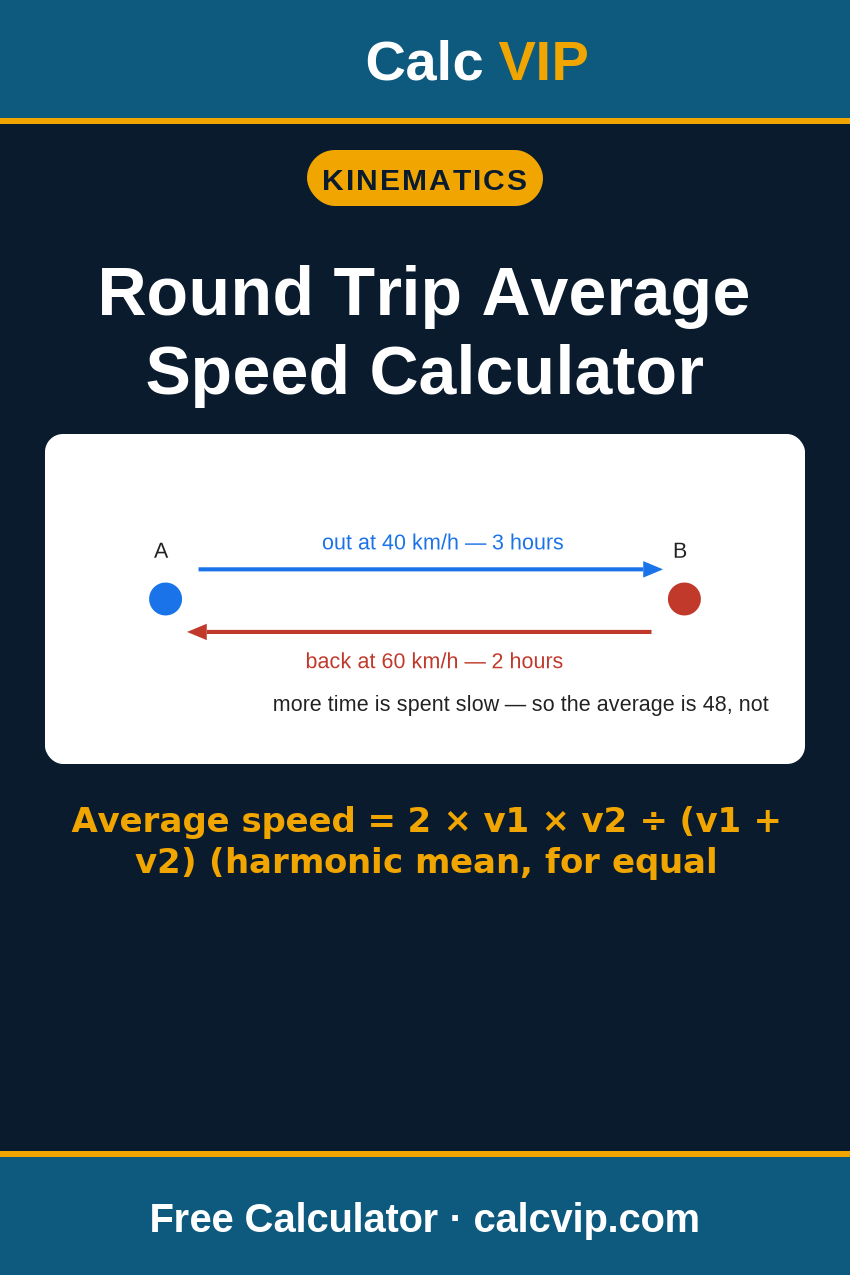
The calculator asks for one more thing besides the two speeds: the one-way distance. Strictly, the average speed does not depend on it — the harmonic mean emerges whatever the distance — but the distance turns the answer into a full journey summary: total time and total distance, the numbers you actually plan fuel, food and patience around.
Formula
Average speed = 2 × v1 × v2 ÷ (v1 + v2) (harmonic mean, for equal distances) • Total time = d ÷ v1 + d ÷ v2 • Total distance = 2d
The formula is just total distance ÷ total time with the journey's symmetry used to simplify: the two legs contribute 2d of distance and d/v1 + d/v2 of time, and dividing one by the other and tidying the fractions yields 2v1v2/(v1 + v2) — the distance cancels, which is why the average speed is the same for a 2 km errand and a 2,000 km expedition driven at the same two speeds. The calculator nevertheless uses your distance to report the total time, the figure the simplified formula hides. One more rearrangement is worth knowing: if the two legs are driven for equal times instead of equal distances, the ordinary arithmetic mean (v1 + v2) ÷ 2 becomes correct — the mean you must use is decided by what is held equal, time or distance.
| Symbol | Meaning | Units |
|---|---|---|
| v1 | speed of the outward leg | km/h |
| v2 | speed of the return leg | km/h |
| d | one-way distance (same road out and back) | km |
| t | total time for the round trip | hours |
Why the slow leg wins: time is the weight
An average is a weighted sum, and the honest question is always "weighted by what?" For speeds, time is the weight: your overall average is pulled towards whichever speed you spent more time doing. On a round trip the distances are equal, so the slower leg automatically earns more time — 3 hours at 40 km/h against 2 hours at 60 in the worked example — and the average settles closer to 40 than to 60: at 48, two-fifths of the way up from the slow speed rather than halfway. The extreme cases make the rule vivid. Go out at 10 km/h and return at 90, and the average is a humble 18 km/h: the crawl consumed nine-tenths of the journey's time, and the dash home, however heroic, was a one-hour garnish on a nine-hour meal.
This asymmetry has a sharp practical edge, the "can't make up lost time" theorem. Suppose the outward leg is done at 40 km/h over 120 km — 3 hours gone. To average 60 km/h for the whole 240 km trip you must finish within 4 hours total, leaving exactly 1 hour for the return: a required 120 km/h. Go out at 30 km/h instead and the outward leg alone eats all 4 hours of the budget; the target average is now mathematically unreachable at any return speed, even infinite. Slowness early is a debt that speed later cannot always repay.
How to use
- Enter the speed of the outward leg in km/h.
- Enter the speed of the return leg in km/h — the same road, travelled back.
- Enter the one-way distance in km. (The average speed would be the same for any distance; the distance is needed for the total time and total distance.)
- Click "Find Average Speed & Time" to see the round-trip average speed (also shown in m/s), the total time, and the total distance.
- Compare the answer with the ordinary mean (v1 + v2) ÷ 2: the gap between them measures how unequal the two legs were.
Worked examples
Example 1 — the classic. A driver goes 120 km at 40 km/h and returns the same 120 km at 60 km/h. Average speed = 2 × 40 × 60 ÷ (40 + 60) = 4800 ÷ 100 = 48 km/h — not 50. Total time = 120 ÷ 40 + 120 ÷ 60 = 3 + 2 = 5 hours for the 240 km round trip, and 240 ÷ 5 = 48 km/h confirms it.
Example 2 — same speed twice. Out at 30 km/h, back at 30 km/h, 90 km each way: average = 2 × 30 × 30 ÷ 60 = 30 km/h, total time 3 + 3 = 6 hours. When the legs match, every kind of mean agrees — the harmonic correction only appears when the speeds differ.
Example 3 — a crawl and a cruise. Out at 20 km/h, back at 60 km/h over 60 km: average = 2 × 20 × 60 ÷ 80 = 30 km/h — far closer to the crawl than the cruise. Total time = 3 + 1 = 4 hours for 120 km, and 120 ÷ 4 = 30 km/h checks.
Example 4 — the extreme. Out at 10 km/h, back at 90 km/h over 90 km: average = 2 × 10 × 90 ÷ 100 = 18 km/h. The times tell the story: 9 hours out, 1 hour back, 10 hours for 180 km. Nine-tenths of the day was spent at walking pace, and the average knows it.
Example 5 — a flight. An airliner covers 800 km out at 750 km/h (headwind) and returns at 900 km/h (tailwind): average = 2 × 750 × 900 ÷ 1650 = 818.18 km/h. Total time = 800 ÷ 750 + 800 ÷ 900 = 1.07 + 0.89 = 1.96 hours — the wind's gift on the way home never fully repays its theft on the way out, which is why round-trip flight times exceed twice the still-air one-way time.
Example 6 — chasing a target average. You drive 120 km out at 40 km/h (3 hours) and want a 60 km/h average for the whole trip. The 240 km at 60 km/h allows 4 hours total, so the return must take 1 hour: a required return speed of 120 km/h. Had you gone out at 30 km/h (4 hours), the budget would already be spent — no return speed, however large, could rescue the average.
Round-trip averages in real life
Delivery and courier planning. A van that fights city traffic out at 20 km/h and cruises home at 60 does not average 40 — it averages 30, and a route planned on 40 promises deliveries an hour early per round trip. Fleet software uses leg-by-leg times, which is the harmonic mean in work clothes.
Fuel economy. Drive 100 km at 5 L/100 km and 100 km at 9 L/100 km and the trip average is not found by averaging speeds at all — but average the consumption rates over equal distances and the same weighted thinking applies: totals first (14 litres over 200 km), rates second.
Running and cycling splits. An out-and-back run into a headwind shows the effect on every watch: the tailwind return feels glorious and gains back only part of the time the outward leg lost. Coaches set out-and-back sessions by total time for exactly this reason.
Swimming a river. A swimmer or boat making the same journey against and with a current obeys this page twice over — the current adds and subtracts speed (the boat-and-stream problem), and the resulting round-trip average is the harmonic mean of the two leg speeds, always below the still-water speed.
Internet round trips. A data packet's "ping" is a round trip: out through a congested route, back through a clear one. The effective throughput is governed by the total time for the total data — the same total-first bookkeeping, which is why one bad leg poisons the whole connection.
Two workers, one job. If one crew paves a kilometre a day-rate of one value and a second crew the return kilometre at another, the project's average rate over the two kilometres is harmonic again — rates over fixed amounts of work combine exactly like speeds over fixed distances.
The family of means
The harmonic mean has famous siblings, and the round trip is the cleanest place to meet the family. For two positive numbers, the harmonic mean never exceeds the geometric mean, which never exceeds the arithmetic mean — for 40 and 60: harmonic 48, geometric √2400 ≈ 48.99, arithmetic 50. Each mean is the right answer to a different question: arithmetic for equal times or equal counts, geometric for growth rates and ratios, harmonic for rates over equal distances or amounts. Choosing the wrong one is not a rounding error; it is answering a question nobody asked. Examination boards adore the round trip precisely because it separates students who ask "average of what, weighted by what?" from students who reach for (a + b) ÷ 2 by reflex.
Three legs and beyond: the general rule
Real journeys rarely stop at two legs: there is the crawl to the motorway, the cruise, the crawl at the far end, and then the whole thing in reverse with tired eyes. The harmonic idea generalises gracefully. For n legs of equal distance driven at speeds v1…vn, the average is n divided by the sum of the reciprocals — n ÷ (1/v1 + 1/v2 + … + 1/vn) — the true harmonic mean of all the speeds. For legs of unequal distance, no shortcut survives, and the only honest method is the one this calculator's total-time line embodies: distance by distance, time by time, add them all, divide once at the end. That discipline — totals first, ratio last — is the entire secret. Every wrong average-speed answer ever given came from averaging ratios directly; every right one came from adding the underlying totals. It is a habit worth exporting far beyond journeys, to fuel bills, exam marks weighted by credit hours, and any other place where rates tempt you to average them naively.
Quick reference: harmonic versus arithmetic mean
| Out / back speeds | True average (harmonic) | Naive average (arithmetic) |
|---|---|---|
| 30 & 50 km/h | 37.5 km/h | 40 km/h |
| 45 & 55 km/h | 49.5 km/h | 50 km/h |
| 50 & 70 km/h | 58.33 km/h | 60 km/h |
| 20 & 80 km/h | 32 km/h | 50 km/h |
| 60 & 120 km/h | 80 km/h | 90 km/h |
Two lessons hide in the table: similar speeds forgive the naive average (45 and 55 are barely corrected), while wildly different speeds punish it (20 and 80 collapse from a promised 50 to an actual 32). The more unequal the legs, the more the slow one rules.
Common mistakes
- Averaging the speeds directly. (40 + 60) ÷ 2 = 50 km/h is the answer for equal times, not equal distances. For a return journey it is always an overestimate.
- Believing a fast return cancels a slow outward leg. It cannot, fully — the slow leg has already banked more time. Example 6 shows a target average becoming literally impossible after a slow start.
- Using the harmonic mean for equal-time legs. If you drive one hour at 40 and one hour at 60, the average genuinely is 50 km/h, and the harmonic formula would wrongly say 48. Match the mean to what is held equal.
- Thinking the distance changes the average. For fixed leg speeds it does not — the distance cancels in the derivation. It changes only the total time, which is why the calculator asks for it separately.
- Rounding the leg times early. 800 ÷ 750 = 1.0667 h, not 1.07 h, if precision matters: small roundings in each leg compound in the total. Keep digits until the end, then round once.
FAQ
Why is the average not simply (40 + 60) ÷ 2 = 50 km/h?
Because average speed is total distance ÷ total time. The slow leg takes 3 hours and the fast leg only 2 hours, so the slow speed "counts for more" — the correct average is pulled below 50.
What is this kind of average called?
The harmonic mean. It is the right average whenever the same distance (or same amount of work) is covered at different rates.
What if one leg is done at two different speeds?
Split that leg into equal-distance parts and combine all parts with total distance ÷ total time — the calculator's method works for any journey if you add up the times leg by leg.
Does the harmonic mean apply if the two legs have different distances?
Not directly — the neat formula assumes equal legs. The general method always works, though: add the distances, add the times (each distance ÷ its speed), and divide. This calculator's total-time method is that general method specialised to equal legs.
Why is the answer the same in m/s as a proportion?
The calculator also reports the average in m/s (divide km/h by 3.6). For Example 1, 48 km/h = 13.33 m/s. The harmonic relationship holds in any unit, because it is a ratio structure, not a unit trick.
What if one leg is walked and the other driven?
The formula does not care: 5 km/h out and 50 km/h back average to 2 × 5 × 50 ÷ 55 ≈ 9.09 km/h — a number dominated by the walk, as anyone who has missed a bus home already knows.
Where else does 2v1v2/(v1 + v2) appear?
Twice this expression's half is the parallel-resistor formula: 40 Ω and 60 Ω in parallel give 24 Ω, exactly half of 48. It also gives the focal-length-style combinations in optics and the average rate of two workers on equal shares of a job — one algebra, many costumes.
Can the average ever exceed the arithmetic mean?
No. For positive speeds the harmonic mean is always less than or equal to the arithmetic mean, with equality only when v1 = v2. Any "average" for a round trip that comes out above (v1 + v2) ÷ 2 is certainly wrong.
What if the return journey takes a different route?
Then the legs have different distances and you are in the general case: total distance ÷ total time. The calculator's structure still guides you — compute each leg's time separately and add — but the one-line harmonic formula no longer applies.
How do I plan a trip with a target arrival time?
Work backwards from the total time, not the average speed: subtract the slow leg's honest time from your budget first, then see what speed the remainder demands of the return — and, as Example 6 warns, check that the demand is physically and legally possible before relying on it. Building the plan on totals rather than averages is the whole trick.