 Calc
Speed at a Height Calculator – Projectile Speed at a Given Height
 Created by Sarah Mitchell · Physics Editor · Motion & Measurement · Last updated: November 2026
Use this free Speed at a Height Calculator to find how fast a projectile is moving when it reaches a given height. As the projectile climbs it trades kinetic energy for height, so its speed depends only on how high it has risen — not on the launch angle. Enter the angle as well to see the horizontal and vertical parts of the velocity at that height.
The result surprises almost everyone the first time: the speed at a given height does not depend on the launch angle at all. Fire one ball steeply and another shallowly at the same speed, and whenever the two are at the same height — on the way up or the way down — they are moving at exactly the same speed. Only the direction differs, because the angle decides how the speed is shared between the horizontal part, which never changes, and the vertical part, which gravity steadily taxes and then refunds. This calculator gives the total speed and, with the angle entered, the split between the two parts.
The reason is energy. Rising through a height h costs every projectile the same kinetic energy per unit mass, gh, regardless of the path it took to get there — a spiral staircase and a ladder charge the same height. So the speed at height h is fixed by a single subtraction inside a square root: v = √(u² − 2gh). The formula is the work–energy theorem wearing projectile clothes, and it is one of the cleanest examples in mechanics of a question that kinematics answers slowly and energy answers in one line.
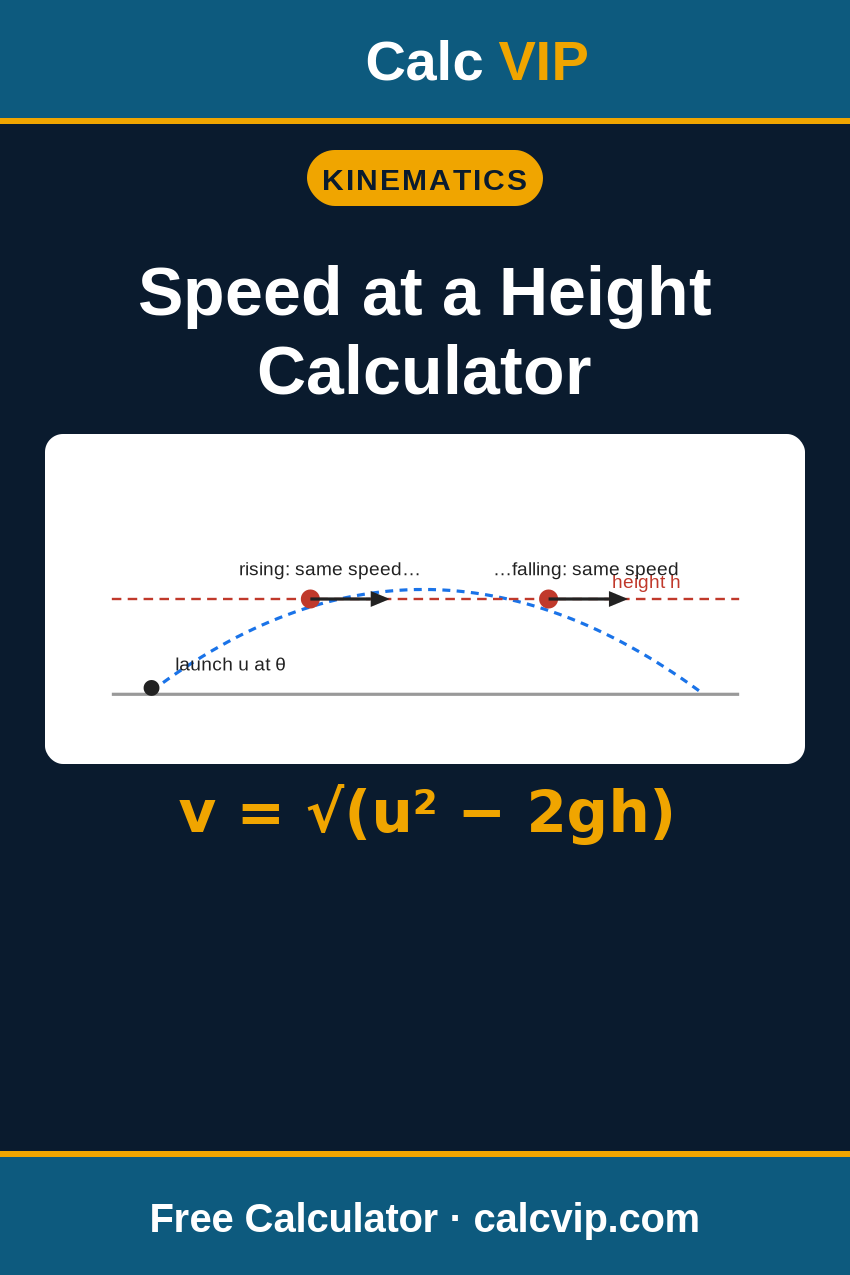
The calculator also guards the boundary of the possible: ask for a height above the projectile's maximum and it declines, reporting the maximum instead. That maximum, u² sin²θ ÷ (2g), is the one place the angle does rule — it sets the ceiling, even though it cannot influence the speed at any height below it.
Formula
Speed at height h: v = √(u² − 2gh) • vx = u cos θ (constant) • vy = √(v² − vx²) • Maximum height: hmax = u² sin²θ ÷ (2g)
The headline formula is energy conservation per unit mass: ½v² = ½u² − gh, the kinetic energy at height h equals the launch kinetic energy minus the potential energy bought. The angle never appears — that absence is the physics. The components then split the answer: the horizontal component is frozen at its launch value because no horizontal force acts (ignoring air resistance), and the vertical component is whatever Pythagoras leaves over, vy = √(v² − vx²). The direction of motion at the height follows as tan φ = vy ÷ vx. The same energy line rearranged gives the launch speed needed to reach a height with a chosen remaining speed, u = √(v² + 2gh) — the form used to size everything from fountain pumps to rocket stages.
| Symbol | Meaning | Units |
|---|---|---|
| u | launch speed | m/s |
| θ | launch angle above the horizontal | degrees |
| h | height above the launch point | m |
| v | speed at height h (direction not included) | m/s |
| vx, vy | horizontal and vertical components at height h | m/s |
| g | gravitational acceleration (9.81 on Earth) | m/s² |
Energy: the bookkeeping gravity cannot cheat
Gravity is a conservative force, which is bookkeeping language for an honest cashier: the work it charges for a height gain depends only on the height, never on the route. A projectile that climbs 20 m in a tall thin arc pays exactly the same kinetic energy as one that climbs 20 m in a flat fast skim — 2 × 9.81 × 20 = 392.4 (m/s)² worth of v², in the squared units this formula trades in. That is why the angle vanishes from the answer, and why the up-leg and down-leg speeds at the same height match: the cashier refunds on descent exactly what was charged on ascent, to the last joule, as long as no air resistance skims a commission.
The components tell the complementary story. Horizontally, nothing pushes, so vx is a constant of the motion — the projectile's shadow on the ground moves like a free particle. Vertically, gravity taxes the motion at g per second, so vy is the spendthrift part, falling to zero at the ceiling and growing again on the way down. Speed at a height is the Pythagorean marriage of one component that never changes and one that does nothing else — and this calculator exists because the marriage, not either partner, is what questions usually ask about.
There is a practical moral for problem-solving here. Whenever a question asks only "how fast at this height?" and offers you angles, times and ranges as distractions, it is advertising for the energy method: one subtraction and one square root, with every distractor politely ignored. Questions asking "when?" or "in which direction?" cannot be answered this way — energy has no clock and no compass — and those belong to the component equations. Choosing the method by the question, rather than by habit, is most of what expertise in mechanics actually is.
How to use
- Enter the launch speed u in m/s.
- Enter the launch angle θ in degrees — 90 for a straight-up throw. The angle is needed for the components and the maximum height, not for the speed itself.
- Enter the height h in metres, measured from the launch point, and adjust g if you are not on Earth (Moon 1.62, Mars 3.71).
- Click "Find Speed at Height" to see the speed at that height, the horizontal and vertical components, and the launch's maximum height.
- If the calculator reports that the projectile never reaches your height, compare your h with the reported maximum — the ceiling set by u and θ.
Worked examples
Example 1 — the reference launch. A ball is launched at u = 30 m/s at θ = 60°. At a height of h = 20 m: v = √(30² − 2 × 9.81 × 20) = √(900 − 392.4) = √507.6 = 22.53 m/s. The horizontal part stays vx = 30 × cos 60° = 15 m/s, so the vertical part is vy = √(507.6 − 225) = 16.81 m/s. (Its maximum height is 34.4 m, so 20 m is reachable.) The direction at that height is arctan(16.81 ÷ 15) ≈ 48.26° above the horizontal.
Example 2 — straight up. A ball thrown vertically at u = 20 m/s: at h = 15 m, v = √(400 − 2 × 9.81 × 15) = √105.7 = 10.28 m/s, all of it vertical (vx = 0). Its ceiling is 20² ÷ (2 × 9.81) = 20.39 m — at 15 m it has spent most of its speed, because the last metres of a climb are bought at the steepest exchange rate.
Example 3 — at the ceiling. A projectile launched at 40 m/s at 30° tops out at hmax = 40² × sin²30° ÷ (2 × 9.81) = 20.39 m. There the vertical component is zero and the speed is purely the horizontal part: v = 40 × cos 30° = 34.64 m/s. Check by the headline formula: √(1600 − 2 × 9.81 × 20.39) = √1200 = 34.64 m/s. Two routes, one answer — the signature of a conservation law.
Example 4 — a shallow launch. At u = 25 m/s and θ = 45°, the speed at h = 10 m is √(625 − 196.2) = √428.8 = 20.71 m/s, with vx = 25 × cos 45° = 17.68 m/s and vy = √(428.8 − 312.5) = 10.78 m/s. Same height, different launch from Example 1, and the speed differs only because u differs — the angle's only fingerprints are in the split.
Example 5 — on the Moon. Repeat Example 1 with lunar gravity, g = 1.62: at h = 20 m, v = √(900 − 2 × 1.62 × 20) = √835.2 = 28.9 m/s, with vy = 24.7 m/s, and the ceiling soars to 208.33 m. Weak gravity taxes height cheaply — the reason lunar landers and astronauts' hops look so leisurely and go so far.
Example 6 — the halfway rule. A vertical throw at u = 20 m/s reaches half its maximum height — h = 10.19 m — with speed √(400 − 2 × 9.81 × 10.19) = √200 = 14.14 m/s, which is exactly u ÷ √2. Halfway up in height is not halfway in speed: the projectile keeps 71% of its speed at the midpoint of the climb, because speed is bought with the square root of the remaining energy.
Speed at a height in real life
Roller-coaster design. A coaster's speed at every point of the track is this formula with the launch replaced by the lift hill: v = √(u² − 2gh) run from the first drop. Designers lay out hills knowing each metre of height costs exactly 2g of v² — the track is an energy budget drawn in steel.
Fountains and water jets. A jet leaving a nozzle at speed u rises until v falls to the value the designer wants at the arc's top; the height of a fountain is u² ÷ (2g) in the ideal case. Pump sizing is the rearranged formula u = √(v² + 2gh) with plumbing losses added.
Ballistics and safety. How much speed a projectile retains at a given height decides everything from the danger space of a falling round to the placement of protective screens. The angle-independence simplifies the safety case: only the launch speed and the height matter, never the direction it was fired.
Ski jumping and skateboarding. A ski jumper's speed at the knoll and a skater's speed at the top of a ramp are energy questions: both athletes are projectiles with better outfits, and the speed they carry into the air is set by the height they have surrendered, not by the shape of the ramp.
Volcanology. Volcanic bombs are timed and tracked to their apex; the ejection speed follows from u = √(2g × hmax) for the vertical part. Hazard maps are drawn from exactly such launch-speed estimates — this page run backwards, with mountains.
Spaceflight. A rocket's speed at altitude is governed by the same ledger, extended: kinetic energy traded against potential energy is why orbital mechanics speaks of "energy" where school physics speaks of speed at a height. The vis-viva equation governing orbits is this formula's grown-up form.
The square-root shape of slowing down
Plot the speed of a vertical throw against height and the curve is a quarter-ellipse's poorer cousin: v = √(u² − 2gh), steep near the top, shallow near the ground. The numbers for u = 30 m/s make the shape concrete — at 5 m the speed is still 28.32 m/s; at 15 m, 24.61; at 25 m, 20.24; at 35 m, 14.6; at 45 m, just 4.14, with the ceiling at 45.87 m. Equal steps of height cost ever more speed as the store runs dry, because each metre charges the same energy while the remaining speed represents ever less energy per (m/s). It is the mathematics of a draining battery or a spending spree: the last portion of any squared quantity is the most expensive, and projectiles pay it at the top of the arc.
Quick reference: vertical throw at u = 30 m/s
| Height h | Speed v | Share of launch speed |
|---|---|---|
| 0 m | 30 m/s | 100% |
| 5 m | 28.32 m/s | 94% |
| 10 m | 26.53 m/s | 88% |
| 15 m | 24.61 m/s | 82% |
| 20 m | 22.53 m/s | 75% |
| 25 m | 20.24 m/s | 67% |
| 30 m | 17.65 m/s | 59% |
| 35 m | 14.6 m/s | 49% |
| 40 m | 10.73 m/s | 36% |
| 45 m | 4.14 m/s | 14% |
The ceiling is 45.87 m. Notice the rhythm: the first 15 m cost barely 18% of the speed, the last 10 m cost more than half of what remained — the square-root curve in tabular form.
Common mistakes
- Putting the angle inside the speed formula. v = √(u² − 2gh) has no angle in it. Students who write √(u²sin²θ − 2gh) have computed something else (a component-related quantity) and will disagree with this calculator — which is right.
- Measuring h from the ground when the launch was elevated. The formula's h is height above the launch point. Launched from a 10 m cliff, a projectile at 25 m above the sea is at h = 15 m for this page.
- Reporting vy as the speed. The speed is the full magnitude √(vx² + vy²). At the ceiling of an angled launch the speed is vx, not zero — only a vertical throw truly stops.
- Asking for heights above the ceiling. If h exceeds u² sin²θ ÷ (2g) the projectile never gets there and no speed exists. The calculator says so; on paper, the giveaway is a negative number inside the square root — for the components. (The total-speed formula would still return a value up to the vertical ceiling u²/2g, but the projectile at that angle never visits those heights.)
- Forgetting air resistance in real cases. Drag taxes both components and breaks the up/down symmetry: real projectiles return through a height slightly slower than they rose through it. The formula is the ideal, vacuum benchmark.
FAQ
Why doesn't the launch angle change the speed at a height?
Energy conservation: the kinetic energy lost depends only on the height gained (mgh), whatever path the projectile took. The angle only decides how the remaining speed splits between horizontal and vertical parts.
Is the speed the same going up and coming down through the same height?
Yes — at the same height the speed is identical both ways; only the vertical component points the opposite way (ignoring air resistance).
What happens at the maximum height?
For an angled launch the vertical component becomes zero and the speed equals the horizontal component, u cos θ. For a vertical throw the speed there is zero.
Does the mass of the projectile matter?
No. The energy equation divides by mass at the first step — kinetic and potential energy both scale with m — so a cricket ball and a cannonball launched at the same speed share the same speed at every height (in vacuum). Galileo's insight, again.
How do I find the direction of motion at a height?
From the components: the angle below or above the horizontal is arctan(vy ÷ vx). In Example 1 that is arctan(16.81 ÷ 15) ≈ 48.26° — flatter than the 60° launch, because the vertical part has been taxed while the horizontal part has not.
What is the speed at a height below the launch point?
The formula still works with h negative: v = √(u² + 2g|h|) — the projectile is faster than at launch, having been refunded with interest. A ball launched off a cliff at 30 m/s is moving at √(900 + 2 × 9.81 × 10) = 33.11 m/s after falling 10 m below the launch level.
Why does the calculator ask for the angle at all?
Because the components and the ceiling need it. The speed does not — but "how fast, and in which direction, and could it even get there?" is the complete question, and the angle answers the second and third parts.
How does this connect to escape velocity?
Escape velocity is this formula with the ceiling at infinity: the launch speed whose remaining speed reaches zero only at infinite height. With Earth's varying gravity the integral gives 11.2 km/s — the same energy ledger, kept over a planetary scale.
Is the speed at a height the same on Mars?
The formula is, with g = 3.71 m/s²: a 30 m/s launch at 60° still has √(900 − 2 × 3.71 × 20) = √751.6 ≈ 27.42 m/s at 20 m — between Earth's 22.53 and the Moon's 28.9, exactly as the three gravities order themselves.
Can I use this for a pendulum or a swing?
Yes — a pendulum bob is a projectile constrained to an arc, and its speed at a height above its lowest point is √(u² − 2gh) with u the speed at the bottom. The constraint changes the direction continuously but the energy bookkeeping is identical.