 Calc
Spring Launch Calculator – Launch Speed from Spring Energy
 Created by Priya Sharma · Physics Editor · Energy & Gravity · Last updated: November 2026
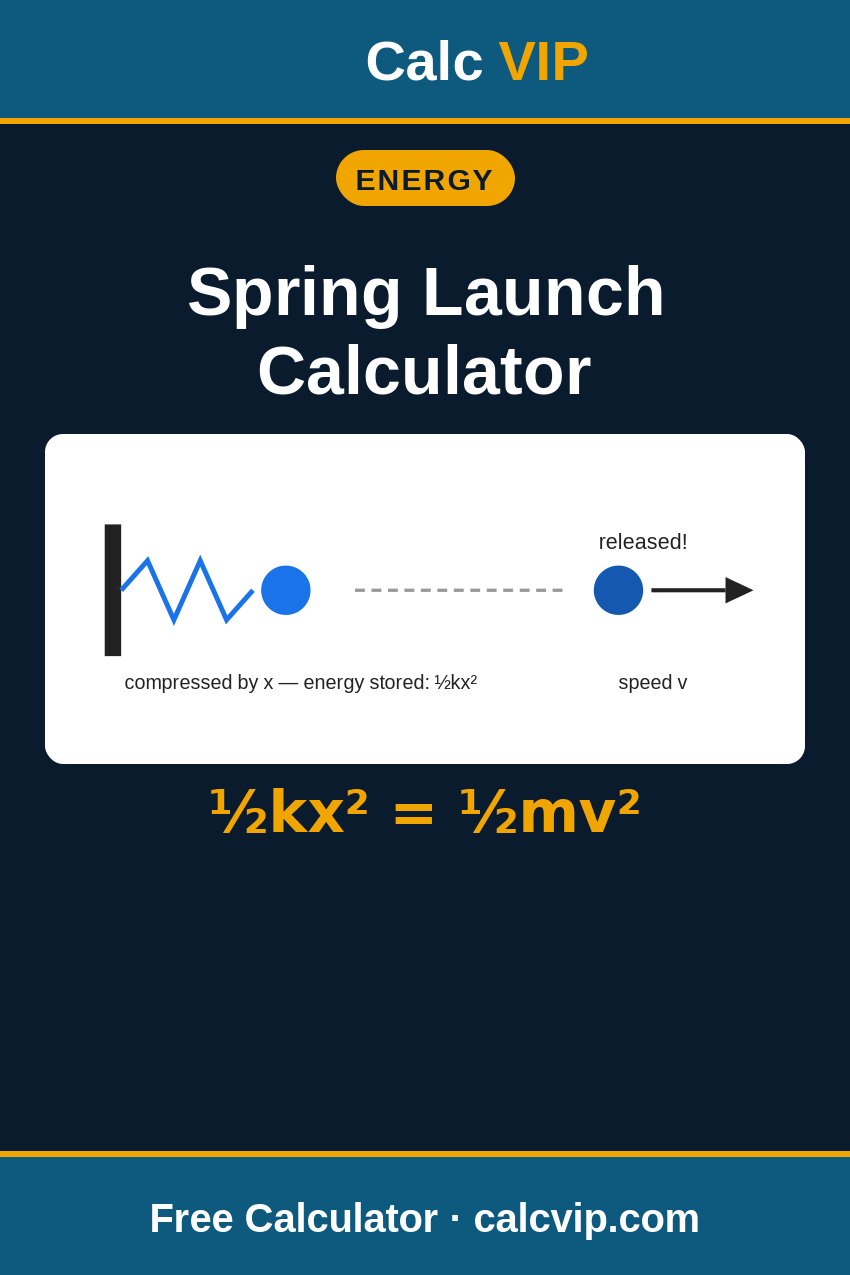
Use this free Spring Launch Calculator to find how fast a spring can launch an object. The spring's stored elastic potential energy (½kx²) turns into kinetic energy (½mv²) — enter the spring constant, compression and mass to get the launch speed.
A compressed spring is a battery you can see. Push it down and you do work on it, coil by coil; that work does not disappear but waits, stored as elastic potential energy, for as long as you hold the spring in check. Release it and the stored energy pours back out in a fraction of a second, converted almost entirely into the kinetic energy of whatever the spring was holding. This calculator performs that one conversion: give it the spring's stiffness, how far it is compressed, and the mass being launched, and it returns the launch speed.
The governing equation, ½kx² = ½mv², has a shape worth noticing. The energy stored grows with the square of the compression — squeeze a spring twice as far and it holds four times the energy, because you are pushing against a force that itself doubles as you go. But the launch speed grows only in direct proportion to the compression, since the speed comes from the square root of the energy. Double the squeeze, double the speed, quadruple the energy: that pair of facts designs everything from pinball plungers to the draw weight of bows.
The other two players matter just as predictably. A stiffer spring (larger k) stores more energy at the same compression and launches faster; a heavier mass launches slower, but only with the square root — quadruple the mass and the speed merely halves. Real launchers fall a little short of the ideal because friction, sound and the spring's own mass all take a small cut, so read the calculator's answer as the honest ceiling: the speed a perfect spring would deliver, and the number every real design is chasing.
Formula
Spring Energy = Kinetic Energy → ½kx² = ½mv²
So the launch speed is v = x × √(k / m), and the stored energy on its own is E = ½kx². The formula rearranges for design work: the spring constant needed for a target speed is k = mv² ÷ x², and the compression needed is x = v ÷ √(k/m). Underneath sits Hooke's law, F = kx: the spring's push grows in proportion to the compression, starting gently and ending at full force — which is exactly why the stored energy carries the ½ and the square, as the depth section below shows. Units decide most errors here: k in newtons per metre, x in metres (a 10 cm compression is 0.1 m, and entering "10" inflates the energy a hundredfold), and mass in kilograms.
| Symbol | Meaning | Units |
|---|---|---|
| k | spring constant — stiffness of the spring | newtons per metre (N/m) |
| x | compression or stretch from the natural length | metres (m) |
| m | mass of the object launched | kilograms (kg) |
| E or PE | elastic potential energy stored, ½kx² | joules (J) |
| v | launch speed, x√(k/m) | m/s |
The spring as a battery: why the energy is ½kx²
Charging a battery is steady work against a steady opposition; charging a spring is work against an opposition that grows. At the first millimetre of compression the spring pushes back with almost nothing; at full compression it pushes with its maximum, F = kx. The work you do — the energy stored — is the average force multiplied by the distance, and since the force grows evenly from 0 to kx, the average is ½kx. Multiply by the distance x and the stored energy is ½kx². Physicists draw this as a graph of force against compression: a straight rising line, with the stored energy as the triangle beneath it. The ½ is the triangle's ½, and the square is the triangle growing in both directions at once.
That geometry explains the spring's split personality. Energy responds to compression quadratically — the last centimetre of a squeeze stores far more than the first — which is why the final click of a mousetrap or the last inch of a bow's draw feels disproportionately powerful. Speed, being the square root of energy per unit mass, responds only linearly: v = x√(k/m). Designers live inside these two scalings. Want twice the launch speed? Either double the compression (and accept four times the stored energy and force), or quadruple the stiffness, or quarter the mass — the formula prices every option before a single spring is wound.
It is worth seeing the launch as the reverse of a catch. The same spring, used as a cushion, would absorb an incoming object's kinetic energy by compressing — car suspension and packaging foam do exactly this. Storage devices are judged by how much of the energy survives the round trip: a good steel spring returns well over 90% of what it stores, which is why springs, not explosives or motors, power the world's toys, triggers, valves and vaulting poles at small scales.
How to use
- Enter the spring constant k in newtons per metre (N/m) — bigger means a stiffer spring. If you do not know it, the FAQ below shows how to measure it with a known mass.
- Enter how far the spring is compressed or stretched, in metres (m) — convert centimetres by dividing by 100.
- Enter the mass of the object in kilograms (kg).
- Click "Calculate Launch Speed" to see the speed and the stored spring energy.
- Expect a real launcher to fall a little short of the figure — friction and the spring's own mass take their cut — so treat it as the design ceiling.
Worked examples
Example 1 — the headline case. A spring with k = 200 N/m is compressed by 0.1 m and launches a 0.05 kg ball. Stored energy = ½ × 200 × 0.1² = 1 J. Launch speed = 0.1 × √(200 ÷ 0.05) = 0.1 × √4,000 = 6.32 m/s — about 23 km/h from a spring you could squeeze with one hand.
Example 2 — a toy launcher. A gentler spring, k = 150 N/m, compressed 0.05 m, fires a 0.02 kg foam dart. Stored energy = ½ × 150 × 0.05² = 0.19 J. Speed = 0.05 × √(150 ÷ 0.02) = 0.05 × √7,500 = 4.33 m/s. Small energy, modest speed — the design brief of every safe toy ever made, written in arithmetic.
Example 3 — double the squeeze. Take Example 1's spring and ball but compress 0.2 m instead. Stored energy = ½ × 200 × 0.2² = 4 J — four times the energy, as the square demands. Speed = 0.2 × √4,000 = 12.65 m/s — exactly double. This pair of numbers is the spring designer's mantra: compression buys speed linearly and energy quadratically.
Example 4 — pointing it at the sky. Fire Example 1's ball straight up. Its 1 J of kinetic energy converts to height: h = E ÷ (mg) = 1 ÷ (0.05 × 9.81) = 2.04 m. (Equivalently, h = v² ÷ 2g = 6.32² ÷ 19.62.) A spring that fits in a fist throws a ball above head height — and the ceiling fan is officially in range.
Example 5 — a stiff spring, a heavier load. A suspension-grade spring with k = 800 N/m, compressed 0.08 m, launches 0.1 kg. Stored energy = ½ × 800 × 0.08² = 2.56 J; speed = 0.08 × √(800 ÷ 0.1) = 0.08 × √8,000 = 7.16 m/s. Four times Example 1's stiffness did not give four times the speed — the doubled mass and shorter compression clawed much of it back, exactly as the square roots predict.
Example 6 — designing backwards. You want a launcher to fire a 0.25 kg ball at 10 m/s, with room to compress the spring 0.15 m. Rearranged: k = mv² ÷ x² = 0.25 × 100 ÷ 0.0225 = 1,111 N/m. That is a seriously stiff spring — car-suspension territory — and the calculation has just saved you from buying a box of springs that could never have done the job.
Spring launches in real life
Pinball and plunger toys. The pinball plunger is this calculator with a knob: pull it back further and x grows, and the ball leaves proportionally faster. Skilled players are, without knowing the formula, metering compression to place the ball — speed control through x alone.
The mousetrap. A mousetrap is a torsion spring — the same physics wound in a circle. Setting the trap stores elastic energy slowly and safely; the trigger releases it in milliseconds. The trap's fearsome reputation is the energy-time trade: energy stored over seconds, spent in a blink.
Archery bows. A bow's limbs are springs, and its "draw weight" is the force at full draw. The energy stored is the area under the draw curve — the triangle of this page's second diagram, measured on every serious bow. Arrow speed then follows v = √(2E/m), which is why lighter arrows leave faster from the same bow.
Pole vault. The modern fibreglass pole is a giant spring the vaulter charges by sprinting: kinetic energy bends the pole, the pole stores it elastically, then returns it as height. Vaulters choose pole stiffness the way Example 6 chooses k — matched to their mass and speed, too stiff and it will not bend, too soft and it will not give the energy back in time.
Catapults and ballistae. Ancient artillery stored energy in twisted rope skeins and bent arms — springs by another name. Their range calculations were this page's formula learned by experience: more twist (x) and stiffer skeins (k) threw heavier stones (m) at speeds their crews could pace out on the range.
Clockwork and wind-up toys. A mainspring stores energy in the tightest package of all — a coiled strip — and meters it out over hours instead of milliseconds. Same ½kx² bookkeeping, opposite philosophy: the launch calculator spends the energy at once, the clock spends it a tick at a time.
Hooke's law has limits — and the spring has mass
Everything on this page assumes the spring obeys Hooke's law, F = kx, with one constant k. Real springs do — up to a point. Stretch or compress too far and the coils begin to deform permanently: the spring takes a "set", its natural length changes, and k drifts. Designers keep working compressions well inside the elastic limit for exactly this reason. The second correction is subtler: the spring itself has mass, and its coils near the moving end must accelerate too. A standard refinement adds about a third of the spring's mass to the load — replace m by m + (spring mass ÷ 3) — which is one reason measured launch speeds land a few percent below this calculator's ideal. For light springs and heavy loads the correction vanishes; for a heavy spring launching a foam dart, it is the whole story.
Quick reference: one spring, four compressions (k = 200 N/m, m = 0.05 kg)
| Compression x | Stored energy ½kx² | Launch speed |
|---|---|---|
| 0.05 m | 0.25 J | 3.16 m/s |
| 0.10 m | 1.00 J | 6.32 m/s |
| 0.15 m | 2.25 J | 9.49 m/s |
| 0.20 m | 4.00 J | 12.65 m/s |
Read the two right-hand columns against each other: every doubling of compression doubles the speed but quadruples the energy. If a design needs more speed, compression is the cheap dial; if it needs more energy delivered — a heavier load at the same speed — the bill grows with the square.
Common mistakes
- Entering the compression in centimetres. The formula wants metres. A 10 cm squeeze entered as "10" instead of 0.1 inflates the stored energy by a factor of 10,000 (the square of 100) and the speed a hundredfold — the most destructive slip available on this page.
- Expecting double compression to double the energy. It quadruples it. Energy follows x²; only the speed follows x. Confusing the two leads to springs specified four times too weak — or structures four times too lightly built for the forces involved.
- Measuring x from the wrong place. x is the displacement from the spring's natural, unloaded length — not the spring's current length, and not the travel of the launcher. A spring pre-compressed in its housing already stores energy before your measured squeeze begins.
- Ignoring the spring's own mass. With a heavy spring and a light projectile, a noticeable share of the energy accelerates the coils themselves. If measured speeds fall well short of the calculator, add a third of the spring's mass to the load and calculate again.
- Assuming a heavier load launches at the same speed. Speed falls with 1/√m: quadruple the mass and the speed halves. There is no spring setting that escapes this — only more k or more x can win the speed back, at the prices the formula quotes.
FAQ
Does it matter whether the spring is compressed or stretched?
No. The energy depends on x², so compressing and stretching by the same amount store the same energy and give the same launch speed.
What if the launch is vertical?
This calculator gives the starting speed. Going up, the object trades that kinetic energy for height — it can rise about v²/(2g) metres before stopping.
Why is the real speed slightly lower?
Some energy is lost to friction, sound and moving the spring's own mass, so a real launcher reaches a little less than this ideal value.
What exactly is the spring constant k?
It is the spring's stiffness: the force needed to stretch or compress it by one metre. A spring with k = 200 N/m pushes back with 200 N when compressed a full metre, or 20 N at a 0.1 m compression. Bigger k means a stiffer spring. It is a property of the spring's material, wire thickness and coil geometry — not of how you use it.
How can I measure k for a spring I own?
Hang a known mass on it and measure the stretch. The weight mg stretches the spring until kx = mg, so k = mg ÷ x. Example: a 0.5 kg mass (weight 4.905 N) stretching a spring by 0.05 m gives k = 4.905 ÷ 0.05 = 98.1 N/m. Use a stretch in the spring's comfortable middle range for the cleanest figure.
Why does doubling the compression double the speed but quadruple the energy?
Because the two quantities scale differently. Stored energy is ½kx² — the square makes it quadruple. Speed is the square root of energy per unit mass, v = x√(k/m), and the square root of a quadrupling is a doubling. The two facts are the same fact read at different depths of the formula.
What if I launch the object at an angle?
The spring sets the speed; the angle decides how it is shared between horizontal and vertical motion. Launched at 30° with Example 1's 6.32 m/s, the vertical component is 6.32 × sin 30° = 3.16 m/s, giving a peak height of 3.16² ÷ (2 × 9.81) = 0.51 m. The launch speed from this calculator is the starting point for all projectile questions.
Does a rubber band follow the same formula?
In spirit, yes — a stretched band stores elastic energy that becomes kinetic energy on release. In detail, rubber is not Hookean: its stiffness changes as it stretches, so there is no single k and the ½kx² figure is an estimate. The energy method still works if you measure the stored energy directly, but expect the simple formula to be approximate.
Can a spring launch an object heavier than the spring itself?
Certainly — mass ratio is no obstacle; only speed suffers, by the 1/√m rule. A 0.1 kg spring assembly launching a 1 kg mass simply delivers its stored energy into a heavier load: with 4 J stored, the speed is √(2 × 4 ÷ 1) = 2.83 m/s. Catapults threw boulders with rope springs far lighter than their stones.
Why do real launchers never quite reach the calculated speed?
Three small taxes: friction in the guide or barrel, the spring's own mass (about a third of it rides along with the load), and sound and vibration at release. Together they typically cost 5–15%. The calculator's figure is the frictionless ideal — the right target for design, and the reason a measured speed close to it means a well-built launcher.