 Calc
Radioactive Decay Calculator – Amount Remaining & Activity Over Time
 Created by Yuki Tanaka · Physics Editor · Modern Physics · Last updated: November 2026
Use this free Radioactive Decay Calculator to find how many undecayed nuclei remain after a given time, using N(t) = N0 e(−λt). Enter the starting number of nuclei, the half-life and the elapsed time — the tool also works out the sample's activity at that moment.
Radioactive decay is the most dependable clock in nature, and it runs on a beautifully simple rule: every unstable nucleus has a fixed probability of decaying in the next second, the next minute or the next year, and that probability never changes. One nucleus on its own is pure chance — it might decay in a microsecond or outlive the Sun — but a real sample contains so many nuclei that the randomness averages out into an exact, predictable curve. That curve is the exponential N(t) = N0 e(−λt), and this calculator traces it for any starting amount, any half-life and any elapsed time, reporting the survivors, the percentage remaining and the activity the sample has reached at that moment.
The shape of the curve is worth picturing. It falls steeply at first, when undecayed nuclei are plentiful and decays come thick and fast, then flattens as the supply dwindles. In each half-life, exactly half of whatever is present disappears: 100% becomes 50%, then 25%, then 12.5%, and after ten half-lives only about a thousandth of the original is left (1/1024 ≈ 0.098%). Crucially, the curve never quite touches zero — there is always a smaller half still to halve — which is why "how long until it is all gone?" has no exact answer, only practical ones.
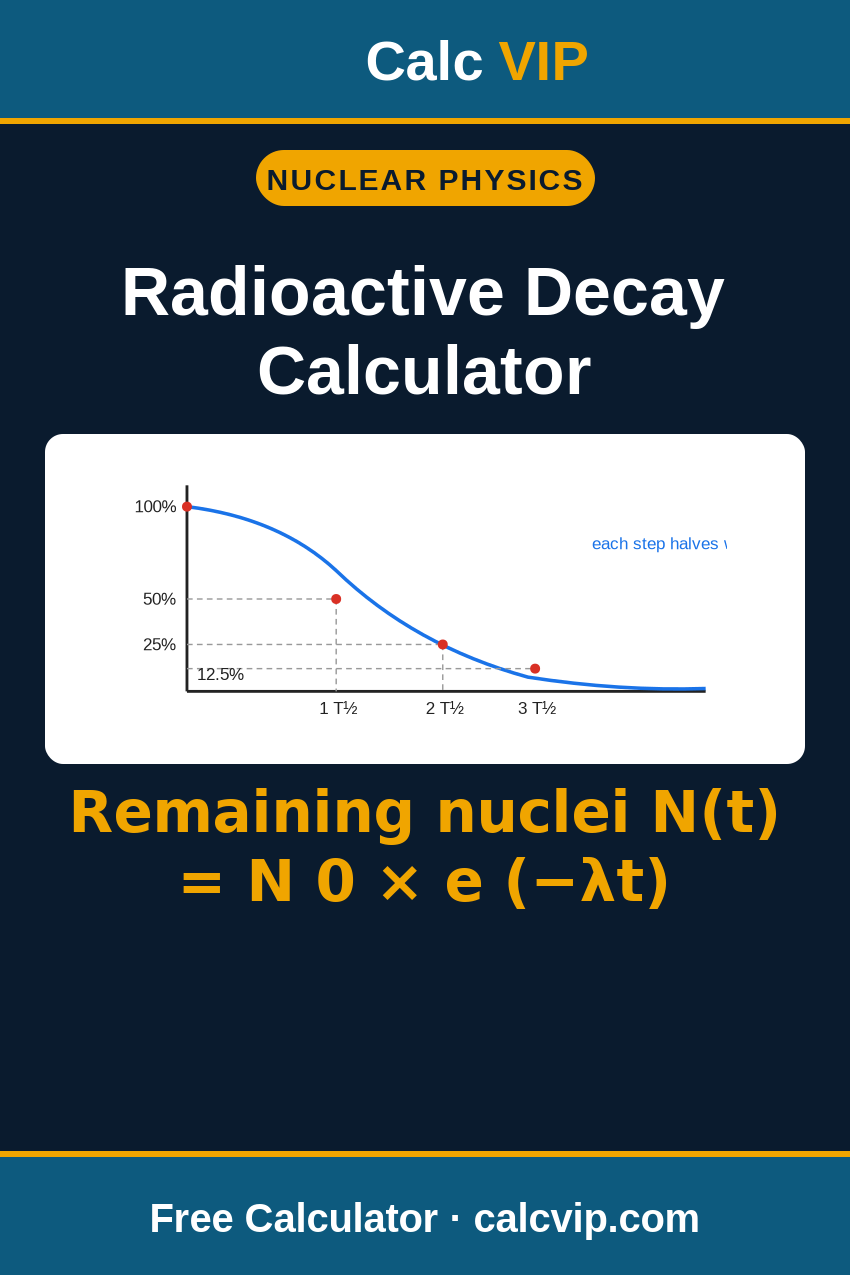
Two constants describe the whole process. The half-life T½ is the headline figure quoted for every isotope, from the 110 minutes of fluorine-18 to the 4.47 billion years of uranium-238. Hidden inside the exponent is the decay constant λ = ln 2 / T½, the per-unit-time decay probability that actually drives the mathematics. Give this calculator the half-life in any unit from seconds to years and it handles both constants for you, converting λ to per-second so the activity comes out in true becquerels — decays per second — whatever unit you started in.
Formula
Remaining nuclei N(t) = N0 × e(−λt), where the decay constant λ = ln 2 / T½. The activity at time t is A = λ × N(t) — with λ in per-second, A comes out in becquerel (decays per second).
The same law wears a second, often handier disguise: N(t) = N0 × (½)(t/T½) — start with the original amount and halve it once for every half-life elapsed, fractional half-lives included. The two forms are identical, since e(−λt) with λ = ln 2 / T½ is exactly (½) raised to the power t/T½. Rearranged, the law also answers the backwards questions: the time to reach a given amount is t = ln(N0/N) / λ, and the half-life hidden in two measurements is T½ = t × ln 2 / ln(N0/N). One discipline governs all of it: t and T½ must be in the same unit before they meet, because only their ratio — the number of half-lives — is dimensionless and meaningful. This calculator enforces that by asking for one shared time unit, then converts λ to per-second behind the scenes for the activity.
| Symbol | Meaning | Units |
|---|---|---|
| N(t) | undecayed nuclei remaining at time t | atoms (count) |
| N0 | nuclei present at t = 0 | atoms (count) |
| λ | decay constant — decay probability per unit time | per second (s−1), or per chosen unit |
| T½ | half-life — time for half the nuclei to decay | s, min, h, days or years |
| A | activity — decays per second at time t | becquerel (Bq) |
Why the curve is an exponential — and why nuclei never age
Nothing inside a nucleus counts the days. A carbon-14 nucleus that has sat in a tomb for 5,000 years is exactly as likely to decay in the next hour as one created in the atmosphere this morning: decay is memoryless, governed by a constant probability per unit time set by quantum mechanics, not by history. That single fact forces the exponential. If every nucleus, old or young, carries the same chance λ of decaying per second, then the number decaying per second is simply λ × (number present) — so the sample shrinks at a rate proportional to its own size. Quantities that shrink in proportion to themselves always trace e(−λt): the same curve describes a capacitor discharging, a hot drink cooling and a drug clearing from the bloodstream.
The smoothness is a gift of large numbers. A gram of material holds around 1022 nuclei; even if each is a coin toss, the law of large numbers irons billions of tosses per second into a curve you can set your watch by — which is precisely what radiometric dating does. Shrink the sample to a handful of nuclei, though, and the smoothness dissolves: ten nuclei with a one-day half-life will not politely leave five tomorrow, only about five on average, with luck playing a visible part. The exponential law is a statement about crowds, and nature almost always deals in crowds.
How to use
- Enter the initial number of nuclei N₀ — scientific notation like 1e20 is fine.
- Enter the half-life and the elapsed time, and pick the time unit they are both measured in.
- Click the button to see the nuclei remaining, the percentage left, and the activity at that time.
- Read the activity with care: it is a true becquerel figure because the tool converts λ to per-second for that line, whatever unit you chose for the half-life.
- To find when a sample will fall to a target amount, try a time, check the percentage, and adjust — or use t = ln(N₀/N) / λ from the Formula section.
Worked examples
Example 1 — iodine-131 in a thyroid clinic. A sample starts with 1 × 10²⁰ iodine-131 nuclei (half-life 8 days). How many remain after 24 days?
24 / 8 = 3 half-lives → N = 1e20 × (½)³ = 1.25 × 10¹⁹ nuclei (12.5% left).
Activity then: λ = ln2 / (8 × 86,400 s) ≈ 1.003 × 10⁻⁶ /s, so A = λN ≈ 1.25 × 10¹³ Bq.
Example 2 — a technetium-99m scan dose. A hospital generator elutes 2.4 × 10¹⁵ nuclei of technetium-99m (half-life 6 hours). After 18 hours — three half-lives — N = 2.4e15 × (½)³ = 3.0 × 10¹⁴ nuclei. With λ = ln2 / 21,600 s ≈ 3.21 × 10⁻⁵ /s, the activity has fallen to A ≈ 9.6 × 10⁹ Bq (9.6 GBq). This is why nuclear-medicine doses are prepared fresh each morning and why a scan booked for the afternoon needs a bigger starting dose than one booked for 9 a.m.
Example 3 — a cobalt-60 therapy source growing old. A teletherapy unit starts with 8 × 10¹⁸ cobalt-60 nuclei (half-life 5.27 years) and a fresh activity of about 33 GBq. After exactly one half-life, 4 × 10¹⁸ nuclei remain and, with λ ≈ 4.17 × 10⁻⁹ /s, the activity is A ≈ 1.67 × 10¹⁰ Bq — half the original. Treatment times must double to deliver the same dose, which is why such sources are replaced every five to seven years.
Example 4 — radon-222 in a sealed sample jar. A jar traps 1 × 10¹² radon-222 nuclei (half-life 3.82 days). After 7.64 days, two half-lives, 2.5 × 10¹¹ nuclei remain (25%), and with λ = ln2 / (3.82 × 86,400 s) ≈ 2.10 × 10⁻⁶ /s the activity is about 5.25 × 10⁵ Bq (525 kBq). Radon's short half-life is a mercy in homes: ventilate a room and the trapped radon decays away within weeks even if no fresh gas seeps in.
Example 5 — uranium-238 and geological patience. Start with 1 × 1024 uranium-238 nuclei (half-life 4.47 billion years). After 1 billion years the surviving fraction is (½)(1/4.47) = 0.856, so 8.56 × 10²³ nuclei — 85.6% — are still there, with an activity of only about 4.2 × 10⁶ Bq despite the colossal number of atoms. Long half-life means slow decay: the Earth still holds roughly half the uranium it was born with.
Example 6 — a fluorine-18 PET tracer racing the clock. A PET dose leaves the cyclotron with an activity of 800 MBq (half-life 110 minutes). Activity follows the same halving law as the nuclei themselves, so after 330 minutes — three half-lives — it is down to 800 × (½)³ = 100 MBq. Production, transport and injection are choreographed to the minute because the clock in this calculator never stops.
Radioactive decay in real life
Medical imaging windows. A tracer is useful only while it is active enough to image but not so long-lived that it irradiates the patient for weeks. Technetium-99m's 6-hour half-life threads that needle: bright in the morning, essentially gone (under 1%) within two days — exactly the arithmetic of Example 2.
Radiotherapy source management. Hospitals track their cobalt-60 and iridium-192 sources with this calculator. Iridium-192 (half-life 74 days) loses about 1% of its activity per day, so brachytherapy planning software re-derives treatment times daily from the decay curve.
Smoke detectors that never need recharging. The americium-241 in a household smoke detector has a half-life of 432 years, so over a ten-year detector life its activity falls by less than 2% — for practical purposes it never decays, and the battery, not the source, sets the replacement date.
Nuclear waste planning. Caesium-137 and strontium-90 (half-lives near 30 years) dominate the heat and activity of spent fuel for the first few centuries: ten half-lives, about 300 years, reduce them a thousandfold. Plutonium-239, at 24,100 years, is the reason repositories are designed on geological timescales — this calculator shows why no human institution can simply "wait it out" on shorter-lived assumptions.
Dating the Earth itself. Run the law backwards on uranium-238 and lead-206 in meteorites and the surviving fraction gives the age of the solar system: about 4.57 billion years, close to one uranium half-life — a pleasing check against Example 5.
Food irradiation and sterilisation. Cobalt-60 irradiators dose food and medical supplies by exposure time; as the source decays through its 5.27-year half-life, conveyor dwell times are lengthened on a schedule computed from the same exponential, keeping the delivered dose constant year after year.
The ten-half-life rule
Because the halving never ends, professionals replace "gone" with a practical threshold: after ten half-lives, (½)10 = 1/1024 ≈ 0.098% of the original remains — a thousandfold reduction that usually puts a source below regulatory concern or a drug below detection. Medical waste stores hold short-lived isotopes for ten half-lives before disposal as ordinary waste; the same rule sizes the shielding period for spent tracer syringes. The table shows the whole staircase — notice how the first half-life does more absolute work than the next nine combined.
| Half-lives elapsed | Fraction remaining | Percent remaining |
|---|---|---|
| 0 | 1 | 100% |
| 1 | 1/2 | 50% |
| 2 | 1/4 | 25% |
| 3 | 1/8 | 12.5% |
| 4 | 1/16 | 6.25% |
| 5 | 1/32 | 3.125% |
| 6 | 1/64 | 1.5625% |
| 7 | 1/128 | 0.78125% |
| 10 | 1/1024 | 0.0977% |
When the daughter is radioactive too: decay chains
This calculator follows a single isotope decaying into something stable, but nature often strings decays into chains: uranium-238 sheds alpha and beta particles through fourteen steps before settling as lead-206, and several links — radium-226, radon-222 — are themselves fiercely radioactive. In a chain, the daughter is continuously replenished by the parent, so its amount can hold steady for centuries (secular equilibrium) even though each individual daughter nucleus decays within days. That is why uranium ore is far more radioactive than purified uranium, and why radon keeps appearing in basements built over radium-bearing rock: the parent in the ground is still manufacturing it. Chain mathematics extends the same exponential with one term per link — but the single-isotope law on this page is the building block every one of those terms uses.
Common mistakes
- Thinking linearly. "Half gone in one half-life, so all gone in two" is the classic error. After two half-lives a quarter remains, not zero — each half-life halves what is left, not what you started with.
- Mixing time units. A half-life of 8 days with a time of 24 hours is a ratio of 1/8 of a half-life, not 3. t and T½ must share a unit before they are compared — the calculator makes you pick one unit for both for exactly this reason.
- Expecting becquerels from grams. The remaining-amount maths works in any unit, but A = λN is only a true activity when N is a count of nuclei. Feed in grams and the "activity" line is meaningless until you convert mass to atoms.
- Believing conditions change the rate. Heating, squeezing, dissolving or chemically reacting a sample does not measurably change its half-life — decay is a nuclear process, sealed off from the electron-level world of chemistry. (Extreme astrophysical environments are the exotic exception, not the laboratory rule.)
- Confusing half-life with mean lifetime. The average nucleus lives τ = 1/λ ≈ 1.44 × T½, longer than the half-life, because the long-lived tail pulls the average up. Using T½ where τ belongs skews any average-based estimate by 44%.
FAQ
What is the decay constant λ?
It is the probability per unit time that any one nucleus decays: λ = ln 2 / T½ ≈ 0.693 / T½. A bigger λ means a faster-decaying substance.
Why does the activity fall over time?
Activity is proportional to how many undecayed nuclei are left. As they decay away, there are fewer nuclei available to decay each second, so the activity halves every half-life too.
Can I enter the amount in grams instead of atoms?
The remaining-amount maths works for any unit, but the activity result (A = λN) is only correct when N is a number of nuclei (atoms).
Can anything speed up or slow down radioactive decay?
For practical purposes, no. Decay constants are fixed by the structure of the nucleus and are immune to temperature, pressure, chemical state and electric or magnetic fields. A few exotic cases (electron-capture isotopes in extreme ionisation states, as found in stars) shift by tiny amounts, but nothing you can do in a lab, kitchen or freezer changes a half-life.
What do the decayed nuclei turn into?
Into daughter nuclei of a different element: alpha decay removes two protons and two neutrons, beta decay converts a neutron into a proton (or the reverse). The daughter may be stable — iodine-131 becomes stable xenon-131 — or radioactive itself, continuing a decay chain until a stable nucleus such as lead-206 ends the line.
Can we predict when one particular atom will decay?
No — and not for lack of cleverness. Quantum mechanics gives only the probability per unit time, λ. A single nucleus might decay in the next microsecond or survive a trillion years; only the statistics of large numbers are predictable, which is why this calculator asks for amounts like 10²⁰ atoms rather than ten.
Why does the sample never completely finish decaying?
Because halving has no last step: there is always a smaller half remaining. In practice the last few nuclei decay at random and the sample does reach zero eventually — but the exponential only approaches zero, and the useful question is when it falls below a level that matters (the ten-half-life rule gives a thousandfold reduction).
Is the activity curve the same shape as the amount curve?
Yes, identical. Activity A = λN is just the amount multiplied by a constant, so activity halves every half-life too. A Geiger counter's falling click rate is tracing the very same exponential as the invisible loss of nuclei.
What is the difference between activity and a counter's count rate?
Activity is the total decays per second in the whole sample, in all directions. A detector intercepts only the fraction heading its way and registers only some of those, so count rate is always lower than activity — the two are proportional, but converting between them needs the detector's geometry and efficiency.
Does a sample get lighter as it decays?
Slightly, yes. Escaping radiation carries away energy, and the mass-energy books balance: a decaying sample's mass falls by exactly E/c² for the energy released. For any real source the change is far too small to weigh — a gigabecquerel source running for a year loses far less than a nanogram — but the principle is the same one that powers the fission-energy calculator.