 Calc
Radiation Shielding Calculator – Half-Value Layer Attenuation
 Created by Yuki Tanaka · Physics Editor · Modern Physics · Last updated: November 2026
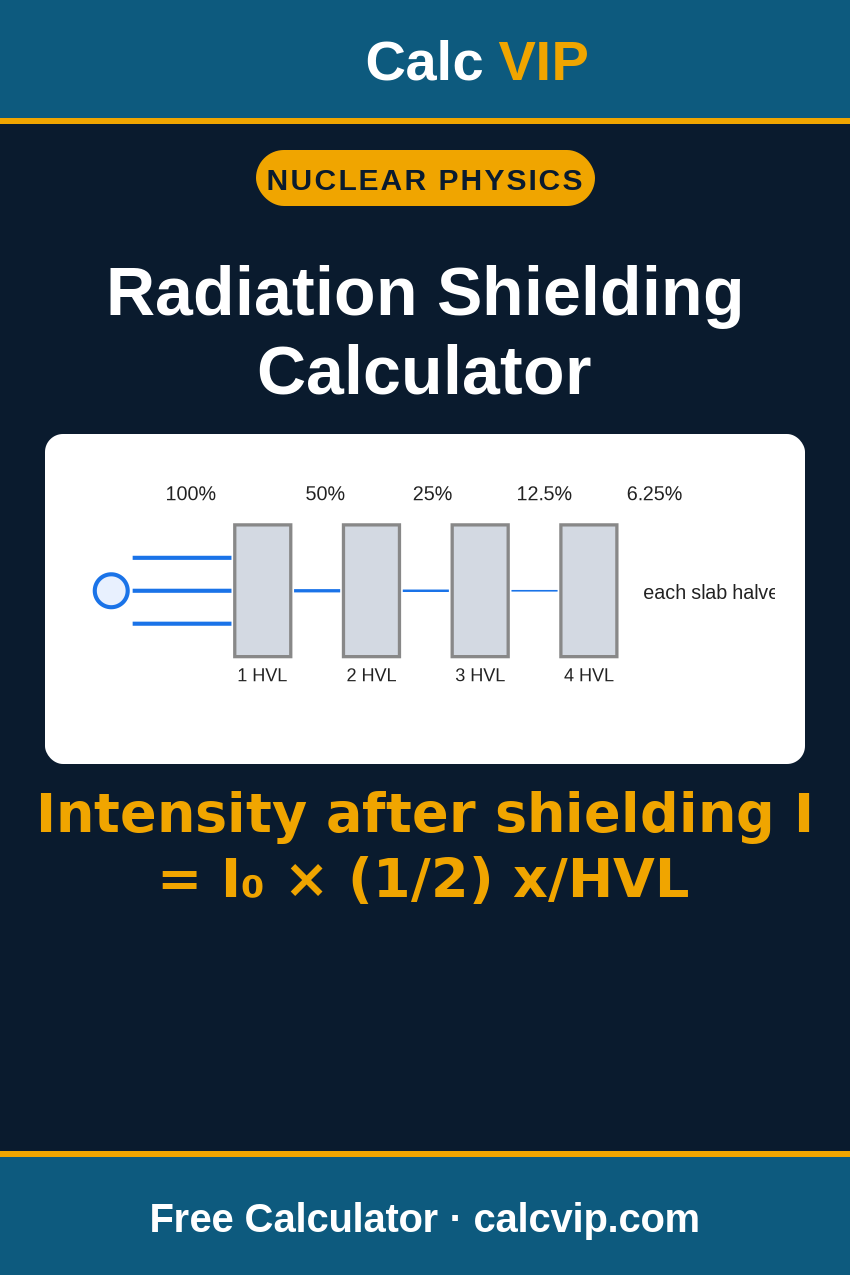
Use this free Radiation Shielding Calculator to work out how much a shield weakens a radiation beam. Every half-value layer (HVL) of shielding cuts the intensity in half — so the maths is just repeated halving.
The half-value layer is one of those rare ideas that is exactly as simple as it sounds, and powerful because of it. Whatever intensity arrives at a slab of material, a fixed fraction — one half — emerges, provided the slab is one HVL thick for that material and that radiation energy. Stack a second HVL and the half is halved again: a quarter. A third: an eighth. Shielding design is therefore arithmetic in powers of two, and this calculator does both directions of it: given a thickness, the surviving intensity; given a target intensity, the thickness required. Every lead apron, concrete bunker wall and transport cask in the radiation world was sized, at first pass, with exactly this repeated halving.
The HVL itself is where all the physics hides. It is not a property of the material alone: it depends on the radiation's energy. A soft X-ray beam may have an HVL of a fraction of a millimetre of lead, while the fierce 1.33 MeV gamma rays of cobalt-60 need about 12 mm of lead per halving. Denser materials pack more electrons and nuclei into each millimetre, so lead (dense, high atomic number) shields gamma rays far more thinly than concrete — but concrete is cheap, structural and self-supporting, which is why radiotherapy bunkers are built of metres of it while X-ray staff wear millimetres of lead. Choosing a shield is choosing an HVL, and this page's formula turns that choice into numbers.
One warning belongs at the front: the halving rule is exact for a narrow, monoenergetic beam, and real life is messier. Real beams scatter inside the shield and some scattered radiation reaches the detector anyway (the "build-up" effect), and real sources emit a spectrum of energies, of which the soft components are stripped first, hardening the beam as it passes. Professional shielding calculations add safety margins for both. But the HVL model is the universal first estimate — the calculation on the back of every envelope in radiation protection — and it is never far wrong.
Formula
Intensity after shielding I = I₀ × (1/2)x/HVL • I and I₀ in any matching unit, x and HVL in the same length unit.
The rearrangement for design work is x = HVL × log2(I₀ / I): decide the reduction factor you need, take its base-2 logarithm to get the number of half-value layers, and multiply by the HVL. The same law in continuous form is I = I₀ e−μx, where the linear attenuation coefficient μ = ln 2 / HVL ≈ 0.693 / HVL — for lead with an HVL of 5 mm, μ ≈ 0.139 per mm; for concrete at 45 mm, μ ≈ 0.0154 per mm. Ten HVLs reduce a beam to (1/2)10 = 1/1024 ≈ 0.098% — the origin of the designer's rule that "ten half-value layers is a factor of a thousand." A close cousin, the tenth-value layer (TVL = 3.32 HVL), reduces the beam to one tenth per layer. Typical gamma-ray HVLs quoted with this calculator's examples: lead ≈ 5 mm at 0.5 MeV and ≈ 12 mm for cobalt-60, concrete ≈ 45 mm, steel ≈ 15 mm — all energy-dependent, all to be checked against tables for serious design.
| Symbol | Meaning | Units |
|---|---|---|
| I | intensity after the shield | same as I₀ (µSv/h, counts/s, …) |
| I₀ | intensity before the shield | any unit |
| x | shield thickness | same unit as HVL (mm, cm) |
| HVL | half-value layer of the material at that energy | mm or cm |
| μ | linear attenuation coefficient, μ = 0.693 / HVL | per mm or per cm |
Why the halving never reaches zero — and why that is fine
Exponential attenuation has a distinctive personality: every layer removes a fraction of what arrives, never a fixed amount. The first HVL of lead removes 400 µSv/h of an 800 µSv/h beam; the fifth removes only 12.5. The beam is never annihilated, only diminished — mathematically it survives any finite shield at some level. This troubles beginners ("so shielding doesn't work?") until the scale of the game is clear: background radiation itself is a few tenths of a µSv/h, so a beam reduced below that has, for every practical purpose, vanished into the noise of the natural world. Shielding design is therefore the art of choosing how many halvings separate your source from your people, and the answer is usually between five and fifteen.
The same exponential shape explains why shielding surprises people at the margins. Adding one more HVL to a thick shield feels futile — it only halves an already small number — yet that is exactly the same power the first layer had. Conversely, a shield that is one HVL too thin does not fail by a little; it fails by a factor of two, everywhere, all the time. There is no "almost enough" plateau in an exponential. This is also why the calculator's thickness mode is the professional's mode: you state the dose rate you are willing to accept, and the logarithm tells you the truth about the wall.
How to use
- Choose the mode: "Intensity after a given thickness" if your shield exists and you want the dose rate behind it, or "Thickness needed for a target intensity" if you are designing the shield.
- Enter the starting intensity I₀ in any unit — µSv/h is typical — and read every answer in that same unit.
- Enter the thickness (or, in design mode, the target intensity) and the HVL of your material for your radiation's energy, keeping thickness and HVL in the same unit, both mm or both cm.
- Treat the answer as a first estimate: for real installations, cross-check the HVL at your exact energy and add margin for scattered radiation (build-up), especially for thick shields and broad beams.
Worked examples
Example 1 — the reference case, both modes. A gamma source reads 800 µSv/h. Lead's HVL for it is 5 mm and the shield is 20 mm thick — 20 / 5 = 4 half-value layers.
I = 800 × (1/2)4 = 800 / 16 = 50 µSv/h.
Design mode: to reach 8 µSv/h needs log2(800/8) = log2(100) = 6.644 HVLs, i.e. 6.644 × 5 = 33.219 mm of lead — call it 34 mm with margin.
Example 2 — a concrete wall. A source room reads 320 µSv/h at the wall; the concrete's HVL is 45 mm and the wall is 180 mm thick — exactly 4 HVLs.
I = 320 × (1/2)4 = 20 µSv/h, with 6.25% of the beam surviving. One more HVL (225 mm) would halve it again to 10 µSv/h — the exponential charges full price for every factor of two.
Example 3 — thinking in tenth-value layers. For thick barriers, designers quote TVLs: one TVL = log2(10) = 3.32 HVLs. For lead with HVL 5 mm, the TVL is 3.32 × 5 = 16.6 mm. A shield of 2 TVL (33.2 mm) leaves (1/10)² = 1% — the same answer the HVL mode gives for 6.64 layers, as it must.
Example 4 — a steel plate. Steel's HVL for this beam is 15 mm. A 45 mm plate is 3 HVLs, so a 640 µSv/h beam emerges at 640 × (1/2)³ = 640 / 8 = 80 µSv/h (12.5% transmission). Steel shields less efficiently per millimetre than lead but carries structural loads lead cannot — shields are engineering compromises, not just physics.
Example 5 — designing for a factor of a thousand. A store for gamma sources must cut any beam by 1,000×. Layers needed: log2(1000) = 9.97 ≈ 10 HVLs — in lead at 5 mm, 49.8 mm; in concrete at 45 mm, about 449 mm. The "ten HVLs ≈ 1000×" rule is the fastest mental arithmetic in radiation protection.
Example 6 — cobalt-60, the hard case. Co-60's gamma rays (1.17 and 1.33 MeV) are penetrating: lead's HVL rises to about 12 mm. A teletherapy head leaking 2,000 µSv/h behind 60 mm of lead (5 HVLs) gives 2,000 / 32 = 62.5 µSv/h. Using the 0.5 MeV HVL of 5 mm here would have predicted 12 layers and a wildly wrong answer — the energy-dependence of HVL is the whole game.
Shielding in real life
The lead apron. Radiographers wear aprons of 0.25–0.5 mm lead equivalence. Diagnostic X-rays are soft, with HVLs around a quarter-millimetre of lead, so an apron is one to two HVLs thick for the scattered radiation that reaches staff — cutting their dose by half to three-quarters while remaining wearable. The thyroid collar and lead glasses protect the organs the apron misses.
Radiotherapy bunkers. A linear accelerator's room is a concrete maze with walls often 1.5–2.5 m thick — dozens of HVLs — plus a door layered with lead and neutron-absorbing material. The maze shape matters as much as thickness: scattered radiation must bounce several times, losing energy at each bounce, before it can reach the door.
Nuclear medicine hot labs. Syringes of radioactive tracer are handled behind lead-glass screens and carried in lead pots; the tungsten syringe shields used for PET tracers exist because the 511 keV annihilation photons need dense material in a small, hand-held package.
Transport casks. Spent nuclear fuel travels in steel-and-lead casks whose walls are tens of centimetres thick — enough HVLs to bring the surface dose rate down to transport limits despite the fierce source inside. The cask is this calculator's formula rendered in fifty tonnes of metal.
Spacecraft and astronauts. In space the shielding problem inverts: heavy shields can make cosmic-ray exposure worse by shattering incoming ions into secondary radiation. Polyethylene — hydrogen-rich, low atomic number — outperforms lead per kilogram, and mission designers count "HVLs" in plastic and water rather than metal.
Everyday glass and walls. Even ordinary building materials shield a little: a brick wall is a meaningful fraction of an HVL for soft gamma rays, which is why indoor background radiation is measurably lower than outdoor, and why basement corners are the safest place in a fallout scenario — mass in every direction, counted in halvings.
Build-up: why real shields underperform the formula
The halving law describes photons that either pass through untouched or are absorbed outright. Real photons also scatter: a Compton interaction deflects a photon, robs it of some energy, and sends it onward at an angle — sometimes toward the very person the shield protects. Behind a thick shield, a significant share of the measured dose is this scattered "build-up" radiation, which the narrow-beam formula ignores. Broad beams and thick, low-density shields maximise the effect. Professionals handle it with build-up factors — multipliers tabulated against material, energy and thickness — or with Monte Carlo simulations that follow millions of individual photons. For the estimates this calculator is meant for, the practical translation is simple: add an extra HVL or two of margin on thick shields, and never treat the exponential as a guarantee.
Quick reference: how many HVLs do I need?
| Reduction wanted | HVLs needed | Beam remaining |
|---|---|---|
| 2× | 1 | 50% |
| 10× | 3.32 | 10% |
| 100× | 6.64 | 1% |
| 1,000× | 9.97 | 0.1% |
| 1,000,000× | 19.93 | 0.0001% |
The pattern is the whole subject in one table: every factor of ten costs about 3.32 more layers, forever. Shielding is bought in halvings and paid for in logarithms.
Distance: the shield that costs nothing
Shielding is one leg of the protection tripod — time, distance, shielding — and distance is the only leg that is free. A point source's intensity falls with the inverse square of distance: double your distance and the dose rate quarters, exactly as if you had inserted two HVLs, with no material at all. The two effects multiply: a source behind 4 HVLs at twice the distance delivers (1/2)4 × (1/2)² = 1/64 of its unshielded contact dose rate. This is why radiographers step behind the screen and stand back, why source handlers use long tongs, and why the cheapest shielding upgrade in any facility is often a longer corridor. When you use this calculator, remember that the thickness it gives assumes you stay where you are — moving away is always available as extra margin.
Common mistakes
- Using an HVL from the wrong energy. Lead's HVL is ~5 mm at 0.5 MeV but ~12 mm for Co-60 and a fraction of a millimetre for dental X-rays. An HVL without an energy is meaningless; Example 6 shows the size of the error.
- Expecting the shield to reach zero. It never does — the intensity fades exponentially toward background. "Negligible compared with background" is the real design target, not zero.
- Confusing HVL and TVL. A tenth-value layer (3.32 HVL) cuts the beam to 10%, not to a tenth of a half or any other hybrid. Mixing the two understates a shield by more than a factor of three per layer.
- Adding millimetres of different materials. Ten mm of lead plus ten of concrete is not "20 mm of shielding" — convert each layer to its own HVL count (2 + 0.22) and add the counts.
- Applying the halving rule to alpha and beta. Charged particles have a definite range, not an exponential attenuation: paper stops alpha completely, a few mm of plastic stops beta. The HVL model belongs to photons (and, approximately, neutrons with suitable materials).
FAQ
Does shielding ever stop radiation completely?
No. Each layer only halves what is left, so the intensity falls exponentially but never quite reaches zero. In practice a few extra HVLs make it negligible compared with background.
What is the difference between HVL and TVL?
The tenth-value layer (TVL) cuts the beam to one tenth and equals about 3.32 HVLs. Shielding designers often quote TVLs for thick barriers such as concrete walls.
Does this work for alpha and beta radiation?
Not really — alpha particles are stopped by paper and beta particles by a few mm of plastic or aluminium; they do not follow the halving rule. The HVL model is designed for penetrating gamma rays and X-rays.
How many HVLs make a beam safe?
There is no universal number — it depends on the starting intensity and the limit you must meet. Divide the two, take log2, and that is your layer count: cutting 800 µSv/h to the 0.5 µSv/h of background needs log2(1600) ≈ 10.6 HVLs. The calculator's thickness mode does exactly this.
Why is lead so much better than concrete?
Two reasons: density (11.3 g/cm³ against 2.3) packs more attenuating matter into each millimetre, and lead's high atomic number (Z = 82) makes the photoelectric effect — complete photon absorption — far more likely at diagnostic and moderate gamma energies. Per HVL of protection, lead is simply much thinner.
Does the order of layered shields matter?
It can. For beta sources, low-Z material goes first (to stop the electrons without creating bremsstrahlung X-rays) and lead second (to absorb those X-rays). For pure gamma beams, order matters little; total HVL count is what counts.
What shields neutrons?
Not lead — neutrons barely notice it. Hydrogen-rich materials (water, paraffin, polyethylene) slow neutrons down by collisions, and boron or cadmium then absorbs the slow neutrons. Reactor shields are layered composites for exactly this reason.
Is a thinner HVL always better?
For compactness, yes; for cost and structure, often no. Lead is expensive, toxic, soft and heavy per volume; concrete is nearly free and holds the building up. Real shields balance HVL against money, weight, space and fire regulations.
How accurate is this calculator for a real installation?
It gives the standard first estimate used throughout radiation protection. Licensed installations then refine it with build-up factors, exact energy spectra, occupancy factors and measurements after construction. If health or licensing depends on the answer, a qualified shielding physicist must sign it off.
Why does the beam get "harder" through a shield?
Lower-energy photons are absorbed more readily (they have a shorter HVL), so a mixed beam loses its soft components first. The surviving beam has a higher average energy — and a longer effective HVL — than the beam that entered, one more reason thick-shield design adds margin.