 Calc
Reaction Rate Calculator – Flux × Cross Section × Target Nuclei
 Created by Yuki Tanaka · Physics Editor · Modern Physics · Last updated: November 2026
Use this free Reaction Rate Calculator to find how many nuclear reactions per second a particle beam or neutron flux produces in a target. It is the basic equation behind isotope production, neutron activation analysis and reactor physics.
Three factors decide how busy a nuclear target is, and this calculator multiplies them together. The flux φ counts how many particles stream through each square centimetre each second — the traffic density of the beam. The cross-section σ measures how large each target nucleus effectively appears to that traffic — not its physical size, but its probability of reacting, expressed as an area. And N is simply how many target nuclei are on the field. Traffic × apparent size × number of targets = reactions per second: R = φσN. It is the master equation of applied nuclear physics — the formula that sizes isotope production runs, predicts reactor power, calibrates neutron detectors and tells an activation analyst how long to irradiate a sample.
The cross-section is the concept that needs a moment, because its unit is a joke that became a unit. During the Manhattan Project, physicists found that slow neutrons reacted with uranium nuclei so readily that the effective target area — about 10−24 cm² — was, in their words, "as big as a barn". The barn stuck. But σ is not a tape-measure area: it is an interaction probability dressed as geometry, and it can dwarf the nucleus's true cross-section when resonances align (xenon-135 absorbs thermal neutrons with σ ≈ 2.6 million barns) or shrink to almost nothing for reluctant reactions. It also changes with the incoming particle's energy — most capture cross-sections grow as neutrons slow down, following a 1/v law — so every σ carries an implicit "at this energy" that this calculator expects you to honour by choosing the value for your beam.
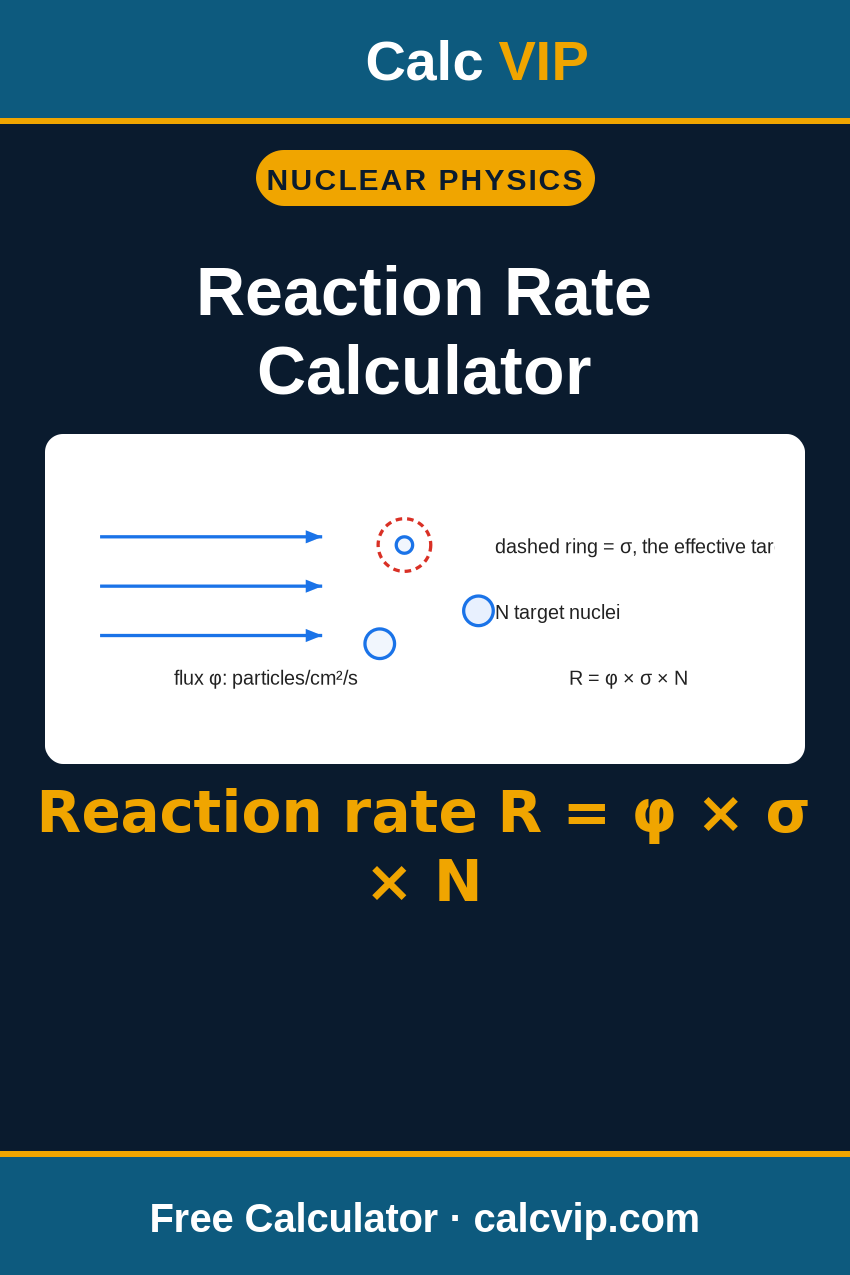
The third factor hides a conversion worth stating aloud: N is a count of nuclei, not a mass. A gram of cobalt-59 holds 6.022 × 10²³ / 58.933 ≈ 1.022 × 10²² nuclei; a milligram of gold-197, about 3.06 × 10¹⁸. Avogadro's number is the bridge between the chemist's balance and this formula, and forgetting the division by molar mass is the commonest way to be wrong by twenty-two orders of magnitude. With the three factors honestly assembled, R is exact — and, as the examples show, it reaches from a detector's whisper of counts to a power station's gigawatts without changing its form.
Formula
Reaction rate R = φ × σ × N • R in reactions per second, φ in particles per cm² per second, σ in cm² (entered in barns: 1 barn = 10−24 cm²), N a pure count of target nuclei.
Unit discipline is the whole game: the calculator converts your barns to cm² (× 10−24) so that φ (per cm²) and σ (cm²) cancel to a per-nucleus probability per second; multiplying by N gives the total rate. Two derived quantities matter constantly. If the reaction product is radioactive, its activity during irradiation grows as A(t) = R × (1 − e−λt) — the same ingrowth curve as the Daughter Activity Calculator — levelling at the saturation activity A = R, where production and decay balance; after one product half-life you hold 50% of saturation, after five, 96.9%. And the energy version: multiply a fission rate by the energy per fission (~200 MeV = 3.204 × 10⁻¹¹ J) to get thermal power. Rearranged, the formula also runs backwards — φ = R/(σN) turns a known reaction rate into a flux measurement, which is precisely how foil-activation flux monitors work.
| Symbol | Meaning | Units |
|---|---|---|
| R | reaction rate | reactions per second |
| φ | particle flux — beam density × speed, as particles crossing unit area | particles / cm² / s |
| σ | microscopic cross-section at the beam energy | barns (1 b = 10−24 cm²) |
| N | number of target nuclei present | count (mass × NA / molar mass) |
From one nucleus to a material: the macroscopic view
Multiply the microscopic cross-section by the number of nuclei per cubic centimetre and the formula changes costume: Σ = nσ is the macroscopic cross-section, the probability per centimetre of travel that a particle reacts, and its reciprocal is the mean free path. Solid boron-10 makes the arithmetic vivid: at density 2.34 g/cm³ it holds n = (2.34 / 10.013) × 6.022 × 1023 ≈ 1.407 × 10²³ nuclei/cm³, and with σ = 3,840 barns, Σ ≈ 540 per cm — a thermal neutron's mean free path in boron is 1/540 cm ≈ 18.5 micrometres. That is why boron-lined detectors and boron carbide control rods are so effective in so little material, and why the same neutron sails through metres of air (where n is a thousand times smaller) untouched. R = φσN and the mean free path are one idea at two zoom levels: probability per nucleus, or probability per centimetre.
The zoom matters because it exposes the formula's fine print: R = φσN assumes every nucleus sees the same flux. In a thick or strongly absorbing target the front layers shadow the back ones (self-shielding), the flux sags with depth, and the honest calculation integrates φ(x)σn over the volume. Dilute samples, thin foils and well-stirred solutions — the working forms of activation analysis — are all strategies for keeping the simple formula true. When a problem gives you a target "thin" enough, this calculator's multiplication is the exact answer; when it does not, treat R as the ceiling the real rate approaches.
How to use
- Enter the flux φ in particles per cm² per second — a research reactor's thermal neutron flux is typically 1013–1014; a modest beamline may be 108 or less.
- Enter the cross-section σ in barns for your reaction at your beam energy — thermal-neutron values are the usual defaults (Au-197 capture 98.7 b, Co-59 capture 37 b, B-10 absorption 3,840 b, U-235 fission 585 b).
- Enter N, the number of target nuclei: N = (mass in grams / molar mass) × 6.022 × 10²³, times the isotopic abundance if the target element is a mixture. Scientific notation like 1e20 is expected here.
- Read the reaction rate per second and per hour, and — if the product is radioactive — the saturation activity in becquerel, the ceiling its activity approaches during a long irradiation.
Worked examples
Example 1 — the reference irradiation. N = 1 × 10²⁰ target nuclei in a flux φ = 1 × 10¹³ /cm²/s, with σ = 100 barns = 1 × 10⁻²² cm².
R = 1 × 1013 × 1 × 10−22 × 1 × 1020 = 1 × 10¹¹ reactions per second (3.6 × 10¹⁴ per hour). If the product is radioactive, its activity can therefore build up to at most 1 × 10¹¹ Bq (100 GBq) at saturation.
Example 2 — making cobalt-60. One gram of cobalt-59 (N = 6.022 × 10²³ / 58.933 = 1.022 × 10²² nuclei) in a reactor flux of 1 × 10¹⁴, with the thermal capture cross-section σ = 37 barns.
R = 1014 × 37 × 10−24 × 1.022 × 1022 = 3.78 × 10¹³ per second — a saturation activity of 37.8 TBq. Industrial Co-60 sources are brewed exactly this way, over months, approaching (never reaching) that ceiling as the product's 5.27-year half-life allows.
Example 3 — neutron activation analysis of gold. A 1 mg gold sample (N = (0.001 / 196.967) × 6.022 × 1023 = 3.06 × 10¹⁸ nuclei) in a flux of 1 × 10¹², σ = 98.7 barns for Au-197 capture.
R = 1012 × 98.7 × 10−24 × 3.06 × 1018 = 3.02 × 10⁸ per second. The Au-198 produced (half-life 2.7 days) is counted after irradiation to assay the gold — the same method measures trace elements in artworks, forensic samples and moon rocks without dissolving them.
Example 4 — a boron neutron counter. A detector lining holds N = 1 × 10¹⁸ boron-10 nuclei; a weak beam of φ = 1 × 10⁸ /cm²/s crosses it; σ = 3,840 barns for the (n, α) reaction.
R = 108 × 3,840 × 10−24 × 1018 = 3.84 × 10⁵ counts per second — each reaction's alpha particle is one detected count. Detector design is this formula aimed at a target count rate.
Example 5 — from reaction rate to reactor power. U-235 fission, σ = 585 barns, in a flux of 1 × 10¹⁴ with N = 1 × 10²⁰ fissile nuclei present.
R = 1014 × 585 × 10−24 × 1020 = 5.85 × 10¹² fissions/s. At 200 MeV (3.204 × 10⁻¹¹ J) per fission, power = 5.85 × 1012 × 3.204 × 10−11 = 187 W. Scale the flux and fuel up: a 1 GW thermal reactor sustains 109 / 3.204 × 10−11 = 3.12 × 10¹⁹ fissions every second.
Example 6 — approaching saturation. A product with a 6-hour half-life is made at R = 1 × 10¹¹ /s (Example 1's target). Its activity during irradiation: after 6 hours, 5 × 10¹⁰ Bq (50%); after 24 hours (4 half-lives), 1011 × (1 − 1/16) = 9.375 × 10¹⁰ Bq; after 30 hours (5 half-lives), 9.69 × 10¹⁰ Bq (96.9%). Irradiating past about three half-lives buys little — reactor time is precious, and this curve is the receipt that proves it.
Reaction rate in real life
Medical isotope production. Molybdenum-99, iodine-131, lutetium-177 and the rest of the nuclear-pharmacy shelf are scheduled with R = φσN: target mass, reactor flux and cross-section fix the production rate, and the saturation curve fixes the irradiation time that balances yield against reactor cost.
Neutron activation analysis. Archaeologists, forensic scientists and geochemists irradiate samples and count the induced activities; each element's σ and half-life form a fingerprint, and this formula converts counts back into concentrations — famously applied to Napoleonic-era hair, pottery provenance and Apollo samples.
Reactor operation and xenon poisoning. After a reactor shutdown, xenon-135 (σ ≈ 2.6 × 10⁶ barns) builds in from iodine decay and devours neutrons so greedily that restart can be blocked for a day — the "iodine pit". Operators track it with exactly this rate equation, run for absorption instead of production.
Radiation detection. Every neutron counter — boron-lined tubes, helium-3 detectors (σ = 5,333 barns), scintillators — is R = φσN engineered so the expected flux yields a countable rate without drowning in it.
Boron neutron capture therapy. BNCT doses are planned as reaction rates in tissue: the boron concentration in the tumour (N), the epithermal beam's flux at depth (φ) and B-10's 3,840-barn cross-section multiply into the alpha-particle production that does the therapy.
Stellar burning. Inside stars, the same product — flux (from particle density × speed) times cross-section times target count — sets how fast each fusion stage consumes its fuel, with σ measured in microbarns and R, integrated over a core, deciding whether the star lives a million years or ten billion.
The gram of uranium that powers a megawatt-day
Run Example 5's energy conversion on a single gram of U-235 and the nuclear age explains itself. One gram holds N = 6.022 × 10²³ / 235.044 = 2.562 × 10²¹ nuclei. Fissioning every one at 200 MeV releases 2.562 × 1021 × 3.204 × 10−11 J = 8.21 × 10¹⁰ joules — enough to run a 1 MW power output for 0.95 days: the famous rule that a gram of uranium-235 is worth roughly a megawatt-day, and (against coal's ~3 × 10⁷ J/kg) about 2.7 tonnes of coal per gram... per gram of fuel. R = φσN is how fast you may spend that inheritance; the cross-section and the flux are the throttle on the most concentrated energy store in practical use.
Quick reference: thermal-neutron cross-sections
| Target & reaction | σ (barns) | Why it matters |
|---|---|---|
| H-1 capture | 0.333 | sets hydrogen's weak absorption in moderators |
| U-238 capture | 2.68 | breeds Pu-239 in reactors |
| Co-59 capture | 37 | makes Co-60 sources |
| Au-197 capture | 98.7 | flux-monitor foils, activation analysis |
| U-235 fission | 585 | reactor power |
| B-10 (n, α) | 3,840 | detectors, control rods, BNCT |
| He-3 (n, p) | 5,333 | the classic neutron detector gas |
| Cd-113 capture | 20,600 | cadmium cut-off filters for thermal beams |
| Xe-135 capture | ≈ 2,600,000 | reactor poison — the largest common σ |
Seven orders of magnitude in one table — the barn is a small unit asked to describe both a nucleus's shyest and greediest behaviours, and R = φσN handles them all without modification.
Common mistakes
- Forgetting the barn conversion. σ must enter in cm²: multiply barns by 10−24. Skipping it inflates R by twenty-four orders of magnitude — the largest single-keystroke error in the subject.
- Entering mass where N belongs. The formula counts nuclei. Convert with N = (grams / molar mass) × 6.022 × 10²³, and multiply by the isotopic abundance when the target is a natural element rather than a pure isotope.
- Using a thermal cross-section for a fast beam. Most capture σ values fall steeply with energy (roughly 1/v) and fission σ collapses from 585 barns thermal to about 1 barn at MeV energies. A σ without an energy is only half a fact.
- Equating reaction rate with product activity from the first second. Activity lags production by the ingrowth curve A = R(1 − e−λt). A one-hour irradiation of a 6-hour product yields 10.9% of R, not R — plan counting and shipping accordingly.
- Ignoring self-shielding and burn-up in thick targets. If the target absorbs a meaningful share of the beam, inner nuclei see less flux and R = φσN overestimates; if R × t approaches N, the target itself is being consumed and the rate sags. Both corrections matter in production-scale work.
FAQ
Why is the cross-section called a "barn"?
During the Manhattan Project, physicists joked that a uranium nucleus was "as big as a barn" for slow neutrons. The name stuck: 1 barn = 10−24 cm². Cross-sections are effective target areas, not literal sizes — resonance peaks can make them far larger than the geometric area.
What does saturation activity mean?
A radioactive product is created at rate R but also decays. Its activity climbs as A(t) = R(1 − e−λt) and levels off at A = R, when production and decay balance — after about 5 product half-lives it is within 3% of saturation.
Does the target get used up?
Slowly, yes — each reaction consumes one target nucleus. This "burn-up" only matters when R × t becomes comparable with N; for most activation calculations the target is treated as constant, as in this calculator.
What flux do typical neutron sources provide?
A research reactor's core reaches 1013–1014 /cm²/s thermal; beam tubes deliver 108–1010 at the sample; a laboratory americium-beryllium source manages perhaps 105–106 around it; spallation sources compete on pulsed peak flux. The twelve orders of magnitude between them are why the same experiment can take a minute or a month.
Is the cross-section really an area?
Formally it behaves as one in the formula — probability per unit flux — and for hard-sphere-like scattering it approximates the geometric area. But resonance reactions can exceed the geometric area by thousands of times (Xe-135), because σ encodes quantum-mechanical probability, not silhouette. Treat it as an effective area and you will not go wrong.
How is flux measured in practice?
By this formula run backwards: irradiate a foil of known N and σ (gold is the standard), measure the induced activity, and solve for φ. Cadmium-covered twin foils separate the thermal and epithermal parts of the spectrum, since cadmium's huge σ below 0.5 eV swallows the thermal component whole.
Why does the product's activity saturate instead of growing forever?
Because the product decays as fast as it is made once A = R. Each new atom is balanced by a decay; the stock stops growing. Saturation is a dynamic balance, not exhaustion — stop the beam and the activity simply decays away with the product's half-life.
Does R = φσN work for charged-particle beams?
Yes — accelerators quote current instead of flux (particles per second through the target), and the same multiplication with the appropriate σ gives the rate. The practical differences are energy loss in the target (σ changes as the beam slows) and much smaller penetration depths.
What is a millibarn, microbarn — do I need them?
Only for reading the literature: cross-sections span from megabarns (Xe-135) through barns (this page) down to microbarns for many fusion and high-energy reactions. The calculator takes barns; divide microbarn figures by 106 before entering them.
How long should I irradiate to get 90% of saturation?
Solve 1 − e−λt = 0.9: t = ln(10)/λ = 3.32 product half-lives. For 99%: 6.64 half-lives — the same 6.64 that governs daughter ingrowth, because it is the same exponential wearing its other hat.