 Calc
Threshold Frequency Calculator – Work Function, f₀ & λ₀
 Created by Yuki Tanaka · Physics Editor · Modern Physics · Last updated: November 2026
Use this free Threshold Frequency Calculator to find the threshold (cut-off) frequency f₀ and threshold wavelength λ₀ of a metal from its work function φ. Below f₀, no electrons are emitted in the photoelectric effect — no matter how bright the light is.
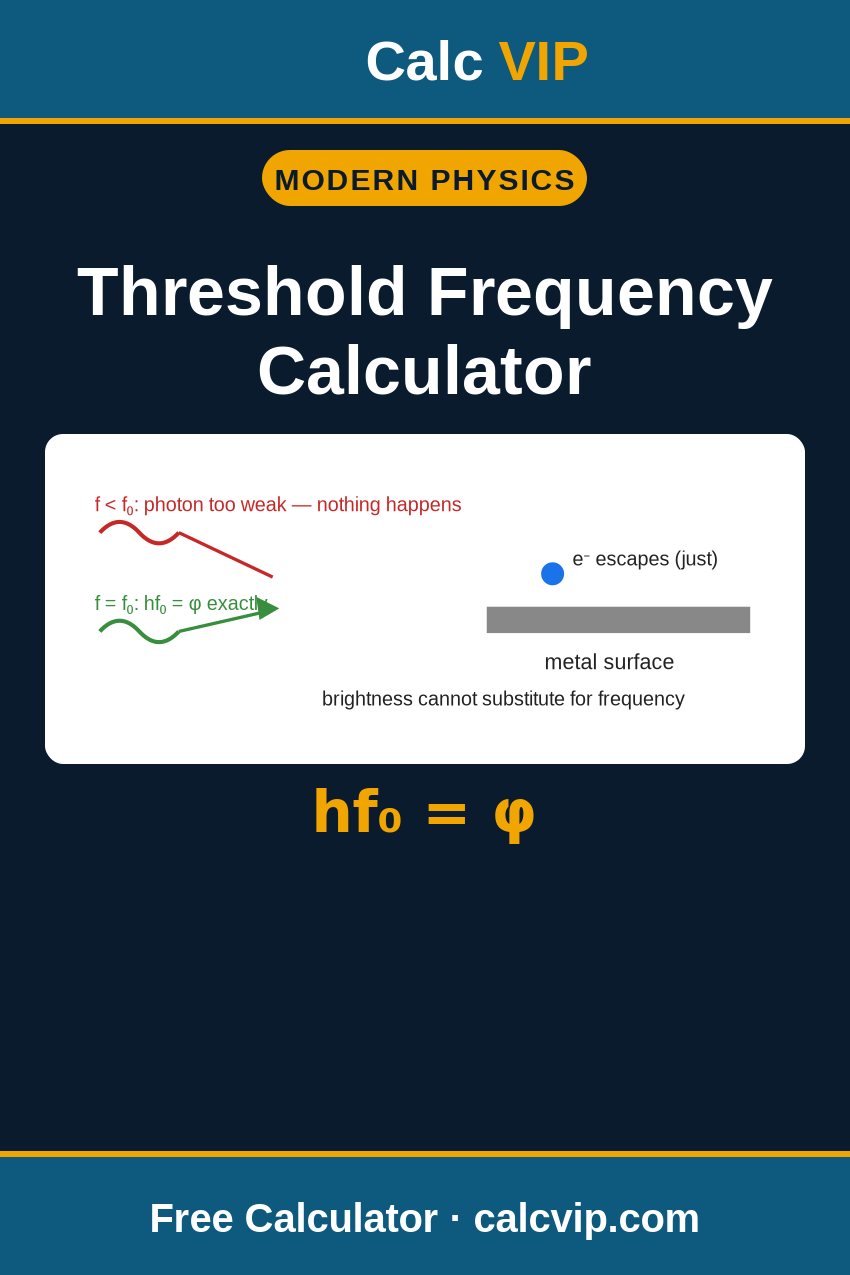
Every metal holds its electrons with a characteristic grip, the work function φ — the minimum energy an electron needs to escape the surface. Einstein's 1905 insight was that light delivers its energy in indivisible packets, photons, each carrying hf. The threshold frequency is the break-even point of that transaction: the frequency at which one photon's energy exactly equals the grip, hf₀ = φ. This calculator finds that break-even frequency f₀ = φ/h and the matching threshold wavelength λ₀ = hc/φ — the longest wavelength that can eject an electron at all.
The threshold is a cliff, not a slope. Light just above f₀ releases electrons with almost no spare energy — they dribble out with near-zero kinetic energy. Light just below f₀ releases nothing, and "nothing" is absolute: not at high intensity, not after long exposure, not ever, because the energy arrives photon by photon and no electron can pool the offerings of several photons. Before Einstein, this cliff was inexplicable — wave theory said bright red light should eventually deliver enough energy. The cliff's existence, and the exact formula for where it stands, became the decisive evidence that light is quantised.
Where the cliff stands depends entirely on the metal. Alkali metals grip loosely: caesium's φ = 2.1 eV puts its threshold at 590.9 nm, in the yellow, so ordinary visible light works it. Sodium (2.36 eV) thresholds at green, 525.8 nm. The coinage and structural metals grip hard — zinc at 4.3 eV and platinum at 5.65 eV threshold at 288.6 nm and 219.6 nm respectively, deep in the ultraviolet, which is why the classic school demonstration uses a UV lamp and a zinc plate. One number, φ, decides whether a metal can serve in a camera sensor, a photocell or a night-vision tube, and this calculator converts it into the two numbers engineers actually specify: f₀ and λ₀.
Formula
At threshold the photon's energy exactly pays the work function: hf₀ = φ, so f₀ = φ/h and λ₀ = c/f₀ = hc/φ. With φ entered in electron-volts, the calculator first converts: φ(J) = φ(eV) × 1.602 × 10⁻¹⁹. The constants combine into a pocket shortcut worth memorising: since hc/e = 1240.8 eV·nm, λ₀(nm) ≈ 1240/φ(eV) and f₀ ≈ φ × 2.418 × 10¹⁴ Hz per eV. The rearrangements matter as much as the originals: a measured threshold wavelength gives the work function, φ = hc/λ₀, which is how many tabulated φ values were obtained in the first place. Above threshold, the surplus becomes kinetic energy, KEmax = hf − φ — the province of the stopping-potential calculation — but at f₀ itself the surplus is exactly zero by definition.
| Symbol | Meaning | Units |
|---|---|---|
| φ | work function — energy needed to free an electron | eV (or J) |
| f₀ | threshold (cut-off) frequency | Hz |
| λ₀ | threshold wavelength — the longest that works | nm |
| h | Planck's constant, 6.626 × 10⁻³⁴ | J·s |
| c | speed of light, 3 × 10⁸ | m/s |
Why the cliff is sharp: one photon, one electron
The threshold only makes sense in a photon world. In the wave picture, energy arrives as a continuous flow spread over the wavefront; a dim light would simply take longer to deliver φ's worth of energy to some lucky electron, and any frequency would eventually work. Experiment says otherwise, and the photon picture explains why: absorption is an all-or-nothing handshake between one photon and one electron. If hf < φ the handshake fails completely — the electron rattles and the energy degrades to heat. If hf ≥ φ it succeeds instantly, which matches the observed absence of any time lag, even in light so dim that wave theory would demand minutes of accumulation.
The work function itself is surface physics, not atomic trivia. Escaping electrons must cross the surface barrier formed by the metal's own charge distribution, so φ depends on the metal, its crystal face and its cleanliness — a contaminated or oxidised surface can shift φ by tenths of an eV and drag f₀ with it. This is why photoelectric devices are sealed in vacuum with pristine alkali coatings, and why the tabulated values used with this calculator are guides: a real photocathode's threshold is measured, not assumed, and its slow drift with age is φ changing as the surface ages.
How to use
- Enter the metal's work function φ in eV.
- Click "Calculate Threshold Frequency".
- You get the threshold frequency f₀ in Hz and the longest wavelength λ₀ that can still eject electrons.
- Compare λ₀ with your light source: any wavelength shorter than λ₀ works; anything longer fails completely, regardless of brightness.
Worked examples
Example 1 — sodium. Sodium has a work function of φ = 2.36 eV = 2.36 × 1.602 × 10⁻¹⁹ = 3.78 × 10⁻¹⁹ J.
f₀ = φ/h = 3.78 × 10⁻¹⁹ / 6.626 × 10⁻³⁴ = 5.71 × 10¹⁴ Hz
λ₀ = c/f₀ = 3 × 10⁸ / 5.71 × 10¹⁴ = 525.8 nm.
So 525.8 nm (green light) is the LONGEST wavelength that works on sodium: any light greener, bluer or ultraviolet ejects electrons; yellow, orange and red light cannot, however bright.
Example 2 — caesium, the photocell metal. For φ = 2.1 eV: φ = 3.36 × 10⁻¹⁹ J, f₀ = 5.08 × 10¹⁴ Hz, λ₀ = 590.9 nm.
Caesium thresholds in the yellow, so the whole visible spectrum is above its threshold — the reason caesium coatings dominated photocells and early television cameras.
Example 3 — zinc, the school-lab metal. For φ = 4.3 eV: φ = 6.89 × 10⁻¹⁹ J, f₀ = 1.04 × 10¹⁵ Hz, λ₀ = 288.6 nm.
Zinc's threshold sits in the ultraviolet, which is why the classic electroscope demonstration needs a UV lamp: visible light of any colour leaves the charged zinc plate untouched.
Example 4 — platinum, the stubborn metal. For φ = 5.65 eV: φ = 9.05 × 10⁻¹⁹ J, f₀ = 1.37 × 10¹⁵ Hz, λ₀ = 219.6 nm.
Platinum demands deep ultraviolet. Its tight grip on electrons is the same property that makes it chemically inert and an excellent catalyst surface — electrons are hard to remove by any means.
Example 5 — copper. For φ = 4.7 eV: φ = 7.53 × 10⁻¹⁹ J, f₀ = 1.14 × 10¹⁵ Hz, λ₀ = 264.0 nm.
Copper wiring will never shed electrons under room lighting — a small mercy of electrical engineering that follows directly from this arithmetic.
Example 6 — working backwards from a wavelength. A photocathode is specified with λ₀ = 600 nm. What is its work function?
φ = hc/λ₀ = (6.626 × 10⁻³⁴ × 3 × 10⁸)/(600 × 10⁻⁹) = 3.31 × 10⁻¹⁹ J = 2.07 eV — potassium-like (2.29 eV) or a caesium compound, certainly an alkali surface, since no structural metal grips that loosely.
Threshold frequencies in real life
Photocells and light meters. A photocell's spectral range is its cathode's threshold written in glass: caesium-based cells see the visible spectrum; zinc-based ones see only UV. Choosing the metal is choosing f₀.
Night-vision tubes. Image intensifiers need cathodes that respond to the near-infrared glow of starlight, pushing designers to compound cathodes with effective work functions near 1.1–1.4 eV and thresholds beyond 900 nm.
Photomultiplier tubes. These ultra-sensitive detectors, used from astronomy to medical scanners, pair a low-φ cathode with electron multiplication — the threshold formula sets the reddest light they can count.
Solar cells by analogy. A semiconductor's band gap plays the work function's role: photons below the gap energy pass through unharvested. Silicon's 1.1 eV gap thresholds at about 1,100 nm — the same cliff logic, in a crystal.
UV safety engineering. Sunburn and photo-chemical damage have threshold-like behaviour set by molecular bond energies; the erythemal action spectrum is biology's version of f₀, which is why UV-B harms and visible light does not.
Spacecraft charging. Sunlight above threshold strips electrons from sunlit spacecraft surfaces, charging them positive — a real design constraint for satellites, computed from the surface materials' work functions.
Work functions of common metals
Measured work functions vary a little with crystal face and surface condition, but the ordering never changes: alkalis at the loose end, noble metals at the tight end. Read the table as a menu of thresholds — pick the row whose λ₀ covers the light you need to detect, and you have picked your cathode.
| Metal | φ (eV) | f₀ (Hz) | λ₀ (nm) | Works with |
|---|---|---|---|---|
| Caesium | 2.10 | 5.08 × 10¹⁴ | 590.9 | all visible light |
| Potassium | 2.29 | 5.54 × 10¹⁴ | 541.8 | green and shorter |
| Sodium | 2.36 | 5.71 × 10¹⁴ | 525.8 | green and shorter |
| Calcium | 2.87 | 6.94 × 10¹⁴ | 432.3 | violet and UV |
| Magnesium | 3.66 | 8.85 × 10¹⁴ | 339.0 | ultraviolet only |
| Zinc | 4.30 | 1.04 × 10¹⁵ | 288.6 | ultraviolet only |
| Copper | 4.70 | 1.14 × 10¹⁵ | 264.0 | deep UV only |
| Platinum | 5.65 | 1.37 × 10¹⁵ | 219.6 | deep UV only |
Photocathode engineering: cheating the work function down
Pure metals bottom out at caesium's 2.1 eV, but device physics needed thresholds beyond the red — into the near-infrared where night vision and fibre-optic test gear live — so engineers learned to build surfaces whose effective work function no pure metal offers. Compound cathodes layer alkali metals with oxygen and silver or antimony: the classic multi-alkali (S-20) cathode responds out to about 900 nm, an effective threshold near 1.4 eV, while caesium–oxygen activation of gallium arsenide produces a negative-electron-affinity surface, where the vacuum level sits below the conduction band and electrons excited by photons as feeble as ~1.4 eV (λ₀ ≈ 900 nm) spill out freely. Each of these is still Einstein's equation at work — the "work function" has simply become an engineered property of a stack of materials rather than a constant of one. When this calculator is fed φ = 1.4 eV it returns f₀ = 3.39 × 10¹⁴ Hz and λ₀ = 886 nm: the design target of a night-vision tube, computed in one line from a 1905 formula.
The engineering cuts both ways. A cathode's threshold also defines its noise: the lower φ, the more readily thermal energy alone can eject electrons (the Richardson thermionic current grows as φ shrinks), producing dark counts that fog sensitive detectors. Photomultiplier designers therefore cool infrared-sensitive cathodes, accepting the threshold they need and refrigerating the noise it brings. The work function is never a free lunch — it is a single dial controlling sensitivity, spectral range and noise together, and f₀ = φ/h is the dial's calibration.
The photoelectric family: three effects, one threshold idea
The effect on this page — electrons ejected from a surface — is the external photoelectric effect. It has two siblings that share its threshold logic. In the internal effect (photoconductivity), the photon never ejects the electron from the material; it promotes it across the band gap into the conduction band, and the material's resistance falls. The threshold is the gap energy: cadmium sulphide cells (gap ≈ 2.4 eV, threshold ≈ 517 nm) darken-and-lighten the street lamps they switch, responding only to photons above their gap. In the photovoltaic effect, the promoted carriers are separated by a junction's built-in field and delivered as current — the solar cell, whose silicon gap of 1.1 eV sets its 1,100 nm threshold. Three industries — photocells, light-dependent resistors, solar panels — are one idea with three barriers: work function, band gap, band gap again. Learn to compute one threshold and you have learned the grammar of all three.
Designing backwards: choosing a cathode from a target wavelength
Engineers run this calculator in reverse, and the reversed calculation is worth doing once in full. A fibre-optic test set must detect 850 nm light. The cathode's threshold must lie at or beyond 850 nm, so φ ≤ 1240.8/850 = 1.46 eV — below every pure metal, which is why such detectors use GaAs-family cathodes or internal-effect semiconductors. Aim at the 1,310 nm telecom window and the requirement tightens to φ ≤ 1240.8/1310 = 0.95 eV, beyond any practical photocathode; the industry therefore abandons the external effect there and uses InGaAs photodiodes, whose 0.75 eV band gap absorbs 1,310 nm internally. Two divisions by 1240.8 have just dictated two different detector industries — a measure of how much engineering hangs on this page's one inequality, f ≥ φ/h.
A biological benchmark
Your own eye obeys a threshold of the same kind. Vision ends at the deep red, about 700 nm, where photons carry 1240.8/700 = 1.77 eV — close to the activation energy a rhodopsin molecule needs to isomerise and fire a signal. Below that energy, photons pass through the retina's chemistry unregistered, however many arrive: the eye, like a caesium photocathode, counts energy per photon, not photons per second. Evolution set the threshold where the Sun's spectrum is rich and thermal noise at body temperature is tolerable — the same trade, struck by natural selection, that photocathode engineers strike with the Richardson equation.
Common mistakes
- Calling λ₀ the shortest working wavelength. It is the longest. Frequency and wavelength run opposite: the threshold frequency is a minimum, so the threshold wavelength is a maximum. Inverting this flips every conclusion.
- Believing brightness can compensate. Below f₀, intensity changes only how many photons fail. A stadium floodlight of red light ejects exactly zero electrons from sodium — the cliff does not care about flux.
- Feeding φ in joules into an eV shortcut. The 1240/φ rule needs φ in eV. Mixing units is the classic way to land a threshold in the X-ray region for a metal that works in daylight.
- Treating φ as a property of the light. The threshold belongs to the metal's surface. The same lamp that works caesium fails zinc completely; always pair the source's λ with the surface's λ₀.
- Assuming tabulated φ is exact for your sample. Oxidation and contamination shift φ noticeably. Precision photoelectric work measures the actual threshold of the actual surface — with this formula run in reverse.
FAQ
Why does brighter light below f₀ still eject nothing?
Electrons absorb energy one photon at a time. Brightness adds more photons, but each one still carries less than φ, so no single electron ever gains enough energy to escape.
Which metal is easiest to use in a photocell?
One with a small work function, like caesium (2.1 eV), because even visible light exceeds its threshold. Zinc (4.3 eV) needs ultraviolet light.
Is λ₀ the shortest or longest working wavelength?
The longest. Shorter wavelengths mean higher frequencies and more energetic photons, so anything shorter than λ₀ also works.
What is the threshold frequency of sunlight-sensitive metals in everyday devices?
Camera and light-meter cathodes historically used caesium compounds with thresholds in the near-infrared (λ₀ up to ~900 nm, φ ≈ 1.4 eV), so they respond across the whole visible range the way the eye does.
Can two low-frequency photons team up to eject one electron?
Under ordinary light, effectively never — an electron absorbs one photon and either escapes or thermalises within femtoseconds, long before a second photon arrives. Only under intense laser pulses does two-photon photoemission become measurable, a specialised laboratory effect.
Does temperature change the threshold?
Slightly. Heating smears the electrons' energies, so a few can escape with photons marginally below f₀ — the cliff softens at its very edge. At high enough temperatures electrons boil off without light at all (thermionic emission, the working principle of vacuum tubes).
How is the work function measured?
Most directly by this page's physics in reverse: shine tunable light, find the longest wavelength that still ejects electrons, and compute φ = hc/λ₀. Photoelectron spectroscopy refines the same measurement into an energy spectrum.
Why do alkali metals have such low work functions?
Their single outer electron is loosely bound and well shielded from the nucleus, and their surfaces present a weak barrier. The same looseness makes them violently reactive chemically — easy electron loss is the family trait in both stories.
Is there a threshold for the photoelectric effect inside a material?
Yes — the internal photoelectric effect (photoconductivity) has the band gap as its threshold, which is why silicon detectors cut off near 1,100 nm and germanium near 1,800 nm. Same cliff, different barrier.
What did the threshold prove historically?
That light energy is quantised. The existence of a sharp f₀, its exact proportionality to φ through h, and the absence of any time lag forced the photon picture on physics — Einstein's Nobel Prize was awarded for this explanation, not for relativity.