 Calc
Time Dilation Calculator – Δt = γΔt₀ & Lorentz Factor
 Created by Yuki Tanaka · Physics Editor · Modern Physics · Last updated: November 2026
Use this free Time Dilation Calculator to see how much slower a moving clock ticks, using Einstein's special relativity: Δt = γ × Δt₀. Enter a time measured on the moving clock and its speed, and find the time measured by a stationary observer — and the Lorentz factor γ.
Time dilation is relativity's most intimate shock: a moving clock genuinely ticks slower than a stationary one — not mechanically, not apparently, but in the sense that less time passes for it. This calculator evaluates the effect with Einstein's formula Δt = γΔt₀, where Δt₀ is the time measured on the moving clock itself (its proper time) and γ = 1/√(1 − v²/c²) is the Lorentz factor that stretches it for everyone watching from outside. At everyday speeds γ is 1.0000000000-something and the effect is invisible; approach light speed and γ explodes, so that a traveller can cross centuries of Earth time in a year of their own.
Two clarifications keep the idea honest. First, "clock" means any process that measures time — a heartbeat, a decaying atom, a ageing body. Muons created in the upper atmosphere live 2.2 microseconds by their own clocks, yet at 0.99c they survive the trip to the ground because, from Earth, their internal clocks run 7.09 times slow and their lifetimes stretch to 15.6 µs. Second, the effect is reciprocal between two observers in uniform motion — each measures the other's clock as slow — and the symmetry is only broken when one of them turns around and comes back, which is why the travelling twin of the famous paradox returns genuinely younger: the turnaround is a real physical event in their history, not a bookkeeping choice.
This is not philosophy; it is engineering. GPS satellites' clocks run fast by a net 38 microseconds a day once this effect (which slows them by 7.2 µs) and general relativity's opposite effect (which speeds them by about 45.7 µs) are combined, and the system would accumulate kilometres of positioning error daily if engineers did not correct for both. Particle physicists, meanwhile, use time dilation as a tool: unstable particles in accelerators live γ times longer than their rest lifetimes, long enough to be steered, collided and studied. Enter a proper time and a speed below, and watch γ do its work.
Formula
Dilated time Δt = γ × Δt₀ • Lorentz factor γ = 1 ÷ √(1 − v²/c²) • with v entered as a fraction of c, γ = 1 ÷ √(1 − β²)
Δt₀ is the proper time — the interval measured by a single clock present at both events, the one riding with the traveller. Δt is the longer interval measured by observers who stay home. The formula inverts directly: Δt₀ = Δt ÷ γ converts an Earth-frame interval back into traveller time, and solving for speed gives β = √(1 − 1/γ²) when you know the stretch you want. At low speeds the binomial approximation γ ≈ 1 + β²/2 is superb — it is how the nanosecond-scale effects in aircraft and satellites are computed — while near c nothing approximates γ's vertical climb: from 0.99c (γ = 7.09) to 0.9999c (γ = 70.7), a 1% speed increase buys a tenfold stretch of time.
| Symbol | Meaning | Units |
|---|---|---|
| Δt₀ | proper time — interval on the moving clock | s, years — any time unit |
| Δt | interval measured by the stationary observer | same unit as Δt₀ |
| γ | Lorentz factor, always ≥ 1 | dimensionless |
| β | speed as a fraction of light speed, v/c | dimensionless, 0 ≤ β < 1 |
| c | speed of light, 3 × 10⁸ | m/s |
Proper time: the traveller's own clock is the honest one
The word "proper" in proper time is not praise; it means belonging to — the time that belongs to a particular clock's path through the universe. Every object carries its own proper time, accumulating along its journey like an odometer reading, and observers comparing notes afterwards always agree on what each clock reads. That is the resolution of the twin paradox and the real content of this calculator: Δt₀ is not "the time the traveller thinks passed" but the time that physically accumulated for them — their cells, their clocks and their memories all record it. The stay-at-home Δt is equally real, in the home frame. Relativity does not say one is an illusion; it says time is a path-dependent quantity, and the two paths genuinely differ in length.
This reframing — time as an odometer, not a universal river — is what makes the effect inevitable rather than mysterious. Two cars driving different routes between cities show different odometer readings without paradox; two clocks taking different routes through spacetime accumulate different proper times. The straightest, laziest path (staying home) accumulates the most time; any excursion at speed trims the total. The traveller does not experience slowness — their seconds feel exactly like seconds — they simply travel a shorter road through time to the same reunion.
The laboratory version of the muon test has become precision science. In storage-ring experiments (the famous muon g−2 rings at Brookhaven and Fermilab), muons are held circulating at the "magic" γ of 29.3, where this calculator stretches their 2.2 µs lifetime to about 64 µs of laboratory time — long enough to watch billions of them decay and to measure the dilation itself as a routine calibration of the experiment. The agreement between the observed decay rate and the γ prediction is at the level of parts per thousand, and it is so reliable that the experiments treat time dilation as a tool rather than a hypothesis under test. When a physical effect graduates from discovery to instrumentation, it has been understood about as thoroughly as physics manages.
How to use
- Enter the proper time Δt₀ — the interval measured on the moving clock — in any unit you like (seconds, years); the answer comes back in the same unit.
- Enter the speed as a fraction of light speed: 0.8 means 0.8c. It must be at least 0 and less than 1.
- Click "Calculate Dilated Time" to see the Lorentz factor γ and the dilated time Δt measured by the stationary observer.
- For real vehicles, first convert: β = v ÷ 3 × 10⁸. A jet at 250 m/s has β ≈ 8.3 × 10⁻⁷ — expect γ to differ from 1 only in its thirteenth decimal place, which is exactly why the effect hid until atomic clocks arrived.
Worked examples
Example 1 — the textbook case. Δt₀ = 10 (seconds, say) at 0.8c:
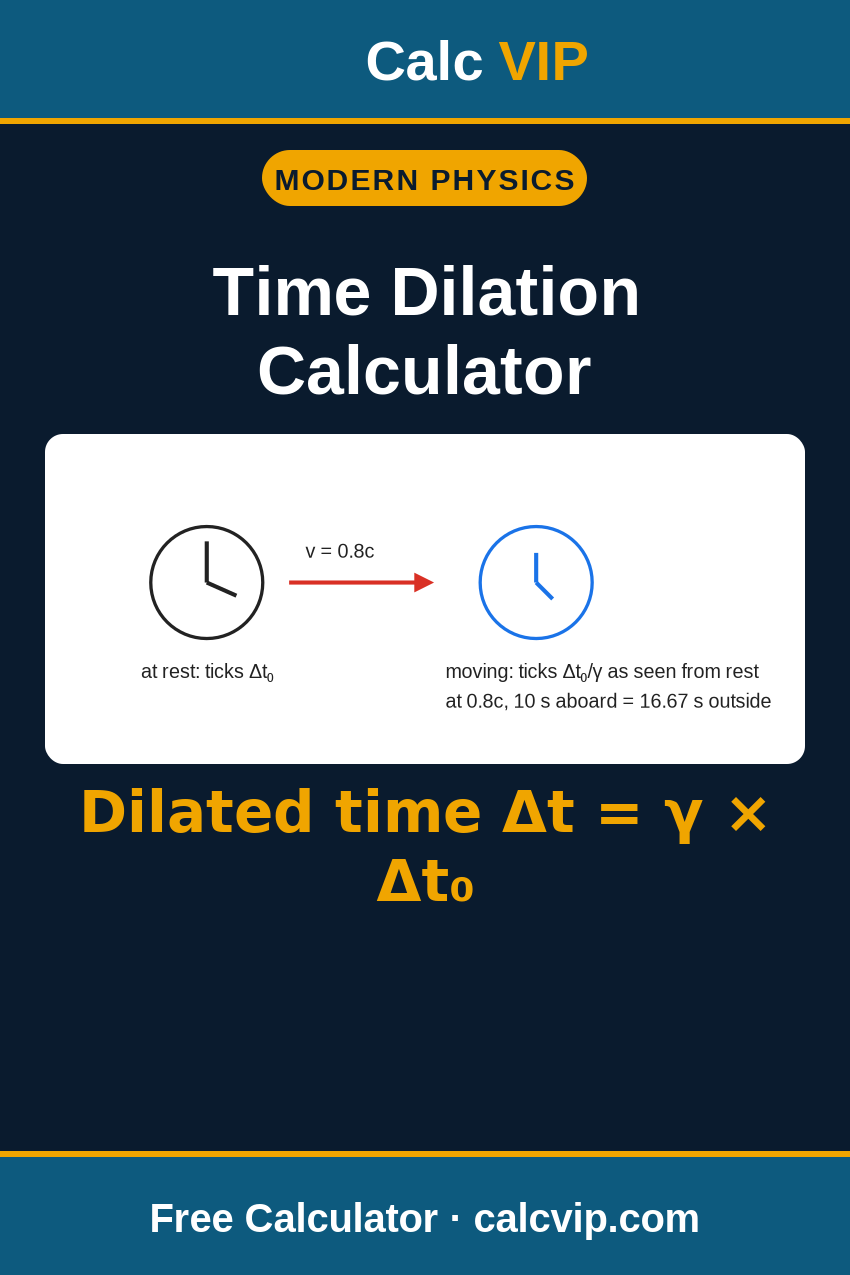
γ = 1 ÷ √(1 − 0.64) = 1 ÷ 0.6 = 1.667, so Δt = 1.667 × 10 = 16.667. Ten seconds pass on the moving clock while sixteen and two-thirds pass outside. The 0.8c speed is relativity's favourite illustration because the numbers are clean — γ = 5/3 exactly — but the physics at any other speed is identical in kind.
Example 2 — the muon that should not reach the ground. A muon lives 2.2 µs at rest. Created at the top of the atmosphere travelling at 0.99c, classically it would cover 0.99 × 3 × 108 × 2.2 × 10−6 = 653 m before decaying — yet muons pour onto detectors at sea level, 10 km down. With γ = 7.089, its lifetime in Earth's frame stretches to 15.6 µs and its range to 4632 m per lifetime — and with several lifetimes' worth of luck, plenty survive the full descent. This is time dilation measured with cosmic rays, for free, every day.
Example 3 — the twin paradox, quantified. A traveller spends 5 years by their own clock cruising at 0.99c (γ = 7.089). Earth measures the trip at Δt = 7.089 × 5 = 35.4 years. On return the traveller is 5 years older; their twin is 35.4 years older. The 30-year difference is not a perspective trick — it is written in grey hair and grown children, and every element of it follows from this one multiplication.
Example 4 — GPS satellites. A GPS satellite orbits at about 3870 m/s, β = 1.29 × 10⁻⁵. The low-speed approximation gives γ − 1 ≈ β²/2 = 8.3 × 10⁻¹¹, so over a day its clock loses 8.3 × 10−11 × 86,400 s ≈ 7.2 µs to special relativity. General relativity (weaker gravity up there) gains it about 45.7 µs, for a net +38 µs/day that the system corrects continuously — uncorrected, positions would drift by roughly 10 km daily.
Example 5 — the astronaut's small change. On the ISS at 7660 m/s for six months (1.578 × 10⁷ s), the SR effect alone trims (7660 ÷ 3 × 10⁸)² ÷ 2 × 1.578 × 107 ≈ 5.1 ms — astronauts return a few milliseconds younger than they would have been. (Gravity's opposing effect claws some of it back; the net for ISS crew is still younger, by milliseconds per mission.)
Example 6 — the atomic-clock aeroplane. In the 1971 Hafele–Keating experiment, caesium clocks flown around the world at jet speeds (~250 m/s, β²/2 ≈ 3.5 × 10⁻¹³) were predicted to shift by mere tens of nanoseconds from velocity alone — about 50 ns over 40 hours of flying — entangled with a larger gravitational shift of the opposite sign. The measured results matched relativity's combined prediction, the first direct proof that transported clocks keep different time.
Time dilation in real life
GPS and satellite navigation. The standing industrial application: every navigation fix you have ever taken depended on relativistic clock corrections computed with this formula (plus its gravitational twin). Relativity is not a theory about GPS; it is part of its plumbing.
Particle accelerators. Unstable particles at high γ live long enough to be useful: muons at γ = 29 in storage rings live 64 µs instead of 2.2 µs, enabling precision measurements of their magnetic properties that probe for new physics. The dilation is measured directly from their decay curves.
Cosmic-ray physics. The muons reaching sea level (Example 2) are the cheapest demonstration in all of relativity — a detector on a desk registers particles that classical physics says should have died kilometres overhead.
Deep-space mission planning. A probe at a tenth of light speed — beyond current engineering but studied for interstellar concepts — would age measurably slower than mission control: at 0.1c, γ = 1.005, so a 40-year mission by Earth clocks is 39.8 years aboard. Small, but mission designers already log relativistic corrections for fast probes' clocks and signals.
Atomic timekeeping. The world's time standard is maintained by comparing atomic clocks, some of them transported between laboratories. At the precision of modern optical clocks — which can detect the dilation from a speed of a few metres per second and the gravitational shift from a height change of centimetres — relativity is a calibration issue, not a curiosity.
Interstellar travel studies. Every serious starship design runs on this calculator: at 0.99c a crew could reach the galactic centre, 26,000 light-years away, in about 3,700 ship years; at 0.999999c, in about 37. Time dilation is the only known loophole that lets humans outlive a journey measured in light-millennia — at ferocious energy cost.
Quick reference: the Lorentz factor
| Speed | γ | 1 year aboard equals |
|---|---|---|
| 0.1c | 1.005 | 1.005 years at home |
| 0.5c | 1.155 | 1.155 years |
| 0.8c | 1.667 | 1.667 years |
| 0.9c | 2.294 | 2.294 years |
| 0.99c | 7.089 | 7.09 years |
| 0.999c | 22.37 | 22.4 years |
| 0.9999c | 70.71 | 70.7 years |
The table's lesson is the cliff at the right-hand end: the first 90% of light speed buys you barely γ = 2.3, while the last 0.09% buys a factor of thirty. Time dilation is a game played entirely in the final decimal places of β — and priced accordingly in energy.
What about gravity? The other clock effect
Special relativity is only half the clock story. General relativity adds that clocks deeper in a gravitational field tick slower — a clock at sea level ages less than one on a mountain, by about a part in 1013 per kilometre of height. For GPS the two effects fight: velocity slows the satellite clocks by 7.2 µs/day, altitude speeds them by 45.7 µs/day, net +38 µs/day fast. For the ISS, orbiting lower and faster, velocity wins narrowly and crews age slightly slower. The two effects are computed separately and added; this calculator handles the velocity half, which dominates for anything moving fast and far from home — and for the deepest space probes, both corrections are already routine in navigation.
Common mistakes
- Swapping Δt and Δt₀. The moving clock's own reading (proper time) is always the smaller number. If your result has the traveller ageing more than the stay-at-home, the two have been exchanged.
- Entering the speed in m/s. This calculator wants β, the fraction of c. Entering 250 for a jet asks for 250 times light speed and is refused; convert first: β = v ÷ 3 × 10⁸.
- Expecting an effect at road speeds. At 30 m/s, γ − 1 ≈ 5 × 10⁻¹⁵: over a human lifetime of driving it accumulates to far less than a microsecond. The formula is exact at low speed — it just has almost nothing to say there.
- Thinking the traveller feels time slow down. Aboard the ship, everything — clocks, hearts, thoughts — is slowed together, so nothing feels different. Dilation is only visible when clocks are compared, never from inside one clock.
- Treating the twin paradox as a contradiction. The asymmetry is real: only one twin accelerates and turns around. Uniform-motion reciprocity applies while both coast; the reunion comparison is unambiguous, and experiment sides with the formula.
FAQ
Is time dilation real or just a maths trick?
Completely real and measured daily: fast-moving muons live longer than stationary ones, and GPS satellites' clocks must be corrected for relativity or navigation would drift by kilometres per day.
Why don't we notice it in daily life?
At everyday speeds v/c is nearly zero, so γ ≈ 1.0000000... The effect only becomes noticeable above roughly a tenth of light speed.
Can γ be less than 1?
No. γ is always 1 or more, and grows to infinity as v approaches c — which is one reason nothing with mass can reach light speed.
Does time dilation mean astronauts age more slowly?
Yes — by milliseconds per mission at orbital speeds, as Example 5 shows. It is the same effect as the twin paradox, scaled down to what chemical rockets can reach: real, measured with atomic clocks flown in orbit, and far too small to notice without them.
If I travel at 0.99c, do I see Earth clocks running fast?
While coasting, each of you measures the other's clock as slow — the situation is symmetric. The asymmetry appears only when someone turns around to compare clocks in person; then the traveller's total is unambiguously the smaller, and both twins agree on the result.
Has time dilation ever been measured with people?
Not perceptibly — human-scale speeds are too low. The record-holders are astronauts, younger by milliseconds. The effect has, however, been measured with clocks at walking pace: modern optical clocks detect the dilation from motion of a few metres per second.
What happens to time exactly at light speed?
The formula refuses to answer: γ becomes infinite and Δt₀ shrinks to zero along a light ray's path. Massive objects can never get there — the energy required grows without limit — so the question sits outside what the physics allows to happen.
Is time dilation the same as the Doppler effect?
No. Doppler shifts change the rate at which signals arrive because distance is changing; time dilation changes the rate at which the moving clock itself ticks, even after the changing distance is accounted for. The transverse Doppler shift — measured sideways, with no approach or recession — is pure time dilation and has been measured directly.
Could time dilation let me live forever?
It can stretch your wait but not your life: you would experience your own years at the usual rate, merely fewer of them while the outside universe rushes ahead. You could witness the far future, but you would age normally getting there — a one-way trip into tomorrow, not an escape from ageing.
Why does GPS need general relativity too?
Because gravity also bends clock rates, in the opposite direction for satellites and by a larger amount (+45.7 µs/day against −7.2 µs/day). Netting the two is what the system's engineers actually do; this calculator covers the special-relativistic term.