 Calc
Transition Energy Calculator – Hydrogen Electron Jumps & Photon Wavelength
 Created by Yuki Tanaka · Physics Editor · Modern Physics · Last updated: November 2026
Use this free Hydrogen Transition Energy Calculator to find the energy released (or absorbed) when an electron jumps between energy levels (shells) in a hydrogen atom, plus the frequency and wavelength of the photon involved.
The story begins with the ladder itself. In the Bohr picture of hydrogen, the electron may sit only on certain rungs, labelled n = 1, 2, 3…, with energies En = −13.6/n² eV. The negative sign means the electron is bound: you would have to add 13.6 eV to free it completely from the ground state. The rungs crowd together as n grows — the gap from n = 1 to n = 2 is 10.2 eV, while from n = 9 to n = 10 it is a mere 0.026 eV — and at n = ∞ the energy reaches zero, the electron escapes, and the atom is ionised.
Because only the rungs exist, only the gaps between them can appear as light. When an electron drops from rung n₂ to rung n₁, the atom sheds the difference as a single photon whose energy is exactly the gap, ΔE = 13.6 × (1/n₁² − 1/n₂²) eV. That one fact explains the entire science of spectroscopy: the spectrum of hydrogen is not a rainbow but a barcode, a set of sharp lines whose positions are fixed by arithmetic on small whole numbers. This calculator performs that arithmetic and reports the photon's energy, frequency and wavelength, together with the series the line belongs to.
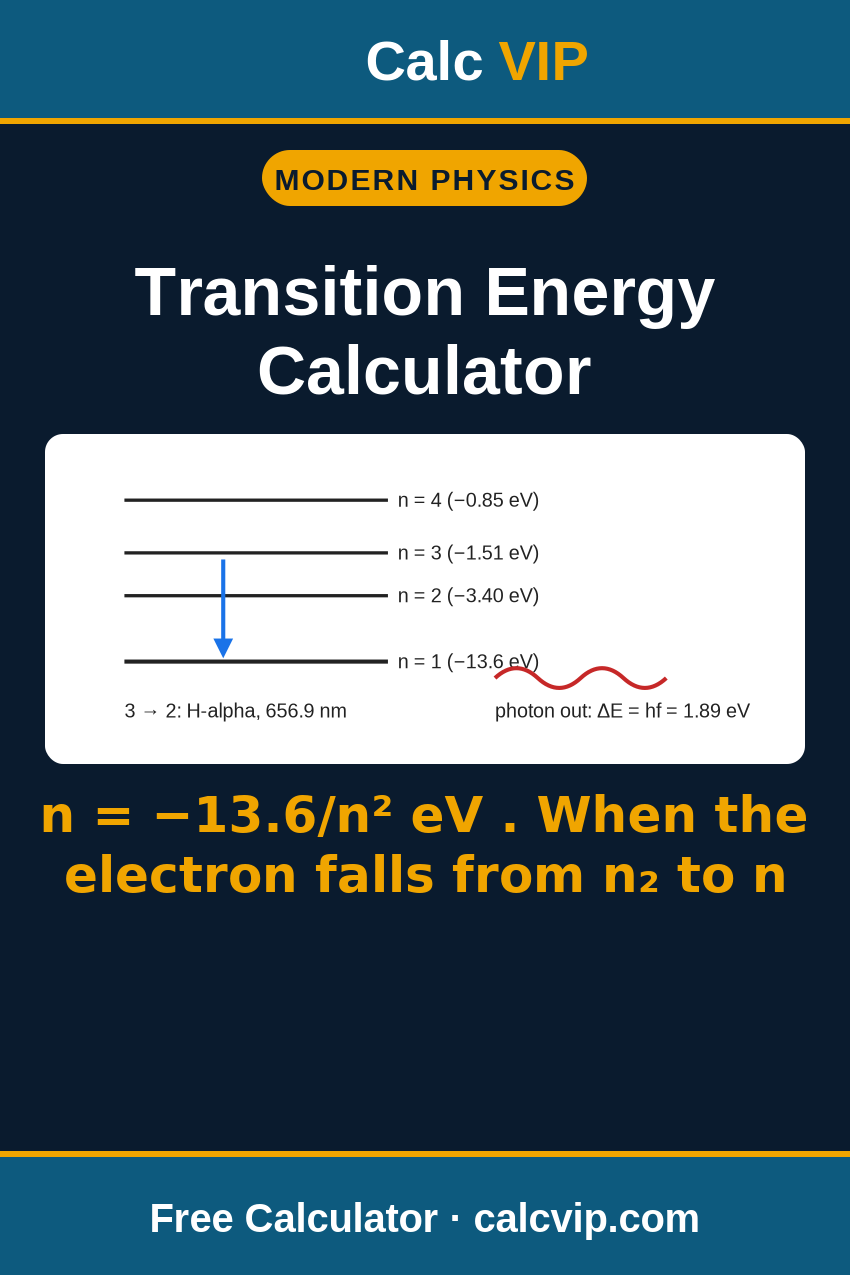
The series names mark where the fall ends. Falls to n₁ = 1 release the most energetic photons, the ultraviolet Lyman series; falls to n₁ = 2 give the Balmer series, the only one landing in visible light and the source of hydrogen's famous red glow in nebulae; falls to n₁ = 3, 4 and beyond trail off into the infrared Paschen and Brackett series. One atom, one ladder, three families of light — and, as the worked examples show, wavelengths spanning from 30 nm to nearly 2 µm once a second electron is removed to make He⁺.
Formula
The energy of level n in hydrogen is En = −13.6/n² eV. When the electron falls from n₂ to n₁, the photon carries away the difference: ΔE = 13.6 × (1/n₁² − 1/n₂²) eV. The same result rearranges into the photon's other identities: in joules, ΔE(J) = ΔE(eV) × 1.602 × 10⁻¹⁹; its frequency is f = ΔE/h; and its wavelength is λ = c/f = hc/ΔE. Combining the constants gives the spectroscopist's shortcut λ(nm) ≈ 1240/ΔE(eV). For a hydrogen-like ion with nuclear charge Z (He⁺, Li²⁺), every energy scales by Z²: ΔE = 13.6 Z² × (1/n₁² − 1/n₂²) eV. This calculator treats hydrogen itself (Z = 1), so for ions, multiply its ΔE by Z² and divide its wavelength by Z².
| Symbol | Meaning | Units |
|---|---|---|
| n₁, n₂ | lower and upper energy levels (shells) | whole numbers, n₂ > n₁ |
| ΔE | energy of the emitted (or absorbed) photon | eV or J |
| f | photon frequency | Hz |
| λ | photon wavelength | nm |
| 13.6 eV | hydrogen's ground-state binding (ionisation) energy | eV |
Why the lines are sharp — and why each element has its own barcode
A free particle can have any energy, so processes involving free particles produce smooth, continuous spectra — the rainbow smear of a hot filament. A bound electron cannot. Its menu of energies is a discrete list, so the photon energies it can emit form a discrete list too, and a spectroscope shows them as isolated bright lines with darkness between. The gaps in the ladder become gaps in the light. That discreteness is the entire basis of chemical fingerprinting: hydrogen's ladder is fixed by 13.6 eV and the 1/n² pattern, helium's by a different set of levels, iron's by a forest of thousands — and none of them can be confused with another, because the arithmetic of each ladder is unique.
The ladder also dictates a strict etiquette. An atom in its ground state can absorb only photons whose energy matches a climb from n = 1 — which is why cool hydrogen gas absorbs exactly the Lyman wavelengths it would emit when excited, carving dark lines into starlight at the same positions. And an electron need not fall in one leap: an electron landing from n = 4 may pause at n = 3, then n = 2, then n = 1, emitting three cheaper photons instead of one expensive one. Nebulae exploit every route, which is why their spectra contain the whole family of lines at once, each one a direct readout of a single rung-to-rung fall.
How to use
- Enter the upper level n₂ (where the electron starts) — it must be the bigger number, at least 2.
- Enter the lower level n₁ (where the electron ends up), at least 1.
- Click "Calculate Transition Energy" to get ΔE in eV and joules, the photon frequency, wavelength and spectral series.
- For an absorption, read the same numbers in reverse: a photon of exactly this energy is what the atom must swallow to climb from n₁ to n₂.
Worked examples
Example 1 — H-alpha, the red line. An electron falls from n₂ = 3 to n₁ = 2.
ΔE = 13.6 × (1/2² − 1/3²) = 13.6 × (0.25 − 0.1111) = 1.89 eV = 3.03 × 10⁻¹⁹ J
f = ΔE/h = 3.03 × 10⁻¹⁹ / 6.626 × 10⁻³⁴ = 4.57 × 10¹⁴ Hz
λ = c/f = 3 × 10⁸ / 4.57 × 10¹⁴ = 656.9 nm — deep red light, the colour that makes many nebulae glow red.
Example 2 — Lyman-alpha. A fall from n₂ = 2 to n₁ = 1.
ΔE = 13.6 × (1 − 1/4) = 10.2 eV = 1.63 × 10⁻¹⁸ J; f = 2.47 × 10¹⁵ Hz; λ = 121.6 nm, in the far ultraviolet. Lyman-alpha is the most important single line in astronomy — the glow of hydrogen itself, used to find the youngest galaxies.
Example 3 — H-beta. A fall from n₂ = 4 to n₁ = 2.
ΔE = 13.6 × (0.25 − 0.0625) = 2.55 eV; f = 6.17 × 10¹⁴ Hz; λ = 486.6 nm — the blue-green Balmer line that pairs with H-alpha in nebula photographs.
Example 4 — Paschen-alpha. A fall from n₂ = 4 to n₁ = 3.
ΔE = 13.6 × (1/9 − 1/16) = 13.6 × 0.04861 = 0.661 eV; f = 1.60 × 10¹⁴ Hz; λ = 1876.9 nm — invisible infrared, nearly three times H-alpha's wavelength for a fall between neighbouring high rungs.
Example 5 — the ionisation edge. An electron at n₁ = 1 absorbs a photon and just escapes (n₂ = ∞).
ΔE = 13.6 × (1 − 0) = 13.6 eV; λ = 91.2 nm. Any photon shorter than 91.2 nm ionises hydrogen from the ground state — the Lyman limit, a cliff edge written into the spectra of stars and quasars.
Example 6 — helium ion, He⁺. With Z = 2, energies scale by Z² = 4. The 2 → 1 fall gives
ΔE = 13.6 × 4 × (1 − 1/4) = 40.8 eV; λ = 121.6/4 = 30.4 nm — extreme ultraviolet, four times as energetic as hydrogen's own Lyman-alpha. The same trick with Z² lets one calculator serve every hydrogen-like ion.
Transition energies in real life
Nebula colours. The red of the Orion Nebula is H-alpha photons from 3 → 2 falls; the teal-green tinge comes from oxygen's own ladder. Astrophotographers' narrowband filters are cut to exactly these calculated wavelengths.
Identifying elements in stars. Astronomers match observed line positions against ladder arithmetic like this page's to read a star's composition from light that left it thousands of years ago — no sample required.
Neon signs and discharge lamps. Gas-discharge tubes glow at their gases' transition wavelengths. Hydrogen lamps, used to calibrate spectroscopes, shine precisely because their Balmer lines are known to this calculator's precision.
Lasers. A laser engineers a situation where many atoms sit on an upper rung and fall together, emitting identical photons in step. The laser's colour is a transition energy chosen in advance — the red of a helium–neon laser is a neon ladder gap.
Flame tests and fireworks. Heat lifts electrons up the ladder; their falls produce each element's signature colour — sodium's orange, strontium's crimson, copper's green — analytical chemistry performed by eye.
The 21 cm line of radio astronomy. Hydrogen's ground state is split by a tiny magnetic interaction into two levels a mere 5.9 × 10⁻⁶ eV apart; falls between them emit at λ = 21 cm, the signal that maps our galaxy's spiral arms.
The Rydberg formula: the same ladder, read as wavelengths
Before Bohr explained the ladder, spectroscopists had already found its shadow empirically. The Rydberg formula, 1/λ = R × (1/n₁² − 1/n₂²) with R = 1.097 × 10⁷ m⁻¹, predicts every hydrogen wavelength directly. Check it against Example 1: 1/λ = 1.097 × 10⁷ × (0.25 − 0.1111) = 1.524 × 10⁶ m⁻¹, so λ = 656.9 nm — the same answer, because Rydberg's constant is just 13.6 eV wearing wavelength units (R = 13.6 eV/(hc)). Each series also has a limit, the wavelength of the ∞ → n₁ fall: 91.2 nm for Lyman, 364.9 nm for Balmer. Lines crowd ever closer together as they approach the limit, then stop — the visible edge of the ladder, beyond which the electron is free and the spectrum turns continuous.
Quick reference: hydrogen's headline transitions
| Transition | Name / series | ΔE (eV) | λ (nm) |
|---|---|---|---|
| 2 → 1 | Lyman-alpha (UV) | 10.20 | 121.6 |
| 3 → 1 | Lyman-beta (UV) | 12.09 | 102.6 |
| 3 → 2 | H-alpha (Balmer) | 1.89 | 656.9 |
| 4 → 2 | H-beta (Balmer) | 2.55 | 486.6 |
| 5 → 2 | H-gamma (Balmer) | 2.86 | 434.5 |
| 4 → 3 | Paschen-alpha (IR) | 0.66 | 1876.9 |
| ∞ → 1 | Lyman limit (ionisation) | 13.60 | 91.2 |
Selection rules and forbidden lines: the falls that barely happen
Not every rung-to-rung fall is equally willing. The photon carries one unit of angular momentum, so the electron's orbital quantum number must change by exactly one (Δl = ±1) for a "permitted" transition; falls that break the rule are called forbidden — not impossible, but slowed by factors of millions. The most famous forbidden line in astronomy is the green 500.7 nm emission of doubly ionised oxygen, [O III], which lit up nebulae for decades as the mysterious "nebulium" lines before being identified in 1927. In a laboratory the excited oxygen ion is knocked out of its metastable state by collisions long before it can radiate; in a nebula, where an atom may wait years between collisions, the forbidden fall finally happens. The same physics makes hydrogen's 21 cm line absurdly slow — it is a magnetic spin-flip transition with a mean wait of about ten million years per atom — yet the sheer census of hydrogen atoms makes it the brightest radio beacon in the galaxy. Transition energy tells you where a line sits; selection rules tell you whether the universe bothers to shine there.
Cascades have their own etiquette too. An electron arriving at n = 4 holds a ticket worth 12.75 eV if it falls straight to the ground (a 97.3 nm photon), but it may instead descend the stairs — 4 → 3 (0.66 eV), 3 → 2 (1.89 eV), 2 → 1 (10.2 eV) — and the step energies sum exactly to the direct fall's: 0.66 + 1.89 + 10.2 = 12.75 eV. Energy conservation guarantees the bookkeeping; probability decides the route. In a hot nebula all routes are populated at once, which is why a single spectrogram shows the whole family — Lyman, Balmer and Paschen lines side by side, one atom's ladder read out in parallel by billions of atoms taking different stairs.
Absorption, emission and the temperature of gas
Kirchhoff's laws tie this calculator to thermometers. A hot, dense gas emits a continuous spectrum; a hot, thin gas emits bright lines at exactly the transition energies; a cool, thin gas in front of a bright source absorbs at those same energies, carving dark lines. The identity of the emission and absorption wavelengths is forced by the ladder: climbing a gap costs precisely what falling it pays. Astronomers exploit the ratio of line strengths to read temperature — the relative population of rungs follows Boltzmann's factor, so a gas hot enough to populate n = 3 shows H-alpha in absorption in stellar spectra, while cooler gas shows only ground-state (Lyman) absorption. The calculator gives the rungs; the populations written on them are the gas's temperature, pressure and history, which is why a page of arithmetic on the numbers 1, 2, 3… underlies so much of astrophysics.
Common mistakes
- Swapping n₁ and n₂. The formula needs (1/n₁² − 1/n₂²) with n₁ the lower level. Reversed, ΔE comes out negative — the calculator refuses n₂ ≤ n₁ for exactly this reason.
- Forgetting the squares. The levels go as 1/n², not 1/n. Using 1/2 − 1/3 for H-alpha gives 2.27 eV instead of 1.89 eV — plausible-looking and wrong.
- Mixing eV and joules in f = ΔE/h. Planck's constant in SI needs ΔE in joules. Skipping the × 1.602 × 10⁻¹⁹ conversion throws the frequency off by nineteen orders of magnitude.
- Applying 13.6 eV to other atoms. Only hydrogen (and hydrogen-like ions, with the Z² factor) uses 13.6. Helium's neutral atom, sodium, iron — all have their own level structures that this simple ladder cannot reproduce.
- Expecting a continuum from bound electrons. Bound-to-bound transitions give sharp lines only. A smooth spectrum means free electrons or hot dense matter are involved, not this ladder.
FAQ
What if the electron jumps UP to a higher level?
Then the atom must absorb a photon of exactly the same ΔE. The energy amount is identical; only the direction (absorption instead of emission) changes.
Why do only certain wavelengths appear?
Because the energy levels are discrete (quantised), only photons whose energy exactly matches a gap between two levels can be emitted or absorbed. That is why each element has its own fingerprint of spectral lines.
Does this work for other atoms?
The 13.6 eV formula is exact only for hydrogen (and hydrogen-like ions with one electron, where 13.6 is multiplied by Z²). Multi-electron atoms have more complicated level patterns.
What does the negative sign in En = −13.6/n² mean?
The zero of energy is set at a free electron at rest (n = ∞). Bound states sit below zero: you must supply +13.6 eV to lift a ground-state electron up to freedom. The photon energy ΔE is quoted as a positive amount because it is the size of the gap.
How many spectral lines can hydrogen produce?
From a single excited level n, the electron can cascade through every lower rung, giving up to n(n−1)/2 distinct lines across all cascades — from n = 4, six lines. Real spectra show all of them at once because countless atoms take different routes down.
Why is the Balmer series the only visible one?
Coincidence of scale: Lyman gaps (≥ 10.2 eV) are too energetic for the eye, landing in the ultraviolet; Paschen gaps (at most 1.51 eV, the energy of the ∞ → 3 series limit) are too feeble, landing in the infrared. Balmer gaps of 1.89–3.4 eV sit exactly in the visible window.
What is the Rydberg constant?
R = 1.097 × 10⁷ m⁻¹, the constant in 1/λ = R(1/n₁² − 1/n₂²). It is not a new piece of physics: R = 13.6 eV expressed through hc, so the Rydberg and Bohr formulas are the same ladder read in different units.
Can an electron fall more than one rung at a time?
Yes — direct falls like 4 → 1 happen and emit a single photon with the full gap energy (12.75 eV, 97.3 nm). Cascades through intermediate rungs are simply the alternative route, and the photon energies of the steps add up to the direct fall's energy.
Why do real hydrogen lines have such precise wavelengths?
Because the inputs are fundamental constants: the electron mass, its charge and Planck's constant fix 13.6 eV with no adjustable knobs. Tiny corrections (the nucleus's finite mass, relativistic effects) shift lines by parts in ten thousand — measured, and themselves a triumph of the theory.
What happens above the ionisation limit?
Once the electron is free it can carry any kinetic energy, so absorption above 13.6 eV (below 91.2 nm) is continuous rather than line-like. The sharp edge at the series limit, with continuum beyond, is a fingerprint seen in stellar spectra.