 Calc
Rocket Equation Calculator – Tsiolkovsky Δv = ve ln(m0/mf)
 Created by James Carter · Physics Writer · Forces & Motion · Last updated: November 2026
Use this free Rocket Equation Calculator to find a rocket's change in velocity (Δv) with the Tsiolkovsky rocket equation. It shows why rockets are mostly fuel: Δv grows only with the logarithm of the mass ratio.
Tsiolkovsky Rocket Equation
Every rocket ever flown is an argument with one equation. The Tsiolkovsky rocket equation, published by Konstantin Tsiolkovsky in 1903 — decades before any rocket left the ground — states that a rocket's total change in velocity depends on just two things: how fast it throws its exhaust backwards, and the ratio of its mass fully fuelled to its mass empty. Nothing else. Not its size, not its thrust, not its shape. This calculator evaluates that verdict: enter the exhaust velocity and the two masses, and it returns the Δv — the rocket's entire budget of manoeuvre, the currency in which all spaceflight is priced.
The equation's sting is the logarithm. Δv grows with ln(m0 / mf), and logarithms grow with excruciating slowness: doubling your fuel does not double your Δv, it adds a fixed increment — one exhaust-velocity times ln 2 — no matter how large the rocket already is. Run the numbers the other way and the demand is exponential: each additional ve worth of Δv multiplies the required mass ratio by e ≈ 2.718. This is the famous tyranny of the rocket equation, and it is why a rocket on the launch pad is typically 85–95% propellant by mass, why its tanks are gossamer-thin, and why engineers speak of payloads in grudging kilograms.
Δv itself deserves a word, because it is not a speed but a capacity: the total velocity change the rocket can perform across its whole mission, spent however the flight plan chooses — climbing to orbit, braking into orbit around another world, or coming home. Reaching low Earth orbit costs about 9–10 km/s of it once gravity and drag take their cut; escaping Earth entirely takes about 13; and every mission in the catalogue is a shopping list measured against what the equation grants. Enter idealised numbers here — the calculator ignores gravity and drag, as the equation itself does — and read the result as the rocket's theoretical best, the number real missions then discount.
Formula
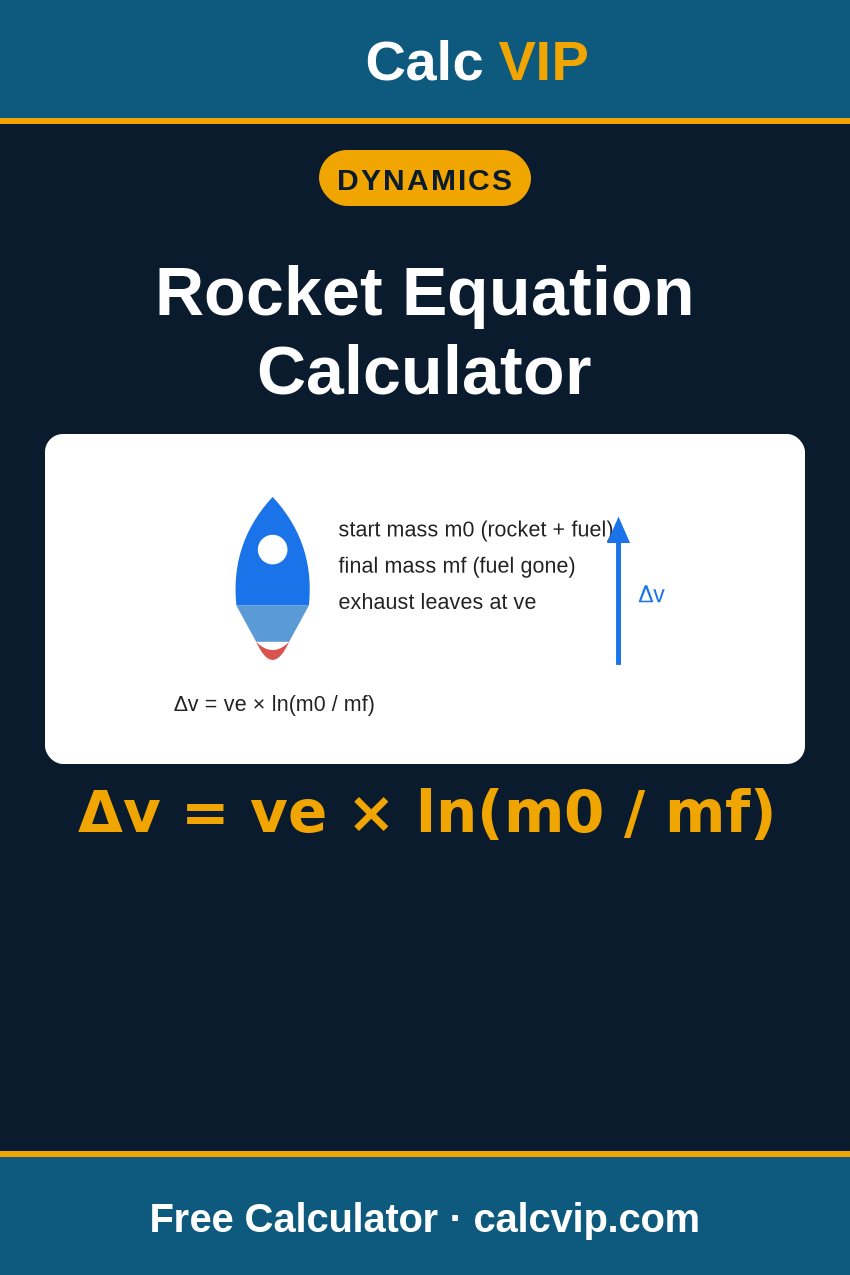
Δv = ve × ln(m0 / mf) — the Tsiolkovsky rocket equation. ve is the exhaust velocity relative to the rocket, m0 the fully fuelled mass, mf the dry (final) mass, and ln the natural logarithm. It comes from applying momentum conservation continuously as the rocket throws mass backwards.
The equation rearranges into its most sobering form when solved for the mass ratio: m0 / mf = e^(Δv / ve). Read it as a price list — to buy Δv equal to one exhaust velocity, the rocket must start e times heavier than it ends; two exhaust velocities cost e² ≈ 7.4; three cost e³ ≈ 20. Engineers also meet the exhaust velocity wearing a different uniform: specific impulse, Isp = ve / g0, quoted in seconds (chemical engines score 250–450 s; ion thrusters, thousands). The derivation is momentum conservation applied drop by drop: each parcel of exhaust thrown backwards at ve carries momentum the rocket must match forwards, but the rocket being accelerated is lighter with every parcel — and integrating that shrinking-mass recoil, parcel by parcel, is precisely what produces the logarithm.
| Symbol | Meaning | Units |
|---|---|---|
| Δv | total change in velocity the rocket can achieve | m/s |
| ve | exhaust velocity relative to the rocket | m/s |
| m0 | initial mass — rocket plus all propellant | kg |
| mf | final (dry) mass after the burn | kg |
| ln | natural logarithm (base e ≈ 2.718) | — |
Why the logarithm? The rocket must carry its own future
Imagine the burn in two halves. In the first half, the rocket accelerates not only itself but all the fuel reserved for the second half — that unburnt fuel is dead weight being carried along. In the second half, the fuel burnt is accelerating a much lighter vehicle, so each kilogram of it buys more velocity. The rocket equation is the exact accounting of that unfairness: the early propellant is spent largely on moving later propellant. This is also why the gains saturate. Going from a mass ratio of 4 to 8 — doubling the propellant fraction's ambition — adds only ve × ln 2 ≈ 0.69 ve of Δv. Going from 8 to 16 adds the same 0.69 ve again. Each doubling of the ratio buys the same fixed increment, forever. There is no cleverness that escapes this; there is only raising ve, or cheating the ratio — which is what staging is.
Staging deserves its paragraph because it is humanity's one real counter-move. A multi-stage rocket discards empty tanks and engines the moment they are dry, so the mass that the remaining fuel must accelerate suddenly shrinks — each stage begins life with a fresh, favourable ratio, and the stages' Δv contributions simply add. The Saturn V stacked three such bargains to reach a total Δv no single stage of its era could have achieved. The price is complexity and discarded hardware; the equation collects its tax regardless, but staging pays it in instalments the engineering can afford.
How to use
- Enter the exhaust velocity in m/s (chemical rockets: roughly 2,500–4,500 m/s; ion thrusters: 20,000–40,000 m/s).
- Enter the starting mass including all fuel (m0), and the final mass once the fuel is gone (mf) — mf must be smaller than m0, and it includes tanks, engines and payload, not just the payload alone.
- Click "Calculate Δv" — the result ignores gravity and air resistance, so it is the ideal velocity change in space.
- Compare against the mission's price: about 9–10 km/s for low Earth orbit from the ground, roughly 3–4 km/s from there to the Moon's surface region — and watch how the required ratio explodes as the demand approaches the rocket's grant.
Worked examples
Example 1 — the textbook rocket. A rocket has exhaust velocity 2,500 m/s, starts at 1,000 kg and burns down to 250 kg.
Mass ratio = 1000 / 250 = 4, and ln(4) = 1.3863.
Δv = 2500 × 1.3863 = 3,465.74 m/s — about 3.47 km/s of velocity change from a mass ratio of just 4. Respectable — enough for serious in-space manoeuvring — but barely a third of the way to orbit from the ground.
Example 2 — a ratio of ten. A more ambitious stage with ve = 3,000 m/s starts at 10,000 kg and ends at 1,000 kg. Ratio = 10, ln(10) = 2.3026, so Δv = 3,000 × 2.3026 ≈ 6,907.76 m/s. Two and a half times Example 1's ratio bought exactly double its Δv — the logarithm's exchange rate in action, and note that 90% of this rocket's pad mass was propellant.
Example 3 — the ion probe. An ion thruster's exhaust velocity is 30,000 m/s — ten times a chemical engine's — but the probe can only manage a modest ratio: 1,500 kg fuelled, 1,000 kg dry. ln(1.5) = 0.4055, so Δv = 30,000 × 0.4055 ≈ 12,163.95 m/s. A ratio of merely 1.5 outperforms every chemical example on this page, because ve multiplies everything. This is why probes like Dawn crossed the asteroid belt on a few hundred kilograms of xenon — and why they accelerate with all the urgency of growing grass: the thrust is tiny, the burn is years.
Example 4 — the water rocket. A school water rocket: effective exhaust velocity about 25 m/s, mass 1.5 kg charged, 0.5 kg empty. Ratio = 3, ln(3) = 1.0986, Δv = 25 × 1.0986 ≈ 27.47 m/s — the ideal ceiling before gravity and drag take their share of a real launch. The same equation prices a toy and a Saturn V without blinking; only the inputs change their clothes.
Example 5 — the doubling fallacy. Take Example 1's rocket and double its mass ratio from 4 to 8 by halving the dry mass to 125 kg. Δv = 2,500 × ln(8) = 2,500 × 2.0794 ≈ 5,198.60 m/s. The gain is 5,198.60 − 3,465.74 ≈ 1,732.87 m/s — exactly 2,500 × ln 2. Doubling the ratio always adds ve × ln 2 ≈ 0.69 ve, whether the doubling is from 2 to 4 or from 200 to 400. Whoever budgets "twice the fuel, twice the Δv" has not yet met the logarithm.
Example 6 — the chemical ceiling. The best chemical propellant, hydrogen and oxygen, reaches ve ≈ 4,500 m/s. Grant it a heroic ratio of 20 (95% propellant): Δv = 4,500 × ln(20) = 4,500 × 2.9957 ≈ 13,480.80 m/s. On paper that flirts with the whole Earth-escape budget — but a real single stage cannot be 95% propellant and carry engines, tanks and a payload in the remaining 5%, and gravity and drag would tax the ideal figure heavily. This gap between the equation's grant and the structure's demand is the entire reason staging exists.
The rocket equation in real life
Launch vehicles. Every rocket on every pad is this equation made metal: roughly nine tenths propellant, with stages stacked to reset the ratio. When a commentator says a launcher can place X tonnes in orbit, they are reporting the solution of this equation for that vehicle's ve and its sequence of ratios.
Deep-space probes. Ion propulsion trades thrust for exhaust velocity — Example 3's bargain. Dawn orbited two different asteroids on one tank of xenon; no chemical rocket with its mass ratio could have bought the Δv. Mission designers choose the trade whenever the journey is long and the cargo is patient.
Station-keeping and satellites. A communications satellite carries a Δv budget measured in decades: small burns to resist orbital drift, each priced by this equation against its remaining propellant. When the budget empties, the satellite is retired — not broken, merely out of Δv, which in orbit is the same thing.
Model and water rockets. Hobbyists meet the tyranny at kitchen-table scale: adding more water to a bottle rocket quickly stops helping, because the added mass must itself be lifted. Example 4's 27 m/s ceiling is why water-rocket altitude records are won on lightweight bottles, not bigger ones.
Why there are no single-stage spaceplanes (yet). Orbit demands about 9–10 km/s after losses; a single stage must earn it all from one ratio while carrying wings, heat shields and landing gear inside mf. The equation permits it only at ratios and exhaust velocities at the edge of materials science — which is why, a century after Tsiolkovsky, rockets still drop their empty tanks and fly on.
Electric aircraft and drones, by analogy. Any vehicle that must carry its energy source fights a gentler cousin of this battle: the battery or fuel that extends range also adds the mass that consumes it. The rocket's logarithm is the purest form of a universal transportation headache.
The price list: mass ratio per mission
Because the ratio is e raised to (Δv / ve), mission demands convert into structural demands with brutal directness. With a chemical exhaust velocity of 3,000 m/s: buying 3,000 m/s of Δv requires a ratio of e¹ ≈ 2.72 (63% propellant); 6,000 m/s requires e² ≈ 7.39 (86%); 9,000 m/s requires e³ ≈ 20.1 (95%); and 12,000 m/s requires e⁴ ≈ 54.6 — a vehicle that is 98.2% propellant, leaving 1.8% for tanks, engines and everything it exists to carry. No structure survives on that ration, which is why the last row of the price list is never bought in a single stage. Staging is simply the refusal to pay e⁴ at once: pay e² twice, dropping the first purchase's empty packaging before buying the second.
Quick reference: Δv budgets of real journeys
| Journey | Approx. Δv needed | Note |
|---|---|---|
| ground → low Earth orbit | ≈ 9–10 km/s | includes ~1.5–2 km/s of gravity & drag losses |
| low orbit → Moon landing & back to orbit | ≈ 5–6 km/s | no atmosphere to help brake — all rocket work |
| low orbit → Mars transfer | ≈ 4–6 km/s | departure burn; arrival can use the atmosphere |
| satellite station-keeping | ≈ 50 m/s per year | small budget, spent for decades |
| Dawn probe, whole mission | > 11 km/s | ion propulsion, ratio only ≈ 1.5 |
Set the budgets beside the price list and the history of astronautics reads itself: chemical rockets can just barely afford the first row, which is why getting to orbit remains the steepest step — from Earth's surface, half of everywhere is the climb off the pad.
Common mistakes
- Using log base 10 instead of ln. The equation demands the natural logarithm. log₁₀(4) = 0.602 instead of ln(4) = 1.386 — a silent factor of 2.3 that turns a healthy Δv into a feeble one. If the answer looks about 2.3 times too small, this is why.
- Letting mf exclude the tanks and engines. The final mass is everything that remains when the propellant is gone — structure, engines, avionics and payload. Counting only the payload flatters the ratio and promises Δv the hardware cannot deliver.
- Expecting Δv to scale with rocket size or fuel amount. Doubling every mass changes nothing; doubling only the ratio adds a fixed ve ln 2. The equation reads ratios and exhaust velocities, and is deaf to absolute tonnage.
- Treating the ideal Δv as the mission result. Gravity and drag tax a real ascent by roughly 1.5–2 km/s, and steering costs more. This calculator returns the theoretical budget; flight plans must spend it with the taxes prepaid.
- Confusing thrust with exhaust velocity. Thrust decides how fast the Δv is delivered (and whether the rocket can lift off at all); ve decides how much Δv exists. A mighty engine with poor ve is a sprinter with a tiny fuel tank — impressive, and going nowhere distant.
FAQ
Why is the logarithm there?
Early in the burn, the rocket must accelerate the fuel it has not used yet. Each extra bit of Δv costs proportionally more fuel than the last, which is exactly what a logarithm describes — this is the famous "tyranny of the rocket equation".
How do real rockets reach orbit, then?
Orbit needs about 9–10 km/s of Δv. Rockets manage it with high exhaust velocities and staging — dropping empty tanks so the final mass mf stays small and the mass ratio stays high.
Does a bigger rocket give more Δv?
Not by itself. Δv depends only on exhaust velocity and the mass ratio, not the absolute size — a small rocket with the same ratio and engine gets the same Δv.
What is specific impulse, and how does it relate to ve?
Specific impulse is the exhaust velocity measured in units of Earth's gravity: Isp = ve / 9.81, quoted in seconds. A ve of 4,500 m/s is an Isp of about 459 s. It lets engineers compare engines of any size on one number — the higher the seconds, the more Δv each kilogram of propellant buys.
Can Δv be larger than the exhaust velocity?
Yes — whenever the mass ratio exceeds e ≈ 2.718. At a ratio of 20 with ve = 2,500 m/s, Δv = 2,500 × ln(20) ≈ 7,489 m/s, three times the exhaust velocity. The rocket outruns its own exhaust because most of the exhaust was thrown when the rocket was already moving fast.
What exhaust velocities do real engines achieve?
Kerosene engines manage roughly 3,000–3,400 m/s in vacuum, hydrogen–oxygen about 4,400–4,500 m/s, and ion thrusters 20,000–40,000 m/s — at thrusts so small they are measured in fractions of a newton. Chemistry caps the first two; electricity escapes the cap by accelerating ions instead of burning molecules.
Why does staging help so much?
Because mf is the enemy. Dropping an empty stage removes its mass from every subsequent calculation, so the next stage starts with a fresh, high ratio. The total Δv is the sum of the stages' Δv — staging converts one impossible ratio into several possible ones.
Does gravity change the equation?
The equation itself is exact for a rocket in free space. Gravity and drag do not alter it; they levy separate charges — roughly 1.5–2 km/s on an Earth launch — which the mission's Δv budget must pay in addition. Think of the equation as the rocket's income and gravity as a tax on the way up.
Why not simply build the tank bigger?
Because the tank is part of mf, and a bigger tank must also be carried, pressurised and accelerated — and the propellant it holds must first accelerate the propellant behind it. The ratio improves far more slowly than the tank grows. That self-defeating loop is the tyranny itself.
Who was Tsiolkovsky?
Konstantin Tsiolkovsky (1857–1935), a Russian schoolteacher who derived the equation in 1903 and worked out much of astronautics — multistage rockets, space stations, airlocks — on paper, decades before the hardware existed. The equation that prices every mission flown since is his.