 Calc
Water Jet Force Calculator – Force of a Liquid Jet on a Wall F = ρAv²
 Created by James Carter · Physics Writer · Forces & Motion · Last updated: November 2026
Use this free Water Jet Force Calculator to find the force a jet of water (or any liquid) exerts when it hits a flat wall head-on and stops. Enter the nozzle diameter, jet speed and liquid density to get the force and the pressure on the wall.
A jet of water is a conveyor belt of momentum. Every second, the nozzle delivers a fresh parcel of liquid — mass ρAv kilograms of it — travelling at speed v, and whatever the jet strikes must absorb that parcel's momentum and then absorb the next one, and the next. The force on the target is nothing more mysterious than the rate at which momentum arrives: F = ρAv². This calculator evaluates it from the three numbers that fix it — nozzle diameter, jet speed and liquid density — and also reports the pressure the jet exerts on the wall it strikes.
The v² in the formula is the story. One factor of v is the momentum each kilogram carries; the other is the rate at which kilograms arrive. Double the jet speed and both double, so the force quadruples — the same treacherous square law that governs kinetic energy and braking distances. It is why a pressure washer's needle jet can strip paint and cut skin while a garden hose at the same flow merely pushes, and why the firefighters in the examples below lean their whole body weight into a hose whose nozzle is only centimetres wide.
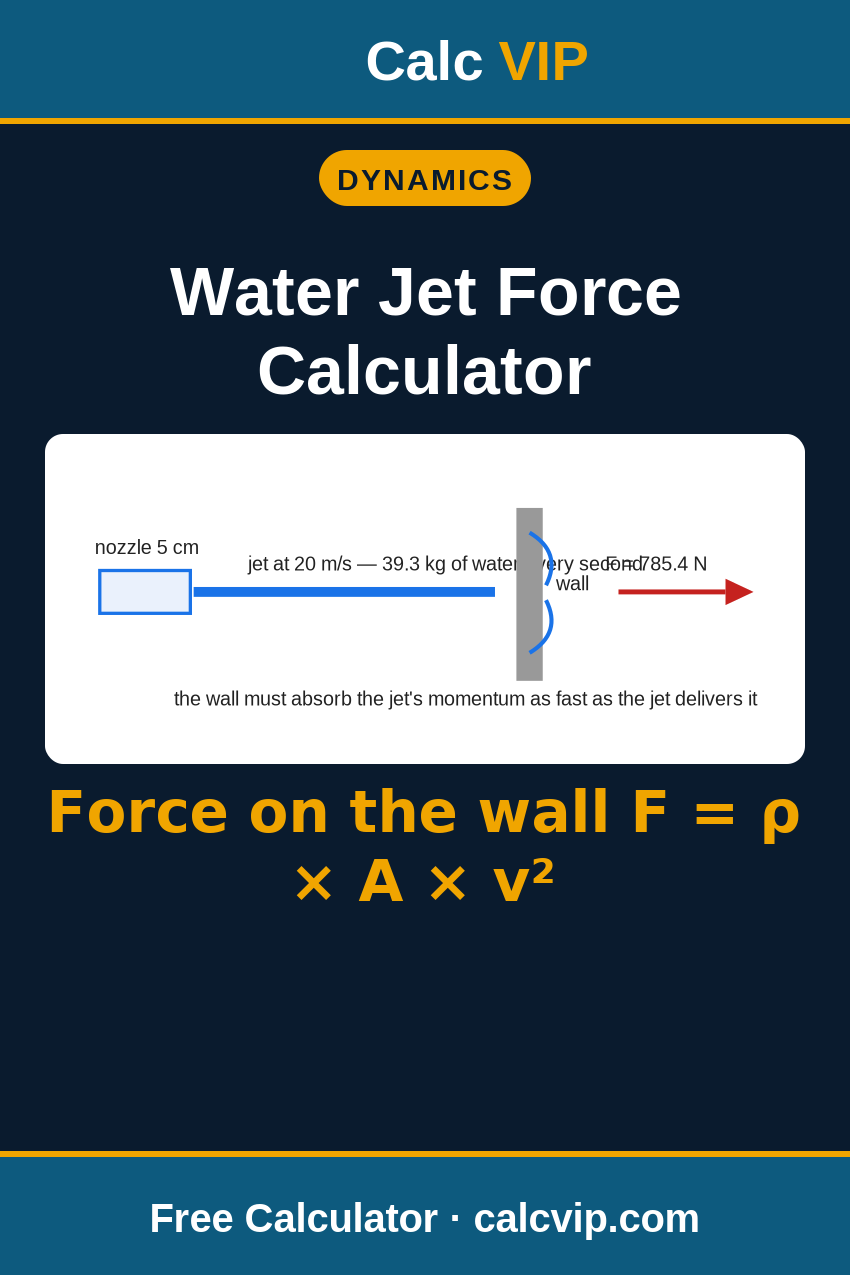
The model here is the clean textbook case: the jet strikes a flat wall head-on and splashes sideways, surrendering all of its forward momentum. Real targets complicate the picture in instructive ways — a curved bucket that turns the jet back on itself doubles the force, a moving wall feels less, an angled wall feels only a component — and the depth sections take up those variations, because between them they explain Pelton turbines, jet boats and the kick of every hose ever held.
Formula
Force on the wall F = ρ × A × v² • Pressure on the wall P = F ÷ A = ρv² • Nozzle area A = π × (d ÷ 2)²
The derivation is one line of momentum bookkeeping. In one second the jet delivers a mass m = ρAv (density × area × the length of jet that arrives, v × 1 s). Stopping that mass removes its momentum, mv = ρAv × v = ρAv², and a rate of momentum removal is a force — Newton's second law in its original form. The pressure follows by dividing the force by the jet's own cross-section, and the area cancels, leaving the memorable P = ρv²: the wall pressure of a stopped jet depends only on the liquid and the speed, not at all on the nozzle size. A wider nozzle pushes proportionally harder in total (more area, more mass per second) but no harder per square metre. Mind the diameter's units as you compute by hand — the calculator takes centimetres and converts; on paper, convert to metres before squaring anything.
| Symbol | Meaning | Units |
|---|---|---|
| F | force exerted on the wall | N |
| ρ | liquid density (water = 1,000) | kg/m³ |
| A | nozzle cross-sectional area, π(d/2)² | m² |
| v | jet speed | m/s |
| P | pressure on the wall, F ÷ A = ρv² | Pa |
Momentum flux: the idea underneath the formula
Physicists call ρAv² a momentum flux — momentum crossing a surface per second — and the concept reaches far beyond hoses. The mass flow rate ṁ = ρAv is the jet's delivery schedule: Example 1's modest 5 cm jet at 20 m/s delivers 1,000 × 0.001963 × 20 ≈ 39.3 kg of water every second, nearly forty litres a second, each kilogram arriving with 20 kg·m/s of momentum to surrender. Force is simply the surrender rate. The same accounting, run in reverse, is rocket thrust (momentum carried away per second by exhaust), the push of a propeller, and the recoil of a hose in the holder's hands — by Newton's third law, the nozzle feels exactly the force the wall feels, backwards, which is why an unrestrained fire hose thrashes like a living thing.
One confusion is worth clearing at the source. Bernoulli's famous dynamic pressure is ½ρv², yet this page's wall pressure is ρv² — twice as large. They are different quantities wearing similar clothes: ½ρv² is the kinetic energy stored in each cubic metre of moving liquid, while ρv² is the momentum each cubic metre delivers per metre of travel. The wall-force calculation is a momentum problem from start to finish, so ρv² is the right figure here; energy bookkeeping governs what a pump must supply, momentum bookkeeping governs what the wall must withstand, and mixing the two ledgers halves or doubles real engineering answers.
How to use
- Enter the nozzle diameter in centimetres — the calculator converts it to metres and computes the area A = π(d/2)² for you.
- Enter the jet speed in metres per second. If you know the flow instead, divide the volume flow rate by the nozzle area to get the speed.
- Leave the density at 1,000 kg/m³ for fresh water, or adjust it — about 1,025 for seawater, 800–900 for oils and fuels.
- Click "Calculate Force" to see the nozzle area, the force on the wall in newtons, and the wall pressure in pascals and kilopascals.
Worked examples
Example 1 — the standard jet. A 5 cm nozzle fires water at 20 m/s: A = π × (0.025)² = 0.001963 m², so F = 1000 × 0.001963 × 20² = 785.4 N — like an 80 kg person standing on the wall — and the pressure is ρv² = 400,000 Pa (400 kPa), four times atmospheric pressure, from an unremarkable-looking jet.
Example 2 — the pressure washer. A washer nozzle of 3 mm drives its jet at 70 m/s: A = π × (0.0015)² ≈ 7.07 × 10⁻⁶ m² and F = 1000 × 7.07 × 10−6 × 70² ≈ 34.64 N of push — modest as a force, but concentrated on a pinhead area the pressure is ρv² = 4.9 MPa, which is what strips paint, moss and careless skin. Small nozzle, huge pressure: the area cancels out of P entirely.
Example 3 — the fire hose. A 6.5 cm hose nozzle at 25 m/s: A = π × (0.0325)² ≈ 0.003318 m² and F = 1000 × 0.003318 × 625 ≈ 2,073.94 N — the weight of a 211 kg mass, pushing continuously. No single firefighter holds that alone against a wall, and by reaction the same force shoves backwards on the crew holding the hose.
Example 4 — doubling the speed. Example 1's nozzle at 40 m/s instead of 20: F = 1000 × 0.001963 × 1,600 = 3,141.59 N — exactly four times the force for twice the speed. The square law is the whole cautionary tale of high-pressure water: modest speed upgrades demand disproportionately stronger walls, hoses and arms.
Example 5 — the garden hose. A 1.5 cm nozzle at a gentle 8 m/s: A ≈ 1.767 × 10⁻⁴ m² and F = 1000 × 1.767 × 10−4 × 64 ≈ 11.31 N — a kilogram's worth of push, enough to water plants and rinse a car, harmless against a wall. Everyday experience of hoses lives at this tame corner of the formula.
Example 6 — the jet that turns back. Aim Example 1's jet into a curved bucket that reverses it completely, Pelton-wheel style, and the momentum change doubles: the water arrives at +20 m/s and leaves at −20, so F = 2ρAv² = 1,570.8 N. Nothing about the jet changed — only the wall's shape — yet the force doubled, which is why turbine buckets are cupped and why a jet glancing off a surface pushes less than one stopped dead.
Water jets in real life
Firefighting. Example 3's two kilonewtons are a working condition, not a curiosity: hose teams brace, branch pipes are held by two or three firefighters, and ladder monitors are bolted down, all because the reaction to ρAv² acts on the crew exactly as the force acts on the fire's wall.
Pelton turbines. Mountain hydro plants fire jets at 100 m/s or more into cupped buckets that split and reverse the stream, harvesting close to the doubled force of Example 6 as torque. The bucket shape is the formula's reflection term, cast in steel.
Water-jet cutting. Industrial cutters push water through hair-thin nozzles at several hundred metres per second; at those speeds ρv² reaches hundreds of megapascals and the jet — often laced with abrasive — slices steel, stone and composites that no hose could scratch.
Jet boats and thrust. A jet boat's impeller throws water backwards; the reaction — momentum flux again — drives the boat forwards. The same equation that sizes the force on a wall sizes the thrust of the nozzle that never touches one.
Pressure washing and cleaning. Example 2's lesson — pressure independent of nozzle size, force not — is the product category: washers advertise pressure because ρv² does the cleaning, while the modest total force keeps the lance holdable.
Hydraulic mining and dredging. Monitor nozzles wash away whole hillsides of gravel by momentum flux, and dredgers fluidise riverbeds with jets — the garden hose of Example 5 scaled by the square law into an earthmoving tool.
Moving walls, angled walls and other honest complications
Three refinements cover most real targets. A retreating wall feels less: if the surface moves away at speed u, the jet catches it at relative speed (v − u), the arriving mass per second falls to ρA(v − u), and the force becomes ρA(v − u)² — the principle that lets a well-timed step backwards soften a hose blast, and the reason turbine buckets are designed around the jet-to-bucket speed ratio. An angled wall only surrenders the momentum component normal to its surface: tilt the plate by angle θ from head-on and the normal force scales down (for a frictionless plate, roughly with cos²θ of the head-on value), the rest of the jet sliding away along the surface. A wall that absorbs the jet into a tank — filling a tanker from a hose — feels the same ρAv² while the jet's momentum is destroyed inside; the tanker genuinely gains that momentum as it fills, a bookkeeping subtlety that has embarrassed more than one exam candidate. In every variant the method survives intact: count the momentum arriving per second, count how much of it the target destroys, and the quotient is the force.
The reaction at the nozzle: the force's mirror image
Every figure in this page has a twin acting on whoever holds the hose. Newton's third law gives the nozzle a backward push exactly equal to the force the jet will exert on its target: Example 3's fire hose shoves its crew with the same 2,073.94 N the stream delivers to the fire, which is why the crew braces before the branch is opened and why a dropped, charged hose whips violently — its reaction, suddenly unopposed, steers the nozzle in circles. At the tame end, Example 5's garden hose pushes back with 11.31 N, the weight of about 1.15 kg — noticeable in the wrist over an afternoon, no more. Propulsion engineers read the same mirror from the other side: a rocket is a nozzle whose "jet" is exhaust gas, and its thrust is the reaction, ρAv² in spirit (with pressure terms the gas adds). The wall and the rocket are one equation read in two directions — what the target feels as force, the source feels as thrust.
Quick reference: force from a 5 cm water nozzle
| Jet speed | Force on wall | Wall pressure |
|---|---|---|
| 5 m/s | 49.09 N | 25 kPa |
| 10 m/s | 196.35 N | 100 kPa |
| 20 m/s | 785.40 N | 400 kPa |
| 40 m/s | 3,141.59 N | 1,600 kPa |
Each doubling of speed multiplies both columns by four. The pressure column is also a stand-alone rule of thumb — ρv² with ρ = 1,000 means every 10 m/s of water speed is worth 100 kPa, roughly one atmosphere, on whatever stops it.
Common mistakes
- Entering the radius where the diameter belongs (or squaring the diameter itself). The area is π(d/2)²: using d instead of d/2 quadruples the area and the force. The calculator's field is the diameter, in centimetres.
- Expecting force to grow in proportion to speed. It grows with v² — one factor for the extra mass per second, one for the extra momentum per kilogram. Doubling the pump speed quadruples the push, the pressure and the danger.
- Reaching for ½ρv². That is Bernoulli's dynamic pressure, an energy density. The force on a wall that stops a jet is a momentum calculation and comes out at ρv² per unit area. Halving it under-designs the wall by a factor of two.
- Forgetting the jet must actually stop. A jet glancing along a wall, or split by a wedge, surrenders only part of its forward momentum. The full ρAv² applies to the head-on stop; angled and curved targets need the component analysis of the depth section.
- Mixing up flow and speed. A fat slow jet and a thin fast jet can carry the same litres per second with wildly different forces, because force prices speed twice. Convert flow to speed through the nozzle area before judging a jet by its flow rate.
FAQ
Why does the force depend on v², not just v?
Doubling the speed doubles the mass arriving each second AND doubles the momentum each kilogram carries — so the force goes up four times.
What if the jet bounces back instead of stopping?
If the jet is reflected straight back (like off a Pelton turbine bucket), the momentum change doubles and the force becomes 2ρAv². This calculator assumes the jet hits a flat wall and splashes sideways, losing its forward momentum.
Is this how fire hoses and pressure washers push?
Yes — the same momentum-flux principle explains the kick of a fire hose and the cutting pressure of a water jet cutter.
What force does the nozzle itself feel?
Exactly the same force, backwards — Newton's third law. The reaction is what kicks a fire hose, pushes a jet boat (whose "wall" is its own impeller throwing water astern) and would propel a garden sprinkler. Whoever creates the jet pays the reaction; whoever stops it pays the force.
How much water does Example 1's jet actually deliver?
ṁ = ρAv = 1,000 × 0.001963 × 20 ≈ 39.3 kg per second — about 39 litres every second, over two tonnes a minute. The force of 785.4 N is what it costs, per second, to keep stopping that delivery.
Does a longer hose change the force?
Only indirectly: friction in a long hose bleeds pressure, so the jet leaves the nozzle slower, and the v² law punishes the loss twice over. The formula always applies to the speed at the nozzle exit, whatever the plumbing upstream did to achieve it.
What if the liquid is seawater or oil?
Change ρ. Seawater at about 1,025 kg/m³ pushes 2.5% harder than fresh water at the same speed; a light oil at 850 kg/m³ pushes about 15% less. Density enters linearly — a gentle effect next to the speed's square.
Can a water jet really cut steel?
Yes. Raise the speed to several hundred metres per second and ρv² climbs into the hundreds of megapascals; add abrasive grit and the jet erodes metal, stone and composites cleanly, with no heat damage — an industry built entirely on this page's formula pushed to its extreme.
Why does the pressure not depend on the nozzle size?
Because pressure is force per area, and both grow together: a nozzle twice as wide delivers four times the area, four times the mass per second and four times the force — the ratio is unmoved. What the wall feels per square metre is set by ρ and v alone.
What if the wall is moving towards the jet?
Then the closing speed rises to (v + u) and the force becomes ρA(v + u)² — one reason driving rain stings a cyclist more than standing rain, and why impact speeds, not jet speeds alone, belong in any honest estimate.