 Calc
Weight Calculator – W = mg on Earth, Moon & Mars
 Created by James Carter · Physics Writer · Forces & Motion · Last updated: November 2026
Use this free Weight Calculator to find the weight of a mass on Earth, the Moon or Mars. Enter the mass, choose the planet, and the calculator gives you the weight in newtons (N).
"What do you weigh?" is a trickier question than it sounds. The number people usually give — so many kilograms — is not really a weight at all. It is a mass: the amount of matter in the body, and it is the same on Earth, on the Moon, in orbit and in deep space. Weight is something different. Weight is a force: the pull of gravity on that mass, measured in newtons. Change the gravity and the weight changes, even though not a single atom of you has been added or removed. This calculator exists to make that distinction concrete, planet by planet.
The confusion is built into everyday language. Shops sell potatoes "by weight" in kilograms, and bathroom scales print kilograms, because on Earth's surface the two quantities march in fixed proportion: every kilogram of mass weighs 9.81 N here, so dividing by 9.81 converts one to the other invisibly. Take the same scale to the Moon, though, and the trick collapses — it would report a "weight" of about a sixth of your Earth value, while your mass, your size and the effort of moving you around remain exactly what they were.
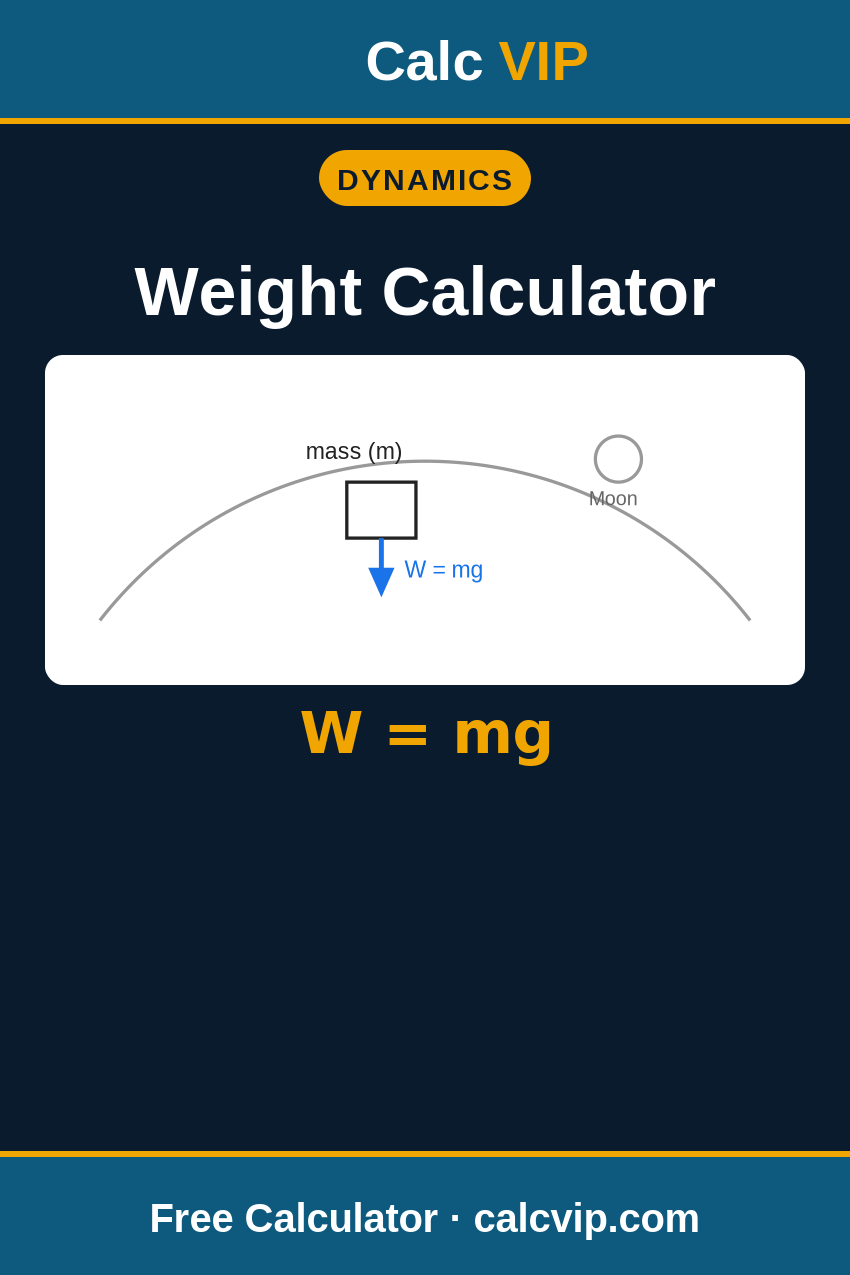
Gravity's strength, written g, is set by the planet beneath you: its mass and its radius. The Moon is small and light, so its surface gravity is feeble. Mars is bigger but still much less massive than Earth. Jupiter, the giant, pulls with nearly two and a half times Earth's gravity. Choose a world in the calculator and watch the same mass report three very different weights.
Formula
Weight = Mass × Gravity → W = mg
Mass stays the same everywhere, but weight depends on the strength of gravity where you are. Gravity is weaker on the Moon and Mars than on Earth, so you would weigh less there. The formula rearranges to find mass from a measured weight: m = W ÷ g — an object weighing 588.6 N on Earth has a mass of 588.6 ÷ 9.81 = 60 kg. And if you ever stand on an unknown world with a spring scale and a known mass, g = W ÷ m tells you that world's surface gravity from a single measurement — which is, in essence, how the gravity of other planets was first estimated from the behaviour of their moons and landers.
Keep the units straight and the formula can never hurt you: kilograms times metres per second squared give newtons, the unit of force. If a "weight" ever arrives in kilograms, it is a mass wearing the wrong label — divide or multiply by the local g to translate.
| Symbol | Meaning | Units |
|---|---|---|
| W | weight — the force of gravity on the mass | newtons (N) |
| m | mass | kilograms (kg) |
| g | surface gravity of the chosen world | m/s² |
Gravity across the solar system
The calculator covers Earth, the Moon and Mars, but the pattern extends. Mercury's g (3.70 m/s²) is almost identical to Mars's, despite Mercury being smaller, because Mercury is unusually dense. Venus, nearly Earth's twin in size, has g = 8.87 m/s², so you would weigh only slightly less there. Jupiter's 24.79 m/s² is the champion among the planets: our 60 kg person would weigh 60 × 24.79 = 1487.4 N, and would struggle to stand. At the opposite extreme, standing on a small asteroid, your weight could be less than the force of a gentle handshake — astronauts hopping on the Moon were, by comparison, firmly planted.
How to use
- Enter the mass in kilograms (kg).
- Choose Earth, the Moon or Mars from the list.
- Click "Calculate Weight" to see the weight in newtons.
- To feel the answer in familiar terms, divide the newtons by 9.81 — that is what an Earth bathroom scale would display for the same pull.
Worked examples
Example 1 — one person, three worlds. A person with a mass of 60 kg on Earth: Weight = 60 × 9.81 = 588.6 N. On the Moon the same person weighs only 60 × 1.62 = 97.2 N, and on Mars 60 × 3.71 = 222.6 N.
Example 2 — an astronaut in a suit. Astronaut plus life-support suit have a combined mass of 120 kg. On Earth that is a weight of 120 × 9.81 = 1177.2 N — a heavy carry. On the Moon it falls to 120 × 1.62 = 194.4 N, which is why Apollo astronauts could work for hours in suits that would have been punishing in Earth gravity, and why their training suits on Earth needed support rigs.
Example 3 — a bag of rice. A 2 kg bag weighs 2 × 9.81 = 19.62 N on Earth, but only 2 × 3.71 = 7.42 N on Mars. A Martian supermarket would sell exactly the same bag with exactly the same "2 kg" on the label — the mass is printed, not the weight, and now you know why that is the honest choice.
Example 5 — one kilogram, four worlds. A standard 1 kg mass weighs 1 × 9.81 = 9.81 N on Earth, 1 × 1.62 = 1.62 N on the Moon, 1 × 3.71 = 3.71 N on Mars and 1 × 24.79 = 24.79 N on Jupiter. The kilogram itself — a definite lump of matter — is the same object in all four places; only the pull reading changes. This is why scientists trade in mass and leave weight to the travel brochures.
Example 6 — reading a weight backwards. A probe reports that a rock weighs 222.6 N on Mars. Its mass is m = W ÷ g = 222.6 ÷ 3.71 = 60 kg — coincidentally the mass of Example 1's person, whose Mars weight this exactly is. Landers really do characterise samples this way: weigh them where they lie, divide by the local g, and the mass is known on Earth without the rock ever leaving Mars.
Weight in real life
Jumping records. On the Moon, the same legs that lift you 0.5 m on Earth could launch you about six times higher and let you hang in the air far longer, because your weight — the force pulling you back — is a sixth as strong, while your mass and muscle power are unchanged. High jump and long jump records would be unrecognisable.
Elevators and apparent weight. Step on a scale in a lift and the reading changes as the lift accelerates: it climbs as the lift starts upward and dips as it slows to a stop. Your true weight, mg, never changed — but the floor's push on you did. What scales measure is that push, called apparent weight, and it is why your stomach lurches in fast lifts and on roller coasters.
Weightlessness is not zero gravity. Astronauts on the International Space Station float, yet gravity at their altitude is still about 8.7 m/s² — nearly 90% of its surface strength. They are weightless because they and their station are falling around the Earth together, in continuous free fall. Nothing supports them, so no support force presses back, and apparent weight vanishes while true weight remains.
Example 4 — a Mars rover. A rover of mass 1000 kg weighs 1000 × 9.81 = 9810 N on Earth but only 1000 × 3.71 = 3710 N on Mars. Its wheels and suspension are designed around the smaller Martian figure — one reason rovers can be built with surprisingly slender legs, and why testing them on Earth requires cranes and rigs to offload the extra Earth weight they were never meant to carry at full strength.
Weightlifting on Mars. A 200 kg barbell weighs 200 × 9.81 = 1962 N on Earth but only 200 × 3.71 = 742 N on Mars. A Martian colonist could "lift" it with Earth-effort to spare — yet swinging it sideways would feel just as sluggish, because its mass, and therefore its inertia, is still the full 200 kg. Weight is negotiable; mass is not.
Rocket cargo and the two budgets. Mission planners track a spacecraft's mass for the rocket equation (thrust must accelerate it) and its weight for the launch pad, cranes and landing legs (structures must support it). The same craft is budgeted twice, in kilograms and in newtons, and confusing the two columns is a category of error with its own incident reports.
Gravity is not quite constant on Earth either
Even at home, g varies a little. Earth's rotation flings the equator outward slightly, and the planet bulges, so g at the equator is about 9.78 m/s² while at the poles it is about 9.83 m/s² — a difference of roughly half a percent. Our 60 kg person would "lose" about 3 N by flying from a pole to the equator, and gain it back on the return trip, without their mass changing by a gram. Altitude weakens g too: on Everest's summit it is about 9.77 m/s². Precision scales are calibrated where they will be used for exactly this reason — a scale is a weight-measurer pretending to report mass, and the pretence only works for one local g.
And in deep space? Far from any planet, g fades toward zero and weight fades with it: an object drifting between the stars is, for practical purposes, weightless. Yet every kilogram of its mass remains stubbornly present the moment you try to push it. This is why astronauts can set a multi-tonne satellite drifting with a fingertip nudge, yet must brace themselves carefully to stop it again \u2014 no weight to fight, but all the inertia in the world.
Weight fades with altitude — slowly, then not at all
Surface gravity is only the first floor of the story. Climb, and g falls with the inverse square of the distance from the planet's centre: at the space station's altitude of about 400 km, g = 9.81 × (6371 ÷ 6771)² ≈ 8.69 m/s² — barely 11% less than on the ground. The astronauts' weightlessness is therefore not weak gravity; it is free fall, the whole station and crew falling together around the Earth, as the free-fall calculator explains.
Even on the surface, g varies by about half a percent between the equator (9.78 m/s², helped away by the planet's spin) and the poles (9.83 m/s²). Precision scales notice; gravimeters, which map those variations to hunt for oil, minerals and hidden aquifers, notice a thousand times finer. Weight, this page's simple product, turns out to be a measuring instrument for the planet's interior.
Quick reference: a 60 kg person, weighed across the solar system
One traveller, four sets of scales. The mass column would read 60 kg on every world and is therefore too boring to print; the weight column is the travel diary. Jupiter's entry — two and a half Earth-weights — is why no one will ever stand on Jupiter, even before the small detail that it has no surface to stand on.
| World | g | Weight of 60 kg |
|---|---|---|
| Moon | 1.62 m/s² | 97.2 N |
| Mars | 3.71 m/s² | 222.6 N |
| Earth | 9.81 m/s² | 588.6 N |
| Jupiter | 24.79 m/s² | 1487.4 N |
Heavier at the poles: weighing the same person twice
Carry the 60 kg traveller of the quick-reference table from the equator to a pole — no spacecraft required — and the scales move: at the pole, g ≈ 9.83 m/s² gives a weight of 60 × 9.83 = 589.8 N; at the equator, g ≈ 9.78 m/s² gives 586.8 N. Three newtons — the weight of an apple — appear and disappear with latitude, half from the Earth's slight equatorial bulge (the surface there is farther from the centre) and half from the spin flinging a small share of gravity's pull into centripetal duty.
Three newtons is beneath a bathroom scale's dignity but well within a gravimeter's, and the same effect, mapped finely, betrays what lies underground: dense ore bodies pull g up, oil-bearing salt domes let it sag. Prospectors have hunted minerals with this page's formula read backwards — measure W and m, divide, and let the planet confess its composition.
Saturn offers a final curiosity: its surface gravity, 10.44 m/s², is barely above Earth's despite the planet massing 95 Earths, because its enormous radius dilutes the pull. The 60 kg traveller would weigh 60 × 10.44 = 626.4 N there — a familiar heaviness on a world built of gas, could a floor be found to stand on.
Common mistakes
- Saying "my weight is 60 kg". Kilograms measure mass. Your weight is 588.6 N on Earth — the kilogram figure is your mass, and it is the same on every planet.
- Thinking mass changes on the Moon. Astronauts do not lose mass in space. Their weight drops because g drops; the effort to push, stop or turn them is unchanged.
- Feeding grams into the formula. W = mg needs kilograms. A 500 g object has a mass of 0.5 kg and a weight of about 4.9 N, not 4905 N.
- Believing orbit means no gravity. The space station is pulled by nearly full-strength gravity; its crew float because everything falls together, not because gravity has switched off.
- Assuming a bathroom scale travels well. A scale is a force meter wearing a kilogram costume: it divides the force by Earth's g. Take it to Mars unadjusted and it will report a 60 kg colonist as 22.7 kg — the mass has not changed; the costume no longer fits the planet.
FAQ
What is the difference between mass and weight?
Mass (in kg) measures how much matter an object contains and never changes with location. Weight (in N) is the force of gravity pulling on that mass, and it changes from planet to planet.
Why do astronauts bounce on the Moon?
The Moon's gravity (1.62 m/s²) is about one-sixth of Earth's, so their weight is about one-sixth too — while their mass, and the effort to start or stop moving, stays the same.
What does a bathroom scale really measure?
It measures the force pushing on it — your weight — and then divides by Earth's g to display a "mass" in kilograms. On the Moon it would show a much smaller number.
Would a balance and a spring scale agree on the Moon?
No — and the disagreement is instructive. A balance compares your mass against known masses, and both sides are pulled equally, so it still reads 60 kg. A spring scale measures force, so it would show about a sixth of your Earth weight. One instrument measures mass, the other weight.
How much would a 60 kg person weigh on Jupiter?
60 × 24.79 = 1487.4 N — about two and a half times their Earth weight. Standing would feel like permanently carrying a heavy backpack, and their mass would still be exactly 60 kg.
Is weight a vector?
Yes. Weight is a force, so it has a direction: toward the centre of the planet pulling you. Mass, by contrast, is a simple scalar quantity with no direction at all.
Can weight ever be zero while gravity still acts?
Your apparent weight can: in free fall — a falling lift, a diving aircraft, an orbiting station — nothing pushes back against you, so scales read zero. Your true weight, mg, is still there, which is precisely what keeps the falling object accelerating downward.
How much would a 60 kg person weigh on Venus?
Venus's surface gravity is 8.87 m/s², surprisingly Earth-like for so hostile a world: 60 × 8.87 = 532.2 N. A visitor would feel almost normally heavy — for the few moments the pressure and acid permitted the experiment.
Does your weight change during a single day?
Yes, slightly: eating, drinking and breathing shift your mass by up to a kilogram or so, and 0.5 kg of it is 0.5 × 9.81 ≈ 4.9 N of weight. The morning-after-a-feast reading is real physics, not scale error — mass genuinely arrived, and weight followed.
Why do astronauts train in swimming pools if water is not space?
Buoyancy can be tuned to cancel weight almost exactly, letting a suited astronaut rehearse tasks in neutral buoyancy. The mass — and every push's F = ma consequence — remains fully real, which is what makes pool training honest practice for orbit.