 Calc
Two-Rope Tension Calculator – Tension in Two Ropes at Angles
 Created by James Carter · Physics Writer · Forces & Motion · Last updated: November 2026
Use this free Two-Rope Tension Calculator to find the tension in each of two ropes or cables that share a hanging load at different angles — a classic static equilibrium problem.
Hang a sign, a load or a climber from two ropes anchored at different points, and a deceptively simple question appears: how much tension does each rope carry? Intuition says "half each", and intuition is wrong the moment the ropes hang at different angles. The rope that runs steeper does more of the lifting; the shallow rope mostly pulls sideways and must pull enormously hard for the little lift it contributes. This calculator solves the equilibrium exactly: give it the load's weight and the two rope angles from the horizontal, and it returns both tensions — the numbers that decide whether the rope, the anchors and the fittings are working comfortably or living dangerously.
The physics is a two-line argument. The load hangs still, so forces balance in both directions. Horizontally, the two ropes' sideways components must cancel — neither rope can win, or the load would drift. Vertically, the two ropes' upward components must together equal the weight. Two equations, two unknown tensions: solve them and the formulas on this page fall out, with the elegant feature that each rope's tension is set by the other rope's angle — T₁ carries cos θ₂ in its numerator — because a rope's burden grows as its partner flattens and leaves it to do the work. Everything on this page follows from those two balance conditions and nothing else.
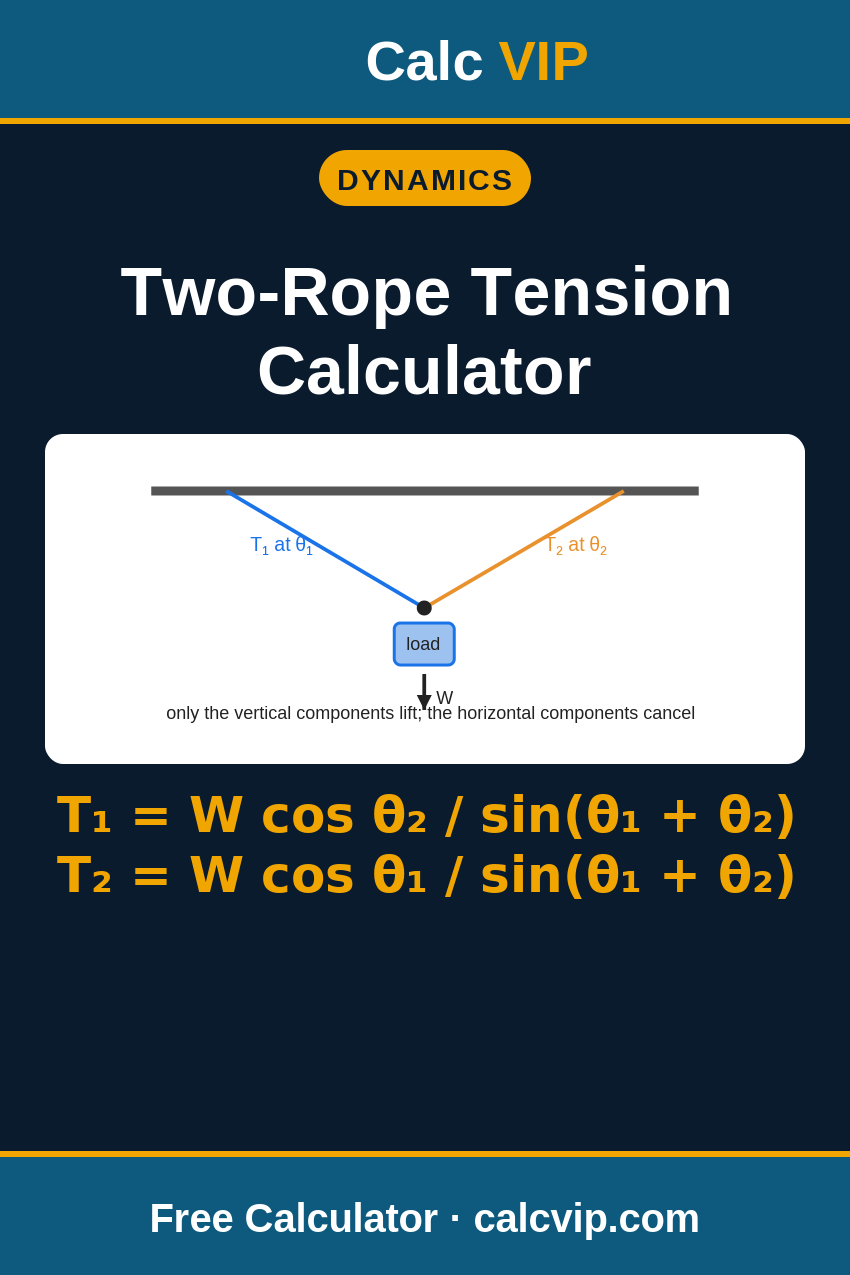
The denominator carries the warning: both tensions are divided by sin(θ₁ + θ₂), so as the ropes approach a straight line between them (θ₁ + θ₂ → 180°) or collapse together (→ 0°), the tensions soar without limit. This is why a tightrope can never be pulled perfectly straight, why a tow rope rigged nearly flat between two anchor points can snap under a modest load, and why riggers treat shallow angles as a hazard in their own right — the "angle factor" tables in every lifting manual are this denominator, tabulated. The calculator refuses angles whose sum makes the ropes nearly parallel, because at that point the honest answer is "more tension than any rope should carry".
Formula
From equilibrium (horizontal forces cancel, vertical forces balance W):
T₁ = W cos θ₂ / sin(θ₁ + θ₂)
T₂ = W cos θ₁ / sin(θ₁ + θ₂)
where θ₁ and θ₂ are measured from the horizontal.
The derivation is three lines. Horizontal balance: T₁ cos θ₁ = T₂ cos θ₂. Vertical balance: T₁ sin θ₁ + T₂ sin θ₂ = W. Solving the pair simultaneously gives the formulas above — a special case of Lami's theorem, which says each force in a three-force equilibrium is proportional to the sine of the angle between the other two. The symmetric case collapses beautifully: if θ₁ = θ₂ = θ, then T = W / (2 sin θ) — at θ = 90° (two vertical ropes) each carries W/2, and at θ = 30° each already carries the full W. If your angles are measured from the vertical instead, swap sine and cosine throughout — the calculator expects angles from the horizontal, matching its labels and the worked examples.
| Symbol | Meaning | Units |
|---|---|---|
| T₁, T₂ | tension in the left and right ropes | N |
| W | weight of the hanging load | N |
| θ₁, θ₂ | each rope's angle above the horizontal at the load | degrees (°) |
| θ₁ + θ₂ | angle between the two ropes at the load point | degrees (°) |
Components: each rope is two forces wearing one coat
The way to see why the steeper rope wins is to split each tension into its vertical and horizontal components. A rope at angle θ lifts with T sin θ and pulls sideways with T cos θ. A steep rope (θ near 90°) converts almost all its tension into lift; a shallow rope (θ near 0°) converts almost all of it into a sideways tug that does no lifting at all — it merely forces the other rope to pull sideways back, inflating both tensions in a standoff that the load never asked for. The vertical components are the useful workforce and must sum to W; the horizontal components are pure overhead, an internal argument between the ropes that the anchors must absorb. Every rigging decision on this page — steepen the ropes, raise the anchors, narrow the span — is an attempt to shrink the overhead and let tension become lift.
Equilibrium also has a geometric portrait worth knowing: three forces in balance form a closed triangle when drawn head-to-tail. Draw W pointing down, then T₁ along its rope's direction, then T₂ along its; if the three arrows form a closed triangle, the load hangs still, and the side lengths are the tensions, readable with a ruler. Before calculators, this force triangle was how engineers solved rigging on the drawing board — and it remains the fastest sanity check on this page's numbers: sketch the triangle, and a tension that comes out shorter than W/2 or longer than several W announces itself visually before it announces itself in a snapped line.
How to use
- Enter the weight of the hanging load in newtons.
- Enter each rope's angle from the horizontal — the angle between the rope and a level line at the load.
- Click "Calculate" to get both tensions.
- Compare each tension with the rope's and anchors' ratings, remembering that the anchor also feels the full tension along the rope's direction.
Worked examples
Example 1 — the hanging sign. A sign weighing 100 N hangs from two ropes, the left at 30° and the right at 60° from the horizontal.
T₁ = 100 × cos 60° / sin 90° = 50 N (left rope).
T₂ = 100 × cos 30° / sin 90° = 86.6 N (right rope).
The steeper rope (60°) carries more of the load — it does more of the lifting.
Example 2 — perfect symmetry. A 200 N load hangs from two ropes both at 45°: by the symmetric formula, T = W / (2 sin 45°) = 200 / 1.414 = 141.42 N in each rope. Note the quiet surprise: even at a healthy 45°, each rope carries over 70% of the load — the sideways standoff adds the rest.
Example 3 — the shallow trap. The same 100 N load on two ropes at just 20° each: T = 100 / (2 sin 20°) = 100 / 0.684 = 146.19 N per rope — each rope now carries more than the whole load. Nothing about the load changed; only the geometry did. This is the calculation that explains snapped clotheslines and bent anchor bolts.
Example 4 — an asymmetric rig. A 500 N stage light hangs with the left rope at 45° and the right at 30°: sin(75°) = 0.9659, so T₁ = 500 × cos 30° / 0.9659 = 448.28 N and T₂ = 500 × cos 45° / 0.9659 = 366.03 N. Check the lift: 448.28 × sin 45° + 366.03 × sin 30° = 317 + 183 = 500 N — the vertical components repay the weight exactly.
Example 5 — one vertical rope. A 100 N load with the left rope vertical (θ₁ = 90°) and the right at 45°: T₁ = 100 × cos 45° / sin 135° = 100 N, T₂ = 100 × cos 90° / sin 135° = 0 N. The slanted rope carries nothing at all — with a vertical rope present, equilibrium leaves it slack, and the load hangs plumb beneath the vertical anchor. A limiting case that verifies the formulas at their edge.
Example 6 — a crane's two-leg sling. A 10,000 N machine part is lifted on two sling legs at 60° each: T = 10,000 / (2 sin 60°) = 5773.5 N per leg. Lifting manuals tabulate exactly this: at 60° the leg factor is a mild 1.15 × the leg's share, at 30° it is 2×, and below 30° the lift is discouraged outright — the denominator of this page, enforced by regulation.
Two-rope tension in real life
Hanging signs, lights and speakers. Every shop sign, theatre light and line-array speaker hangs on this calculation. The asymmetric case is the everyday one — anchors are rarely placed symmetrically — and the steeper-side tension is the number the fixings must survive.
Crane slings and lifting. Multi-leg slings are rated by angle: the same sling leg is legal for a heavy load at 60° and a much lighter one at 30°. Riggers carry the angle-factor table because the load's weight alone never tells you the leg tension — this page is that table's engine.
Climbing and rope rescue. Highlines, Tyrolean traverses and anchor systems live in the shallow-angle danger zone: a traverse line rigged at 10° to the horizontal multiplies a climber's weight many times over at each anchor, which is why rescue anchors are built to strengths that look paranoid until you run Example 3's arithmetic.
Tow ropes and clotheslines. The near-straight line that cannot be tensioned flat is this formula's folk version: the last few degrees of straightness cost more tension than the load itself. A sagging line is not laziness — it is geometry keeping the tension finite.
Zip lines and cableways. A zip line's tension under a rider is a two-rope problem with the rider at the middle and the sag setting the angles; the cable and its end anchors are sized from the shallow-angle multiplication, with dynamic allowances on top.
Mooring and rigging at sea. A boat held between two mooring lines, or a mast stayed by shrouds at differing angles, distributes wind and tide loads between the lines by these same rules — the leeward shroud, standing steeper under load, takes the greater share.
Lami's theorem and the force triangle
The two-rope problem is the friendliest case of a general jewel: when three forces hold a point in equilibrium, each force divided by the sine of the angle opposite it in the force triangle gives the same ratio — Lami's theorem. Here the three forces are T₁, T₂ and W, and the theorem produces this page's formulas in one step: T₁ / sin(angle between T₂ and W) = T₂ / sin(angle between T₁ and W) = W / sin(angle between the ropes). It also generalises where the two-equation method labours — a load held by a rope and a strut, a knot in a climbing system with three lines, a sign hung from a wall bracket. Whenever exactly three forces meet at a point and the point does not move, the sines apportion the forces. The calculator solves the commonest case; the theorem is the key that opens all the others.
Quick reference: symmetric two-rope rigs (angle per rope)
| θ (each rope) | Tension in each rope | Verdict |
|---|---|---|
| 90° (vertical) | 0.50 × W | the honest half-and-half |
| 60° | 0.58 × W | comfortable rigging |
| 45° | 0.71 × W | common, acceptable |
| 30° | 1.00 × W | each rope carries the whole load |
| 20° | 1.46 × W | Example 3 — caution |
| 10° | 2.88 × W | specialist territory only |
Memorise the 30° row: it is the boundary below which "sharing" a load between two ropes stops reducing the tension in each and starts amplifying it.
Why the load hangs where it hangs
Nothing in the setup forces the load to sit midway between the anchors — it chooses its own position, and the angles follow. A load on two fixed-length ropes slides until the geometry and the equilibrium equations are satisfied together, which is why the same two ropes give different angle pairs for different loads hung at different points. This self-seeking property is a gift: it means the system always finds the configuration this calculator describes, and measuring the two angles at the load — with a protractor app and a level — is all the fieldwork a real rig requires. It also means a load that is pushed sideways does not stay: released, it swings back to the one position where the horizontal components cancel, the pendulum rest position that every hanging sign quietly reports.
Common mistakes
- Assuming the load splits in half. Only true when both ropes are vertical or perfectly symmetric and steep. Any asymmetry or shallowness moves tension — sometimes dramatically — towards the steeper rope.
- Measuring angles from the vertical. This calculator (and its formulas) measure from the horizontal. Angles taken from a plumb line must be subtracted from 90° first; feeding them in raw swaps the roles of sine and cosine and can understate the tension dangerously.
- Forgetting the anchors feel the tension too. Each anchor is pulled along its rope with the full tension T, not with W/2. Anchor bolts and wall plugs are the usual failure point, and they fail by this page's numbers, not by the load's weight.
- Rigging shallow for a "tidier" look. A nearly straight line between anchors looks neat and multiplies tension without limit. Leave the sag in; it is the cheapest safety device in rigging.
- Ignoring dynamics. These are static tensions. A load that is swung, dropped a few centimetres onto the ropes, or bounced by wind can momentarily double them. Real rigging adds a safety factor on top of the static answer — often 5:1 or more for anything over people.
FAQ
Why does the steeper rope carry more tension?
Only the vertical part of each tension lifts the load. A steep rope points mostly upward, so more of its tension is useful; a shallow rope wastes most of its pull sideways.
What if both ropes are nearly horizontal?
The tensions explode — sin(θ₁ + θ₂) gets small, so T becomes huge. That is why you can never pull a clothesline or tow rope perfectly straight under load.
What if the two angles are equal?
Then the tensions are equal too, each T = W / (2 sin θ), by symmetry.
Can a rope's tension be less than half the load?
Yes — the shallower partner in an asymmetric rig can carry less than W/2 (Example 1's left rope carries exactly 50 N of a 100 N load, and shallower still would carry less), while its steeper partner carries correspondingly more. The vertical components, not the tensions, are what must sum to W.
What if one rope is vertical?
Then it carries the entire load if the other rope has any sideways slant that leaves it nothing to balance — Example 5 shows the slanted rope going completely slack. In practice a rigged second rope shares a little, because real loads shift until both lines are taut.
How do I find the angles if I only know the anchor positions?
Geometry first: the angle of each rope follows from the horizontal distance between its anchor and the load's plumb line and the vertical drop. Surveyors and riggers compute θ = tan⁻¹(vertical drop ÷ horizontal offset) for each side, then use this calculator.
Does the rope's own weight matter?
For long or heavy ropes, yes: the rope sags into a catenary, the angle varies along its length, and its weight adds to the load. For the short, light lines of signs and stage rigs the straight-rope model here is the standard approximation.
What safety factor should I apply?
The static tensions from this calculator are the starting point, never the rating. General rigging practice applies at least 4:1 to 5:1 against the rope's breaking strength, and more where failure could drop a load on people — plus allowances for wear, knots (which can halve a rope's strength) and dynamics.
Why does the calculator refuse very shallow angle sums?
When θ₁ + θ₂ approaches 0° or 180°, sin(θ₁ + θ₂) approaches zero and the tensions approach infinity — the ropes are effectively one straight line. The refusal marks the boundary where the model's answer stops being a number and becomes a warning.
Can this solve three-rope problems?
Not directly — three ropes make the system statically indeterminate, so the tensions depend on the ropes' stretch as well as the geometry. Engineers solve those with stiffness methods; this two-rope case is special precisely because equilibrium alone decides it.