 Calc
Terminal Velocity Calculator – v = √(2mg/ρCdA) in Air & Water
 Created by James Carter · Physics Writer · Forces & Motion · Last updated: November 2026
Use this free Terminal Velocity Calculator to find the constant speed a falling object reaches when air (or water) resistance grows to equal its weight, so it stops accelerating.
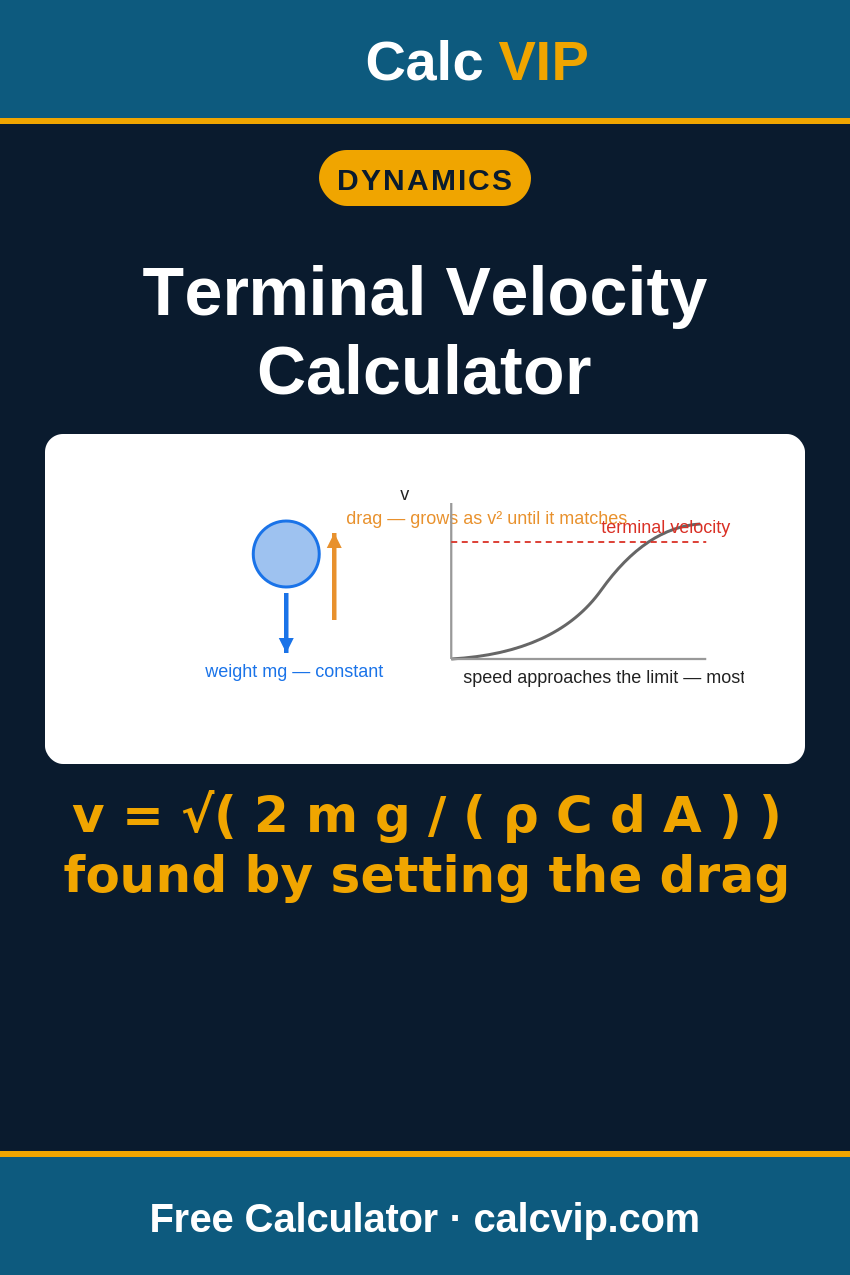
Drop anything from a height and it does not accelerate forever. As it speeds up, the fluid it falls through pushes back harder and harder — drag grows with the square of the speed — until the upward drag exactly cancels the downward weight. From that moment the net force is zero, acceleration stops, and the object falls the rest of the way at a constant speed: its terminal velocity. This calculator finds that speed from the object's mass, its drag coefficient, the area it presents to the flow, and the density of the fluid — the four numbers that decide whether something plummets at 300 km/h or drifts down like a seed.
The formula's shape rewards a close look. Mass sits in the numerator: heavier objects fall faster, because their weight grows while their drag — set by size and shape — does not keep pace. Area and drag coefficient sit in the denominator: spread the same mass over a bigger, bluffer shape and the terminal velocity collapses, which is the entire principle of the parachute. Fluid density completes the picture: fall through water and terminal velocity arrives almost immediately at a crawl; fall through the thin air at 30 km altitude and the same body can exceed the speed of sound before drag catches up — as Felix Baumgartner did in 2012, reaching 1,358 km/h in the stratosphere before the thickening air slowed him to an ordinary skydiver's pace.
Two honest warnings belong with the number. The drag law used here — drag = ½ρCdAv² — is the high-speed, turbulent regime of skydivers, hailstones and sinking stones; very small or slow objects (dust, mist droplets, plankton) live in the viscous Stokes regime where drag grows only with v, and their terminal velocities follow a different formula. And the calculator balances drag against full weight, ignoring buoyancy: in water, where buoyancy can rival weight, treat the result as the speed before that correction — the discussion below shows how to fold buoyancy in by using an effective weight.
Formula
Terminal velocity: v = √( 2 m g / ( ρ Cd A ) )
found by setting the drag force ½ ρ Cd A v² equal to the weight mg.
The rearrangements expose the design levers: m = ρ Cd A v² / (2g) (the mass a shape of given size can bring down at a chosen speed — the parachute designer's form), A = 2mg / (ρ Cd v²) (the canopy area a target descent speed requires), and Cd = 2mg / (ρ A v²) (the drag coefficient inferred from a measured fall — how wind-tunnel-free Cd values are often estimated). Everything enters in SI: kilograms, square metres, kilograms per cubic metre for density. Note the square roots and squares: because drag grows with v², doubling the mass raises terminal velocity only by √2 ≈ 1.41, while doubling the area cuts it by the same factor — mass and area trade at square-root rates, a fact that shapes everything from parachute sizing to the sizes of hailstones.
| Symbol | Meaning | Units |
|---|---|---|
| v | terminal velocity — the constant final fall speed | m/s |
| m | mass of the falling object | kg |
| g | gravitational field strength (9.81 on Earth) | m/s² |
| ρ | density of the fluid fallen through (air 1.225, water 1000) | kg/m³ |
| Cd | drag coefficient — the shape's slipperiness score | none |
| A | cross-sectional area facing the flow | m² |
The approach: how an object settles onto its terminal velocity
Terminal velocity is a limit, approached but never quite announced. Released from rest, the object first accelerates at nearly g, drag being still negligible; as speed builds, drag eats into the net force, acceleration fades, and the speed curve bends towards its ceiling — mathematically the approach follows a hyperbolic-tangent curve, reaching about 90% of terminal velocity in a time set by vt/g. For the skydiver of Example 1 that time is roughly 4–5 seconds and a few hundred metres of fall: most of a skydive is spent at terminal velocity, not getting there. For a raindrop the settling takes a second or less; for a dust grain, microseconds. The same curve, run with the signs flipped, describes a rising bubble or a balloon finding its ascent speed — terminal velocity is a general idea about force balance in fluids, and falling is only its most famous direction.
The balance also explains the skydiver's art. Terminal velocity is not a property of the person but of the posture: spread-eagled, A is large and Cd near 1, giving the familiar ~55 m/s of freefall in round numbers for a lighter diver; tucked head-down, A shrinks and Cd falls, and the same person passes 78 m/s in Example 2's numbers. Formation skydivers exploit the formula socially — matching fall rates by adjusting area with suits and grips — and the whole discipline of speed skydiving is a war on the denominator: minimise CdA and let the numerator's mg do its work.
How to use
- Enter the falling object's mass, drag coefficient and the area it presents to the flow.
- Pick the medium — air, water, or a custom density (thin air high up, for example).
- Click "Calculate" to get the terminal velocity in m/s and km/h.
- For objects in water, remember buoyancy: replace the weight with the effective (submerged) weight for a realistic figure, as the examples discuss.
Worked examples
Example 1 — the skydiver. A skydiver of mass 80 kg falls belly-first with Cd = 1.0 and area A = 0.7 m² in sea-level air (ρ = 1.225 kg/m³).
v = √(2 × 80 × 9.81 / (1.225 × 1.0 × 0.7)) = √(1569.6 / 0.8575) = 42.78 m/s = 154.02 km/h.
Opening the parachute hugely increases A and Cd, so the terminal velocity drops to a safe landing speed.
Example 2 — the same skydiver, head-down. Tucked into a dive with Cd = 0.7 and A = 0.3 m²: v = √(1569.6 / (1.225 × 0.7 × 0.3)) = √(1569.6 / 0.25725) = 78.11 m/s = 281.2 km/h. No extra weight, no engine — the near-doubling of speed was bought entirely by shrinking the denominator, which is why posture is the skydiver's throttle.
Example 3 — a raindrop. A large raindrop of radius 2 mm has mass m = 3.35 × 10⁻⁵ kg and area A = 1.257 × 10⁻⁵ m², with Cd ≈ 0.47: v = √(2 × 3.35 × 10⁻⁵ × 9.81 / (1.225 × 0.47 × 1.257 × 10⁻⁵)) = 9.53 m/s ≈ 34 km/h. Rain arrives at jogging-to-cycling pace, not bullet pace — the reason a downpour stings but does not injure. (Real drops also flatten as they fall, raising Cd and trimming the speed further.)
Example 4 — a hailstone. A hailstone of radius 1 cm: m = 4.19 × 10⁻³ kg, A = 3.14 × 10⁻⁴ m², Cd = 0.47: v = √(2 × 4.19 × 10⁻³ × 9.81 / (1.225 × 0.47 × 3.14 × 10⁻⁴)) = 21.32 m/s = 76.8 km/h. Scale is destiny: ten times the drop's radius means a thousand times the mass but only a hundred times the area, so the stone falls more than twice as fast — and golf-ball hail, larger again, is a genuine hazard to roofs and windscreens.
Example 5 — a stone sinking in water. A 0.5 kg stone with Cd = 0.47 and A = 0.01 m² in water (ρ = 1000): v = √(2 × 0.5 × 9.81 / (1000 × 0.47 × 0.01)) = 1.44 m/s. Water's density — 816 times air's — does the braking. Buoyancy would trim the stone's effective weight and lower the speed further; the calculator's figure is the uncorrected ceiling.
Example 6 — under parachute. A 90 kg jumper under a canopy with Cd = 1.4 and A = 40 m²: v = √(2 × 90 × 9.81 / (1.225 × 1.4 × 40)) = √(1765.8 / 68.6) = 5.07 m/s = 18.26 km/h — about the speed of jumping off a low wall, which is precisely the design target. Canopy sizing is this calculation with a safety margin and a flare at the end.
Terminal velocity in real life
Parachutes and escape systems. Canopy area is chosen from the A-rearrangement of the formula to deliver a survivable descent speed for the total suspended mass — cargo pallets, space capsules and ejection-seat pilots all come down at speeds this equation signed off. Apollo's capsules splashed down near 8.5 m/s under three canopies; the maths is identical, the stakes higher.
Rain, hail and weather. Drop sizes in a cloud are sorted by terminal velocity: updrafts stronger than a drop's vt carry it upward to grow, which is how hailstones are built layer by layer in a storm — and why the largest hail reports the strongest updrafts. Rain gauges, radar meteorology and roof design all consume these numbers.
Seeds, spores and parachuting spiders. Evolution found the denominator long ago: dandelion clocks, maple samaras and ballooning spiderlings maximise area and drag per unit mass until terminal velocity falls to a drift. Their dispersal distances are this formula multiplied by wind and time.
Sedimentation and industry. Settling tanks, clarifiers and centrifuges separate mixtures by terminal velocity — particles of different size and density sink at different rates through water or air. Water treatment, mining and pharmaceutical powder handling are, in large part, applied settling-speed engineering (in the fine-particle regime, via the Stokes variant discussed below).
Ballistics and safety. A bullet fired straight up returns at its terminal velocity — far below its muzzle velocity, though still dangerous for a streamlined projectile; falling debris, dropped tools on construction sites and aircraft ice-shedding are all assessed with this calculation.
Animals falling. Small animals survive falls that would kill large ones because terminal velocity scales with size: mass grows with volume while area grows with the square of length, so the small fall slowly. A mouse's vt is a survivable ~13 m/s; the square-root scaling of this formula is the entire explanation, and the reason "raining cats and dogs" would be a tragedy rather than a weather report.
When the formula changes: Stokes' law and the very small
The v² drag law rules when the flow around the object is turbulent — roughly, for objects bigger than a millimetre moving at everyday speeds in air or water. Shrink the object or slow it down and viscosity takes over: drag becomes proportional to v itself, F = 6πηrv for a sphere (Stokes' law), and terminal velocity follows v = 2r²g(ρobject − ρfluid) / (9η). Mist droplets, fine dust, blood cells and plankton live in this regime — it is why fog hangs for hours (a 10 µm droplet settles at millimetres per second) and why Millikan could balance oil droplets against gravity to measure the electron's charge. The crossover is judged by the Reynolds number; the honest habit is to ask which regime you are in before choosing the formula — this page's calculator is the turbulent one, the skydiver's and hailstone's own.
Quick reference: drag coefficients of common shapes
| Shape | Cd (approx.) | Note |
|---|---|---|
| streamlined body (wing, teardrop) | 0.04–0.1 | shape buys a 10–25× advantage over a plate |
| smooth sphere | 0.47 | the raindrop and hailstone value |
| typical car | 0.25–0.35 | decades of wind tunnels in one number |
| belly-to-earth skydiver | ≈ 1.0 | Example 1 |
| flat plate facing the flow | 1.28 | near the practical maximum |
| parachute canopy | 1.3–1.5 | a plate that also traps air — Example 6 |
Cd compresses a wind tunnel's worth of flow physics into one multiplier — treat tabulated values as good estimates, and measure (via the Cd-rearrangement of this very formula) when the answer matters.
Common mistakes
- Using the surface area instead of the cross-section. A is the silhouette facing the flow — for a sphere, πr², not 4πr². Using total surface area inflates A fourfold and halves the predicted speed.
- Forgetting that the speed is a limit, not an instant value. A short fall may end before terminal velocity is approached. The formula gives the ceiling the speed tends towards, given enough height — check the fall is long enough (hundreds of metres for a skydiver to fully settle).
- Ignoring buoyancy in liquids. In water the effective weight is mg minus the displaced water's weight. For a stone the correction is modest; for wood or ice it reverses the motion entirely — they rise to their "terminal velocity" upward, or float.
- Using sea-level air density at altitude. ρ at 10 km is about 0.41 kg/m³, a third of sea level's, so terminal velocity there is some 70% higher. Jumpers and drop tests at altitude must use the local density — the calculator's custom option exists for this.
- Applying the v² formula to dust and droplets. Tiny, slow objects obey Stokes' law instead. If the object is smaller than a grain of sand, check the regime before trusting a v² answer.
FAQ
Why does a feather fall so slowly?
Its mass is tiny but its area is large, so drag equals its weight at a very low speed — its terminal velocity is only about 1 m/s or less.
Does terminal velocity depend on the height of the fall?
Not directly — but air gets thinner with altitude, so ρ is smaller and the terminal velocity is higher. Felix Baumgartner fell faster than the speed of sound in the thin upper air.
What drag coefficient should I use?
Rough guides: a smooth sphere ≈ 0.47, a streamlined body ≈ 0.04–0.1, a flat plate facing the flow ≈ 1.28, a belly-to-earth skydiver ≈ 1.0.
How long does it take to reach terminal velocity?
Most of the approach happens within a time of roughly vt/g — about 4–5 seconds for a skydiver, who covers a few hundred metres getting there and reaches around 90% of the final speed in that time. Small objects settle almost instantly.
Do heavier skydivers fall faster?
Yes — with the same posture and area, v grows with √m. A diver 40% heavier falls about 18% faster, which is why heavier jumpers wear drag-adding suits and lighter ones add weight belts to match a formation's fall rate.
Why does a crumpled paper ball fall faster than a flat sheet?
Same mass, same paper — but crumpling shrinks A dramatically and lowers the effective drag, so the balance with weight happens at a much higher speed. It is the cleanest classroom demonstration that terminal velocity lives in the denominator.
Is there a terminal velocity in space?
No — with no fluid there is no drag, so a falling object accelerates indefinitely (until relativity or impact intervenes). Terminal velocity is entirely a fluid phenomenon; the Moon's hammer-and-feather drop fell together precisely because there is no air to sort them.
Can terminal velocity be dangerous in water?
The speeds are low, but the concept governs real hazards: a sinking object's vt sets how fast wreckage reaches the seabed, and a rising runaway buoy or a dropped gas cylinder underwater accelerates to its own balance speed. Divers also meet it as the settling rate of silt that clouds the water.
Why do cats famously survive falls from high windows?
Their terminal velocity is modest (a spread cat presents a large area for its ~4 kg mass, giving roughly 27 m/s), they reach it within a few storeys — after which more height adds no more speed — and their righting reflex and flexible landing distribute the impact. Survival is not guaranteed, but the physics is firmly on the cat's side compared with a human's ~55 m/s-class fall.
What happens if the object is dropped on the Moon?
With no atmosphere there is no drag and no terminal velocity: the object accelerates at 1.62 m/s² until it lands, however far it falls — the Apollo hammer-feather demonstration again. Enter ρ = 0 here and the formula's denominator vanishes, which is the algebra agreeing.