 Calc
Tension Calculator – Hanging Mass, Horizontal Pull & Atwood Machine
 Created by James Carter · Physics Writer · Forces & Motion · Last updated: November 2026
Use this free Tension Calculator to find the tension in a rope or cable in three classic setups: a hanging mass at rest, a mass pulled horizontally on a frictionless surface, and an Atwood machine — two masses hanging over a pulley. Choose the setup, enter the masses, and read off the tension (and, for Atwood, the acceleration).
Tension is the pulling force inside a rope, cable, string or chain. Cut one anywhere — mentally — and the two halves are found pulling each other apart with a force T, the tension. It is the force that lets you haul a bucket from a well, that keeps a hanging sign hanging, that a crane's cable quietly carries all day. Unlike a push, a rope's pull can go around corners: a pulley redirects tension without (ideally) diminishing it, which is why ropes and pulleys are humanity's oldest force-routing technology.
The three setups on this page are the three ways tension earns its living. A mass hanging still needs the rope to carry its whole weight, T = mg. A mass pulled along a frictionless floor needs only enough tension to accelerate it, T = ma — the rope carries no weight at all, because the floor does. And two masses over a pulley negotiate a shared tension that sits between their two weights, each mass getting neither the victory of free fall nor the rest of balance. Almost every real rig — lifts, cranes, tow ropes, cable cars — is one of these three, or a combination of them.
The calculator assumes the idealisations that make tension teachable: a massless, unstretchable rope and a frictionless, massless pulley, so the tension is the same at every point of the rope. Real rigs depart from that ideal in ways the final section discusses, but the ideal numbers are the ones designs start from — and the ones safety factors are then applied to.
Formula
Hanging at rest: T = m × g • Horizontal pull (frictionless): T = m × a • Atwood machine: a = (m₁ − m₂) × g ÷ (m₁ + m₂), T = 2 × m₁ × m₂ × g ÷ (m₁ + m₂)
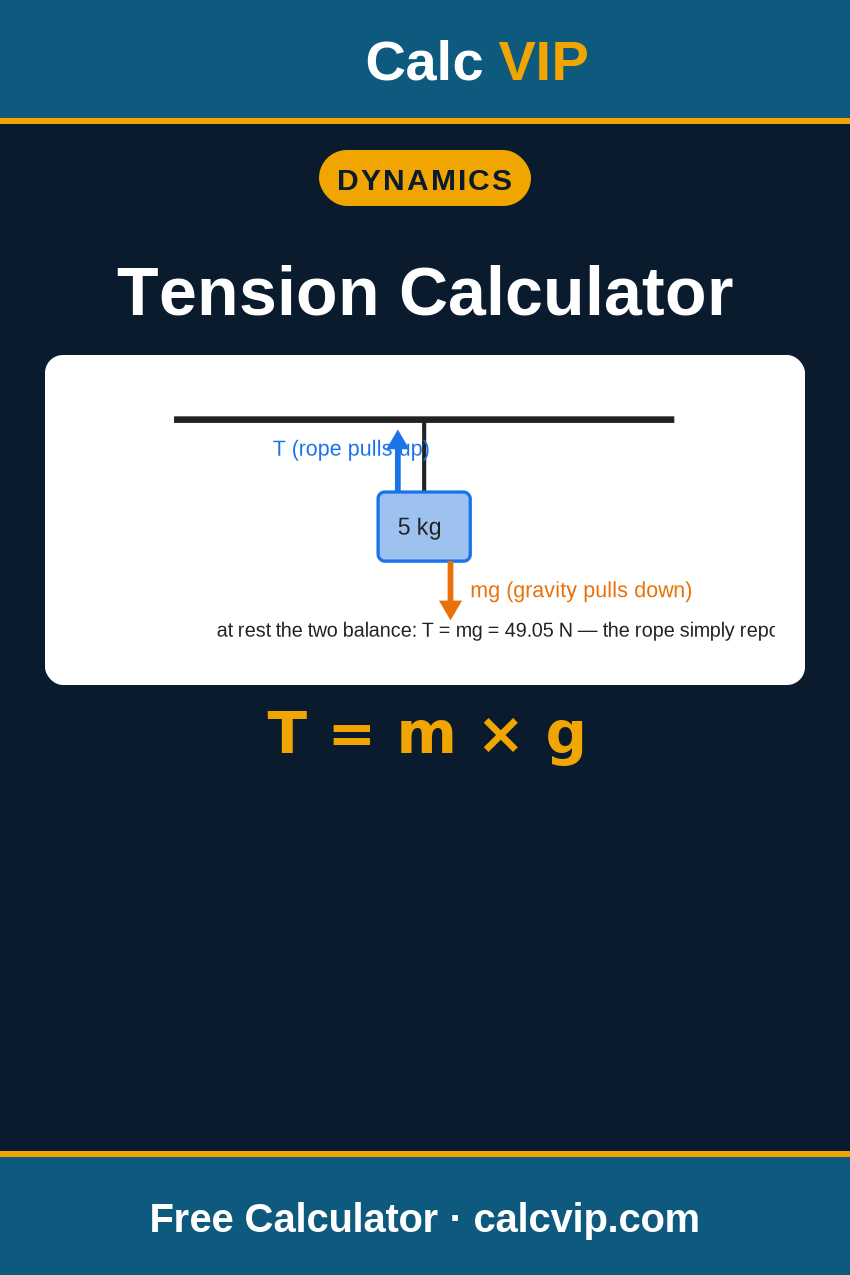
Each formula is Newton's Second Law applied to one mass at a time. For the hanging mass, the forces are T up and mg down; at rest they balance. For the pulled mass, tension is the only horizontal force, so it alone must equal ma. The Atwood formulas come from writing F = ma for each mass with the same T and the same a — the rope enforces both — and solving the pair of equations. The Atwood tension formula has a memorable reading: it is twice the product of the masses over their sum, times g — always less than the heavier weight (the heavy mass is accelerating down, so the rope need not fully hold it) and always more than the lighter weight (which is being hauled up). Rearranged, the hanging formula also gives the mass a cable of known safe tension can hold: m = T ÷ g.
| Symbol | Meaning | Units |
|---|---|---|
| T | tension — the pull inside the rope | newtons (N) |
| m, m₁, m₂ | mass (m₁ = heavier in Atwood problems) | kilograms (kg) |
| a | acceleration of the mass (or system) | m/s² |
| g | gravitational field strength (Earth ≈ 9.81) | m/s² |
One rope, one tension — and why
Students often ask whether the tension at the top of a hanging rope exceeds the tension at the bottom, since the top "carries more". For the ideal massless rope the answer is no, and the reason is a neat piece of physics: if any segment of a massless rope felt a bigger pull on one side than the other, the net force on that segment would produce an infinite acceleration (a = F ÷ 0), which cannot happen — so the pulls equalise instantly and the tension is uniform. The rope transmits force the way a wire transmits current in these problems: unchanged from end to end, around pulleys included.
Real ropes have mass, and then the answer changes gracefully: each point of a real hanging rope carries the weight of everything below it, so tension grows from the load's weight at the bottom to load-plus-rope at the top. A 30 m climbing rope weighs only a couple of kilograms and the correction is a footnote; a kilometre of mine-shaft cable or an anchor chain outweighs its load, and engineers there compute tension as a profile, not a number. The ideal calculator remains the right starting point — real designs are the ideal answer plus corrections, not a different physics.
Tension also has a direction discipline worth stating: a rope can only pull, never push. Every tension arrow points away from the object, along the rope. The moment a problem would require a rope to push, the rope goes slack, the tension drops to zero, and the physics changes regime — falling objects with ropes attached are free until the rope runs out, a fact that climbing fall-arrest and bungee design are built around.
How to use
- Choose the setup: hanging mass at rest, horizontal pull, or Atwood machine.
- The two input boxes relabel themselves for your setup — enter the mass (and, for Atwood, the second mass; for the pull, the acceleration), in kilograms and m/s² as labelled.
- Check g: 9.81 on Earth, or change it for another planet.
- Click "Calculate" to see the tension in newtons — and, for the Atwood machine, the system's acceleration as well.
Worked examples
Example 1 — all three setups at once. Hanging: a 5 kg mass hangs at rest, so T = mg = 5 × 9.81 = 49.05 N. Horizontal pull: a 4 kg block on frictionless ice is pulled to accelerate at 2.5 m/s², so T = ma = 4 × 2.5 = 10 N — far less than the block's weight, because the ice carries the weight and the rope only supplies acceleration. Atwood: masses of 6 kg and 4 kg over a pulley: a = (6 − 4) × 9.81 ÷ (6 + 4) = 1.96 m/s², and T = 2 × 6 × 4 × 9.81 ÷ 10 = 47.09 N. Check it against each mass: the 6 kg mass has 58.86 − 47.09 = 11.77 N of net force = 6 × 1.96 ✓; the 4 kg mass has 47.09 − 39.24 = 7.85 N = 4 × 1.96 ✓. One tension, two satisfied equations.
Example 2 — the lift cable. A lift car and passengers total 800 kg. Hanging still, its cable carries 800 × 9.81 = 7,848 N. Accelerating upwards at 1.5 m/s², the cable must supply weight plus acceleration force: T = m(g + a) = 800 × (9.81 + 1.5) = 800 × 11.31 = 9,048 N. That 1,200 N surplus is why lift cables are rated well above the static load — and why a lift that accelerates briskly makes your knees notice.
Example 3 — a hanging sign. A shop sign of 12 kg hangs from two vertical wires sharing the load. Total tension needed: 12 × 9.81 = 117.72 N, so each wire carries 58.86 N if the sign hangs level. Tilt the sign and the shares unbalance — the shorter-side wire takes more — which is why lopsided signs eventually tear their weaker fixing out.
Example 4 — a lopsided Atwood. Masses of 10 kg and 5 kg: a = (10 − 5) × 9.81 ÷ 15 = 3.27 m/s² and T = 2 × 10 × 5 × 9.81 ÷ 15 = 65.4 N. Compare the extremes: equal masses would give T = mg with no motion at all, while a 5 kg mass against a near-massless one would free-fall with T near zero. This pair sits between — the fall is real but restrained, at a third of g.
Example 5 — pulling a sled. A child pulls an 8 kg sled across frictionless ice (a pond, briefly) accelerating it at 1.5 m/s². The rope's tension is T = ma = 8 × 1.5 = 12 N — a gentle pull, because on ice nothing else resists. On snow, friction would add its demand to the rope: tension must then cover friction plus ma, which is the usual real-world correction to this mode.
Example 6 — the crane's two numbers. A crane holds a 500 kg load: T = 500 × 9.81 = 4,905 N. Hoisting with an upward acceleration of 0.8 m/s²: T = 500 × (9.81 + 0.8) = 5,305 N. The 400 N difference is invisible on a diagram and decisive in a specification — cables, winches and brakes are all chosen for the accelerating case, then multiplied by a safety factor, because a cable that fails at its static rating fails the first time the load is hurried.
Tension in real life
Lifts and hoists. Every lift ride is Example 2 with better upholstery. Counterweights — a giant Atwood machine sharing the shaft — cut the motor's work by balancing most of the car's weight, leaving the motor to supply only the difference and the acceleration.
Climbing and fall arrest. A climber's rope carries body weight at rest (~mg), but a fall converts it into a tension problem with a vengeance: the rope must absorb the fall's energy by stretching, and its rated "impact force" is the peak tension of that arrest. Dynamic ropes are engineered elasticity — tension management as a product.
Towing. A tow rope's steady tension covers the towed car's rolling resistance plus any acceleration; the dangerous moments are the jerks, when slack runs out and tension spikes several-fold. Elastic tow straps exist to soften exactly those spikes.
Suspension bridges and cable cars. A bridge deck hangs from vertical hangers whose tensions sum to the deck's weight; the main cables gather those tensions and deliver them to the towers. A cable car is a hanging mass that moves — its hanger tension is mg on the flat sections and more where the cable accelerates it.
Sailing rigging. A mast stays upright because shrouds and stays hold it in a tension balance, each wire pre-tensioned so that wind loads never let the leeward side go slack. Rig tuning is applied Atwood thinking: adjust the tensions and the "system" — the mast — stays centred.
Power lines and catenaries. Overhead cables are tensioned against their own sagging weight; too little tension and they sag into trees, too much and winter contraction snaps them. The visible curve of every power line is a tension calculation drawn in the air.
Real ropes: stretch, mass and safety factors
Three corrections separate textbook tension from rigging practice. Stretch: real ropes elongate under load — a few percent for steel cable, 30% or more for dynamic climbing rope — and stretch is often a feature, spreading a jerk over time and cutting its peak tension. Rope mass: long vertical ropes add their own weight to the top-end tension, as the earlier section explained. Dynamic factors: starting, stopping and swinging multiply tensions; a load swung like a pendulum can briefly double its cable tension at the bottom of the swing. Practice wraps all three into a safety factor: lifting gear is commonly rated at a fifth or a tenth of its breaking tension, so the working number from this calculator should always be read against a much larger breaking number on the manufacturer's plate.
Quick reference: tension by situation
| Situation | Tension |
|---|---|
| mass hanging at rest / steady speed | T = mg |
| mass accelerating up at a | T = m(g + a) |
| mass accelerating down at a | T = m(g − a) |
| free fall (rope slack) | T = 0 |
| horizontal pull, frictionless | T = ma |
| horizontal pull, friction f | T = ma + f |
| Atwood machine | T = 2m₁m₂g ÷ (m₁ + m₂) |
The first four rows are one family — a single hanging mass whose tension follows its acceleration — and they reappear, disguised, in the apparent-weight topic, where the "tension" is supplied by a lift floor instead of a rope.
Common mistakes
- Setting T = mg for an accelerating mass. mg is the at-rest (or steady-speed) value only. Accelerating up adds ma; accelerating down subtracts it. If the mass's speed is changing, the tension is not mg.
- Giving each Atwood mass its own tension. One rope means one T. Writing T₁ for one side and T₂ for the other invents a second rope and breaks the problem; the pulley enforces a single shared tension.
- Using the total mass in T = ma for the pull mode. The rope pulls one mass; the tension accelerates that mass alone. (In Atwood, by contrast, the acceleration formula uses the total mass — the rope moves both.)
- Forgetting friction in real pulls. The calculator's pull mode is frictionless by design. On any real surface, tension must overcome friction as well: T = ma + f. Omitting f underestimates every real tow and drag.
- Letting a rope "push". If your equations return a negative tension, the rope has gone slack and the true tension is zero — the setup has changed, and pushing-through-rope answers should be discarded, not reported.
FAQ
Is the tension the same on both sides of a pulley?
Yes, for an ideal (massless, frictionless) pulley and rope, the tension is the same throughout the rope — that is the assumption used here.
In an Atwood machine, why is T less than the heavier weight?
The heavier mass is accelerating downwards, so its weight mg is only partly balanced by tension; the difference is what accelerates it.
What if the two Atwood masses are equal?
Then a = 0 and the tension simply equals each weight, T = mg — the system balances.
What is the tension in a rope that is not moving anything?
Whatever the loads at its ends demand. A rope strung between two walls and pulled tight at both ends carries that installation tension even with nothing hanging from it — tension is a state of the rope, not a consequence of motion.
Does the angle of a hanging rope matter?
Yes. A mass hung from two angled ropes shares its weight between them, and each rope's tension is larger than half the weight — at 60° from vertical each rope carries the full mg. Shallow angles multiply tension, which is why tightropes and zip lines are under such enormous strain from modest loads.
Why do ropes break at knots?
A knot concentrates stress and bends fibres sharply, cutting the rope's effective strength by a third to a half. The tension is the same there as elsewhere — the local strength is not — so failure starts at the knot.
How is tension measured on a real rig?
With inline load cells and dynamometers, or by the rope's stretch (calibrated against load), or, for cables, by plucking them and measuring the vibration frequency — guitar tuning applied to bridge cables, whose note rises with tension.
Can tension ever exceed the weight it lifts?
Easily — whenever the load accelerates upwards, swings, or is jerked. A crane load of 4,905 N at rest needed 5,305 N just for a gentle start; a snatched lift can double it. Ratings assume you know this.
What is an Atwood machine used for?
Historically, to slow gravity down: two nearly equal masses accelerate at a small fraction of g, letting 18th-century experimenters time "falling" with clocks of the day and verify Newton's laws. It remains the cleanest classroom demonstration that acceleration is net force divided by total mass.
Does a pulley change the tension?
An ideal pulley changes only the direction of the rope, not the tension. Real pulleys tax a few percent to friction in their bearings. Systems of multiple pulleys (block and tackle) do change the trade — less tension needed, more rope pulled — by sharing the load among several rope segments.