 Calc
Torque Solver Calculator – Solve τ = F·r·sinθ for Torque, Force, Lever Arm or Angle
 Created by Rachel Novak · Senior Editor · All Topics · Last updated: November 2026
Use this free Torque Solver Calculator to work with the full torque equation τ = F × r × sinθ. Choose what you want to find — torque, force, lever arm or angle — enter the other three values, and get the answer instantly.
Torque is the turning effect of a force — the rotational counterpart of the push or pull that accelerates things in a straight line. A force applied to a door far from its hinges swings it easily; the same force applied near the hinges barely moves it. That everyday observation is the whole subject in miniature: what matters is not just how hard you push, but where you push and in which direction. Torque, given the Greek letter τ (tau), packages all three facts — force, distance from the pivot, and angle — into a single number that predicts how strongly something will twist.
The equation τ = F × r × sinθ is really three levers of control multiplied together. Double the force and you double the torque. Double the lever arm r — the distance from the pivot to where the force acts — and you double it again, which is why a long wrench loosens bolts that a short one cannot. And the sinθ factor quietly decides how much of your force counts at all: only the component acting at right angles to the arm does any twisting, so a force aimed along the arm, however strong, produces no torque whatsoever. Mechanics, cyclists, surgeons and carpenters all live inside this one multiplication.
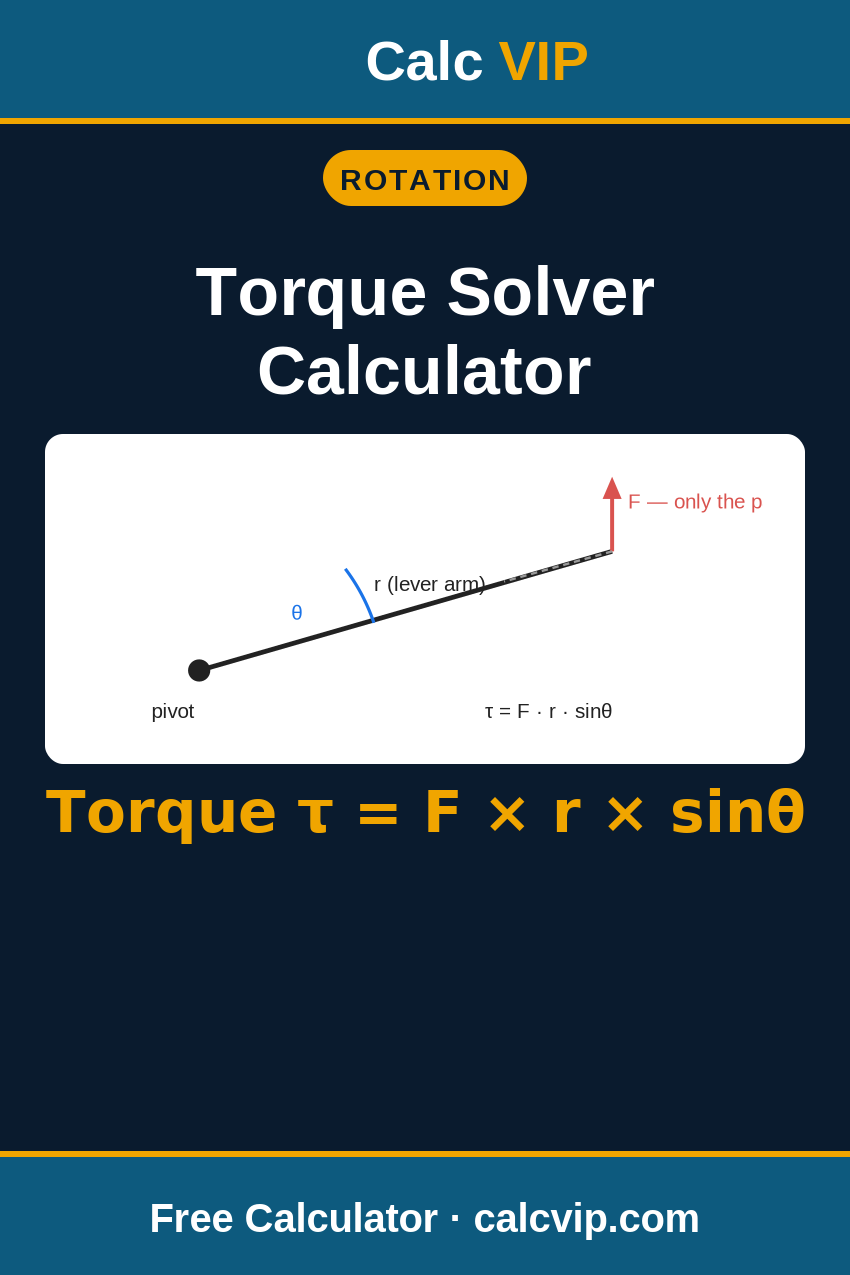
This solver handles the equation in every direction. Most calculators only find τ; this one also works backwards — tell it the torque you need and it finds the force, the lever arm, or the angle required. That reverse view is the engineer's view: a bolt specification states a torque, a machine offers a certain arm length, and the question is how hard something must push, or at what angle, to deliver it. Whichever quantity is unknown, the other three pin it down exactly.
Formula
Torque τ = F × r × sinθ • τ in newton-metres (N·m), F in newtons (N), r in metres (m), θ in degrees
The solver uses all four rearrangements of the same equation: F = τ / (r sinθ) to find the force a given arm and angle require, r = τ / (F sinθ) to find how long an arm a given force needs, and θ = sin⁻¹( τ / (F r) ) to find the angle at which a force delivers a target torque. That last form carries a warning inside it: if τ is larger than F × r, the calculator reports no solution, because F × r is the greatest torque that force and arm can ever produce (at θ = 90°) — no angle can beat it. Note also that the angle answer comes in a pair: sinθ takes the same value at θ and at 180° − θ, so a torque reached at 30° is also reached at 150°, a fact the calculator reports alongside the main answer.
| Symbol | Meaning | Units |
|---|---|---|
| τ | torque — the turning effect about the pivot | newton-metres (N·m) |
| F | applied force | newtons (N) |
| r | lever arm — distance from pivot to the line of the force | metres (m) |
| θ | angle between the force and the lever arm | degrees (°) |
Why the perpendicular component does all the work
Resolve any angled force into two parts: one pointing along the lever arm, towards or away from the pivot, and one pointing across it. The along-arm part merely pulls or pushes on the pivot itself — it strains the hinge, the axle or the bolt's threads, but it cannot rotate anything, because its line of action passes straight through the turning point's direction. The across-arm part is the only part with leverage: it acts at the full distance r from the pivot, and it alone appears in the torque. The sinθ factor is exactly the fraction of F that points across the arm. At θ = 90° the whole force is across, sinθ = 1, and torque is at its maximum F × r. At 30° only half the force is across (sin30° = 0.5); at 10° barely a sixth is (sin10° ≈ 0.17).
This is why experienced hands instinctively pull a wrench at right angles and why door handles sit at the edge of the door farthest from the hinges — both habits maximise the useful fraction of the force and the distance it acts over, simultaneously. It is also why pushing a door near its hinge side feels hopeless even when you push hard: r has shrunk towards zero, and no force, however large, can compensate for a lever arm of nothing. Torque problems are almost always won or lost on geometry before strength enters into it.
How to use
- Choose what you want to find from the drop-down menu — torque, force, lever arm or angle. The input box for that quantity disappears, because it is the answer.
- Enter the other three values: force in newtons, lever arm in metres (measure from the pivot to where the force is applied), and the angle between force and arm in degrees.
- Click "Calculate" to see the missing value with the working shown.
- If you are solving for the angle and the calculator says there is no solution, your target torque exceeds F × r — increase the force or lengthen the arm; no angle can rescue the combination.
Worked examples
Example 1 — the wrench at right angles. A force of F = 100 N pushes at the end of a r = 0.5 m wrench, at θ = 90° to the handle:
τ = 100 × 0.5 × sin90° = 100 × 0.5 × 1 = 50 N·m. Run the solver in angle mode with τ = 25 N·m instead and it returns θ = 30° — the angle at which the same push delivers exactly half the torque.
Example 2 — closing a door. You push a door with 15 N at its handle, 0.8 m from the hinges, square-on (θ = 90°):
τ = 15 × 0.8 × 1 = 12 N·m. Push with the same 15 N halfway in, at r = 0.4 m, and the torque halves to 6 N·m — the door feels twice as stubborn, though your push never changed.
Example 3 — the angled pull. A mechanic pulls with F = 50 N on a 0.4 m spanner, but the cramped engine bay forces the pull to θ = 30°:
τ = 50 × 0.4 × sin30° = 50 × 0.4 × 0.5 = 10 N·m — half of what the same pull would give at right angles. This is why tight fasteners in awkward corners defeat people: the geometry quietly confiscates half the force.
Example 4 — solving for the force. A wheel nut must be tightened to τ = 120 N·m and your wrench is 0.3 m long, pulled at 90°:
F = τ / (r sinθ) = 120 / (0.3 × 1) = 400 N — roughly the weight of a 41 kg mass, at the very limit of a strong one-handed pull. The numbers explain the long wrench in every tyre kit: lengthen r to 0.6 m and the required force halves to 200 N.
Example 5 — solving for the lever arm. A technician can comfortably apply 150 N and needs τ = 75 N·m at 90°:
r = τ / (F sinθ) = 75 / 150 = 0.5 m. Any shorter tool demands more force than she has; the solver turns "get a bigger wrench" into an exact shopping specification.
Example 6 — solving for the angle. With F = 100 N on a 0.5 m arm, what angle delivers τ = 43.3013 N·m?
sinθ = 43.3013 / (100 × 0.5) = 0.866, so θ = sin⁻¹(0.866) = 60° (the calculator also notes the twin solution, 120°). Angle mode is the one to use when a mechanism — a pedal crank, a lifting arm — only works at a set inclination and you need to know what it delivers there.
Torque in real life
Wrenches and cheater bars. Slipping a pipe over a wrench handle to lengthen it is applied τ = Fr sinθ: a 60 N push that gives 60 × 0.25 = 15 N·m on a bare 0.25 m wrench gives 60 × 0.6 = 36 N·m with the pipe — enough for the rusted bolt, and enough to snap it if you misjudge, which is why torque wrenches exist.
Doors, lids and taps. Handles are placed far from hinges, jar-lid openers grip the rim (maximum r), and cross-shaped tap handles let you apply force at two arms at once. Every one of these designs is a torque multiplier bought with distance instead of strength.
Cycling. A rider's weight on a pedal produces torque only through the horizontal distance from the bottom bracket — maximal when the crank is horizontal, zero at top dead centre where the force points along the crank (θ = 0°). Longer cranks raise torque slightly, at the cost of pedalling geometry.
Engines and specifications. Cylinder-head bolts, wheel nuts and spark plugs all carry torque specifications (wheel nuts typically 100–120 N·m) because clamping force — hence safety — is set by torque, not by how tight a bolt "feels". Example 4's arithmetic is the daily reality behind the spec sheet.
Seesaws and balance. A 30 kg child sitting 1.2 m from the pivot makes 30 × 9.81 × 1.2 = 353.16 N·m of torque; a 45 kg adult balances it at 353.16 / (45 × 9.81) = 0.8 m. Playground diplomacy is torque equality, negotiated in metres.
Steering and valves. A large steering wheel is a torque device: the same hand force at a larger radius gives the steering column more twist, which is why old cars without power steering had ship-sized wheels, and why pipeline valves have wide handwheels rather than knobs.
Quick reference: the sinθ discount
| Angle θ | sinθ | Share of F × r you actually get |
|---|---|---|
| 10° | 0.1736 | about a sixth |
| 20° | 0.342 | about a third |
| 30° | 0.5 | exactly half |
| 45° | 0.7071 | about seven tenths |
| 60° | 0.866 | about six sevenths |
| 90° | 1 | all of it |
The table's lesson is forgiving: anywhere between 60° and 90° you keep at least 87% of the maximum torque, so "roughly square-on" is good enough for almost every practical job. Below 30°, though, the discount turns savage — reposition your grip before you pull harder.
Torque is not energy — the N·m that is not a joule
Torque and energy share the same unit, the newton-metre, and this traps generations of students. They are different kinds of quantity. Energy (in joules) is force times the distance an object actually moves along the force; torque is force times the perpendicular distance from a pivot, whether anything moves or not. A rusted bolt under 50 N·m of wrench torque absorbs no energy at all until it turns. The two meet only when rotation happens: turn a shaft through one full revolution against a steady torque τ and the work done is 2πτ joules — which is precisely the bridge to rotational power, P = τω, since ω counts those revolutions in radians per second. Keeping the ideas separate — torque as twist, work as twist multiplied by angle turned — makes both formulas obvious rather than memorised.
When torques balance: static equilibrium
Everything that is not angularly accelerating — bridges, shelves, held wrenches, balanced seesaws — obeys one rule: the torques about any pivot sum to zero, clockwise cancelling anticlockwise. This is the working form of torque in statics, and it is how engineers find forces they cannot measure directly. The seesaw above is the friendly case; the same arithmetic sizes the bolts on a sign bracket (the sign's weight acts at its centre, the wall fixings answer with an opposing couple) and explains why a crane's counterweight sits where it does. Whenever a structure holds still under turning influences, a torque equation with zero on one side is silently being satisfied — and this solver's rearrangements are how you find the unknown term in it.
Common mistakes
- Measuring r to the wrong point. The lever arm runs from the pivot to where the force is applied (strictly, to the force's line of action) — not along the whole tool if you grip it halfway, and not to the end of the bolt. Grip a 0.5 m wrench at its middle and your r is 0.25 m, whatever the tool's full length.
- Using the angle to the wrong reference. θ is measured between the force and the lever arm itself. If a problem gives the angle to the perpendicular, or to the vertical, convert first — using the complement silently swaps sin for cos and can halve or double the answer.
- Expecting an angle solution that cannot exist. If τ > F × r there is no angle: sinθ cannot exceed 1. The calculator says so plainly; the fix is more force or more arm, never more optimism.
- Confusing torque with force or pressure. A torque of 50 N·m is not "50 newtons of twist". It could be 100 N at 0.5 m, 200 N at 0.25 m, or 50 N at 1 m — the pair (F, r) is the reality, τ their product. Comparing torques without knowing both is meaningless.
- Mixing up N·m and joules. Same unit, different quantity (see above). Reporting a torque "in joules", or an energy "as torque", marks a calculation as confused even when the number is right.
FAQ
Why does the angle matter in torque?
Only the part of the force acting at right angles to the lever arm twists the object. That is the sinθ factor: at θ = 90° you get the full effect, at θ = 0° (pushing along the arm) the torque is zero.
What are the units of torque?
Torque is measured in newton-metres (N·m): newtons of force multiplied by metres of lever arm.
How can I increase torque without pushing harder?
Use a longer lever arm (a longer wrench) or push at 90° to it. Doubling r doubles τ for the same force.
Can torque be negative?
Yes, by sign convention: torques that twist one way (say clockwise) are counted positive and the other way negative. The sign records direction, not weakness — a −30 N·m torque twists exactly as hard as +30 N·m, the opposite way. This calculator works with magnitudes; add the sign yourself according to your convention.
What is the difference between torque and moment?
In most engineering usage, none worth arguing about: "moment of a force" is the older, structural-engineering term for the same F × r quantity, while "torque" is favoured for rotating machinery and shafts. Bending moments inside beams are the same idea applied to internal stresses.
Why do two angles give the same torque?
Because sinθ = sin(180° − θ): a force at 30° to the arm and one at 150° have the same perpendicular component, 0.5F. The along-arm components differ (one pushes into the pivot, the other pulls away), but the twist is identical — which is why the calculator reports both solutions in angle mode.
How much torque can a person produce?
With a standard 0.3 m wrench and a hard 300 N pull, about 90 N·m — near the limit for most adults, which is why wheel-nut specifications around 110–120 N·m ship with longer wrenches or assume a cheater bar. Body weight helps: standing on a 0.5 m breaker bar, a 70 kg person applies 70 × 9.81 × 0.5 ≈ 343 N·m.
Does torque depend on where the pivot is?
Yes — torque is always about a specified point. The same force produces different torques about different pivots, because r changes. For a free object, the natural pivot is its centre of mass; for a hinged one, the hinge. Always state the pivot when you state a torque.
What is a torque wrench actually measuring?
It measures the torque applied to the fastener — usually by a calibrated spring, beam deflection or an electronic strain gauge — and clicks, slips or beeps at the preset value. It does not measure bolt tension directly; torque is a proxy for clamping force, which is why lubrication (which cuts thread friction) changes the tension a given torque produces.
How does torque relate to power?
Through rotation speed: P = τ × ω. A torque of 50 N·m on a shaft spinning at ω = 20 rad/s delivers 1,000 W. Torque alone says nothing about power — a wrench holding a rusted bolt at 50 N·m delivers no power at all, because nothing is turning.