 Calc
Stair Climbing Power Calculator – P = mgh/t from Steps or Height
 Created by Priya Sharma · Physics Editor · Energy & Gravity · Last updated: November 2026
Use this free Stair Climbing Power Calculator to find the power your body produces when you climb stairs. Enter your mass, the height climbed (or the number of steps), and the time you took — the calculator works out the energy used and your average power in watts.
Climbing stairs is the most accessible power experiment in physics: your own body is the engine, the staircase is the test rig, and the formula is P = mgh ÷ t. Lift your mass m through a height h against gravity g and you have done mgh joules of work; do it in t seconds and your average power is that energy divided by the time. This calculator does the arithmetic either from a total height or from the staircase itself — count the steps, measure one step's height, and the staircase becomes a measuring instrument.
The result startles most people the first time: a brisk climb produces around 200 W of mechanical power — the output of twenty bright LED bulbs, sustained by legs and lungs. It explains viscerally why stairs breathless you in a way flat walking never does. On the flat, your centre of mass barely rises and gravity takes almost nothing; on stairs, every step is a small deadlift of your entire body, and the power equation collects payment continuously, second by second, until you reach the top.
The calculator reports the mechanical power — the rate at which potential energy is banked in your raised body. Your metabolic power, the rate at which you actually burn food energy, is roughly four times higher, because muscles convert chemical energy to work at only about 20–25% efficiency. Both numbers are honest; they answer different questions. The mechanical figure compares you with machines and other athletes; the metabolic figure explains the hunger afterwards. The sections below keep the two apart and show how each is used.
Formula
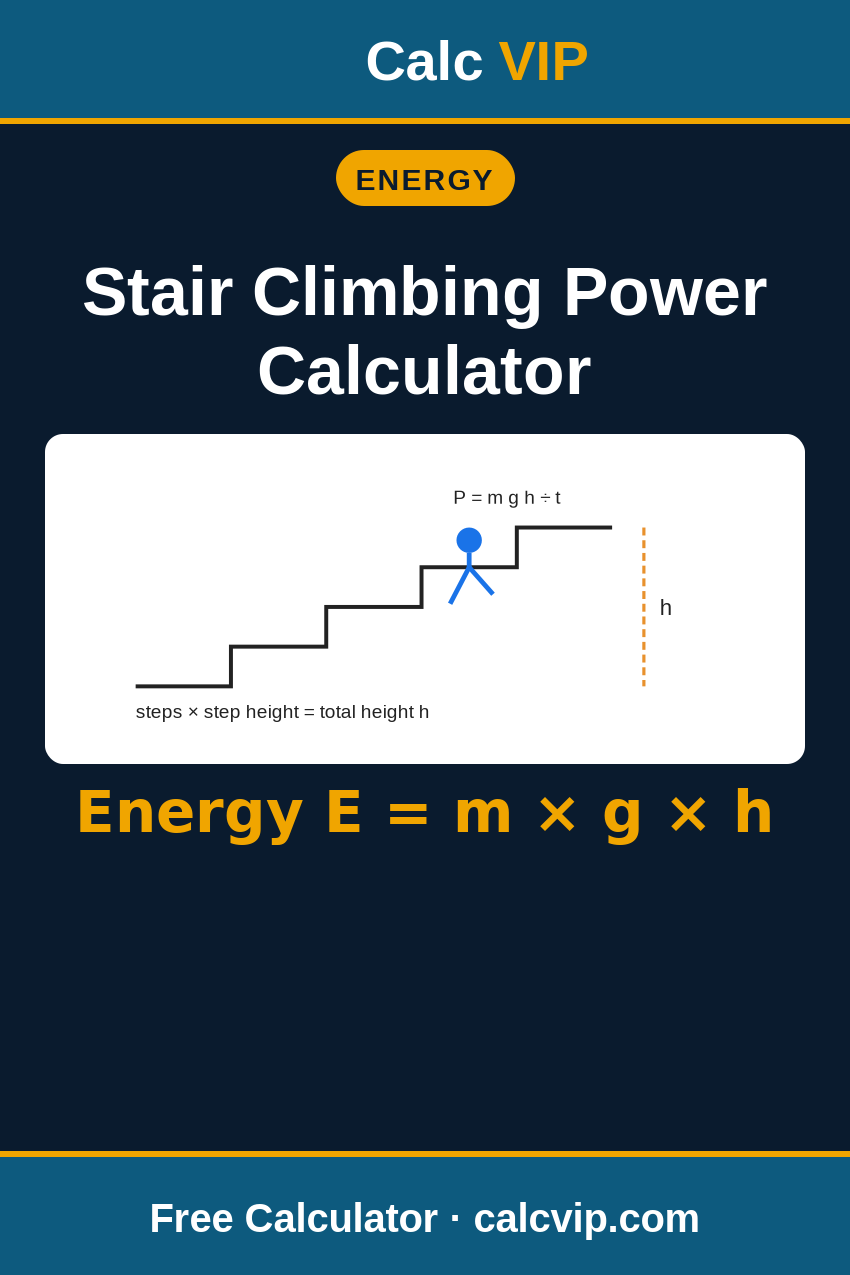
Energy E = m × g × h • Power P = E ÷ t = m × g × h ÷ t • g = 9.81 m/s², h = steps × step height
The calculation is two of this site's staples chained together. First the potential energy: raising mass m through height h banks E = mgh joules — the same formula as the potential-energy pages, with the height assembled from the staircase when you use steps mode (h = number of steps × height of each step). Then the power: divide by the climbing time t, because power is the rate of doing work. Every factor is proportional: a heavier climber produces more power at the same speed (more mass lifted), a taller staircase more (more height), a faster climb more (less time). The calculator uses g = 9.81 m/s² and reports total height, energy in joules and average power in watts, rounded to two decimal places. It deliberately reports average power: your instantaneous power surges with each step and dips between them, and mgh/t is the honest mean of that rhythm.
| Symbol | Meaning | Units |
|---|---|---|
| m | climber's mass (body + anything carried) | kilograms (kg) |
| g | gravitational field strength | 9.81 m/s² |
| h | total height climbed | metres (m) |
| E | energy used against gravity = mgh | joules (J) |
| t | time taken | seconds (s) |
| P | average mechanical power = E ÷ t | watts (W) |
Same stairs, same energy — the stopwatch writes the power
Here is the experiment this calculator was born for. Two climbers of equal mass ascend the same staircase: one strolls in 30 seconds, one runs in 10. Their energies are identical to the joule — mgh does not contain a clock. Their powers differ threefold. That is the whole distinction between energy and power, felt in the lungs: the runner is not doing more work, they are doing the same work at a greater rate, and the rate is what a body experiences as effort. Fitness, in this corner of physics, is precisely the sustainable rate — the watts you can hold — which is why stair-climb tests measure time so carefully and why the same staircase is a gentle warm-up at one pace and a maximal test at another.
The proportionality cuts the other way for the staircase itself. Double the height at the same pace and both energy and power double; the building's architecture sets the dose. This is why the world's tower-running races are ranked by vertical metres, why physiotherapists prescribe stairs by flights rather than minutes, and why a bungalow's three steps will never breathless anyone: h is too small for mgh/t to reach an interesting wattage at any survivable t. Every staircase in your life has a wattage written on it by your mass and your stopwatch — this calculator just reads it aloud.
How to use
- Enter your mass in kilograms — including anything you carry, since your legs lift the backpack too.
- Choose how to enter the height: "steps" mode (count the steps and measure one step's rise, typically 0.17 m) or "total height" mode (one floor ≈ 3 m; measure or estimate the full vertical climb).
- Enter the time in seconds from a stopwatch — start it on the first step, stop it on the last.
- Click "Calculate Climbing Power" for the total height, the energy in joules and your average power in watts. Repeat the climb at different paces and watch the energy stay fixed while the power moves — the lesson of the page, in your own numbers.
Worked examples
Example 1 — the manifest check: a brisk flight. A 60 kg climber takes 20 steps of 0.17 m in 10 s.
Height = 20 × 0.17 = 3.4 m. Energy = 60 × 9.81 × 3.4 = 2,001.24 J. Power = 2,001.24 ÷ 10 = 200.12 W — one flight of stairs, twenty LED bulbs' worth of output, from one pair of legs.
Example 2 — one floor, unhurried. A 70 kg person climbs a 3 m floor in 15 s.
Energy = 70 × 9.81 × 3 = 2,060.1 J; power = 2,060.1 ÷ 15 = 137.34 W. A perfectly respectable output — roughly a bright old light bulb — and a sustainable one, which is the point of taking the stairs at a civilised pace.
Example 3 — a student racing to class. A 50 kg student climbs 40 steps of 0.17 m (6.8 m) in 20 s.
Energy = 50 × 9.81 × 6.8 = 3,335.4 J; power = 3,335.4 ÷ 20 = 166.77 W. Two floors at a hurry: less power than Example 1 despite more energy, because the time stretched — the energy/power distinction in a school corridor.
Example 4 — a tall climb, steadily. An 80 kg hiker gains 10 m of switchback steps in 30 s.
Energy = 80 × 9.81 × 10 = 7,848 J; power = 7,848 ÷ 30 = 261.6 W. Mass and height are both large here; even a half-minute pace cannot keep the wattage modest.
Example 5 — the same flight, raced. Example 1's climber and staircase, but in 5 s instead of 10.
Energy is unchanged: 2,001.24 J. Power = 2,001.24 ÷ 5 = 400.25 W — exactly double, because the time halved. This is the cleanest demonstration on the page that power is a rate: nothing about the climb changed except the clock.
Example 6 — a tower run. A 75 kg runner climbs 320 m (the Empire State Building's 86th-floor observatory is about this high) in 1,200 s (20 minutes).
Energy = 75 × 9.81 × 320 = 235,440 J; power = 235,440 ÷ 1,200 = 196.2 W sustained for twenty minutes — elite endurance territory, and a hint of why tower runners are among the fittest athletes alive.
Stair power in real life
Fitness testing. Stair-climb tests — from school PE to cardiac rehabilitation — use exactly this calculation: mass, vertical height and time combine into a power figure that tracks fitness objectively, no laboratory required.
Firefighter and military assessment. Stair climbs with kit are standard occupational tests because the job is literally this formula under load: mass (body + gear) raised through a building's height against a clock.
Building and evacuation design. How fast crowds can descend — the negative of this calculation — shapes stairwell widths and evacuation models. The energy cost of climbing also informs where lifts are essential rather than kind.
Weight management honesty. Stair machines in gyms display calories from this physics: mechanical work from mgh, grossed up by muscle efficiency. Knowing the chain lets you read the display critically — and spot machines flattering you.
Tower-running sport. An entire racing discipline climbs skyscrapers for time. Its results tables are this calculator's outputs ranked: vertical metres, seconds, watts per kilogram — the purest power-to-weight contest in athletics.
Everyday energy intuition. Once you have felt 200 W in your legs, specifications acquire meaning: a 200 W solar panel, a 200 W amplifier, a horse at 746 W. The staircase calibrates the watt against your own body better than any textbook.
Mechanical watts versus metabolic watts: the efficiency gap
The calculator's power is the useful output — potential energy banked per second. Your body, however, pays retail. Human muscle converts food energy into mechanical work at roughly 20–25% efficiency; the rest leaves as heat, which is why climbing makes you warm. Run Example 1 through that lens: 2,001.24 J of mechanical work cost the climber about 2,001.24 ÷ 0.25 = 8,004.96 J of food energy — about 1.91 kcal. That small number surprises people twice: first that a breathless climb burns under two kilocalories of useful-accounted food energy, and second that the rate still felt enormous. Both are true, and together they explain a great deal: exercise is a poor way to burn large energies quickly (the joules are few) but an excellent way to demand large powers (the watts are real) — and it is the power demand that trains the heart and lungs.
Descending: the negative climb
There is a measurement refinement worth adding once you start comparing climbs seriously: use the same staircase, the same start and finish lines, and repeat each effort at least twice. Staircases are honest instruments — their height does not drift — but human pacing does, and a single heroic or sluggish attempt can easily misstate your typical sustainable power by a fifth or even more. Athletes who train seriously by stairs keep careful written logs of mass, height and time for exactly this reason; the three numbers are a complete training diary, and this calculator is the simple arithmetic that turns the diary into a verdict on progress.
Coming down reverses the energy flow: your potential energy drains away, and your muscles act as brakes, absorbing the energy eccentrically rather than producing it. The magnitude is the same mgh — a descent of Example 1's staircase disposes of the same 2,001.24 J — but the metabolic cost is far lower than climbing, because braking is cheap for muscle even though it is hard on knees. This asymmetry is why descent feels easy yet injures: the energy must go somewhere, and it goes into controlled lengthening of the quadriceps and into joint structures. Elevator engineers exploit the same physics in reverse — a descending loaded lift can regenerate electricity, the staircase calculation with a generator where the legs would be.
Quick reference: human power outputs
| Activity | Typical mechanical power | Notes |
|---|---|---|
| resting (basal heat) | ~80–100 W | metabolic, not mechanical — you are a light bulb at rest |
| one floor, unhurried (Ex. 2) | 137.34 W | sustainable all day |
| brisk flight (Ex. 1) | 200.12 W | about 0.27 horsepower |
| trained cyclist, one hour | 250–400 W | the endurance elite live here |
| raced flight (Ex. 5) | 400.25 W | seconds only, for most people |
| one horse | 746 W | the original horsepower, by definition |
The table's lesson is humbling and useful: human beings are 100–400 W machines. Every appliance in your home rated above that is, in a real sense, outmuscling you — and the staircase is where you can verify your own rating with a tape measure and a phone timer.
Common mistakes
- Using the slope length instead of the vertical height. mgh needs the vertical rise — steps × step height — not the distance your feet travel along the staircase's slope. The slope is longer than the rise, and using it inflates both energy and power.
- Guessing step height carelessly. Step rises vary (0.15–0.19 m in most buildings; 0.17 is a fair default). A 2 cm error per step compounds over 40 steps into a 0.8 m height error. Measure one step and multiply — or measure the whole flight directly.
- Forgetting the backpack. The m in the formula is everything being lifted, including bags, children being carried and firefighting kit. Ten extra kilograms is ten extra kilograms of power at the same pace.
- Reading the result as calories burned. The calculator gives mechanical energy and power. Food energy burned is roughly four times the mechanical energy (at ~25% efficiency) — conflating the two makes exercise look four times more effective, or four times less, depending on the direction of the error.
- Timing from the wrong moment. Reaction time at the start and a lunge at the top can each steal half a second — on a 5-second raced climb, a 20% power error. For short climbs, average several attempts; the physics rewards the honest stopwatch.
FAQ
How does 200 W compare with everyday things?
It is about the power of 20 bright LED bulbs (10 W each) — or roughly 0.27 horsepower. Climbing stairs is hard work because your body must produce this power continuously.
Does running up the stairs use more energy?
Not for the same stairs — the energy mgh is the same. But it takes less time, so the power is higher. Your body also burns extra food energy because muscles are only about 20–25% efficient.
What if I only know the number of floors?
One floor is usually about 3 m high. Multiply the floors by 3 m and use the "total height" mode.
How many calories does climbing one flight burn?
Example 1's flight banks 2,001.24 J mechanically; at 25% muscle efficiency the body spends about 8,005 J of food energy, which is roughly 1.91 kcal. Small — the climb's challenge is its power (200 W), not its total energy.
Why do stairs feel so much harder than walking the same distance?
Because walking on the flat barely raises your centre of mass, so gravity collects almost nothing. Every stair step lifts your whole mass by the step height, and mgh/t accumulates into hundreds of watts — the feeling of effort is the feeling of power.
What is a good stair-climbing power?
For a healthy adult, sustaining 150–250 W for a flight or two is solid; trained endurance athletes hold 300–400 W far longer. The fair comparison is power per kilogram of body mass — Example 1's climber produced 200.12 ÷ 60 ≈ 3.34 W/kg.
Does a heavier person really produce more power on the same climb?
Yes, at the same pace — they lift more mass through the same height, so mgh and mgh/t are both larger. It is also why they work harder in absolute terms, even though the power per kilogram may match a lighter climber's exactly.
Can I use this for a stair machine at the gym?
Yes, with care: enter the vertical height the machine reports (not the "floors" it invents, unless they are true 3 m floors) and your session time. Comparing the machine's calorie display against mgh ÷ 0.25 is a quick audit of its honesty.
Why does the calculator use g = 9.81?
Because the climb happens on Earth, against Earth's gravity. The same staircase on the Moon (g = 1.62) would cost a sixth of the energy and power — one reason lunar astronauts bounded so easily in their heavy suits.
What about climbing with a heart-rate monitor instead?
Heart rate estimates metabolic power indirectly and personally — useful for training, but it drifts with heat, fatigue and caffeine. The stopwatch-and-tape-measure method on this page measures the mechanical truth directly; the two together give the full picture, output and cost.