 Calc
Vertical Circle Calculator – Minimum Top Speed √(gr), Tension at Top and Bottom
 Created by Rachel Novak · Senior Editor · All Topics · Last updated: November 2026
Use this free Vertical Circle Calculator for loop-the-loop problems: find the minimum speed needed at the top of the loop, √(g × r), plus the tension (or track force) at the top and at the bottom for a given speed at the top.
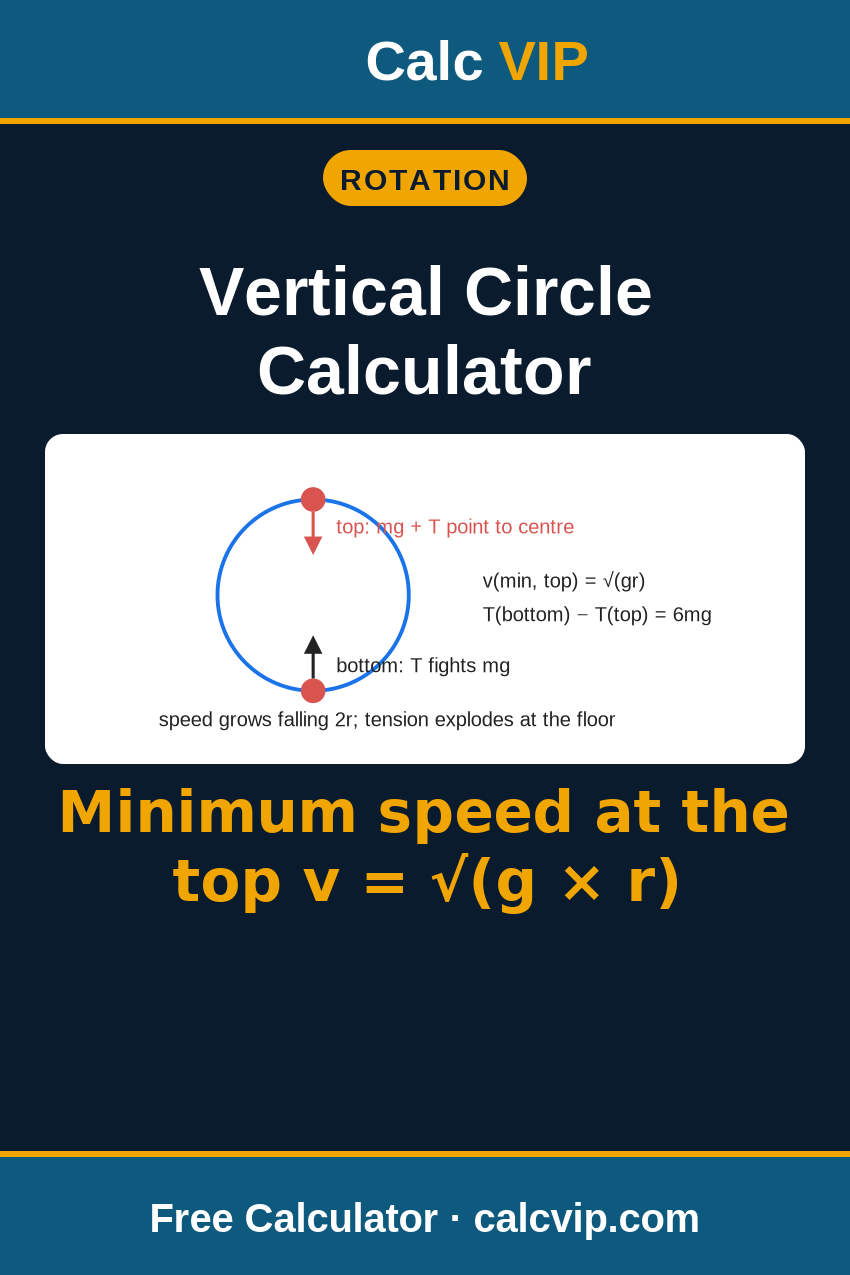
Loop-the-loop is the vertical circle's enduring drama: a car, a bucket of water, a pilot, a bead on a wire — something must crest the top of a circle without falling off it. The physics turns on one unforgiving fact: at the top, gravity is no longer the enemy of the circle but its last defender. Both weight and the string's tension (or the track's push) point towards the centre there, and the motion survives only if their sum meets the centripetal requirement mv²/r. Slow down too much and gravity wins the wrong way — the object leaves the circle and falls inside it. The boundary speed is √(gr), and this calculator is built around it.
Enter mass, radius and the speed at the top, and the calculator returns the whole story: the minimum top speed √(gr) and a verdict on yours; the tension at the top; the speed at the bottom, found by energy conservation (falling 2r trades height for speed: v²_bottom = v²_top + 4gr); and the tension at the bottom, which is always dramatically larger. That top-to-bottom contrast — a few newtons at the crest, six times the weight's worth of difference by the floor — is the signature of every loop ever ridden, and the reason loop design is an engineering discipline rather than a dare.
The same equations govern a stone on a string, water in a swung bucket, a roller-coaster car and an aerobatic aircraft, with one substitution: for anything running on a track or inside a hoop, read "tension" as the track's normal push. Where the object is on a rigid rod or a wire threaded through it, the rules soften — the rod can push as well as pull — and the concept section marks exactly where the calculator's string-based verdicts stop applying.
Formulas
Minimum speed at the top v = √(g × r) • tension at the top T = m × (v²/r − g) • speed at the bottom v²(bottom) = v²(top) + 4 × g × r • tension at the bottom T = m × (v²(bottom)/r + g) • (g = 9.81 m/s²)
Each line has a one-sentence derivation. At the top, mg + T = mv²/r; setting T = 0 (the string only just taut, gravity alone barely sufficient) gives v² = gr — the minimum speed. The bottom speed is pure energy bookkeeping: descending the diameter 2r converts 2mgr of potential energy into kinetic, adding 4gr to v². At the bottom, T − mg = mv²/r (tension now fights gravity instead of joining it), giving the last formula. Subtract the top tension from the bottom and a small miracle appears: T(bottom) − T(top) = 6mg, always, whatever the speed — a theorem worth remembering, and a built-in check on any loop calculation, including this calculator's own output.
| Symbol | Meaning | Units |
|---|---|---|
| m | mass of the looping object | kg |
| r | radius of the vertical circle | m |
| v | speed at the top of the loop (the input) | m/s |
| T | tension, or the track's normal force | N |
| g | gravitational field strength | 9.81 m/s² |
Strings, rods and tracks: three different minimum speeds
The √(gr) rule belongs to the string (and to objects resting on the inside of a track): the connector can only pull, so the moment the required tension would go negative, contact is lost and the object becomes a projectile inside the circle. A rigid rod, or a bead threaded on a wire, changes the problem completely — the rod can push, holding the object on the circle even at near-zero top speed. For the rod, the condition moves to the bottom: arriving with enough energy to reach the top at all requires v²(bottom) ≥ 4gr, i.e. v(bottom) ≥ 2√(gr) (for r = 2 m, 8.8589 m/s). A car on top of a loop-the-loop track (wheels above the rails, held by them) behaves like the bead; a car hanging inside a hoop behaves like the string. Before applying this calculator's verdict, ask which connector you have — the physics grades them differently, and examinations delight in the distinction.
Roller coasters cheat the problem beautifully with the clothoid loop: not a circle but a teardrop, with a large radius at the bottom (gentle curvature where speed and force peak) and a small radius at the top (where √(gr) is then easy to exceed). A circular loop entered at minimum top speed slams riders with a bottom tension of 6mg plus the top's contribution — Example 3's 6.47 × weight — beyond comfort and near structural sense. The clothoid trims the bottom figure to roughly half while keeping the top safe, which is why every modern loop is a teardrop when you look at it properly.
How to use
- Enter the mass in kg and the radius of the vertical circle in metres.
- Enter the object's speed at the top of the loop in m/s. (If you know the bottom speed instead, convert: v²(top) = v²(bottom) − 4gr.)
- Click "Calculate Vertical Circle" to see the minimum top speed, the verdict on your speed, and the tensions at top and bottom.
- Check the theorem: bottom tension minus top tension should equal 6 × m × 9.81. If it does not, an input has slipped.
Worked examples
Example 1 — the standard loop. A mass of m = 0.5 kg loops a circle of radius r = 2 m, passing the top at v = 6 m/s:
Minimum top speed = √(9.81 × 2) = 4.4294 m/s — 6 m/s is safely above it ✓
Tension at top = 0.5 × (6²/2 − 9.81) = 0.5 × 8.19 = 4.095 N
Speed at bottom = √(6² + 4 × 9.81 × 2) = √114.48 = 10.6995 m/s
Tension at bottom = 0.5 × (114.48/2 + 9.81) = 33.525 N. And 33.525 − 4.095 = 29.43 = 6 × 0.5 × 9.81 ✓ — the theorem holds.
Example 2 — the bucket of water. Swing a bucket (bucket plus water, m = 2 kg) on an arm's-length circle of r = 0.9 m, cresting at v = 4 m/s:
Minimum top speed = √(9.81 × 0.9) = 2.9714 m/s — comfortably beaten
Tension (your arm's pull) at top = 2 × (16/0.9 − 9.81) = 15.9356 N
Speed at bottom = √(16 + 35.316) = 7.1635 m/s; pull at bottom = 133.6556 N. The water stays in because at the top it, too, is "falling" around the circle faster than gravity alone would drop it — the bucket's base pushes it through the arc.
Example 3 — the roller coaster. A car and passengers of m = 500 kg crest a circular loop of r = 10 m at v = 12 m/s:
Minimum top speed = √(9.81 × 10) = 9.9045 m/s (35.7 km/h)
Track force at top = 500 × (144/10 − 9.81) = 2,295 N
Speed at bottom = √(144 + 392.4) = 23.1603 m/s; track force at bottom = 31,725 N — 6.47 times the car's weight pressing riders into their seats. Real loops are clothoids precisely to tame this last number.
Example 4 — the knife-edge: exactly minimum speed. A stone of m = 0.3 kg on a string of r = 1.2 m crests at exactly v = √(gr) = √(9.81 × 1.2) = 3.431 m/s:
Tension at top = 0.3 × (3.431²/1.2 − 9.81) = 0 N — the string is taut but weightless in effect, gravity doing everything
Speed at bottom = √(11.772 + 47.088) = 7.672 m/s
Tension at bottom = 17.658 N = exactly 6mg (6 × 0.3 × 9.81). At the minimum-energy loop, the bottom tension is always six times the weight — a fact worth more than the example.
Example 5 — below the minimum: the warning case. Example 1's stone slowed to v = 3.5 m/s at the top of its r = 2 m circle, where the minimum is 4.4294 m/s:
The formal tension would be 0.5 × (3.5²/2 − 9.81) = 0.5 × (−3.685) = −1.8425 N — impossible for a string. The calculator therefore warns instead: on a string, the stone leaves the circle before the top and falls inside it. Negative tension is mathematics' way of saying the assumed path no longer exists.
Example 6 — the aerobatic pilot. A pilot of m = 80 kg flies a loop of r = 300 m, cresting at v = 70 m/s:
Minimum top speed = √(9.81 × 300) = 54.2494 m/s (195.3 km/h) — the loop must be entered fast
Seat force at top = 80 × (4900/300 − 9.81) = 521.8667 N (the pilot feels 0.665 × their weight — nearly floating)
Speed at bottom = √(4900 + 11,772) = 129.12 m/s; seat force at bottom = 5,230.6667 N — 6.665 × body weight, the grey-out zone that aerobatic training and g-suits exist to manage.
Vertical circles in real life
Roller coasters. Example 3 plus the clothoid fix is the industry: designers choose the crest radius so trains clear √(gr) with margin at their slowest (fully loaded, cold-morning) speed, and shape the bottom so the 6mg-class forces never fully arrive. The calculator's four outputs are the first four lines of a loop's design file.
The bucket trick. Example 2 is performed in every physics classroom: swing the bucket above √(gr) ≈ 2.9714 m/s at the top and the water stays, slower and it redecorates the room. It is the most persuasive demonstration in mechanics because the student's own arm feels the bottom tension (133.6556 N) doing the persuading.
Aerobatics and airshows. Example 6's numbers are flown daily: loop entry speeds are briefed from √(gr) with margin, and the bottom's 6–7 g is the physiological limit that shapes the manoeuvre. Pull the loop tighter (smaller r) and both the minimum speed and the bottom force fall — pilots trade radius for mercy.
The globe of death. Motorcycle riders loop a spherical cage of about r = 5 m, where √(gr) = 7.0036 m/s = 25.2 km/h is the crest minimum. They ride far above it — the margin is the act — but the floor of their craft is this calculator's first formula.
Stones, slings and tethered demos. Every whirled stone rehearses Example 5's warning: slow at the top and the string goes slack with a visible sag before the fall. The transition is sharp and diagnostic — slackness begins exactly where the formal tension crosses zero.
Washing-machine drums and centrifuges, tilted. A load plastered to a drum wall in a vertical plane obeys the same balance at the drum's top: spin fast enough that v²/r exceeds g and the load stays pinned through the crest; the "distribute" tumble deliberately runs below it so clothes fall and mix. One inequality, two products.
Quick reference: minimum top speed √(gr)
| Radius r (m) | v(min) (m/s) | v(min) (km/h) | Setting |
|---|---|---|---|
| 0.5 | 2.2147 | 8.0 | short string demo |
| 1 | 3.1321 | 11.3 | bucket on a long arm |
| 2 | 4.4294 | 15.9 | Example 1's loop |
| 5 | 7.0036 | 25.2 | globe of death |
| 10 | 9.9045 | 35.7 | coaster loop |
| 20 | 14.0071 | 50.4 | large fairground loop |
| 50 | 22.1472 | 79.7 | gentle aerobatic loop |
The square root is merciful: a loop one hundred times wider needs only ten times the crest speed. It is the bottom tension, growing with v², that punishes size — which is why giant loops are flown gently and tiny loops are brutal.
The 6mg theorem and other built-in checks
Three consistency checks let you audit any vertical-circle answer, including your own examination work. First, T(bottom) − T(top) = 6mg exactly (Examples 1 and 4 both exhibit it). Second, the bottom speed must exceed the top speed by the energy rule v²(bottom) − v²(top) = 4gr — if a solution shows the object faster at the top, energy has been created and the work is wrong. Third, at the minimum top speed the bottom tension is exactly 6mg and the bottom speed is √(5gr) — for Example 4, √(5 × 9.81 × 1.2) = √58.86 = 7.672 m/s ✓. A solution that passes all three checks can still have an arithmetic slip, but it cannot have a conceptual one; examiners have used these checks for generations, and this calculator's outputs pass them by construction.
Common mistakes
- Using the bottom speed in the top formula. The tension formulas are position-specific: at the top, gravity helps (T = m(v²/r − g)); at the bottom, it hinders (T = m(v²/r + g)) — and v itself differs between the two points by the 4gr rule. One speed, used everywhere, is the classic way to fail this topic.
- Forgetting gravity at the top. Writing T(top) = mv²/r omits the weight's contribution and overstates the needed tension — at minimum speed it predicts mgr/r = mg instead of the correct zero. The top is the one place gravity is on the circle's side.
- Expecting the minimum speed to depend on mass. √(gr) contains no m: a marble and a motorcycle share the same crest minimum on the same loop. Mass scales both tensions (and the 6mg gap) but never the speed threshold.
- Applying √(gr) to rods and threaded beads. A rigid rod can push, so its object can crest arbitrarily slowly; the binding condition becomes the bottom speed, v(bottom) ≥ 2√(gr). Quoting √(gr) for a rod problem answers a question nobody asked.
- Taking a negative tension at face value. A negative result from T = m(v²/r − g) is not a compression — strings do not push. It is the signal that the object left the circle earlier, and the correct response is the calculator's warning, not the number.
FAQ
Why is there a minimum speed at the top?
At the top, both weight and tension pull towards the centre. If the object moves too slowly, gravity pulls it off the circular path before tension can help. At v = √(gr) gravity alone is exactly enough, and the tension is zero.
Why is the tension so much bigger at the bottom?
Two reasons: the object is moving fastest at the bottom (it has fallen 2r, gaining speed), and there the tension must also support the weight — it works against gravity instead of with it.
Does this also work for a car on a loop-the-loop track or a bucket of water?
Yes — replace "tension" with the normal reaction from the track. For the bucket, the same √(gr) rule explains why the water stays in when you swing it fast enough.
What is the minimum speed at the bottom of the loop?
For a string, the bottom speed corresponding to a just-taut top: v(bottom) = √(5gr) — for r = 2 m, √(5 × 9.81 × 2) = 9.9045 m/s. Enter the loop slower than that at the bottom and the top cannot be completed, however the motion looks at the start.
Why do riders feel weightless at the top and crushed at the bottom?
Because the seat's push is the "tension" of these formulas. At the top it can fall to near zero (Example 6: 0.665 × body weight, Example 4: exactly zero) — weightlessness. At the bottom it reaches 6–7 times body weight. The feelings are the formulas, read by the inner ear.
Does the mass of the object change the minimum speed?
No. v(min) = √(gr) is mass-free: gravity supplies an acceleration, and the requirement is an acceleration (v²/r = g). Mass enters only the forces — double the mass and both tensions double, the thresholds stand.
What if the object is on a rigid rod instead of a string?
The rod can push, so there is no √(gr) crest condition; the object can creep over the top. The requirement becomes energetic: reach the top at all, needing v(bottom) ≥ 2√(gr). This calculator's tension-at-top formula still works for the rod — negative values then mean the rod is pushing, which it legitimately can.
How do real roller coasters keep the bottom force tolerable?
Clothoid loops: a large radius at the bottom lowers v²/r where v is greatest, and a small radius at the top keeps √(gr) easy. The teardrop shape spreads the force budget around the loop instead of concentrating it at the floor.
Where exactly does a too-slow object leave the circle?
Before the top, at the point where the required tension falls to zero along its actual trajectory — for a string released into the loop with insufficient speed, typically well before the crest, after which the object is a projectile inside the circle. The calculator flags the situation from the top-speed test; finding the exact leaving point needs the energy method applied angle by angle.
Is the 6mg difference really independent of speed?
Yes — the algebra is exact: T(bottom) − T(top) = m(v²(bottom)/r + g) − m(v²(top)/r − g), and substituting v²(bottom) = v²(top) + 4gr collapses it to m(4g + 2g) = 6mg. Speed cancels completely. It is one of the prettiest small theorems in mechanics, and a free check on every loop problem.