 Calc
Angular Acceleration Calculator – α = (ω₂−ω₁)/t & Revolutions Turned
 Created by Elena Petrova · Physics Editor · Fluids & Rotation · Last updated: November 2026
Use this free Angular Acceleration Calculator to find α from the change in angular velocity over time, α = (ω₂ − ω₁)/t — plus the total angle and number of revolutions turned while it speeds up or slows down.
Angular acceleration is the answer to a simple question: how quickly is the spin itself changing? A fan that takes three seconds to reach full speed, a car wheel that stops in two, a centrifuge that climbs for a patient minute — each has its own rate of change of angular velocity, and α is that rate, measured in radians per second, per second. This calculator takes the direct route to it: give it the starting angular velocity ω₁, the final angular velocity ω₂ and the time t between them, and it returns α — and, because a changing spin is also a journey, it reports how far the object turned along the way, in radians and in revolutions.
The formula α = (ω₂ − ω₁)/t is the average angular acceleration over the interval, and for the great majority of machines — anything driven by a roughly steady torque — the average is the whole story, because α stays constant while the torque does. Its sign carries meaning that beginners often miss: positive α means the spin is speeding up in the chosen direction; negative α means it is slowing down, and there is no separate word or formula needed for "deceleration" — the minus sign does the work. A fan switched off does not need a new law; it simply reports a negative α until it stops, as Example 2 shows.
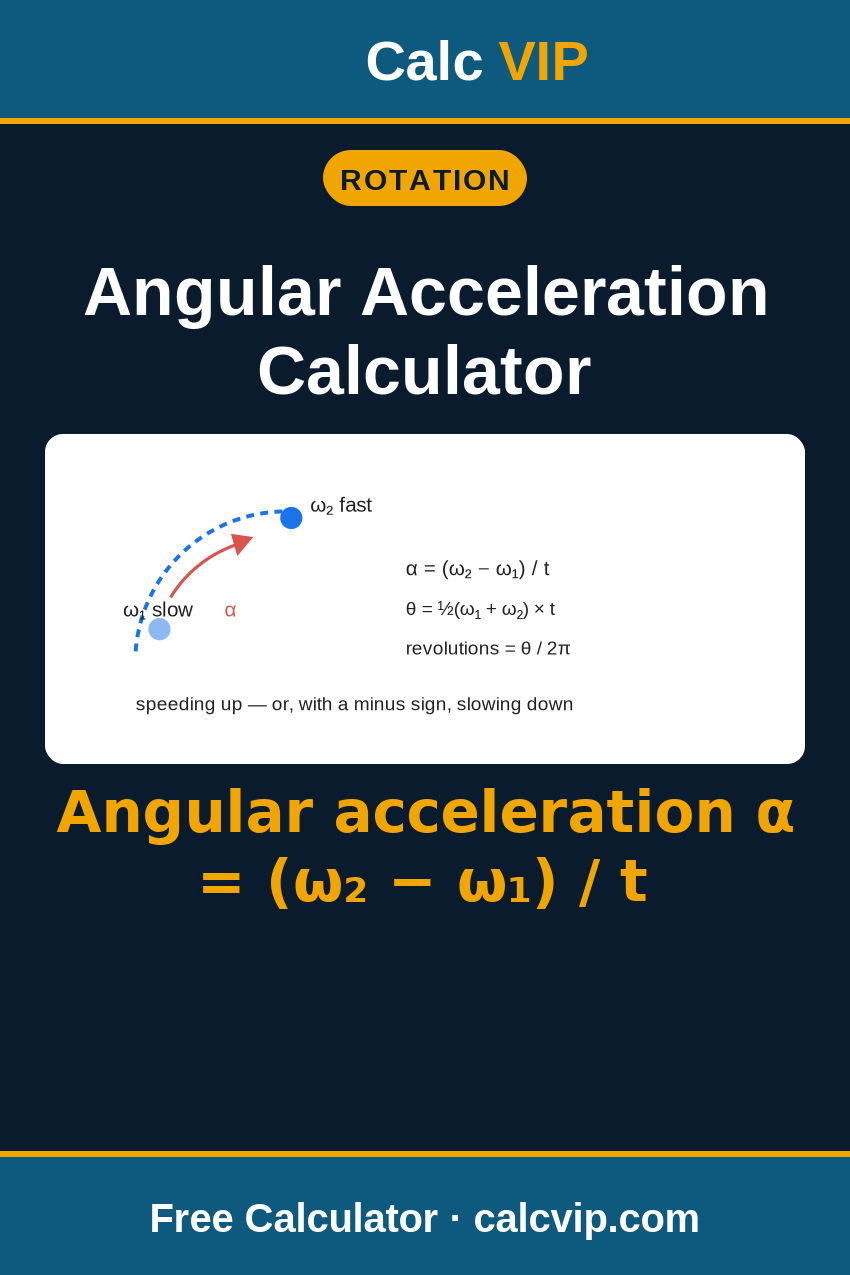
The companion results deserve equal billing. While a spin changes, the object sweeps an angle θ = ½(ω₁ + ω₂) × t — the average angular velocity multiplied by the time, an idea borrowed directly from distance = average speed × time. Divided by 2π, θ becomes the count of revolutions, the number a machinist or a motor controller actually thinks in. Together the three outputs of this calculator — α, θ, revolutions — describe a spin-up or spin-down completely: how hard it is changing, how far it went, and how many turns that was. The sections below connect α to its cause (torque), its family (the rotational kinematics equations), and its fingerprints on everyday machines.
Formula
Angular acceleration α = (ω₂ − ω₁) / t • Angle turned θ = ½ × (ω₁ + ω₂) × t • Revolutions = θ / 2π • α in rad/s², ω in rad/s, t in seconds, θ in radians
The set rearranges freely: t = (ω₂ − ω₁) / α gives the time a given α needs to bridge two speeds; ω₂ = ω₁ + αt predicts the speed after a time; and two further members of the family — θ = ω₁t + ½αt² and ω₂² = ω₁² + 2αθ — handle problems where the angle, rather than the time, is what you know. Where does α come from in the first place? From torque: α = τ/I, the subject of this batch's torque calculator. And what does α do at the rim of the object? It produces a tangential acceleration at = α × r — the forward acceleration felt by a point on the rim, and the quantity that ties angular acceleration to the linear world of forces and passengers. Units throughout: radians are dimensionless travellers, so α emerges honestly in rad/s², and a negative α simply means the object is slowing down.
| Symbol | Meaning | Units |
|---|---|---|
| α | angular acceleration | rad/s² |
| ω₁, ω₂ | angular velocity at the start and end | rad/s |
| t | time over which the spin changes | s |
| θ | angle turned during the change | rad (or revolutions) |
| at | tangential acceleration at radius r, = αr | m/s² |
Average α, instantaneous α, and why the average usually wins
Strictly, α = (ω₂ − ω₁)/t measures the average rate of change across the interval — the slope of the whole climb, not the steepness at any one step. If the torque varies during the interval (a motor whose pull fades with speed, a brake that bites harder as it warms), the true α varies too, and the instantaneous value at a chosen moment would need the slope of ω's graph at that moment. But engineering life is mostly kinder than the strict definition suggests. A constant net torque produces a genuinely constant α, and even when α drifts, the average is exactly the number you need for the questions people actually ask: how long to reach speed, how many turns on the way, what the final ω will be. When precision matters, the remedy is simple — slice the interval. Apply this calculator second by second, feeding each slice's ω₂ in as the next slice's ω₁, and the averages converge on the true, varying story as closely as you care to cut. Motor controllers do exactly this, thousands of times per second, which is why a well-tuned drive can follow a commanded speed profile so faithfully that the slicing becomes invisible.
There is also a quiet assumption in θ = ½(ω₁ + ω₂)t: the average of the start and end speeds is the true average speed only when α is constant, so the angle formula and the acceleration formula stand or fall together. Both are exact for the constant-torque world of motors, brakes and steady friction, and both are the working tools of everyone who specifies them. The examples below stay in that world, and the largest of them — a centrifuge climbing to 300 rad/s — is precisely the sort of patient, steady-torque climb where the average α is not an approximation at all.
How to use
- Enter the starting angular velocity ω₁ in rad/s (0 if the object starts from rest). Convert from rpm, if needed, with ω = rpm × 2π/60.
- Enter the final angular velocity ω₂ in rad/s (0 if it comes to a stop).
- Enter the time t in seconds between the two states.
- Click "Calculate Angular Acceleration" to get α in rad/s², the angle turned in radians, and the number of revolutions. A negative α means the spin is slowing — the angle and revolutions are still reported as positive distances travelled.
Worked examples
Example 1 — a motor spinning up. A motor speeds up from ω₁ = 10 rad/s to ω₂ = 50 rad/s in t = 8 s:
α = (50 − 10) / 8 = 5 rad/s²
θ = ½ × (10 + 50) × 8 = 240 rad, which is 240 / 2π = 38.1972 revolutions
Example 2 — a fan coasting to rest. A ceiling fan turning at ω₁ = 60 rad/s is switched off and stops in t = 12 s:
α = (0 − 60) / 12 = −5 rad/s²; θ = ½ × (60 + 0) × 12 = 360 rad = 57.2958 revolutions of slow, stately dying. The fan makes fifty-seven more turns after the switch — angular acceleration is small precisely because friction is.
Example 3 — from rest. A turntable platter starts from rest and reaches ω₂ = 30 rad/s in t = 5 s:
α = (30 − 0) / 5 = 6 rad/s²; θ = ½ × 30 × 5 = 75 rad = 11.9366 revolutions. Starting from rest makes ω₁ vanish and the arithmetic transparent — which is why textbook problems and motor datasheets both love it.
Example 4 — a car wheel pulling away. A wheel already rolling at ω₁ = 5 rad/s is driven with α = 4 rad/s² for t = 10 s:
ω₂ = 5 + 4 × 10 = 45 rad/s (about 430 rpm); θ = ½ × (5 + 45) × 10 = 250 rad = 39.7887 revolutions. With a 0.32 m radius, those revolutions carry the car 250 × 0.32 = 80 metres down the road.
Example 5 — the centrifuge's long climb. A centrifuge with a modest α = 25 rad/s² aims for ω₂ = 300 rad/s from rest:
t = 300 / 25 = 12 s; θ = ½ × 300 × 12 = 1,800 rad = 286.4789 revolutions on the way up. Twelve seconds feels long at the bench; the formula shows it is simply a small α patiently compounding.
Example 6 — hard braking. A flywheel spinning at ω₁ = 100 rad/s is braked to ω₂ = 40 rad/s in t = 6 s:
α = (40 − 100) / 6 = −10 rad/s²; θ = ½ × (100 + 40) × 6 = 420 rad = 66.8451 revolutions — and every one of those turns is the brake converting the wheel's stored energy into heat, which is why brakes are built like radiators.
Angular acceleration in real life
Electric vehicles. The instant shove of an EV is an α story: the motor's torque arrives immediately and the wheels' α = τ/I is large from the first fraction of a second. Traction control is, in part, an α governor — it watches the wheels' angular acceleration and trims torque when α announces a spin before the driver can feel it.
Washing machines. The climb from tumble to full spin is deliberately slow — α is capped by the controller so the drum's load redistributes instead of climbing the wall as one unbalanced lump. The long, patient spin-up you hear is a chosen α, not a weak motor.
Hard drives and optical discs. A hard drive platter reaches 7,200 rpm with a carefully profiled α, fast enough to be ready in seconds, gentle enough not to stress the bearings; a CD changes its α continuously as it plays, spinning slower for the outer tracks — angular velocity management as a full-time job.
Amusement rides. The thrill of a spinning ride lives in the tangential acceleration at = αr at the rider's seat. Designers budget α so that at stays within what stomachs forgive; the same ride at a larger radius needs a smaller α for the same sensation, which is why big wheels turn gently.
Aircraft and marine propellers. A propeller's α on throttle-up is limited by the engine's torque and the prop's inertia — and by the cavitation or airflow breakdown that punishes greed. Pilots advance throttles smoothly partly to keep α civilised while the blades bite.
Wind turbines. A turbine rotor's α is small in absolute terms — a few hundredths of a rad/s² — but the rotor is enormous, so the tangential speeds and energies involved are large. Gusts are α events: the control system pitches the blades to keep the rotor's angular acceleration, and hence its loads, inside the design envelope.
From α to the rim: tangential acceleration
Angular acceleration is an abstraction until something has to survive it, and what survives it is material at a radius. A point at distance r from the axle experiences a tangential (forward) acceleration at = αr, in ordinary m/s². Example 4's wheel, with α = 4 rad/s² and r = 0.32 m, accelerates every point of its rim forward at 1.28 m/s² while it spins up — modest. A centrifuge tube at r = 0.1 m under α = 25 rad/s² feels 2.5 m/s² tangentially, quite apart from the enormous centripetal acceleration of its steady spin. The rule at = αr is also why large rotors are spun up gently: at r = 10 m (a wind turbine blade's mid-span), even α = 0.05 rad/s² is 0.5 m/s² at that station, applied to tonnes of blade. Small α, large r, serious forces — the multiplication is unforgiving, and this is the formula that does it.
Quick reference: typical angular accelerations
| Machine | Typical α | Why |
|---|---|---|
| wind turbine rotor | ≈ 0.01–0.05 rad/s² | enormous I, gentle torques |
| ceiling fan (coasting down) | ≈ −5 rad/s² | only friction opposes it |
| car wheel pulling away | ≈ 4 rad/s² | engine torque vs wheel + car load |
| laboratory centrifuge | ≈ 25 rad/s² | strong motor, small rotor |
| power drill bit | hundreds of rad/s² | tiny I — α = τ/I explodes |
The table reads as a story about denominators: α spans four orders of magnitude across ordinary machines, and in every row the explanation is the size of I relative to the torque available. When a spin-up feels instant or eternal, you are feeling α = τ/I with your body.
Common mistakes
- Entering rpm where rad/s belong. ω₁ and ω₂ must be in rad/s. A motor "speeding from 100 to 900 rpm" has Δω = 800 × 2π/60 ≈ 83.8 rad/s, not 800 — forget the conversion and α comes out about 9.5 times too large.
- Reporting a slowing spin as a positive α. If ω₂ < ω₁, α is negative, and the sign is information, not an error. Dropping it makes stopping times and braking angles come out wrong-signed and quietly absurd.
- Averaging speeds when α is not constant. θ = ½(ω₁ + ω₂)t assumes a steady α. For a spin-up whose torque fades badly, slice the interval into steps and apply the calculator to each, or the angle will be off.
- Confusing α with ω. A wheel at a constant 500 rad/s has α = 0 — high speed, no acceleration. α measures the change, and a perfectly steady spin, however fast, has none.
- Confusing α with centripetal acceleration. α (rad/s²) changes the spin rate; centripetal acceleration (m/s²) is the inward pull on rim points, ω²r. A speeding-up wheel has both; a steady wheel has only the second; the units alone keep them apart.
FAQ
What are the units of angular acceleration?
Radians per second squared (rad/s²): how much the angular velocity changes every second.
Can angular acceleration be negative?
Yes. If ω₂ is smaller than ω₁, α is negative — the object is decelerating (slowing its spin), like a fan after it is switched off.
How is this related to torque?
Angular acceleration is caused by a net torque: α = τ/I. This calculator finds α from the motion itself, without needing the torque.
How do I convert rpm changes into α?
Convert both speeds first: ω = rpm × 2π/60 ≈ rpm × 0.1047. A rise from 600 to 1,500 rpm is Δω = 900 × 0.1047 ≈ 94.2 rad/s; over 6 s, α ≈ 15.7 rad/s². The converter in this batch does the speed conversions for you.
What if the object reverses direction?
Give the reversed spin a negative sign: if ω₁ = +20 rad/s and ω₂ = −20 rad/s over 4 s, then α = (−20 − 20)/4 = −10 rad/s². The calculator handles signed values naturally — the spin passed through zero and out the other side.
Is angular acceleration a vector?
Yes — it points along the axis of rotation, in the direction given by the right-hand rule (curl the fingers of your right hand with the spin; the thumb gives the direction). Opposite spins have opposite α vectors, which is why signs work in the one-dimensional treatment on this page.
Why does a heavy flywheel take so long to speed up?
Because α = τ/I and its I is large by design. The same motor torque shared over a large inertia gives a small α — the flywheel trades spin-up time for the steadiness it was built to provide. Given minutes rather than seconds, it gets there.
Can α be zero while the object is clearly moving?
Yes — any object spinning at constant ω has α = 0, from a cruising car's wheels to the Earth, whose α is so close to zero that its day lengthens by milliseconds per century. Motion and acceleration are different reports; this page files the second one.
How many revolutions is one radian?
One revolution is 2π ≈ 6.2832 rad, so one radian is 1/(2π) ≈ 0.1592 revolutions — about a sixth of a turn. The calculator's revolution count is θ divided by 2π, which is why 240 rad becomes 38.1972 turns in Example 1.
What α does a hard drive need?
To reach 7,200 rpm (754 rad/s) in about 4 seconds from rest, α ≈ 754/4 ≈ 188 rad/s² — two orders of magnitude beyond a car wheel, achieved because the platter's I is tiny and its motor's torque, though small, is more than sufficient. Small things spin up fast; the formula insists on it.