 Calc
Angular Momentum Calculator – L = Iω and L = mvr
 Created by Elena Petrova · Physics Editor · Fluids & Rotation · Last updated: November 2026
Use this free Angular Momentum Calculator in two ways: for a spinning rigid body with L = Iω, or for a particle moving in a circle with L = mvr.
Linear momentum measures how hard a moving object is to stop. Angular momentum is its rotational counterpart — how hard a spinning or orbiting object is to stop turning — and it obeys the most romantic law in mechanics: in the absence of an outside torque, it can neither be created nor destroyed, only moved around. That single conservation rule explains why skaters spin up when they pull in their arms, why planets have kept their orbits for billions of years, and why a falling cat can turn in mid-air. This calculator evaluates angular momentum both ways it arises: for a rigid body spinning on an axis, L = Iω, and for a particle circling a point, L = mvr.
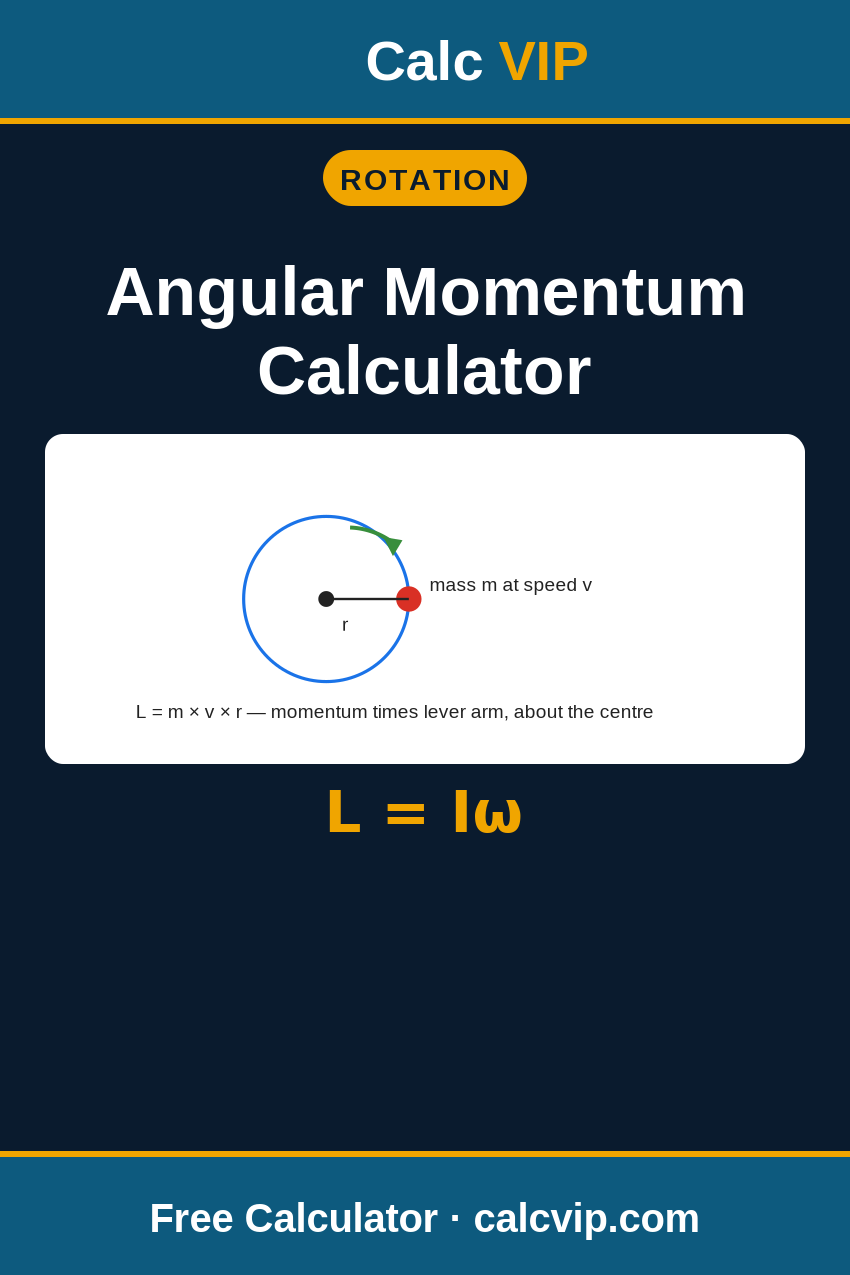
The two formulas look different but are one idea in two costumes. The circling particle's L = mvr is momentum (mv) multiplied by the lever arm (r) — how much "turn" the motion has about the centre. The spinning body's L = Iω replaces the single particle with a whole object's worth of particles, each contributing its own mvr, bundled into the moment of inertia I and the spin rate ω. The original FAQ at the bottom of this page shows the algebra of their equivalence. Whichever costume fits your problem, the unit is the same: kilogram-metres squared per second (kg·m²/s).
What makes angular momentum special among physics quantities is the direction it carries. L is a vector pointing along the rotation axis (by the right-hand rule: curl your fingers with the spin, your thumb gives the direction), and conservation applies to the whole vector — magnitude and direction together. That is why gyroscopes hold their orientation in space, why Earth's axis keeps pointing at the same star as we orbit, and why a torque applied at right angles produces the eerie sideways response called precession. Magnitude questions ("how fast will she spin?") are arithmetic; direction questions are where angular momentum turns into navigation.
Formulas
Spinning body: L = Iω — moment of inertia times angular velocity.
Circling particle: L = mvr — mass times speed times the radius of the circular path.
The two forms unite through ω = v ÷ r and I = mr² for a single particle: L = Iω = mr² × (v/r) = mvr. For extended bodies I comes from the shape formulas (disk ½MR², hoop MR², sphere (2/5)MR² — see the Moment of Inertia Calculator), and ω from the spin rate: one revolution per second is ω = 2π ≈ 6.28 rad/s, so convert rpm by multiplying by 2π/60 ≈ 0.1047. Rearrangements worth having: ω = L ÷ I (the skater's equation — new spin from old angular momentum and new inertia) and v = L ÷ (mr). The calculator accepts either mode; choose the one whose inputs you actually know.
| Symbol | Meaning | Units |
|---|---|---|
| L | angular momentum | kg·m²/s |
| I | moment of inertia about the axis | kg·m² |
| ω | angular velocity (spin rate) | radians per second (rad/s) |
| m, v, r | particle's mass, speed, and path radius | kg, m/s, m |
Conservation: the law that runs the universe's turntables
Torque is to angular momentum what force is to linear momentum: the rate of change, τ = ΔL/Δt. Read it backwards and you get the conservation law — no torque, no change. The skater is the canonical demonstration: on frictionless ice, gravity and the ice's support force both act through her axis, so no torque acts about it, and her L is locked. Pulling in her arms reduces I; since L = Iω cannot change, ω must rise to compensate — she does not push against anything to spin faster, she simply rearranges the inertia she already owns. The energy, delightfully, is not conserved in the process (her muscles do work pulling the arms in against centrifugal tendency, and the spin energy rises) — but L, the books always balance.
Scale the same law up and it becomes astronomy's bookkeeper. A collapsing gas cloud, shrinking under gravity with no outside torque, must spin faster as it contracts — which is why stars are born rotating, why accretion discs form around them, and why a neutron star, the collapsed core of a massive star squeezed from millions of kilometres to a city-sized ball, can spin hundreds of times per second. The fastest pulsars are conservation of angular momentum written in radio pulses across the galaxy. Nothing in the universe gets to spin for free, and nothing spinning gets to stop without paying its L out to something else.
How to use
- Choose the mode that matches your problem: a spinning rigid body (L = Iω) or a particle moving in a circle (L = mvr).
- For a spinning body, enter the moment of inertia I in kg·m² (from the Moment of Inertia Calculator if needed) and the angular velocity ω in rad/s — convert rpm by multiplying by 0.1047.
- For a circling particle, enter its mass m in kg, its speed v in m/s and the radius r of its path in metres.
- Click "Calculate Angular Momentum" to get L in kg·m²/s. For conservation problems, compute L once — that is the value every later configuration must reproduce.
Worked examples
Example 1 — both formulas side by side. Spinning body: I = 2 kg·m², ω = 10 rad/s → L = 2 × 10 = 20 kg·m²/s
Circling particle: m = 2 kg, v = 5 m/s, r = 3 m → L = 2 × 5 × 3 = 30 kg·m²/s
Example 2 — the skater, quantified. A skater spinning with arms outstretched has I = 6 kg·m² and ω = 2 rad/s, so L = 6 × 2 = 12 kg·m²/s. She pulls her arms in, cutting I to 2 kg·m². With no outside torque, L is conserved:
ω = L ÷ I = 12 ÷ 2 = 6 rad/s — her spin rate triples, from about a third of a revolution per second to nearly a full one (6 ÷ 2π ≈ 0.95 rev/s). Every triple jump in skating begins with this division.
Example 3 — a ball on a string. A 0.2 kg ball whirls on a 1.5 m string at 4 m/s:
L = mvr = 0.2 × 4 × 1.5 = 1.2 kg·m²/s. Shorten the string to 0.75 m mid-whirl (pull it through a tube, the classic lecture demo) and conservation of L doubles the speed to 8 m/s: L = 0.2 × 8 × 0.75 = 1.2 ✓. The ball speeds up for the same reason the skater does — r fell, so v rose to keep the product constant.
Example 4 — a bicycle wheel. A wheel (hoop, M = 1.5 kg, R = 0.35 m, so I = MR² = 0.184 kg·m²) on a bike travelling at 8 m/s spins at ω = v ÷ r = 8 ÷ 0.35 ≈ 22.86 rad/s:
L = Iω = 0.184 × 22.86 ≈ 4.2 kg·m²/s per wheel. That stored "turn" is part of why a moving bicycle resists being tipped — changing the wheels' L direction requires a torque, and the road is happy to argue about it.
Example 5 — the merry-go-round. A playground roundabout is a disk of M = 200 kg and R = 2 m: I = ½ × 200 × 2² = 400 kg·m². Spinning at ω = 0.5 rad/s:
L = 400 × 0.5 = 200 kg·m²/s. A child of 30 kg who walks from the rim to the centre removes her mvr share from the total — the roundabout speeds up slightly to compensate, a skater effect you can feel through your feet.
Example 6 — the Earth's own angular momentum. Earth as a spinning body: I ≈ 0.33 × M × R² = 0.33 × 5.972 × 10²⁴ × (6.371 × 10⁶)² ≈ 8.0 × 10³⁷ kg·m², and ω = 2π ÷ 86,164 s ≈ 7.292 × 10⁻⁵ rad/s:
L = Iω ≈ 8.0 × 10³⁷ × 7.292 × 10⁻⁵ ≈ 5.83 × 10³³ kg·m²/s. The Moon's orbital L, for comparison, is mvr = 7.348 × 10²² × 1,018 × 3.844 × 10⁸ ≈ 2.88 × 10³⁴ — five times Earth's spin. Tides are slowly transferring the first into the second, lengthening our day by about 2.3 milliseconds per century.
Angular momentum in real life
Kepler's second law. A planet's orbital L about the Sun is conserved, so when its elliptical orbit brings it closer (smaller r), it must move faster (larger v) — sweeping equal areas in equal times. Earth genuinely travels fastest in January, at perihelion. The law of areas is conservation of angular momentum wearing a geometric disguise.
Rifling and spin-stabilised flight. Bullets, footballs, frisbees and artillery shells are spun so that their L vector holds their orientation against aerodynamic tipping. A frisbee's whole flight character — its stubborn flatness — is angular momentum refusing to change direction.
Spacecraft attitude control. Satellites carry reaction wheels: motors that spin an internal wheel one way so the craft counter-rotates the other, total L conserved. It is the falling-cat trick, mechanised — reorientation with no fuel and nothing to push against, limited only by how fast the wheels can spin before they saturate.
Weather systems. Air spiralling into a low-pressure centre conserves its angular momentum about the storm's axis as r shrinks — so winds accelerate as they converge, the skater effect at the scale of a hurricane. The tightest spin, at the eyewall where r is smallest, is where the winds are fiercest.
Helicopter tail rotors. A helicopter's engine applies torque to its main rotor; conservation demands the fuselage counter-rotate unless something supplies an opposing torque. The tail rotor is that something. Coaxial designs cancel the two rotors' angular momenta against each other and skip the tail rotor entirely.
Divers, gymnasts and trampolines. Every twist and somersault is L management: generate it at take-off (the only moment an outside torque is available), then spend the flight trading I against ω — tuck to spin faster, open to stop — with the total fixed from the instant of leaving the board.
Torque: how angular momentum changes
Conservation holds only where torque is absent, and torque — a force applied off-axis — is how the outside world edits L: τ = ΔL ÷ Δt, exactly parallel to F = Δp ÷ Δt for linear momentum. A torque of 10 N·m applied for 3 s adds 30 kg·m²/s of angular momentum, whatever the object. This is the working equation behind every spin-up: the friction that starts a top, the motor that spools a flywheel, the thruster that desaturates a satellite's reaction wheels. It also explains precession's strangeness: a torque pointing sideways to L changes L's direction rather than its size, so a gyroscope's axis draws a slow cone instead of falling — the change ΔL is always in the torque's direction, and the vector chases its own tip around the cone.
Quick reference: angular momenta of familiar things
| System | L (kg·m²/s) |
|---|---|
| ball on a string (Ex. 3) | 1.2 |
| bicycle wheel at 8 m/s (Ex. 4) | 4.2 |
| skater, arms in (Ex. 2) | 12 |
| merry-go-round (Ex. 5) | 200 |
| Earth's spin (Ex. 6) | 5.83 × 10³³ |
| Moon's orbit (Ex. 6) | 2.88 × 10³⁴ |
| Earth's orbit around the Sun | 2.66 × 10⁴⁰ |
Forty powers of ten on one table, one conservation law over all of it — from a child's toy to the architecture of the Solar System, the books of L must always balance.
Common mistakes
- Feeding rpm into ω. The formulas want radians per second. 300 rpm is 300 × 2π/60 = 31.4 rad/s, not 300. Forgetting the conversion inflates L by a factor of about 9.5 — an error big enough to notice, if you sanity-check against the scale of the problem.
- Using diameter for r. In L = mvr, r is the radius of the circular path. A ball circling at the end of a 1.5 m string has r = 1.5 m (the string's full length) — but a hoop's particle at "diameter 0.7 m" has r = 0.35 m. Know which length your problem actually gives you.
- Expecting energy and angular momentum to behave alike in skater problems. When the skater pulls in, L is conserved but kinetic energy is not — it rises, paid for by muscular work. Using energy conservation there gives the wrong new ω (too small); using L gives the right one.
- Applying conservation when a torque is acting. A spinning top slowing under friction, a satellite meeting drag, a wheel under braking — all have outside torques, and L is not conserved for them. Conservation is a conditional law: check for torques before invoking it.
- Mixing the two formulas' inputs. L = Iω needs the whole body's I about the actual axis; L = mvr describes one particle (or a point mass) about a centre. Using a body's total mass in mvr with some average r is not a shortcut — extended bodies must go through I.
FAQ
What does "conservation of angular momentum" mean?
If no outside torque acts, L stays constant. That is why a skater spins faster when pulling in their arms: I falls, so ω rises to keep L = Iω the same.
Why do planets keep orbiting without slowing down?
In space there is almost no friction or torque on a planet, so its angular momentum stays constant and its orbit keeps its shape.
Are the two formulas connected?
Yes. For a particle in a circle, I = mr² and ω = v/r, so L = Iω = mr² × (v/r) = mvr — the same result.
What is the difference between angular momentum and moment of inertia?
Moment of inertia I is a property of the object and axis alone — its resistance to being spun. Angular momentum L = Iω also includes how fast it is actually spinning. A parked flywheel has plenty of I and zero L; the same wheel at speed has both. Confusing them is like confusing a car's mass with its momentum.
How do gyroscopes use angular momentum?
A spinning wheel's angular momentum points along its axle, and that vector resists reorientation — torque changes it only gradually, by tipping it (precession) rather than toppling it. That stubbornness stabilises everything from bicycle wheels and ship stabilisers to the gyroscopes that tell aircraft and spacecraft which way is up.
Why does the Moon's orbit not decay like a satellite's?
Angular momentum is conserved unless an outside torque acts. A low satellite meets atmospheric drag — an outside force with a torque about Earth's centre — and bleeds L away. The Moon travels through vacuum with essentially no drag, so its orbital angular momentum persists; in fact it is slowly gaining some, transferred from Earth's spin by the tides, which is why the Moon drifts 3.8 cm further away each year and our days lengthen.
Can angular momentum be negative?
Its direction is a matter of convention: pick clockwise as positive and anticlockwise motions carry negative L. What physics guarantees is not the sign but the bookkeeping — the total for an isolated system, signs included, never changes. Two equal wheels spinning oppositely have a combined L of zero and can be braked against each other to a standstill without any outside help.
What is spin angular momentum in quantum physics?
Particles such as electrons carry an intrinsic angular momentum called spin, quantised in units of ħ (Planck's constant divided by 2π). It is not literally a tiny ball rotating — the mathematics of rotation applies, the picture does not — but it obeys the same conservation law, and it underlies magnetism, the Pauli exclusion principle and much of chemistry. The conservation of angular momentum runs unbroken from skaters to electrons.
How does a cat land on its feet?
By cheating the shape, not the law. With zero total angular momentum in the air, the cat twists its front and rear halves in opposite rotations — the two angular momenta cancel — while changing each half's moment of inertia by tucking and extending its legs, so the front can rotate further than the rear counter-rotates. Net L stays zero throughout; the cat simply redistributes orientation, a trick astronauts use to reorient in space.
Why do planets spin at all?
They inherited angular momentum from the cloud of gas and dust that collapsed to form them. As the cloud shrank, conservation of L spun it faster — the skater effect on a solar-system scale — flattening it into a disc from which the planets formed, all orbiting and mostly spinning in the same direction. The Solar System's layout is a fossil of its angular momentum.