 Calc
Sound Intensity Level Calculator – Decibels dB = 10 log₁₀(I/I₀)
 Created by David Okafor · Physics Writer · Waves & Light · Last updated: November 2026
Use this free Sound Intensity Level Calculator to convert a sound intensity in watts per square metre into decibels (dB) — the scale used for everything from a whisper to a jet engine.
Sound carries energy, and intensity is the rate at which that energy flows through each square metre: watts per square metre, W/m². It is the honest physical quantity behind loudness — double the intensity and you have doubled the power arriving at your eardrum. The trouble is the numbers. The quietest sound a healthy young ear can detect carries about 10−12 W/m², a trillionth of a watt per square metre, while a jet engine at close range delivers around 10 W/m². Between those two lies a factor of ten trillion, and no everyday scale built on ordinary counting can make both ends readable at once.
The decibel is the fix, and it works by counting logarithms instead of watts. The sound intensity level compares your intensity with the threshold reference I0 = 10−12 W/m² and asks: by what power of ten does it exceed it? Take the logarithm, multiply by ten, and the trillion-fold range collapses into the friendly span of 0 to about 140 dB. A whisper lands near 20 dB, conversation near 60, and the jet near 130. This calculator performs that conversion; the rest of this page is about reading the result like a physicist — including the two rules (ten-for-ten, and three-for-two) that let you do most decibel arithmetic in your head.
One warning before the numbers seduce you: the decibel is a ratio, not a quantity. "60 dB" means "a million times the reference intensity", nothing more and nothing less. That is why decibels appear everywhere a ratio matters — amplifier gain, signal loss in cables, earthquake energy comparisons — and why a bare dB figure without its reference is meaningless. For sound in air the reference is understood to be I0; underwater, acousticians use a different reference pressure, so a whale's "180 dB" and a jet's "130 dB" are not measured on quite the same ruler.
Formula
Sound intensity level β = 10 × log10(I / I0) • I0 = 10−12 W/m² is the quietest sound a human ear can detect (the reference intensity)
The formula inverts cleanly: I = I0 × 10(β/10) — a level of 85 dB corresponds to I = 10−12 × 108.5 = 10−12 × 3.16 × 10⁸ = 3.16 × 10⁻⁴ W/m². Comparing two sounds directly, the reference cancels: β₂ − β₁ = 10 × log10(I₂ / I₁). From this flows the pair of rules worth memorising. Multiply intensity by ten and the level rises by exactly 10 dB (log₁₀10 = 1). Double the intensity and the level rises by 10 × log₁₀2 = 10 × 0.301 = 3.01 dB — the "3 dB doubling" rule used everywhere from concert rigging to hearing-safety law. A tenfold change is a 10 dB step; a doubling is a 3 dB step; nearly all practical decibel estimates are built from those two bricks.
| Symbol | Meaning | Units |
|---|---|---|
| β | sound intensity level | decibels (dB) |
| I | sound intensity — power per unit area | W/m² |
| I0 | reference intensity, the threshold of hearing | 10−12 W/m² |
| log10 | logarithm to base ten — "by what power of ten" | — |
Why a logarithmic scale matches the ear
The decibel was not chosen merely to shrink big numbers; it matches how hearing actually works. Your ear responds to ratios, not differences: the step from a whisper to a quiet room feels comparable to the step from conversation to a shout, yet the second step is thousands of times more power than the first. A scale that counts equal ratios as equal steps — which is exactly what a logarithm does — therefore maps neatly onto perceived change. As a rule of thumb, an increase of about 10 dB is heard as roughly a doubling of loudness, even though it represents ten times the intensity; a 3 dB increase (double the power) is just noticeable in ordinary listening. This is also why volume controls and audio faders are built logarithmically: equal turns of the knob produce equal apparent steps, though the electrical power changes by wildly unequal amounts.
A practical footnote: most sound level meters actually measure pressure, not intensity. Because intensity is proportional to the square of the pressure amplitude, the pressure version of the formula carries a factor of 20 instead of 10 — level = 20 × log₁₀(p/p₀), with p₀ = 20 micropascals, the pressure twin of I0. The two definitions are carefully matched so both instruments read the same decibels for the same sound; but if you ever derive a factor-of-two discrepancy in a decibel calculation, a pressure-versus-intensity mix-up is the usual suspect.
How to use
- Enter the sound intensity in watts per square metre (W/m²). Very small numbers are normal — a quiet conversation is about 0.000001 W/m², which you can type as 0.000001.
- Click "Calculate Decibels" to convert it to the decibel scale.
- Compare your answer with everyday sounds: whisper ≈ 20–30 dB, conversation ≈ 60 dB, busy traffic ≈ 85 dB, jet take-off ≈ 130 dB.
- To run the conversion backwards (decibels to intensity), use I = I0 × 10(β/10) from the Formula section — every 10 dB multiplies the intensity by ten.
Worked examples
Example 1 — a conversation. A conversation has a sound intensity of 0.000001 W/m² (10−6 W/m²).
β = 10 × log10(10−6 ÷ 10−12) = 10 × log10(106) = 10 × 6 = 60 dB
Example 2 — a whisper. A whisper at arm's length carries about 10−10 W/m²: β = 10 × log10(10−10 ÷ 10−12) = 10 × log10(10²) = 10 × 2 = 20 dB. The whisper is a hundred times the threshold intensity, yet only 20 dB above it — the logarithm compressing as designed.
Example 3 — a jet at take-off. Close to a jet engine the intensity reaches about 10 W/m²: β = 10 × log10(10 ÷ 10−12) = 10 × log10(1013) = 10 × 13 = 130 dB — above the threshold of pain, and a level at which unprotected hearing is damaged in moments.
Example 4 — two speakers are not twice the decibels. One loudspeaker produces 10−6 W/m² at your seat (60 dB, from Example 1). Add a second, identical speaker: the intensities add, giving 2 × 10⁻⁶ W/m², and β = 10 × log10(2 × 10⁶) = 10 × 6.301 = 63.01 dB. Doubling the sound power bought just 3 dB — the doubling rule in action, and the reason "60 dB + 60 dB = 63 dB" is correct arithmetic in this field.
Example 5 — running the formula backwards. A rock concert measures 110 dB at the mixing desk. What intensity is that? I = 10−12 × 10(110/10) = 10−12 × 1011 = 10−1 = 0.1 W/m² — a hundred thousand times the intensity of conversation (10−6), delivered by a 50 dB difference. Backwards conversions like this are how safety officers turn a meter reading into an exposure estimate.
Example 6 — stepping back. A portable speaker measures 80 dB at 2 m. You move to 8 m away — two doublings of distance (2 → 4 → 8). Each doubling subtracts about 6 dB, so the level falls by 12 dB to 68 dB. Working in intensities confirms it: the distance grew 4×, so the intensity fell 16× (4²), and 10 × log10(16) = 12.04 dB. Two routes, one answer — the pocket rules are consistent with the full formula.
Sound levels in real life
Hearing safety at work. Safety rules worldwide are written in decibels: prolonged exposure around 85 dB risks permanent damage, and because of the 3 dB rule, every 3 dB increase halves the safe exposure time — 88 dB is allowed for half as long as 85 dB. Ear defenders are rated by the decibels they subtract.
Concerts and venues. Sound engineers mix to a target level (often near 100–110 dB at the desk) and venues increasingly display live dB readings. The engineer's real budget is intensity: turning the system "a little louder" by 10 dB means ten times the amplifier power.
Headphones and phones. Phones now warn when headphone levels stay high, estimating doses in dB. Because earbuds sit at the eardrum's doorstep, modest settings can still deliver concert-level intensities — the inverse-square advantage works for the sound, against the listener.
Planning and law. New roads, airports and factories must predict dB levels at nearby homes, and night-time limits are typically far stricter than daytime ones. The predictions are pure inverse-square and addition-of-sources arithmetic of the kind in these examples.
Building acoustics. Walls and windows are rated by how many decibels they block; a good studio wall may cut 50 dB or more, turning a 90 dB street into a 40 dB room — an intensity reduction of a hundred thousand times.
Underwater sound. Ships, sonar and marine life are described in decibels too, but referenced to a pressure of 1 micropascal in water and a different intensity scale, so underwater figures run numerically higher for comparable sounds. Comparing a whale's call with a jet's roar demands converting references first.
Distance: the inverse-square rule in decibels
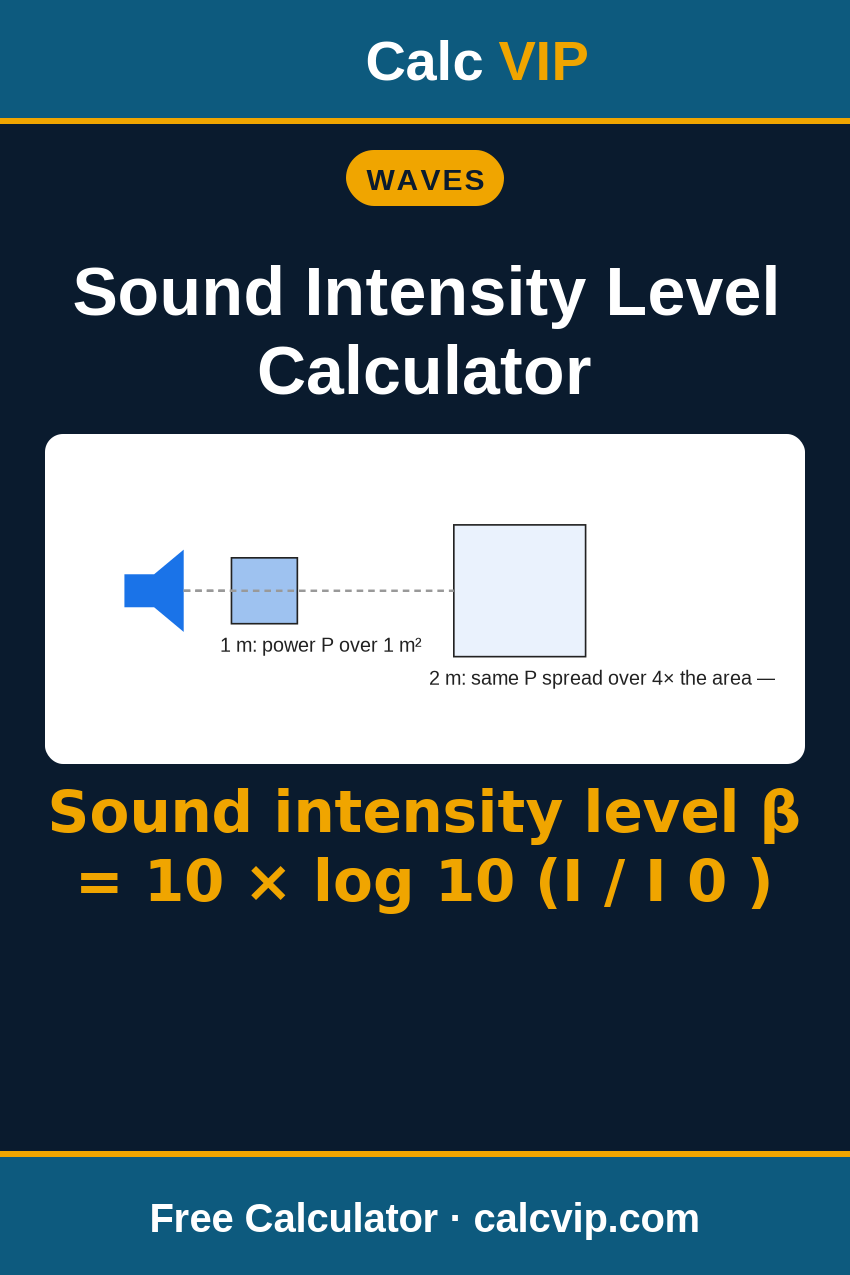
A point source spreads its power over the surface of an expanding sphere, whose area grows as the square of the distance — so intensity falls as 1/r². Doubling your distance quarters the intensity, and a quarter in decibels is 10 × log10(0.25) = −6.02 dB: every doubling of distance costs about 6 dB. A speaker measuring 80 dB at 1 m reads 74 dB at 2 m, 68 dB at 4 m and 62 dB at 8 m — the cheapest volume control ever devised is simply stepping back. (Real rooms soften the rule, because reflections return some energy; outdoors over open ground it holds almost exactly.) Combined with the source rules — ×10 intensity is +10 dB, ×2 is +3 dB — you now own the complete pocket arithmetic of decibels.
Quick reference: everyday sounds
| Sound | Level | Intensity (W/m²) |
|---|---|---|
| threshold of hearing | 0 dB | 10−12 |
| rustling leaves | 10–20 dB | 10−11–10−10 |
| whisper | 20–30 dB | 10−10–10−9 |
| quiet library | 40 dB | 10−8 |
| conversation | 60 dB | 10−6 |
| busy traffic | 85 dB | 3.16 × 10⁻⁴ |
| rock concert | 110 dB | 0.1 |
| threshold of pain | 120 dB | 1 |
| jet take-off (close) | 130 dB | 10 |
Read the intensity column slowly: the whole of human hearing, from the faintest detectable rustle to pain, spans thirteen powers of ten. No linear scale could hold that range on one page — which is, in the end, the entire argument for the decibel. Keep that range in mind whenever a meter reading looks deceptively small.
Why your meter says dB(A): weighting
One refinement appears on every real sound meter and every noise law: the letter in dB(A). The plain decibel treats all frequencies equally, but the ear does not — it is exquisitely sensitive to the few kilohertz of speech and comparatively deaf to deep bass and very high treble, especially at low levels. A-weighting is a filter built into the meter that mimics this response, discounting low and very high frequencies before the level is computed. The result, dB(A), tracks human annoyance and hearing risk far better than the unweighted figure: two sounds with the same raw dB but different spectra — a bass rumble and a whistle — can differ by many dB(A). When a law says a workplace limit is "85 dB", it almost always means 85 dB(A) averaged over the shift. This calculator computes the unweighted physical level, which is the right starting point; treat published dB(A) figures as its ear-adjusted cousins.
It is also worth knowing how little power sound actually is. A person in conversation radiates only about ten microwatts of acoustic power — 0.00001 W — spread in all directions; even a full-throated shout is around a milliwatt. The ear's achievement is detecting a trillionth of a watt per square metre at the other end of that transaction. Sound feels mighty at a concert, but the entire roar of a crowd is, in raw watts, less than the power of the light bulbs above it — a humbling calibration for the decibel's vast range.
Common mistakes
- Believing 0 dB means silence. 0 dB is the reference intensity itself — the threshold of hearing. Sounds below it exist and simply have negative decibel values.
- Adding decibels like ordinary numbers. Two 60 dB sources together give 63 dB, not 120 dB. Convert back to intensities, add those, then convert again.
- Reading 100 dB as "twice" 50 dB. It is 105 = 100,000 times the intensity. On a log scale, differences are ratios in disguise.
- Confusing intensity with level. Intensity is measured in W/m²; the level is the decibel figure. "The intensity is 60" is a sentence missing its meaning — 60 dB, or 60 W/m² (which would be a deafening 138 dB)?
- Comparing decibels across references. Underwater dB (referenced to 1 µPa) and airborne dB (20 µPa) differ by construction; headline comparisons between whales and jets that skip the conversion are meaningless.
FAQ
Why use decibels instead of W/m²?
The range of intensities we can hear is enormous — a jet engine is about a trillion times more intense than the quietest sound. The logarithmic decibel scale squeezes that huge range into friendly numbers from 0 to about 140.
What does 0 dB mean?
0 dB is the threshold of hearing — an intensity of exactly I0 = 10−12 W/m². It does not mean there is no sound at all.
If the intensity becomes 10 times bigger, how many decibels are added?
Exactly 10 dB. Every ×10 increase in intensity adds 10 dB; doubling the intensity adds about 3 dB.
How loud is loud enough to damage hearing?
Risk builds with level and time together: around 85 dB for a full working day is the usual safety boundary, and each extra 3 dB halves the safe duration. Brief peaks above 120 dB can damage instantly. If you must shout to be heard at arm's length, the level is probably in the damage zone.
Can decibels be negative?
Yes — any intensity below I0 gives a negative level. The quietest rooms on Earth (anechoic chambers) measure around −20 dB, where some people report hearing their own heartbeat and blood flow. Negative dB simply means "quieter than the reference".
Why do phone sound-meter apps disagree with real meters?
Phone microphones are designed for speech, not measurement: their sensitivity varies by model, they often cap loud readings, and few are calibrated against a known source. They are fine for comparisons ("the office is louder than the library") but not for legal or safety measurements.
Does a 10 dB increase really sound twice as loud?
Approximately, for most listeners and mid-range levels — it is the standard psychoacoustic rule of thumb. Physically it is ten times the intensity; perceptually it feels like a doubling. The gap between those two statements is exactly why the decibel scale suits human hearing so well.
What is the loudest possible sound in air?
About 194 dB. At that level the pressure swings equal the whole of atmospheric pressure, so the wave can no longer be an ordinary sound wave — beyond it you have a shock wave instead. Rocket launches and large explosions live in that territory.
Are decibels used for anything besides sound?
Everywhere ratios matter: amplifier and antenna gains, signal losses in fibre optics and cables, filter responses, even the brightness of stars has a logarithmic cousin (the magnitude scale). The decibel always means the same thing — ten times the base-ten logarithm of a power ratio.
Why does the same sound measure differently at different distances?
Because intensity obeys the inverse-square law: it quarters with every doubling of distance, costing about 6 dB each time. A decibel reading without a distance is half a measurement — professionals always record both.