 Calc
Sound Intensity Solver Calculator – Intensity & Decibel Level from Power and Distance
 Created by David Okafor · Physics Writer · Waves & Light · Last updated: November 2026
Use this free Sound Intensity Solver Calculator to find the intensity of a sound at any distance from its source, and the decibel level that goes with it. It uses the inverse square law: sound spreads out over a sphere, so intensity falls quickly as you move away.
Two numbers decide how loud a sound will be when it reaches you: how much sound power the source pours out, and how far away you are standing. This calculator connects them through one of the most useful laws in physics — the inverse square law. Sound radiates outwards in an expanding sphere, and the same power must paint an ever-larger sphere, so the power landing on each square metre — the intensity — falls with the square of the distance. Double your distance and the intensity quarters. Move ten times further away and it falls a hundredfold. The calculator then translates that intensity into the decibel level your ears and a sound meter actually report.
Intensity is the physically honest measure of a sound's strength: watts per square metre, energy per second crossing each square metre of the wavefront. It is what damages hearing, what a microphone's diaphragm responds to, and what adds up when several sources play at once. The range the ear handles is staggering — from the threshold of hearing at 10−12 W/m² to the threshold of pain near 1 W/m², a factor of a trillion. That trillion-fold range is precisely why the decibel exists: β = 10 log10(I/I0) compresses it into the friendly 0–130 dB span. This solver works both sides of that translation, giving you the intensity in W/m² and the level in decibels together.
The inputs deserve respect, because they are where real-world answers go wrong. The power P is the acoustic power — the sound energy actually radiated — not the electrical wattage printed on an amplifier. Loudspeakers are wretchedly inefficient, converting often only 1–2% of electrical power into sound, so a "100 W" speaker may radiate barely 1–2 W of sound. And the distance r is measured from the source to the listener in metres, in the open — the inverse square law assumes the sound spreads freely, unreflected. Indoors, walls return energy and the fall with distance softens. Within those honest limits, the two formulas on this page predict concert-hall loudness, alarm audibility and hearing risk with surprising accuracy.
Formula
Intensity I = P / (4πr²) • Sound level β = 10 × log10(I / I0), I0 = 1 × 10⁻¹² W/m² • rearranged: P = I × 4πr² and r = √(P / 4πI)
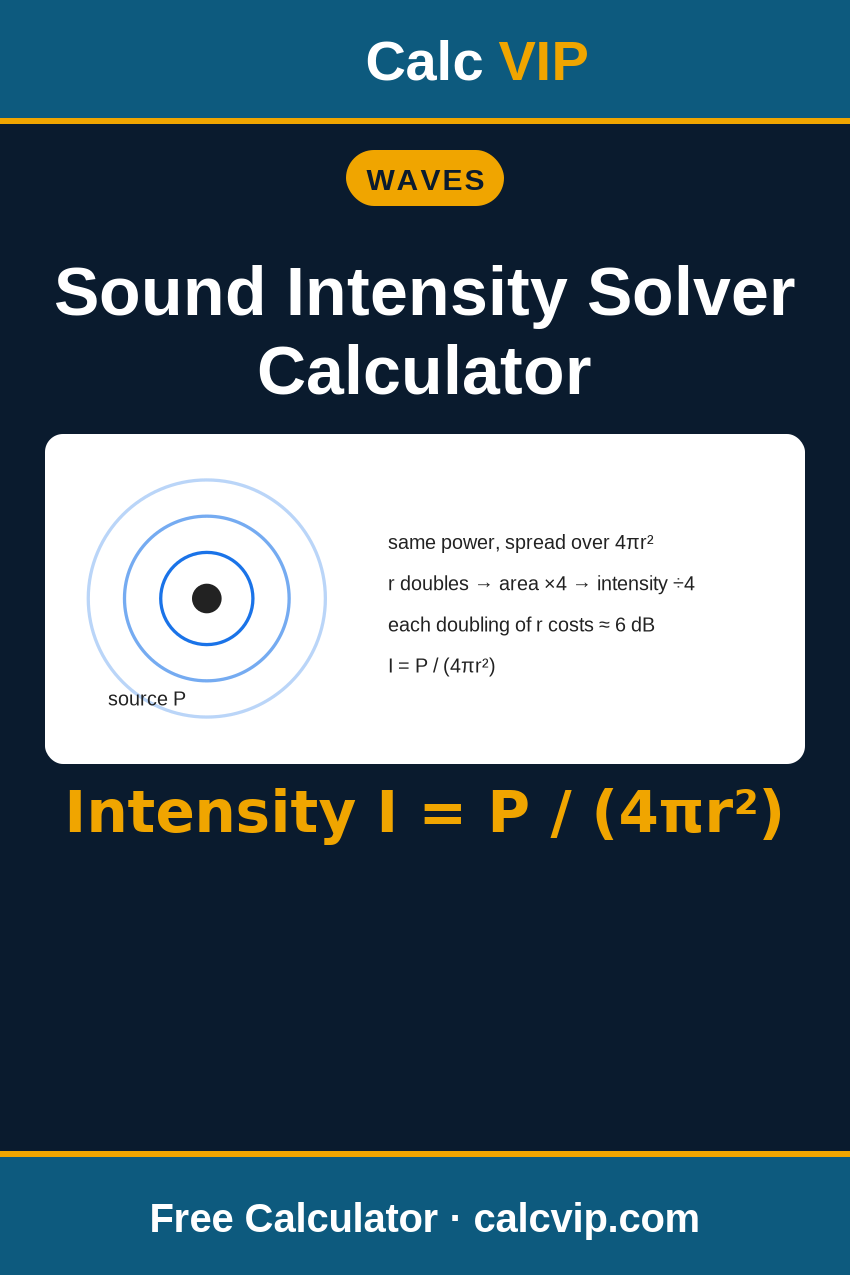
The 4πr² is the surface area of a sphere of radius r — the whole story of the inverse square law in one expression. The source's power P is shared over that entire area, so each square metre receives P divided by 4πr². The decibel formula then measures the result against the quietest sound a healthy young ear can detect. Useful rearrangements: if you know the intensity you want and the distance, P = I × 4πr² tells you how powerful the source must be; if you know the power and the intensity you can tolerate, r = √(P/4πI) tells you how far away to stand — Example 4 below uses exactly that. Two scaling rules are worth memorising: intensity scales in direct proportion to power (double the power, double the intensity, +3 dB), and in inverse proportion to distance squared (double the distance, quarter the intensity, −6 dB).
| Symbol | Meaning | Units |
|---|---|---|
| P | acoustic power radiated by the source | watts (W) |
| r | distance from source to listener | m |
| I | intensity — power per unit area | W/m² |
| β | sound level relative to I₀ = 10⁻¹² W/m² | decibels (dB) |
The geometry that makes sound fade
Imagine the source as a light bulb glowing in the dark, except the "light" is sound power. At 1 m from the bulb, the power crosses a sphere of area 4π ≈ 12.6 m². At 2 m the sphere has swollen to 4π × 4 ≈ 50.3 m²; at 10 m it is 1,257 m². The power has not changed — it is simply spread thinner, like a fixed amount of butter over ever more toast. Intensity is the thickness of the spread, and it must fall as 1/r². Nothing is being "used up" on the journey; the energy is all still there, diluted. (Real air does absorb a little, especially at high frequencies and over long distances, but geometry does the overwhelming share of the work.)
The decibel consequences are beautifully regular. Because β is built from log10 of the intensity, the 1/r² law becomes a simple subtraction: every doubling of distance multiplies I by ¼, and 10 log10(¼) = −6.02, so you lose almost exactly 6 dB per doubling of distance. Ten times the distance costs 20 dB; a hundred times, 40 dB. Sound engineers use this constantly — a singer who steps from 1 m to 4 m from the audience has dropped 12 dB without singing any quieter — and safety officers use it in reverse: moving a worker from 2 m to 8 m from a machine buys the same protection as halving the exposure twice over. The worked examples below are built on these two rules, and the quick-reference table shows them marching in step.
How to use
- Enter the source's acoustic power in watts — the sound power it actually radiates. If you only know an amplifier's electrical rating, remember only about 1–2% of it typically becomes sound.
- Enter the distance from the source to where you want the level, in metres.
- Click "Calculate Intensity" to get the intensity in W/m² (in scientific notation for small values) and the sound level in decibels.
- Try doubling the distance: the intensity should quarter and the level drop by about 6 dB — a quick check that the inverse square law is doing its work.
Worked examples
Example 1 — the loudspeaker. A loudspeaker radiates 10 W of sound power. Find the intensity and level 2 m away.
I = 10 / (4π × 2²) = 10 / 50.27 = 0.20 W/m².
β = 10 × log10(0.199 / 10−12) = 113 dB. That is rock-concert loud — hearing protection territory.
Example 2 — stepping back. The same 10 W speaker, now heard from 10 m.
I = 10 / (4π × 100) = 0.00796 W/m².
β = 10 × log10(0.00796 / 10−12) = 99 dB. Five times the distance cost 14 dB — a little over 6 dB for each of the two-and-a-bit doublings.
Example 3 — a human voice. A speaking voice radiates about 10 µW (1 × 10⁻⁵ W) of sound. Find the level 1 m away.
I = 10−5 / (4π × 1) = 7.96 × 10⁻⁷ W/m².
β = 10 × log10(7.96 × 10⁻⁷ / 10−12) = 59 dB — ordinary conversation, recovered from nothing but a power and a distance.
Example 4 — how far for safety? How far from the 10 W speaker of Example 1 must you stand for the level to fall to 85 dB, the common workplace action level?
85 dB means I = 10−12 × 108.5 = 3.16 × 10⁻⁴ W/m².
r = √(P / 4πI) = √(10 / (4π × 3.16 × 10−4)) = √2,518 ≈ 50 m. Distance is powerful protection: from 2 m to 50 m the level fell 28 dB.
Example 5 — a car horn. A horn radiates about 5 W of sound. Find the level 5 m in front of the car.
I = 5 / (4π × 25) = 0.0159 W/m².
β = 10 × log10(0.0159 / 10−12) = 102 dB — painfully loud at conversational distance, exactly as a warning device should be.
Example 6 — two speakers. Two 10 W speakers play together, both 2 m away. Intensities add: I = 2 × 0.199 = 0.398 W/m².
β = 10 × log10(0.398 / 10−12) = 116 dB — only 3 dB more than one speaker. Doubling the power always buys exactly +3 dB, never double the decibels.
Intensity in real life
Hearing safety. Exposure limits are written in intensity's language: 85 dB for eight hours, with the allowed time halving for every +3 dB. This calculator turns "how loud is it where I stand?" into a number you can plan shifts, barriers and distances around.
Concert and venue design. A system designer picks a target level at the furthest seat — say 100 dB — then works backwards through r = √(P/4πI) and the −6 dB rule to size the speaker array and decide where delay towers are needed in a big field.
Alarm audibility. A fire alarm must be heard over background noise everywhere in a building. Designers model the sounder's power spreading through corridors with the inverse square law, adding units until the quietest corner still clears the target level.
Environmental noise. When a factory or wind farm is proposed, consultants predict the level at the nearest homes from the source power and the distance — this exact calculation, run with maps — long before anything is built.
Why whispers die. A whisper radiates perhaps a nanowatt-scale trickle of power; at a few metres the inverse square law has diluted it below the room's background noise. The same law that makes concerts manageable makes secrets safe.
Underwater acoustics. Sonar engineers use the identical geometry with intensity referenced differently (underwater decibels use a different reference pressure), predicting how a ping fades with range in the sea.
When the inverse square law needs help
The clean 1/r² fall assumes a point source radiating freely into open space, and reality edits it in three known ways. Reflections: indoors, walls, floor and ceiling bounce energy back, building a reverberant field that stops falling with distance — in a living room the level a few metres from a speaker is several dB higher than this calculator's free-field answer, and far corners barely quieten at all. Directionality: real sources beam — a horn, a loudspeaker cone and a human mouth all throw more sound forwards than backwards, so the on-axis intensity exceeds P/4πr² and the off-axis falls short; engineers fold this in as a directivity factor. Absorption: air itself soaks up sound, increasingly at high frequencies — roughly a few dB per hundred metres for treble on a dry day — so distant thunder arrives as rumble, its high frequencies taxed away. Ground effect: a source sitting on hard ground radiates into a half-space rather than a full sphere, so the power is shared over 2πr² instead of 4πr² and the intensity at a ground-level listener doubles — a +3 dB bonus the calculator's open-air formula does not include, and one reason outdoor measurements are always reported with the source's mounting described. None of this dethrones the law; it remains the skeleton every professional model is built on, and outdoors, away from walls, it is accurate to within a decibel or two.
Quick reference: one 10 W source at many distances
| Distance r | Intensity I | Level β |
|---|---|---|
| 1 m | 0.796 W/m² | 119 dB |
| 2 m | 0.199 W/m² | 113 dB |
| 5 m | 0.0318 W/m² | 105 dB |
| 10 m | 0.00796 W/m² | 99 dB |
| 20 m | 0.00199 W/m² | 93 dB |
| 50 m | 3.18 × 10⁻⁴ W/m² | 85 dB |
| 100 m | 7.96 × 10⁻⁵ W/m² | 79 dB |
Watch the decibel column: 119, 113, 105, 99, 93, 85, 79. Every doubling of distance removes 6 dB, as regular as clockwork — the logarithm turning geometry into arithmetic.
From intensity to pressure: what microphones actually measure
A microphone cannot weigh energy flow directly; it feels pressure. The two are linked by the medium: for a travelling wave, I = p²/(ρc), where p is the pressure amplitude (strictly, its root-mean-square value), ρ the density and c the sound speed — the product ρc being the medium's acoustic impedance, about 413 Pa·s/m for air. The link closes the loop on the decibel scale's reference: the threshold pressure of 20 µPa (2 × 10⁻⁵ Pa) gives I = (2 × 10⁻⁵)²/413 ≈ 9.7 × 10⁻¹³ ≈ 10−12 W/m² — the I₀ of the level formula, which is no coincidence: the two references were chosen to describe the same threshold sound. It also explains the calibrator on every acoustician's shelf: a pistonphone producing exactly 1 Pa of pressure corresponds to I = 1/413 = 0.00242 W/m², which is β = 10 log10(0.00242/10−12) ≈ 94 dB — the famous 94 dB calibration point printed on sound level meters worldwide. Intensity is the right language for power and safety; pressure is the right language for measurement; this relation is the dictionary between them.
Common mistakes
- Entering electrical watts as sound power. A "100 W" amplifier does not radiate 100 W of sound — typically only 1–2 W. Using the electrical figure overstates every level by 17–20 dB.
- Forgetting the square. Intensity falls with r², not r. Moving from 2 m to 4 m quarters the intensity (−6 dB); it does not halve it.
- Adding decibels directly. Two 90 dB sources make 93 dB, not 180 dB. Add the intensities, then convert — or remember the rule: equal sources add +3 dB per doubling of their number.
- Measuring distance from the wrong place. r runs from the source itself (the speaker cone, the machine's casing), not from the wall behind you or the edge of the stage.
- Trusting the free-field answer indoors. Reflections hold the level up. The calculator gives the direct sound; a reverberant room adds a roughly constant extra level on top, so treat indoor results as a lower bound.
FAQ
Why does doubling the distance quarter the intensity?
The same power spreads over a sphere whose area grows with r². Double r means four times the area, so each square metre gets one quarter of the power.
How many decibels do I lose when I double my distance?
About 6 dB, because 10 × log10(1/4) ≈ −6 dB.
Is the power of a speaker the same as its electrical rating?
No. A "100 W" amplifier rating is electrical power in; only a small fraction (often 1–2%) becomes sound power out, which is the P you should enter here.
What intensity is the threshold of pain?
About 1 W/m², corresponding to β = 10 log10(1/10−12) = 120 dB. The ear's whole working range, threshold to pain, spans 10−12 to 1 W/m² — twelve powers of ten.
How loud is a normal conversation at 1 m, in W/m²?
About 60 dB, which is I = 10−12 × 10⁶ = 10−6 W/m² — a microwatt per square metre. Your ears work happily at intensities a million times below a watt.
If I halve the power, how much quieter is it?
Half the power means half the intensity, which is 10 log10(0.5) = −3 dB. Noticeable, but modest — perceived loudness roughly halves only for a −10 dB change, which needs the power cut tenfold.
Does the formula work for a line of traffic or a long machine?
Not exactly. Extended "line sources" spread sound over a cylinder, not a sphere, so intensity falls as 1/r and the level drops only about 3 dB per doubling of distance. The point-source formula here is right for compact sources — a speaker, a horn, a single machine.
Why does the calculator show intensity in scientific notation?
Because everyday intensities are tiny — 0.000000000001 W/m² at threshold. Scientific notation (× 10^ with an exponent) keeps such numbers readable and honest about their size.
Can I work out the power of a source from a measurement?
Yes — rearrange: measure the level at a known distance outdoors, convert the level to intensity with I = I₀ × 10^(β/10), then P = I × 4πr². That is exactly how loudspeaker efficiency is measured in anechoic chambers.
How close can I stand to a 1 W source before it hits 120 dB?
Set I = 1 W/m²: r = √(1 / 4π) ≈ 0.28 m. Even a single watt of true acoustic power is pain-level at arm's length — a reminder of how little sound power loudness actually needs.