 Calc
Sound Level Addition Calculator – Add Decibels Correctly
 Created by David Okafor · Physics Writer · Waves & Light · Last updated: November 2026
Use this free Sound Level Addition Calculator to find the combined loudness of up to four noise sources playing at the same time. Decibels cannot just be added — enter each source in dB and this calculator adds their intensities correctly and gives the true total.
Decibels refuse to be added like ordinary numbers, and the refusal is not pedantry — it is physics. The decibel is a logarithm: it counts ratios of power, compressed onto a scale where every 10 dB means ten times the sound intensity. Two machines of 80 dB each do not make 160 dB (that would be a sound so intense it approaches the physical limit of air itself); they make 83 dB, because doubling the power adds just 3.01 dB. This calculator adds sound levels the correct way — by un-compressing them back into intensities, adding those, and compressing again — for up to four sources at once.
The rule has a shape worth internalising before any numbers: the loudest source rules. Add a 90 dB source and an 80 dB source and the total is 90.41 dB — the quieter machine contributes barely a whisper on top of the louder, because it carries only a tenth of the power. Add equals to equals, though, and the total climbs steadily: each doubling of the number of identical sources adds exactly 3.01 dB, so ten equal sources stand 10 dB above one. Workplace noise officers, concert engineers and neighbours of airports all live inside these two facts: you cannot quiet a room by removing its quietest machine, and you cannot predict a crowd's roar by multiplying one voice.
One assumption deserves stating plainly, because the calculator is built on it: the sources are incoherent — independent, uncoordinated sounds whose intensities simply add. That is true of machinery, traffic, crowds and almost every real noise. It fails for coherent sources (two loudspeakers playing the identical signal in phase), where pressures add instead of intensities and interference patterns appear. For everything in ordinary life — the domain of noise regulations, factory floors and this page — intensity addition is the correct and standard method.
Formula
Convert each level back to its intensity ratio, add, and convert back:
Ltotal = 10 × log10( Σ 10(Li ÷ 10) )
Each term 10(L/10) is the source's intensity measured in units of the reference intensity (10−12 W/m² for sound in air). Two shortcuts cover most of daily life: N identical sources give L + 10 × log10(N) — so two add 3.01 dB, four add 6.02 dB, ten add exactly 10 dB — and two sources differing by 10 dB or more give, to within half a decibel, just the louder one. The inverse operation (subtracting a known background from a total to isolate one source) uses the same machinery with a minus sign: Lsource = 10 × log10(10(Ltotal/10) − 10(Lbackground/10)), the standard background-correction of acoustics practice.
| Symbol | Meaning | Units |
|---|---|---|
| Li | sound pressure level of source i | dB |
| 10(L/10) | intensity of that source, in reference units | — (ratio) |
| Ltotal | combined level of all sources together | dB |
| N | number of identical sources | — |
Why the loudest source always wins
The mathematics of the decibel guarantees a tyranny of the loudest. A source 10 dB below the loudest carries one tenth of its intensity, so removing it entirely changes the total by only 0.41 dB — below the threshold most listeners can detect. A source 20 dB down carries one hundredth and moves the total by 0.04 dB: acoustically, it does not exist. This is why noise control is a discipline of hunting the biggest source first, and why "we turned off three of the four machines and it barely helped" is a sentence spoken in factories everywhere — if the fourth machine was 10 dB louder than the other three combined, the arithmetic on this page predicted the disappointment exactly. Conversely, the tyranny has a mercy: a quiet background cannot ruin a loud measurement. A 60 dB room adds only 0.04 dB to a 80 dB machine reading, which is why background corrections matter only when the background creeps within about 10 dB of the signal.
Perception adds a second, softer logarithm on top of the physical one. Human loudness judgement roughly doubles for every 10 dB: 90 dB sounds about twice as loud as 80 dB, which sounds twice as loud as 70 dB — while the intensity has multiplied by ten at each step. So the four 80 dB machines of Example 1, totalling 86.02 dB, do not sound four times as loud as one machine, nor twice; they sound perhaps half again as loud. Hearing damage, however, follows the physics, not the perception: the energy arriving at the eardrum really has quadrupled, and safe-exposure time really has quartered. The decibel's compression hides the energy; this calculator's job is to un-hide it before decisions are made.
How to use
- Enter the sound level of each source in decibels — you may fill one, two, three or all four boxes; empty boxes are ignored.
- All levels should be measured the same way (same weighting, ideally dB(A), and at the same position) for the addition to be meaningful.
- Click "Add Sound Levels" to see the combined level, how many sources were combined, and the increase over the loudest single source.
- Sanity-check the answer: it must be higher than the loudest source alone, but by less than 3.01 dB per doubling of equal sources — and never anywhere near the arithmetic sum.
Worked examples
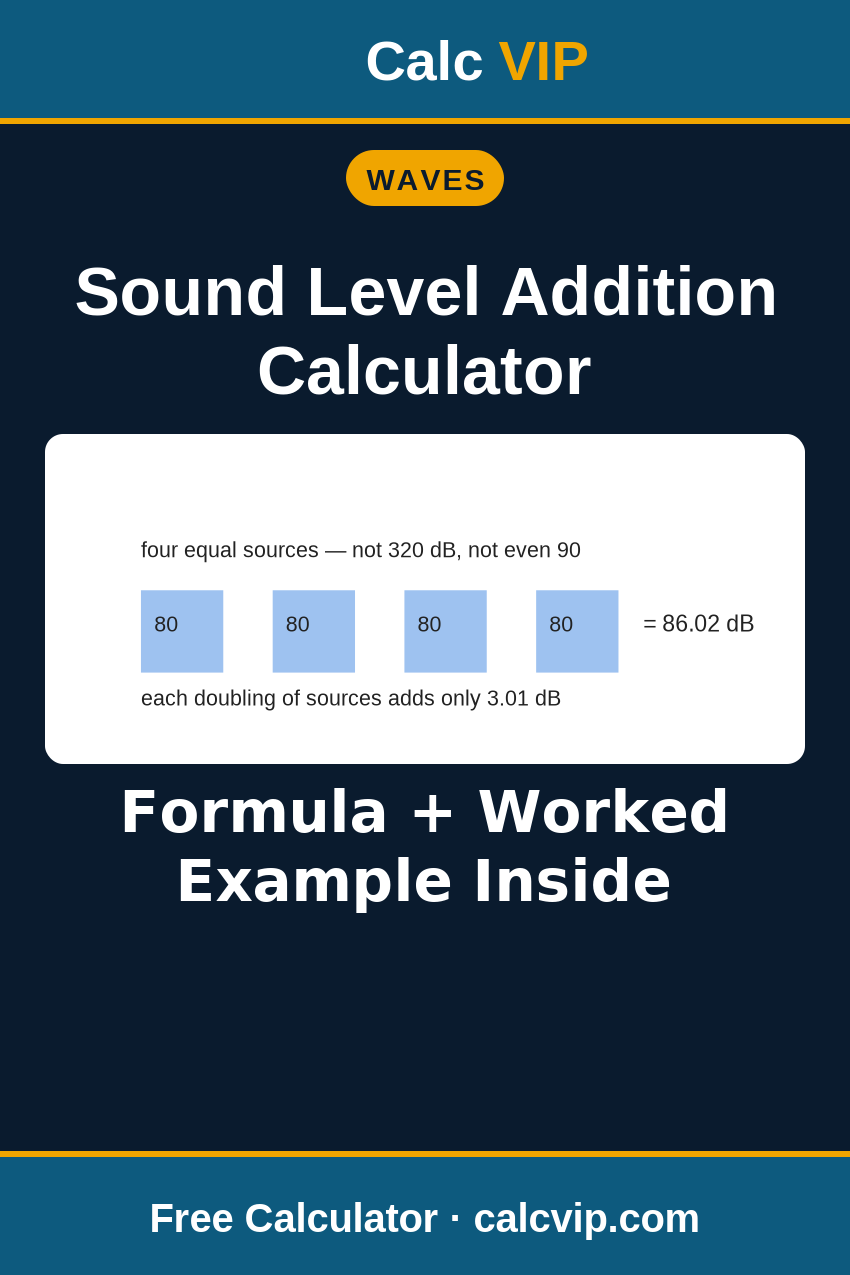
Example 1 — four equal machines. Four sources of 80 dB each.
Each contributes 108 intensity units; four give 4 × 10⁸; L = 10 × log10(4 × 10⁸) = 86.02 dB. Four times the machinery, four times the acoustic energy — and just 6.02 dB on the dial.
Example 2 — the doubling rule. Two sources of 80 dB.
L = 10 × log10(2 × 10⁸) = 83.01 dB. Doubling the power always adds 10 × log10(2) = 3.01 dB, whatever the starting level — the most useful single number in practical acoustics.
Example 3 — a loud source meets a quieter one. 90 dB plus 80 dB.
L = 10 × log10(109 + 108) = 10 × log10(1.1 × 10⁹) = 90.41 dB. The 80 dB source, carrying a tenth of the intensity, buys less than half a decibel. Switching it off would be acoustically invisible.
Example 4 — three equal voices. Three sources of 70 dB.
L = 70 + 10 × log10(3) = 70 + 4.77 = 74.77 dB. The N-identical shortcut (add 10 log N) handles any equal group in one step.
Example 5 — a mixed workshop. Sources of 60, 70 and 80 dB.
Intensities: 106 + 107 + 108 = 1.11 × 10⁸; L = 10 × log10(1.11 × 10⁸) = 80.45 dB. The total sits less than half a decibel above the loudest machine — the two quieter ones together add less than Example 3's single 80 dB source did to a 90.
Example 6 — ten equal sources. Ten sources of 85 dB.
L = 85 + 10 × log10(10) = 85 + 10 = 95.00 dB exactly. Ten times the sources, ten times the intensity, exactly +10 dB — and, by the perception rule, roughly twice as loud as one, with one tenth of the safe exposure time.
Adding sound levels in real life
Workplace noise law. Exposure limits (85 dB(A) over 8 hours in many jurisdictions) apply to the combined level at the worker's ear. Safety officers add machine levels exactly as this page does to decide who needs hearing protection and which machine to enclose first — always the loudest.
Factory layout. Moving a worker's station from beside one 90 dB machine to a spot hearing three 80 dB machines cuts their exposure from 90 to about 84.8 dB — a trade only visible once you can add levels correctly.
Concerts and venues. Multiple speaker stacks and crowd noise combine logarithmically; a full stadium crowd at ~100 dB is tens of thousands of voices summed by the 10 log N rule, not by multiplication of loudness.
Traffic and planning. Doubling traffic flow on a road raises its noise by 3 dB, not double — the famous result that frustrates residents and guides planners. Ten times the traffic adds 10 dB.
Home appliances. A 45 dB dishwasher and a 50 dB extractor fan together make 51.19 dB — worth knowing before paying a premium for the "silent" model of the quieter appliance. (Check: 105 + 104.5 = 131,623; 10 log of that is 51.19.)
Aircraft and airports. Movements are summed into cumulative noise metrics (like Lden) by energy addition over a whole day — one loud night flight can outweigh dozens of quieter daytime ones, which is why night movements are regulated so fiercely.
Background correction: subtraction in disguise
Every real measurement includes the background — the room, the street, the wind — added into the reading by the same law. To report a machine's own level, acousticians subtract energetically: measure the total with the machine on, measure the background alone, and compute Lsource = 10 × log10(10(total/10) − 10(background/10)). If a machine-plus-room reads 90.41 dB and the room alone reads 80 dB, the machine alone is 10 × log10(109.041 − 108) = 90.00 dB — Example 3 run backwards. The method collapses when total and background are close: if they differ by less than about 3 dB, the subtraction amplifies measurement noise so violently that standards bodies declare the result unreliable. Knowing when the arithmetic stops working is as much a part of acoustics as the arithmetic itself.
Averaging over time: the Leq idea
Noise exposure is rarely steady, so regulations average it — energetically, never arithmetically. The equivalent continuous level Leq is the steady level that would deliver the same total sound energy over the shift. Work one hour at 90 dB and seven hours at 70 dB and the eight-hour Leq is 10 × log₁₀((1 × 10⁹ + 7 × 10⁷) ÷ 8) = 10 × log₁₀(1.3375 × 10⁸) = 81.26 dB — far closer to the loud hour than to the quiet seven, because that single hour delivered over 93 percent of the day's acoustic energy. This is the same addition law with time as the weighting, and it explains the brutal arithmetic of hearing conservation: halving exposure time buys exactly 3 dB, the doubling rule in reverse, while halving the level's intensity (a 3 dB quieter machine) buys the same. Every "exchange rate" in noise law — 3 dB in most of the world, 5 dB in some US rules — is a policy decision about how to trade level against time inside this formula. It is also why a short daily blast from a loud tool can dominate a worker's dose more than the all-day hum of the plant around him: the energy bookkeeping of Leq remembers the loud hour long after the ears have stopped ringing, and it is precisely that unforgiving bookkeeping that dosimeters worn on the shoulder perform continuously through a shift.
Quick reference: adding a second source
| Difference between the two levels | Add to the louder level |
|---|---|
| 0 dB (equal sources) | +3.01 dB |
| 1 dB | +2.54 dB |
| 2 dB | +2.12 dB |
| 3 dB | +1.76 dB |
| 5 dB | +1.19 dB |
| 10 dB | +0.41 dB |
| 20 dB | +0.04 dB |
This is the famous addition chart taped inside every acoustician's notebook: find how far below the louder source the quieter one sits, and read off its entire contribution.
Common mistakes
- Adding decibels arithmetically. 80 + 80 = 83.01, never 160. The arithmetic sum of two levels is not a rough answer; it is a physically absurd one, off by more than the entire range of human hearing.
- Averaging levels arithmetically. The average of 80 and 90 dB is not 85: energetically it is 10 × log10((10⁸ + 10⁹) ÷ 2) = 87.40 dB. Time-averaged exposure levels (Leq) are always energy averages.
- Mixing weightings and positions. Adding a dB(A) level measured at 1 m to a dB(C) level measured at 10 m produces a number with no meaning. Same weighting, same position, same conditions — then add.
- Trying to silence a room from the quiet end. Removing sources 10+ dB below the loudest changes nothing measurable. The addition chart shows why: treat the loudest source first, always.
- Forgetting distance. Levels fall about 6 dB per doubling of distance from a point source. Adding levels measured at different distances from their sources — without correcting them to a common position — corrupts the sum before it starts.
FAQ
Why can't I just add decibels?
Because the decibel scale is logarithmic: 80 dB is ten times the intensity of 70 dB, not "a bit more". Adding two 80 dB sources doubles the intensity, and doubling intensity is only +3 dB — hence 83 dB, not 160 dB.
A source is 10 dB quieter than another — does it matter?
Barely. Adding a source 10 dB below the loudest raises the total by only about 0.4 dB, and one 20 dB below adds about 0.04 dB. In practice the loudest source dominates the total.
Does this work for speakers playing the same signal?
This calculator assumes independent (incoherent) sources, which is right for machines, traffic and crowd noise. Perfectly in-phase identical signals can add up to +6 dB per doubling instead of +3 dB, because their pressure amplitudes — not intensities — add.
Why does doubling the sources add only 3 dB?
Because the decibel counts ratios logarithmically: doubling the intensity is the ratio 2, and 10 × log₁₀(2) = 3.01. The energy really has doubled — the scale is simply built so that a doubling is a small step and a tenfold increase is 10 dB.
How much louder is 86 dB than 80 dB, to a listener?
Noticeably louder, but nowhere near "four sources' worth" in feel: perceived loudness roughly doubles per 10 dB, so +6 dB feels like about a 50 percent increase in loudness — while the acoustic energy, and the hearing risk, has genuinely quadrupled.
Can I add more than four sources?
Yes, with the shortcut: group identical sources first (N of them contribute L + 10 log₁₀ N as one combined level), then add the groups with this calculator. A hundred 70 dB voices, for instance, combine to 70 + 20 = 90 dB before any other source is considered.
What if the two sources are loudspeakers playing the same signal?
Then they are coherent, and this calculator's intensity addition does not apply: in-phase pressures can add to give +6 dB in some places and cancel to near silence in others. The formula here is for independent (incoherent) sources — machinery, traffic, crowds, separate instruments.
How do I subtract a background noise?
Energetically: Lsource = 10 × log₁₀(10(total/10) − 10(background/10)). Trust it only when the total exceeds the background by at least 3 dB, and treat corrections as exact only above a 10 dB gap (where the correction is under 0.5 dB anyway).
Is 0 dB silence?
No — 0 dB is the reference level, roughly the quietest sound a young ear can detect at 1 kHz. Negative levels exist (anechoic chambers measure around −10 dB(A)) and add by the same formula; a −10 dB source beside a 0 dB source gives 0.41 dB, not −10 of anything.
Why do regulations use dB(A) rather than dB?
The A-weighting filters the sound to mimic the ear's sensitivity — discounting very low and very high frequencies — before the level is computed. Additions must be performed on levels with the same weighting, or the sum describes no ear and no law.