 Calc
Sound Pressure Level Calculator – Convert Pressure (Pa) to dB SPL
 Created by David Okafor · Physics Writer · Waves & Light · Last updated: November 2026
Use this free Sound Pressure Level Calculator to convert between the pressure of a sound wave (in pascals) and its level in decibels (dB SPL). Sound level meters actually measure pressure, and this tool uses the standard reference pressure of 20 µPa — the quietest sound a healthy ear can hear. Choose a direction, enter one value, and get the other.
Decibels are a compression algorithm for an enormous range. The quietest sound a healthy young ear detects moves the air by 20 micropascals — twenty millionths of a pascal, a hundred-millionth of atmospheric pressure — while the loudest sounds before pain push past 20 pascals, a million times more. No linear scale survives that range gracefully, so acoustics uses a logarithmic one anchored at the threshold itself: SPL = 20 log₁₀(p/p₀), with p₀ = 20 µPa defined as 0 dB. Every 20 dB on the scale is a factor of ten in pressure; every 6 dB, roughly a doubling. This calculator converts in both directions — pressure to level, level back to pressure — because meters measure one and regulations are written in the other.
Two subtleties repay attention before the numbers. First, the pressure in the formula is the rms pressure of the sound wave — the steady equivalent of its oscillation — not the peak; for a sine wave the peak is √2 times larger. Second, SPL is not loudness. It is a physical measurement, reproducible by any calibrated meter, whereas loudness is a perception that depends on frequency and on the listener: the ear is far less sensitive at 50 Hz than at 3 kHz, which is why meters offer A-weighting, a filter that bends the reading towards what a human would report. The unweighted SPL this page computes is the honest physical quantity underneath all of that.
Use the forward direction to translate a measured or specified pressure into the language of noise limits and datasheets; use the reverse to discover what a decibel claim actually means in pascals — the direction that turns "130 dB" back into the 63 pascals of air pressure your eardrum would have to withstand.
Formula
Sound pressure level SPL = 20 × log₁₀(p / p₀), with reference pressure p₀ = 20 µPa = 2 × 10⁻⁵ Pa. Reverse: p = p₀ × 10^(SPL/20).
The factor 20 (not 10) is inherited from power: decibels were defined as 10 log₁₀ of a power ratio, intensity is a power-like quantity proportional to p², and the square pulls a factor of 2 out of the logarithm — 10 becomes 20 when you work with pressure directly. Useful landmarks follow at once: multiplying pressure by 10 adds 20 dB; multiplying by 2 adds 20 × log₁₀2 = 6.02 dB; halving the pressure subtracts the same 6.02 dB. Distance uses the same rule, because pressure from a point source falls as 1/r: doubling your distance from a source costs exactly 6.02 dB, every time. Units: p in pascals (Pa), and note that 1 Pa = 1 N/m²; pressures quoted in µPa must be multiplied by 10⁻⁶ before entering.
| Symbol | Meaning | Units |
|---|---|---|
| SPL | sound pressure level relative to 20 µPa | decibels (dB) |
| p | rms sound pressure of the wave | pascals (Pa) |
| p₀ | reference pressure — the hearing threshold at 1 kHz | 20 µPa = 2 × 10⁻⁵ Pa |
SPL, intensity level and loudness are three different things
Because intensity is proportional to pressure squared, the intensity level computed as 10 log₁₀(I/I₀) with I₀ = 10⁻¹² W/m² gives the same number as the SPL for a sound in air — the two reference values were chosen to make that true. So a meter reading of 80 dB is simultaneously a statement about pressure (0.2 Pa) and about intensity (10⁻⁴ W/m²), and the two communities — audiologists with their pascals, engineers with their watts — share one scale without noticing. Where the scales genuinely part company is perception. Doubling the intensity (+3 dB) is clearly audible but nowhere near "twice as loud"; the psychoacoustic rule of thumb is that loudness doubles per +10 dB. A 100 dB motorcycle thus sounds roughly twice as loud as a 90 dB one, while carrying ten times the intensity and about 3.16 times the pressure.
Frequency bends perception further. The ear's sensitivity peaks around 2–5 kHz and falls steeply towards the bass, so a 50 Hz tone needs far more pressure than a 1 kHz tone to sound equally loud. A-weighted meters (dB(A)) build that curve into the measurement and are what regulations quote; the unweighted SPL of this calculator is the raw physical level. When a datasheet just says "dB" for sound in air, it almost always means SPL relative to 20 µPa — but in underwater acoustics the reference is 1 µPa, and the same physical sound reads 26 dB higher there. Reference discipline is the whole game with decibels.
How to use
- Choose the direction: convert a pressure into decibels, or a decibel level back into pressure.
- For pressure → dB, enter the rms sound pressure in pascals (Pa). Ordinary speech at 1 m is about 0.02 Pa.
- For dB → pressure, enter the sound pressure level in decibels.
- Click "Calculate" to see the converted value — and, in both directions, how many times the reference pressure your sound represents.
Worked examples
Example 1 — the loud alarm. A loud alarm produces a sound pressure of 0.2 Pa.
SPL = 20 × log₁₀(0.2 / 0.00002) = 20 × log₁₀(10,000) = 20 × 4 = 80 dB.
Reverse check: 80 dB → p = 0.00002 × 10^(80/20) = 0.2 Pa. ✔
Example 2 — ordinary conversation. Speech at arm's length has a pressure of about 0.02 Pa: SPL = 20 × log₁₀(0.02/0.00002) = 20 × log₁₀(1000) = 20 × 3 = 60 dB — the textbook figure for conversation, recovered exactly because 0.02 Pa is a clean thousand times the reference.
Example 3 — a whisper. A whisper at 1 m produces roughly 0.0002 Pa (2 × 10⁻⁴ Pa): SPL = 20 × log₁₀(10) = 20 dB. Ten times the reference pressure, twenty decibels — the ladder of this page in miniature, and a useful calibration of how quiet 20 dB really is.
Example 4 — the calibrator standard, in reverse. Sound level meters are calibrated with a pistonphone producing 94 dB. What pressure is that? p = 2 × 10⁻⁵ × 10^(94/20) = 2 × 10⁻⁵ × 50,119 = 1.002 Pa — essentially exactly 1 pascal. The standard was chosen for this elegance: 94 dB ↔ 1 Pa, the acoustician's favourite conversion.
Example 5 — the jet at 130 dB. Convert 130 dB: p = 2 × 10⁻⁵ × 10^6.5 = 63.25 Pa. That is over three million times the reference pressure, yet still only about 0.06% of atmospheric pressure — a reminder that even dangerous sound is a small ripple riding on the enormous static pressure of the air.
Example 6 — two sources are not twice the decibels. Two identical alarms each produce 80 dB (0.2 Pa) at a listener. Their intensities add, so the level rises by 10 × log₁₀2 = 3.01 dB to 83.01 dB, and the combined rms pressure is 0.2 × √2 = 0.28 Pa — not 0.4 Pa, and emphatically not 160 dB. Decibels never add directly; the quantities underneath them do.
Sound pressure levels in real life
Noise regulation and hearing protection. Workplace limits (85 dB(A) for 8 hours in many jurisdictions) are SPL limits with an exchange rate: every +3 dB halves the permitted time, because intensity has doubled. The reverse direction of this calculator turns a limit into the pressure a worker's ear actually endures, which is what hearing damage tracks.
Meter calibration. Every professional sound level meter is checked against the 94 dB = 1 Pa standard of Example 4 (or its 114 dB sibling) before a measurement session. The elegance of that pair of numbers is deliberate — metrology built on this page's formula.
Audio engineering. Microphone sensitivities are quoted in millivolts per pascal, and preamp gains in decibels; converting between a singer's 80 dB at the microphone (0.2 Pa) and the voltage that results is daily studio arithmetic, done with exactly this conversion.
Environmental noise surveys. Planning decisions — flight paths, wind farms, motorways — are fought over maps of predicted SPL. The −6 dB per doubling of distance rule (80 dB at 1 m becomes 74 dB at 2 m, 68 dB at 4 m) is the first model every such prediction is checked against.
Product datasheets. A vacuum cleaner advertised at 70 dB is claiming a pressure of 2 × 10⁻⁵ × 10^3.5 = 0.063 Pa at the standard test distance. The reverse conversion exposes how modest the physical difference is between a "quiet" 65 dB model (0.036 Pa) and a loud one — less than a factor of two in pressure.
Underwater acoustics. Sonar and marine-biology levels use a different reference (1 µPa) and a denser medium, so figures like "180 dB" for a whale or a sonar pulse are not comparable to airborne decibels without conversion — a standing warning that a decibel without its reference is only half a number.
Exposure and dose: the logarithm inside the safety rules
Hearing damage tracks total energy, so safety limits are written as a level plus a time. The widely used NIOSH scheme allows 8 hours a day at 85 dB(A) and applies a 3 dB exchange rate — the intensity doubling rule of this page — halving the permitted time for every 3 dB more: 88 dB for 4 hours, 91 dB for 2 hours, 94 dB for 1 hour, 97 dB for 30 minutes, 100 dB for just 15 minutes. Run the reverse conversion on those limits and the pattern is stark: the permitted daily dose is constant, while the pressure climbs from 0.36 Pa at 85 dB to 2 Pa at 100 dB. A worker's ear integrates pascals squared over time; the decibel table is simply that integral wearing a uniform.
| Level (NIOSH) | Pressure | Maximum daily exposure |
|---|---|---|
| 85 dB(A) | 0.36 Pa | 8 hours |
| 88 dB(A) | 0.50 Pa | 4 hours |
| 91 dB(A) | 0.71 Pa | 2 hours |
| 94 dB(A) | 1.00 Pa | 1 hour |
| 100 dB(A) | 2.00 Pa | 15 minutes |
The same logarithm shapes recording. Human hearing spans from 0 dB to about 120 dB — a pressure ratio of a million and an intensity ratio of a trillion — and a recording chain that wants to capture a whisper and a shout in one take must span most of it. Sixteen-bit digital audio offers about 96 dB of dynamic range in theory (6.02 dB per bit), which is why engineers ride gain levels so carefully, and why a microphone's self-noise, quoted in dB(A) on its datasheet, decides whether a quiet room tone survives the recording. Every one of those specifications is this page's formula, applied at a different desk.
Perception has its own calibrated scale built on top of SPL: the phon. A sound's loudness level in phons is the SPL of a 1 kHz tone judged equally loud — so by definition the two agree at 1 kHz, and diverge elsewhere exactly as the ear's sensitivity does. A 100 Hz tone needs roughly 51 dB SPL to match a 40 dB, 1 kHz tone, so it rates 40 phons despite carrying eleven more decibels of physical level. The phon is the honest bridge between this calculator's pascals and a listener's report, and the reason a single SPL number never fully describes how loud a bass-heavy sound will feel.
Quick reference: the decibel ladder
| SPL | Pressure p | × reference | Typical source |
|---|---|---|---|
| 0 dB | 0.00002 Pa | 1 | threshold of hearing |
| 20 dB | 0.0002 Pa | 10 | whisper at 1 m |
| 40 dB | 0.002 Pa | quiet library | |
| 60 dB | 0.02 Pa | conversation | |
| 80 dB | 0.2 Pa | busy traffic, alarm | |
| 100 dB | 2 Pa | pneumatic drill at 1 m | |
| 120 dB | 20 Pa | threshold of discomfort |
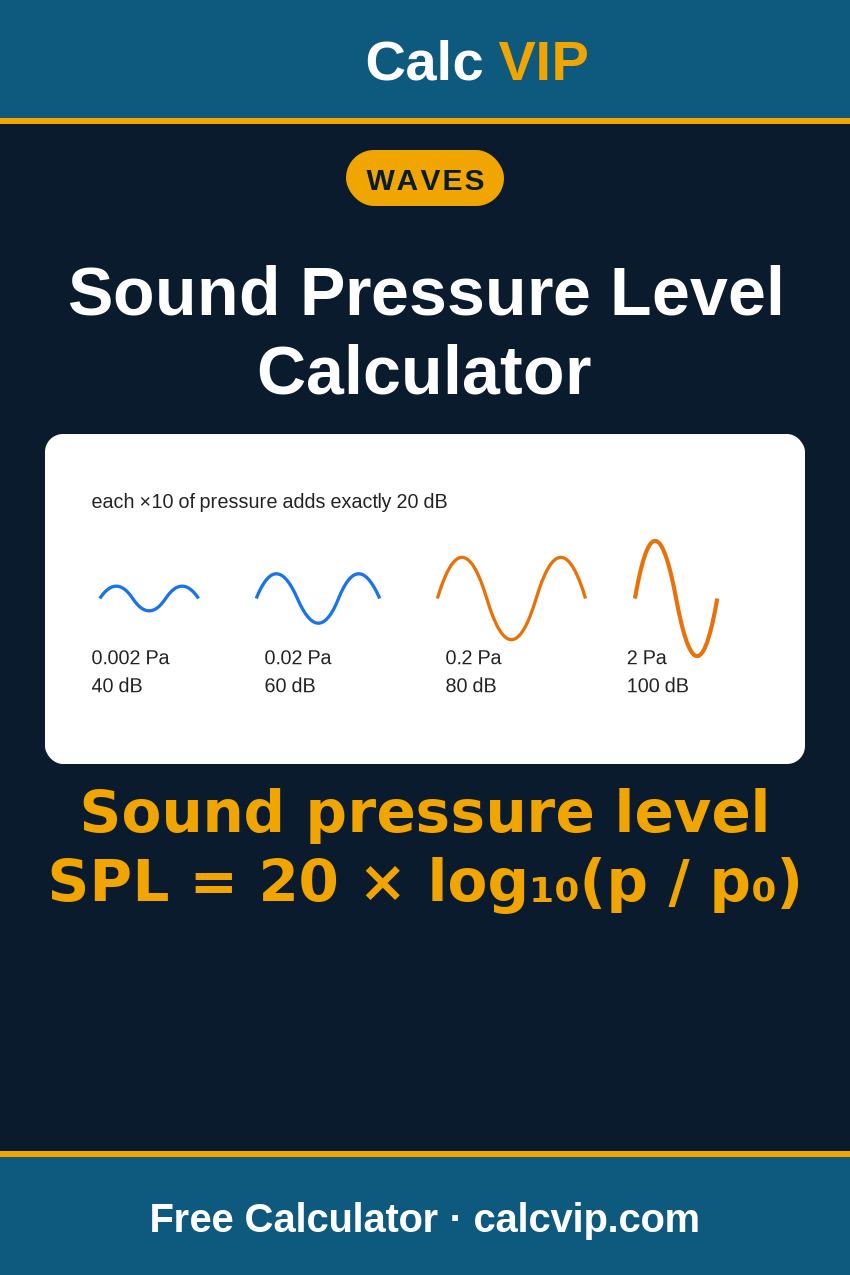
The middle columns are the calculator in tabular form: each 20 dB step multiplies the pressure by ten. Commit the ladder's anchor points — 0.02 Pa = 60 dB, 0.2 Pa = 80 dB, 2 Pa = 100 dB — and you can place any pressure on the scale to within a few decibels in your head, then let the calculator polish the last decimal.
Common mistakes
- Using 10 log instead of 20 log. The decibel's factor of 10 belongs to power and intensity ratios. Pressure is an amplitude, and amplitudes take 20 log. Using 10 log halves every answer — 80 dB becomes a wrong 40 dB.
- Adding decibels directly. Two 80 dB sources make 83 dB, not 160 dB (Example 6). Always return to pressures or intensities, add those, and convert back.
- Confusing peak and rms pressure. The formula expects rms. A sine wave's peak is √2 larger, worth 3.01 dB; oscilloscope readings (peak) and meter readings (rms) differ by exactly that if you forget.
- Forgetting the reference. "80 dB" for sound in air means 80 dB above 20 µPa. Underwater figures use 1 µPa and read 26 dB higher for the same pressure; a bare decibel with no stated reference is an incomplete measurement.
- Entering micropascals as pascals. Datasheets often quote µPa. 200,000 µPa is 0.2 Pa (80 dB); typed in as "200000 Pa" it produces a fantasy level of 200 dB. Check the unit before the arithmetic.
FAQ
Why is the factor 20 and not 10?
Decibels were defined for power-like quantities with a factor of 10. Intensity is proportional to the square of pressure, and the square turns the 10 into 20 when you work with pressure (or voltage) directly.
What does 0 dB mean — no sound at all?
No. 0 dB SPL means the pressure equals the reference pressure of 20 µPa, roughly the threshold of human hearing at 1 kHz. Sounds can even have negative dB values if they are quieter than that reference.
How much pressure is the pain threshold?
Around 120–130 dB, which corresponds to about 20 Pa — a million times the reference pressure, but still only about 0.02% of atmospheric pressure.
What is the loudest possible sound in air?
About 194 dB. At that level the pressure swing (roughly ±1 atmosphere, some 10⁵ Pa by this formula) would need the troughs to reach vacuum, which is impossible — beyond it, the disturbance is no longer sound but a shock wave. The formula still returns numbers, but the physics has left its territory.
Why do meters show negative decibels sometimes?
Because sounds quieter than the reference exist: a −10 dB sound has a pressure of 2 × 10⁻⁵ × 10^(−0.5) ≈ 6.3 × 10⁻⁶ Pa. Anechoic chambers reach such levels, and sensitive microphones in quiet studios register them. Negative dB means "below reference", never "below silence".
How many decibels is a doubling of pressure?
20 × log₁₀2 = 6.02 dB. And a doubling of intensity is 3.01 dB — the same physical event described two ways, since doubling intensity means multiplying pressure by √2. Confusing those two "doublings" is the most common decibel error of all.
Is 80 dB twice as loud as 40 dB?
Twice the number, but perceptually far more than twice: with loudness doubling per 10 dB, 80 dB sounds about 2⁴ = 16 times as loud as 40 dB. Physically it is 100 times the pressure and 10,000 times the intensity. Three honest answers, three different quantities — this page handles the physical one.
What does the "A" in dB(A) do to the pressure?
Nothing — A-weighting is a filter applied to the measurement, discounting low and very high frequencies to mimic the ear. A 100 Hz tone at a true 80 dB SPL might read only about 60 dB(A). The calculator's unweighted value is the one to use for physics; the weighted one for regulations.
How far away does a sound drop by 6 dB?
At twice the distance, for a point source in open space: pressure halves (1/r), and half pressure is −6.02 dB. An 80 dB alarm at 1 m is a 74 dB alarm at 2 m and a 68 dB alarm at 4 m — indoors, reflections soften the rule, which is why real rooms are kinder than the formula.
Can I convert dB SPL to watts per square metre?
Yes, through intensity level: in air the two scales share numbers, so I = 10⁻¹² × 10^(SPL/10) W/m². At 80 dB that is 10⁻⁴ W/m². The bridge works because the reference intensity 10⁻¹² W/m² was chosen to match the reference pressure in air — in water or another gas the correspondence changes.