 Calc
Sound Wavelength Calculator – Wavelength from Frequency & Air Temperature
 Created by David Okafor · Physics Writer · Waves & Light · Last updated: November 2026
Use this free Sound Wavelength Calculator to find the wavelength of a sound from its frequency. The calculator first works out the speed of sound from the air temperature, because sound travels faster in warm air.
That one extra step is what makes this calculator different from a plain λ = v/f tool: the speed of sound is not a constant of nature. It drifts with the weather. On a freezing morning sound crawls at about 331 m/s; on a hot afternoon it hurries at 355 m/s or more. Because the frequency of a note is fixed by the instrument that made it, every change in speed shows up directly as a change in wavelength — the same tuning fork produces waves roughly 7% longer on a hot day than on a cold one. For musicians, acousticians and anyone measuring with sound, that drift is not noise; it is part of the physics, and this calculator builds it in from the start.
The temperature rule it uses, v = 331 + 0.6 × T, is a linear approximation to a deeper truth: sound travels at the speed at which air molecules can hand a push to their neighbours, and that handover speed tracks the molecules' own thermal motion, which grows with the square root of the absolute temperature. The linear rule captures it well across the whole range of weather humans live in — each degree Celsius adds about 0.6 m/s. It is accurate to within a fraction of a percent from deep winter to heatwave, and it explains everyday mysteries: why a distant train sounds different on a frosty night, and why brass and woodwind players find their instruments drifting sharp as a hall warms up.
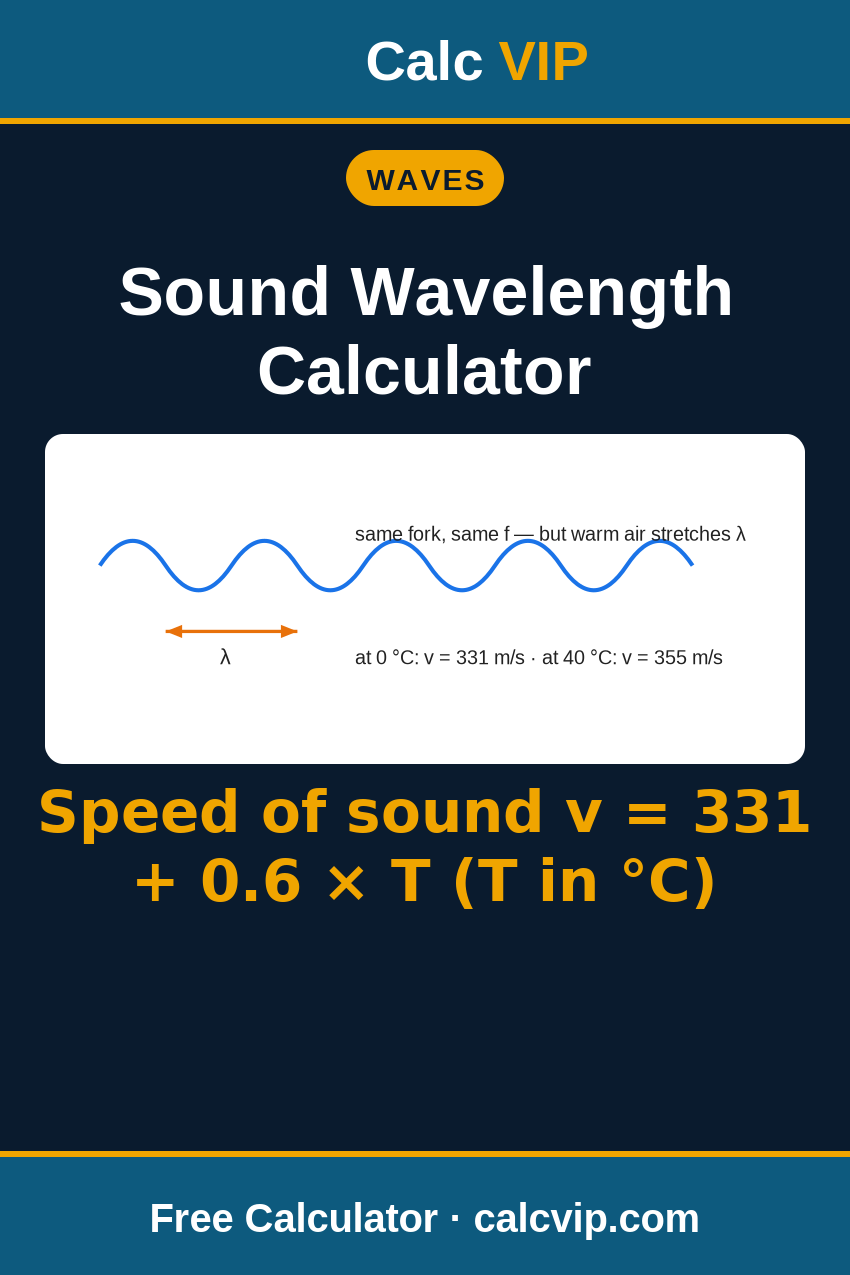
Once the speed is known, the wavelength follows from λ = v/f, and the wavelength is where sound meets the physical world. A wavelength is the size of the wave, and size decides behaviour: waves bend around obstacles smaller than themselves, reflect off surfaces larger than themselves, and resonate in spaces that fit them. The bass note whose wavelength is 17 m treats your house as a minor inconvenience; the 1.7 cm wave of the highest audible treble is blocked by a book. Knowing the wavelength of a sound — at today's temperature — is knowing how that sound will behave in rooms, streets, instruments and ears.
Formula
Speed of sound v = 331 + 0.6 × T (T in °C) • Wavelength λ = v / f • rearranged: f = v / λ
Two formulas chained: temperature fixes the speed, then speed and frequency fix the wavelength. The 331 m/s is the measured speed of sound in dry air at 0 °C; the 0.6 m/s per degree is the slope of the temperature dependence across the everyday range. The more exact physical law is v = 331 × √(1 + T/273), and the linear rule tracks it closely — at 40 °C the exact formula gives about 354.8 m/s against the rule's 355 m/s. For wavelength work the chain has one golden rule: the frequency never changes with temperature. A fork stamped 256 Hz vibrates 256 times a second in any weather; only the spacing of the waves it launches changes. If you know a wavelength and a temperature instead, run the chain backwards: compute v from T, then f = v/λ.
| Symbol | Meaning | Units |
|---|---|---|
| T | air temperature | °C |
| v | speed of sound in air at that temperature | m/s |
| f | frequency — fixed by the source | hertz (Hz) |
| λ | wavelength of the sound in that air | m |
Why warm air carries sound faster — and stretches its waves
Sound is a relay race. A vibrating surface pushes the nearest air molecules; they push the next layer, and the disturbance travels at the speed of that handover. The molecules are not standing still waiting — they are already darting about thermally, faster the warmer the air. A push handed to a fast-moving crowd propagates faster than one handed to a sluggish one, so the sound speed rises with temperature, roughly as the square root of the absolute temperature. At 0 °C (273 K) the speed is 331 m/s; at 20 °C (293 K) the square-root rule gives 331 × √(293/273) = 343 m/s — exactly the standard value this calculator produces from its linear rule.
The consequence for wavelength is direct. λ = v/f, f is locked by the source, so λ inherits every change in v. A 256 Hz fork makes waves of 331 ÷ 256 = 1.29 m in freezing air and 355 ÷ 256 = 1.39 m in a heatwave. Wind instruments feel this from the inside: the air column in a flute or organ pipe resonates at a wavelength set by the pipe's length, so the frequency it produces, f = v/λ, climbs as the air warms — about 3 cents (hundredths of a semitone) per degree, enough for an orchestra's wind section to drift audibly sharp during a long concert under hot lights. String players, whose pitch depends on tension rather than air, drift the other way. The calculator's temperature box is, quite literally, the difference between an instrument in tune and one that is not.
How to use
- Enter the air temperature in degrees Celsius — 20 °C for a normal room, 0 °C for a frosty day, 35 °C for a heatwave.
- Enter the frequency of the sound in hertz (the number stamped on a tuning fork, or the note's known frequency).
- Click "Calculate Wavelength" to see the speed of sound at that temperature and the resulting wavelength in metres.
- Compare across temperatures: rerun at 0 °C and 40 °C to see how much the same note's wavelength stretches between winter and summer — about 7% over that range.
Worked examples
Example 1 — the standard room. On a 20 °C day, find the wavelength of a 256 Hz tuning-fork note.
v = 331 + 0.6 × 20 = 343 m/s.
λ = v / f = 343 / 256 = 1.34 m — a wave taller than a child, from a fork you can hold in two fingers.
Example 2 — a frosty morning. At 0 °C, what is the wavelength of concert A, 440 Hz?
v = 331 + 0 = 331 m/s.
λ = 331 / 440 = 0.75 m. The same note at 20 °C has λ = 343 / 440 = 0.78 m — winter air squeezes each wave about 3 cm shorter.
Example 3 — a heatwave. At 35 °C, find the wavelength of a 1,000 Hz tone.
v = 331 + 0.6 × 35 = 352 m/s.
λ = 352 / 1,000 = 0.352 m (35.2 cm). Kilohertz tones have wavelengths the size of a sheet of paper — small enough to be shadowed by your head, which is how your ears judge direction at this pitch.
Example 4 — below freezing. At −10 °C, find the wavelength of a 50 Hz bass note.
v = 331 − 6 = 325 m/s.
λ = 325 / 50 = 6.5 m. Even slowed by cold, a bass wave is longer than a car — no wall in the house is a serious obstacle to it.
Example 5 — the edge of hearing. At 20 °C, find the wavelength of 20 Hz, the lowest frequency humans can hear.
λ = 343 / 20 = 17.15 m — about 17 m, the length of a bus. At the other edge, 20,000 Hz gives 343 / 20,000 = 0.017 m = 1.7 cm. The whole of human hearing spans wavelengths from centimetres to tens of metres.
Example 6 — a warm hall. At 30 °C, find the wavelength of a 5,000 Hz tone.
v = 331 + 18 = 349 m/s.
λ = 349 / 5,000 = 0.0698 m ≈ 7.0 cm. High frequencies have wavelengths comparable to the ear itself, which is why they are directional and easily blocked — and why tweeters must point at the audience.
Sound wavelength in real life
Tuning and temperature. Orchestras tune after the hall warms up because wind-instrument pitch follows the speed of sound: f = v/λ with λ fixed by the tube. A rise from 15 °C to 25 °C lifts v from 340 to 346 m/s and sharpens a flute by roughly 30 cents — a third of a semitone — unless the player compensates.
Counting the seconds to lightning. The thunder rule — count the seconds, divide by three, get kilometres — is this calculator in disguise: sound covers 343 m in one second, so a 5-second gap means the strike was 343 × 5 = 1,715 m ≈ 1.7 km away. On a cold day the rule under-reads slightly, because v is smaller.
Designing quiet rooms. Absorbing a sound needs material a good fraction of a wavelength deep. Foam a few centimetres thick swallows kilohertz waves (λ ≈ 0.34 m and below) but is nearly invisible to 100 Hz bass (λ = 3.43 m) — which is why proper studios have bass traps the size of furniture.
Ultrasonic parking sensors. These chirp at about 40 kHz, where λ = 343 / 40,000 = 8.6 mm. Obstacles larger than a centimetre reflect the wave cleanly, giving centimetre-accurate ranging; fog droplets, far smaller than λ, are largely ignored.
Animal hearing ranges. Dogs hear to about 45 kHz (λ ≈ 7.6 mm) and bats emit to 100 kHz and beyond (λ ≈ 3.4 mm). Short wavelengths resolve small prey — a bat's wave is fine enough to image a moth — at the price of rapid absorption in air.
Outdoor concerts and refraction. On a still evening, air near the ground cools faster than air above, so v decreases with height and sound bends back down — concerts carry surprisingly far. Under a hot afternoon sun the gradient reverses and sound bends up and away, leaving acoustic shadows. Both effects are the temperature rule acting on a whole sky of air.
What else nudges the speed of sound?
Temperature does most of the work, but not all of it. Humidity raises the speed slightly: water vapour molecules are lighter than the nitrogen and oxygen they displace, so moist air is a touch less dense and carries sound a little faster — up to about 0.3% faster in saturated tropical air, roughly an extra 1 m/s at 20 °C, stretching wavelengths by the same small fraction. Pressure, surprisingly, does almost nothing: squeeze air and it becomes denser but proportionally stiffer, and the two effects cancel — sound travels at the same speed on a mountaintop as at sea level, if the temperature matches. Wind does not change the speed through the air, but it adds or subtracts its own speed for a ground-based listener, which is why sounds carry downwind. And carbon dioxide content matters in precision work — one reason concert-hall acousticians specify the temperature rule with dry air. For school and everyday purposes, v = 331 + 0.6T captures everything that matters; the corrections above are refinements of well under 1%.
Quick reference: wavelengths across the piano (at 20 °C)
| Note | Frequency | Wavelength |
|---|---|---|
| A0 — lowest piano key | 27.5 Hz | 12.47 m |
| A2 | 110 Hz | 3.12 m |
| A4 — tuning standard | 440 Hz | 0.78 m |
| C8 — highest piano key | 4,186 Hz | 0.082 m (8.2 cm) |
Seven octaves of piano span wavelengths from a house-length 12.47 m down to a hand-span 8.2 cm. The instrument is, among other things, a machine for manufacturing every wavelength your ear can use.
Measuring temperature with sound
Run the temperature rule backwards and sound becomes a thermometer. Time a pulse across a known distance and v falls out; v then reports the average temperature along the path — no probe at any single point, and nothing inserted into the flow. The sensitivity is respectable: across a 10 m path, the flight time at 20 °C is 10/343 = 29.15 ms, and warming the air by one degree (v = 343.6 m/s) shortens it to 29.10 ms — a shift of about 0.05 ms per degree, easily resolved by modern electronics. Ultrasonic anemometers exploit exactly this, timing pulses upwind and downwind to read wind and temperature from the same pair of transducers, with no moving parts to freeze or wear. Oceanographers scale the idea up a thousandfold: pulses timed across ocean basins report the average temperature of entire seas, and their wavelengths and travel times are monitored for the slow warming of the deep ocean — this calculator's two formulas, working as climate instruments.
Common mistakes
- Using 343 m/s at every temperature. 343 m/s is only right near 20 °C. At 0 °C the speed is 331 m/s and every wavelength shrinks by about 3.5% — small, but exactly the error this calculator exists to remove.
- Entering the temperature in Fahrenheit. The formula expects Celsius. 68 °F is 20 °C; typing 68 into the temperature box would give v = 371.8 m/s and wavelengths nearly 10% too long.
- Expecting the frequency to change with temperature. It does not. The source vibrates at its own rate in any weather; the speed changes, so the wavelength absorbs the whole difference.
- Applying the air formula to water or solids. v = 331 + 0.6T is for air only. Underwater the speed is about 1,480 m/s and the same 256 Hz note has a wavelength of 5.78 m, not 1.34 m.
- Rounding the speed before dividing. Using v = 340 instead of 343 throws away 1% before you start. Keep the full value through the calculation and round only the final wavelength.
FAQ
Why does temperature change the wavelength?
Warm air molecules move faster, so they pass the sound on more quickly. The frequency is fixed by the source, so a higher speed means a longer wavelength (λ = v/f).
What is the wavelength of the lowest note humans can hear?
At 20 Hz and 343 m/s, λ = 343 / 20 ≈ 17 m — bass waves are as long as a bus, which is why they bend around corners so easily.
Does this formula work underwater?
No. The temperature formula is only for air. In water sound travels at about 1,480 m/s, so wavelengths are more than four times longer for the same frequency.
How fast is sound at 25 °C?
v = 331 + 0.6 × 25 = 346 m/s. A 440 Hz note then has λ = 346 / 440 = 0.79 m — about a centimetre longer than at 20 °C.
Why does the pitch of a recording not change on a hot day?
Because the frequency is baked into the recording and the loudspeaker reproduces it exactly. Only the wavelength in the room air changes. Your ear hears frequency, not wavelength, so the music sounds identical.
Does sound travel faster at night?
Not because it is night — but night air near the ground is often cooler, which slows sound slightly, while the temperature gradient bends sound back towards the ground. The bending, not the small speed change, is why distant sounds seem clearer at night.
What is the wavelength of a dog whistle?
A typical whistle at 23 kHz in 20 °C air: λ = 343 / 23,000 = 0.0149 m ≈ 1.5 cm — inaudible to you because of its frequency, but a neat, centimetre-scale wave that reflects well off small obstacles.
How accurate is the 0.6 rule?
Very good for everyday work: within about 0.2% of the exact square-root law between −30 °C and +40 °C. Precision acoustics uses v = 331.3 × √(1 + T/273.15) and corrects for humidity as well.
Can sound's wavelength be shorter than a millimetre?
Yes — raise the frequency. At 1 MHz in air, λ = 343 / 1,000,000 = 0.343 mm. Such waves are absorbed by air within metres, which is why airborne ultrasound stays at tens of kilohertz, while megahertz ultrasound is used inside the body, where tissue carries it well.
Why do low notes travel around corners but high notes do not?
Diffraction: a wave bends around obstacles smaller than its wavelength. A 17 m bass wave treats a doorway as a pinhole and floods through; a 1.7 cm treble wave is stopped by a head, a book or a wall edge, casting a clean sound shadow.