 Calc
Speed Converter – m/s, km/h, mph, ft/s & Knots Converter
 Created by Sarah Mitchell · Physics Editor · Motion & Measurement · Last updated: November 2026
Use this free Speed Converter to convert any speed between metres per second (m/s), kilometres per hour (km/h), miles per hour (mph), feet per second (ft/s) and knots. Enter a value in any one unit and see all five at once.
The world refuses to agree on how to measure speed. Physics speaks metres per second, road signs speak kilometres per hour (or miles per hour, if the road is British or American), pilots and sailors speak knots, and American engineers still reach for feet per second. The same motion wears five different numbers, and a surprising share of real-world confusion — mis-set cruise controls abroad, misread weather reports, physics answers out by a factor of 3.6 — is nothing more than a traveller caught between these dialects. A converter is the interpreter: it holds the exchange rates between the dialects and translates faithfully in every direction.
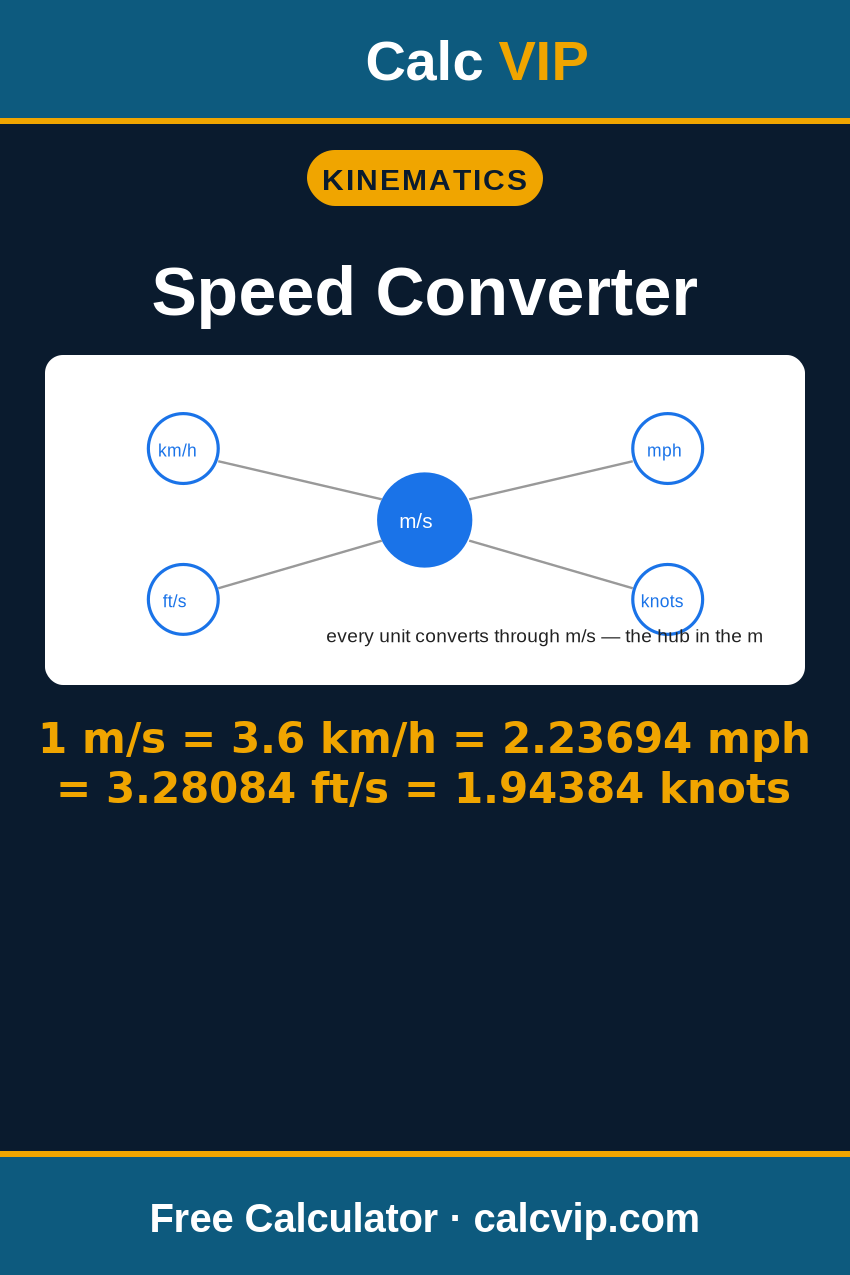
Every rate on this page flows from one hub: the metre per second. Each unit has an exact definition in terms of it — a kilometre per hour is 1,000 metres per 3,600 seconds; a mile per hour is 1,609.344 metres per hour; a foot per second is 0.3048 m/s by the definition of the foot; a knot is one nautical mile (exactly 1,852 m) per hour. Because the definitions are exact, conversions are pure multiplication and division, with no measurement error at all — the only rounding is in how many decimal places the display keeps. This converter routes everything through m/s internally, exactly as its formula describes, so converting A to B and back returns your starting number precisely.
Enter any speed, choose the unit it is measured in, and the converter shows all five units at once — no repeated clicking through pairs. If you take one thing from this page, take the factor 3.6: it translates between the scientist's unit and the road's, and between them those two cover most of daily life. The sections below explain where each unit comes from and where it is used, work through conversions from a motorway cruise to the speed of sound, and collect the quick factors worth memorising (×3.6, ÷3.6, and the sailor's 1.852) so that common translations become mental arithmetic.
Formula
Everything is converted through metres per second first:
1 m/s = 3.6 km/h = 2.23694 mph = 3.28084 ft/s = 1.94384 knots
The hub method is the whole secret: to convert any unit to any other, first turn it into m/s (divide km/h by 3.6; multiply mph by 0.44704; multiply ft/s by 0.3048; multiply knots by 0.514444), then turn the m/s into the target unit with the factors above. Two steps, never a memorised table of twenty pairwise rates. The most-used factor deserves its fame: 3.6 is just 3,600 seconds ÷ 1,000 metres — the count of seconds in an hour divided by the count of metres in a kilometre — which is why m/s ↔ km/h conversions are exact and why "divide by 3.6" is the first conversion every physics student learns. The knot's factor hides a prettier definition: the nautical mile is one minute of arc of the Earth's circumference, so a ship making 1 knot covers one arc-minute of the planet per hour — navigation and geometry in a single unit.
| Unit | Definition | 1 unit in m/s | Where it rules |
|---|---|---|---|
| m/s | SI unit — metres per second | 1 | physics, science, engineering |
| km/h | kilometres per hour | 0.27778 (= 1/3.6) | roads in most of the world |
| mph | miles per hour | 0.44704 | roads in the UK and USA |
| ft/s | feet per second | 0.3048 | US engineering, ballistics |
| knot (kn) | nautical miles per hour | 0.514444 | ships and aircraft |
Five units, five histories
Each unit survives because a community built its intuition around it. The metre per second belongs to the SI system: it plugs directly into every formula in mechanics — kinetic energy ½mv², momentum mv, power Fv — without conversion factors, which is why science tolerates no rival. The kilometre per hour is the same system wearing road clothes: speeds drivers can picture (a town at 50, a motorway at 110) with distances from the same map. Miles per hour persists where the mile persists, in the UK and the United States, defended by a century of signage and speedometers. Feet per second lives in American technical niches — ballistics tables, ventilation engineering, amusement-ride standards — where the foot is the working length. And the knot is the oldest of them all, named for the knotted rope sailors once paid out behind a ship, counting knots per glass of time; its unit, the nautical mile, is still defined by the Earth's own geometry rather than by any artefact.
The practical consequence is that conversion is not pedantry but translation between working intuitions. A British driver in France must feel that 110 km/h is 68 mph; a student must feel that a 25 m/s sprinter-class velocity is a motorway's 90 km/h; a sailor must know that 20 knots is a landsman's 37 km/h. Numbers only guide behaviour once they are in the unit the behaviour was learned in — which is why this converter shows all five at once rather than asking you to pick a single target.
Notice also what conversion never does: it never changes the speed. 20 m/s and 72 km/h are one motion described twice, and any calculation that gives a different physical answer in different units has an error in it. That invariance is a powerful check — if a formula's result changes when you convert the inputs consistently, the formula (or the arithmetic) is wrong. Physicists lean on this constantly; it is the humble ancestor of the dimensional analysis used to audit real engineering.
How to use
- Enter the speed value.
- Choose the unit it is measured in.
- Click "Convert Speed" to see the same speed in m/s, km/h, mph, ft/s and knots all at once.
- For a quick mental check: m/s to km/h is ×3.6, so 20 m/s must show 72 km/h. If it does not, the input unit was probably chosen wrongly.
- Speeds must be zero or positive — the converter rejects negatives, since these units are used for speeds (magnitudes), not signed velocities.
Worked examples
Example 1 — the reference conversion. A speed of 20 m/s converts to: 20 × 3.6 = 72 km/h, 20 × 2.23694 = 44.74 mph, 20 × 3.28084 = 65.62 ft/s and 20 × 1.94384 = 38.88 knots. One motion, five name tags — memorise this row and you own a permanent calibration point.
Example 2 — a motorway cruise. 100 km/h is the world's most common cruising speed. Into m/s: 100 ÷ 3.6 = 27.78 m/s. Then onwards: 62.14 mph, 91.13 ft/s and 54.00 knots. The m/s figure is the one physics wants — a car at motorway speed covers nearly 28 metres every second.
Example 3 — an American speed limit. 60 mph: into m/s, 60 × 0.44704 = 26.82 m/s; then 96.56 km/h, 88.00 ft/s and 52.14 kn. The ft/s figure is a famous coincidence worth remembering: 60 mph is exactly 88 feet per second, the conversion American football commentators quietly use for kick speeds.
Example 4 — a ship making way. 30 knots: into m/s, 30 × 0.514444 = 15.43 m/s; then 55.56 km/h, 34.52 mph and 50.63 ft/s. A fast ferry at 30 knots is doing the speed of a car in town traffic — a translation that surprises landlubbers every time.
Example 5 — a gentle breeze in ft/s. 10 ft/s: into m/s, 10 × 0.3048 = 3.05 m/s; then 10.97 km/h, 6.82 mph and 5.92 kn. Light air at walking pace — the Beaufort scale's lower rungs live down at these single-digit m/s values.
Example 6 — the speed of sound. Sound in air at room temperature travels at 343 m/s: that is 1,234.8 km/h, 767.27 mph, 1,125.33 ft/s and 666.74 knots. Aircraft Mach numbers are multiples of this figure, so a jet at Mach 0.85 cruises at about 0.85 × 343 ≈ 292 m/s relative to the air around it.
Speed conversion in real life
Driving abroad. The classic use: a driver whose intuition is in mph renting a car in a km/h country (or the reverse). The life-saving rows are few — 50 ≈ 31 mph, 80 ≈ 50 mph, 110 ≈ 68 mph, 130 ≈ 81 mph — and this converter is how such a table gets built and checked.
Physics and engineering homework. Nearly every dynamics problem that begins with a road speed needs it in m/s before any formula will accept it. The ÷3.6 step is so routine that examiners plant km/h figures specifically to test whether students convert before they calculate.
Weather reports. Storm winds are quoted in km/h in most countries, mph in the US, and knots in marine forecasts. A "40-knot gale" becomes 74.08 km/h — hurricane categories, roof damage and sailing decisions all depend on translating the forecaster's unit into yours.
Aviation. Pilots live in knots for airspeed, feet per minute for climb, and Mach for the high regime — three dialects inside one cockpit. Flight computers convert continuously; the human cross-checks with the factors on this page.
Sport speeds. A bowler's or pitcher's release is measured in km/h in most of the world and mph in the US: 90 mph = 144.84 km/h = 40.23 m/s. Radar guns, broadcast graphics and scouts' notebooks all pass through this converter's arithmetic.
Treadmills and fitness kit. Gym equipment sold across markets switches between km/h and mph, and a runner's target pace (say 12 km/h = 7.46 mph = 3.33 m/s) must survive the translation exactly, or the workout quietly changes.
Quick reference: familiar speeds in every unit
| Motion | m/s | km/h | mph | knots |
|---|---|---|---|---|
| Walking | 1.4 | 5.04 | 3.13 | 2.72 |
| Sprinting | 10 | 36 | 22.37 | 19.44 |
| Town traffic | 13.89 | 50 | 31.07 | 27.00 |
| Motorway cruise | 27.78 | 100 | 62.14 | 54.00 |
| Cheetah, top speed | 29 | 104.4 | 64.87 | 56.37 |
| Airliner cruise (ground) | 250 | 900 | 559.24 | 485.96 |
| Speed of sound in air | 343 | 1,234.8 | 767.27 | 666.74 |
The town and motorway rows hide the two most useful anchors on this page: 50 km/h is almost exactly 27 knots and 31 mph, and 100 km/h is exactly 54 knots to two decimal places — coincidences that make rough mental conversion at road speeds nearly free.
The mariner's mile: a unit cut from the Earth itself
The nautical mile is the only common unit defined by the planet. Divide the Earth's circumference — very nearly 40,000 km — by the number of arc-minutes in a full circle, 360 × 60 = 21,600, and you get 40,000,000 ÷ 21,600 ≈ 1,851.85 m, standardised internationally as exactly 1,852 m. The definition was a navigator's gift: sail 60 nautical miles along a meridian and your latitude changes by exactly one degree; plot your speed in knots on a chart ruled in degrees and the arithmetic of position becomes counting. No other speed unit carries its map inside it, which is why, alone among pre-metric units, the knot faces no pressure to retire — aviation kept it for the same chart-based reason shipping did.
Rounding honestly: how many decimals does a conversion deserve?
Conversion factors are exact, but measurements are not, and honest answers respect the weaker of the two. A speedometer reading of "about 50 km/h" converts to 13.8889 m/s only arithmetically; physically it deserves "about 13.9 m/s", because the input never knew its own third decimal. The rule is to keep roughly the same number of significant figures the input carried: 50 km/h (two figures) → 14 m/s; 50.0 km/h (three) → 13.9 m/s. This converter displays two decimal places, a sensible middle course — but when you quote a converted value onward, trim it to what the original measurement earned. Spurious precision is not a victimless error: engineers have chased phantom discrepancies that were nothing but a rounded input wearing an exact-looking conversion.
Mach: the unit that refuses to sit still
One speed unit deliberately escapes this converter: the Mach number, the ratio of an object's speed to the local speed of sound. It cannot appear in the table because the speed of sound is not a constant — it falls with altitude as the air thins and cools, from 343 m/s at sea level to about 295 m/s in the stratosphere where airliners cruise. Mach 0.85 therefore means roughly 292 m/s at sea level but only about 251 m/s at cruising altitude. Pilots and aerodynamicists accept the ambiguity because what matters for flight behaviour is the ratio itself — how close the airflow is to the sound barrier — not the raw speed. It is the one "unit" that is really a comparison, and a useful reminder that every other unit on this page is a comparison too: to a metre, a mile, or a minute of the Earth's arc.
Common mistakes
- Multiplying by 3.6 in the wrong direction. m/s → km/h multiplies (the number gets bigger); km/h → m/s divides (it gets smaller). If your converted speed looks absurd — a pedestrian at 18 m/s — the factor went the wrong way.
- Confusing knots with nautical miles. A knot is already a speed: one nautical mile per hour. Saying "knots per hour" describes an acceleration, and converting knots as if they were distances loses the plot entirely.
- Using 1.6 for mph ↔ km/h and stopping there. The rough factor (1 mile ≈ 1.609 km) is fine for estimates, but at motorway speeds the rounding costs 1–2 km/h — enough to matter for a speed limit. The converter's exact factors exist for a reason.
- Feeding a signed velocity into a speed unit. These units describe magnitudes. A velocity of −10 m/s converts as a speed of 10 m/s = 36 km/h, with the direction carried separately in words or signs — mixing the two invites sign errors downstream.
- Assuming Mach is a fixed speed. Mach 1 is 343 m/s only at sea level in mild air; at altitude it is nearer 295 m/s. Any conversion involving Mach must first ask "at what altitude and temperature?"
FAQ
How do I convert km/h to m/s quickly?
Divide by 3.6. For example 90 km/h ÷ 3.6 = 25 m/s. To go from m/s to km/h, multiply by 3.6 instead.
What is a knot?
A knot is one nautical mile per hour, used for ships and aircraft. 1 knot = 0.51444 m/s = 1.852 km/h.
Which unit do physics problems use?
The SI unit is metres per second (m/s). Most physics formulas need speed in m/s, so convert km/h by dividing by 3.6 before substituting.
How many mph is 100 km/h?
62.14 mph. The reverse anchor is worth knowing too: 60 mph = 96.56 km/h. Between them, most road-speed translations can be estimated within a unit or two.
Why does the converter go through m/s instead of converting directly?
Because five units would need twenty pairwise factors, and each would be a chance to err. Routing through one hub needs only five definitions, and it guarantees consistency: A → B → A returns exactly A.
Is a knot the same as a nautical mile?
No. The nautical mile is a distance (exactly 1,852 m); the knot is the speed of covering one such mile per hour. Ships report distances in nautical miles and speeds in knots.
How fast is the speed of light in these units?
299,792,458 m/s exactly — which is 1,079,252,849 km/h (about 1.08 billion) or roughly 670.6 million mph. The m/s value is exact because the metre itself is now defined from the speed of light.
What is the fastest speed ever reached by a crewed vehicle in km/h?
Apollo 10's crew re-entered at about 39,900 km/h — roughly 11,080 m/s or 24,800 mph. This converter handles such numbers happily; only the input's realism is your responsibility.
Why do treadmills and some cars show different speeds in different countries?
Because the display unit follows the market's road unit. The underlying speed is identical — only the dialect changes, which is exactly the situation this page exists for.
Can I convert a negative speed?
The converter rejects negatives because these are speed units (magnitudes). If you have a signed velocity, convert its size and keep the direction as a sign or a word — "36 km/h westward", not "−36 km/h".