 Calc
Speed Distance Time Calculator – Solve s = v × t for Any Variable
 Created by Sarah Mitchell · Physics Editor · Motion & Measurement · Last updated: November 2026
Use this free Speed Distance Time Calculator to solve any one of the three quantities for motion at a constant speed. Pick what you want to find, enter the other two values, and get the answer instantly — with a km/h conversion when speed is involved.
Before acceleration, before forces, before everything else in mechanics, there is this: distance equals speed multiplied by time. It is the first quantitative statement most of us ever make about motion — the journey is so far, the car goes so fast, the trip takes so long — and it remains, long after the equations of motion have been learned, the one used most often in ordinary life. This calculator solves the triangle in all three directions: distance from speed and time, speed from distance and time, time from distance and speed, with the unit conversions (km/h alongside m/s, kilometres alongside metres, minutes alongside seconds) that real journeys demand.
The formula's simplicity hides one honest condition: the speed must be constant, or the "speed" you enter must be understood as the average. That condition is less limiting than it sounds, because average speed is defined by this very equation — total distance divided by total time — so the speed mode of this calculator never lies: whatever the journey's ups and downs, s ÷ t is its true average speed. What the formula cannot do is describe the journey's texture: the fast motorway hour and the crawling city hour are invisible inside their own average. For motion whose speed changes steadily, the equations-of-motion calculators on this site take over; for everything else, the triangle rules.
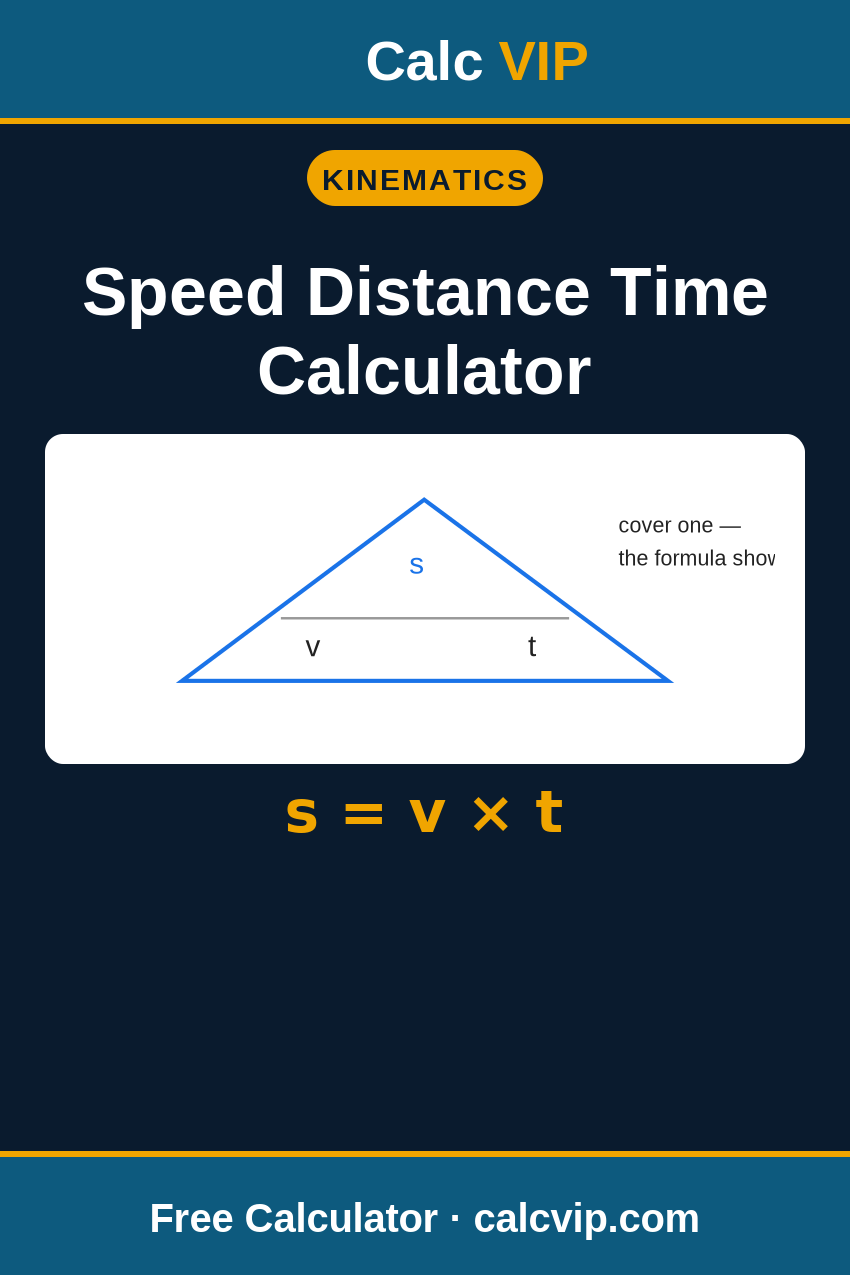
The triangle diagram above is the traditional memory aid, and it encodes the algebra geometrically: distance sits on top, speed and time below. Cover the quantity you want and the triangle shows its formula — cover s and v × t remains side by side (multiply); cover v and s sits over t (divide); cover t and s sits over v. Generations of students have passed exams on that picture. This page keeps the picture and removes the arithmetic.
Formula
s = v × t • v = s / t • t = s / v • s in metres (m), v in metres per second (m/s), t in seconds (s)
One equation, three subjects. The conversion that matters most stands beside it: 1 m/s = 3.6 km/h — multiply m/s by 3.6 to get km/h, divide km/h by 3.6 to get m/s. The factor is exact (a kilometre is 1,000 m, an hour 3,600 s, and 3,600 ÷ 1,000 = 3.6), and the calculator applies it whenever a speed is involved. Distance answers also appear in kilometres and time answers in minutes where those are the natural units. The deeper rearrangements of motion — when speed itself changes at a constant rate — are the equations of motion: v = u + at and its siblings, which reduce to this page's triangle when the acceleration is zero or when v is read as the average.
| Symbol | Meaning | Units |
|---|---|---|
| s | distance travelled | m (also km) |
| v | speed — constant, or the average over the journey | m/s (also km/h) |
| t | time taken | seconds (s) (also minutes, hours) |
Average speed: the honest number and its limits
Average speed is the only speed most journeys ever have. A 180 km drive completed in 2 hours has an average of 90 km/h — 25 m/s — though the speedometer may never have rested there, touching 120 on the motorway and 0 at the toll booth. This calculator's speed mode computes exactly that average, and for planning — fuel, arrival times, connections — the average is usually the number that matters. Its limits show when the average is mistaken for a description: two journeys with identical averages can differ in every other respect, and an average computed over a whole trip cannot answer questions about a part of it. The remedy is segmentation: split the journey at the points where the speed's character changes, apply the triangle to each piece, and add the distances or the times as the question requires.
One trap deserves its own warning: averaging speeds is not averaging numbers. Drive 60 km at 30 km/h and return the same 60 km at 60 km/h, and the average speed is not 45 km/h. The outward leg took 2 hours, the return 1 hour — 120 km in 3 hours is 40 km/h. The slow leg dominates because it occupies more time, and average speed is total distance over total time, always. (The correct shortcut for equal distances is the harmonic mean, 2v₁v₂/(v₁ + v₂) — here 2 × 30 × 60 ÷ 90 = 40.) Any time you are tempted to average two speeds directly, return to this page's definition and divide the totals instead.
How to use
- Choose what you want to find — Distance s, Speed v or Time t — from the first menu; the two input labels change to match.
- Enter the other two values: distance in metres, speed in m/s, time in seconds.
- Click "Calculate" for the answer, with km/h shown when a speed is involved, kilometres for long distances, and minutes for long times.
- Working in km/h or hours? Convert first: divide km/h by 3.6 for m/s, multiply hours by 3,600 for seconds — or compute the whole problem in km and hours, since the triangle works in any consistent units.
- For a journey in stages, calculate each stage separately and add the distances (for total distance) or the times (for total time).
Worked examples
Example 1 — all three directions. Find distance: a runner moves at v = 12 m/s for t = 30 s, so s = 12 × 30 = 360 m.
Find speed: 360 m in 30 s gives v = 360 ÷ 30 = 12 m/s (43.2 km/h).
Find time: 360 m at 12 m/s gives t = 360 ÷ 12 = 30 s.
Example 2 — the two-hour drive. A car averages 90 km/h — that is 90 ÷ 3.6 = 25 m/s — for 2 hours (7,200 s): s = 25 × 7,200 = 180,000 m = 180 km. The triangle in road units: 90 km/h × 2 h = 180 km, same answer, no conversion needed because the units were consistent.
Example 3 — the walk to the station. The station is 5,000 m away and you walk at 1.4 m/s: t = 5,000 ÷ 1.4 = 3,571 s ≈ 59.5 minutes — leave an hour, and the calculator has just planned your morning.
Example 4 — how far is the thunderstorm? Sound travels at about 343 m/s. The thunder arrives 3 s after the flash: s = 343 × 3 = 1,029 m — the storm is about a kilometre away, the oldest calculation on this page, done by counting since long before calculators.
Example 5 — the Moon by light. Light travels at 3 × 10⁸ m/s and takes about 1.28 s to arrive from the Moon: s = 3 × 10⁸ × 1.28 = 3.84 × 10⁸ m — 384,000 km, measured with a stopwatch's worth of light-time and this one multiplication.
Example 6 — the cyclist's average. A cyclist covers 20,000 m in 2,400 s: v = 20,000 ÷ 2,400 = 8.33 m/s = 30 km/h — a strong club rider's average, hills, junctions and all, in one number.
Speed, distance and time in real life
Journey planning. Every satnav arrival estimate is this triangle running continuously — remaining distance divided by current average speed — which is why the estimate breathes in and out with traffic.
Thunderstorm ranging. Count the flash-to-bang seconds, multiply by 343: the folk rule "divide the seconds by three for kilometres" is this calculation rounded for the field.
Shipping and logistics. A container ship at a steady 20 knots covers distance = speed × time across whole oceans; port arrival slots are booked from this arithmetic days in advance.
Athletics pacing. A marathoner's target time divided into the distance gives the required average speed — 42,195 m in 7,200 s is 5.86 m/s — from which every split time is derived.
Data and light. Signal delays are distances in disguise: a transatlantic fibre's ~30 ms one-way delay is light's travel time over ~6,000 km of glass, which is why servers are placed near users. The grandest version of the same arithmetic: sunlight takes 1.496 × 10¹¹ m ÷ 3 × 10⁸ m/s ≈ 499 s — about 8.3 minutes — to reach Earth, so every sunrise is seen 8.3 minutes late, by exactly this formula.
Fuel and range checks. Pilots and sailors convert relentlessly: fuel endurance (a time) at a cruise speed becomes a range (a distance), and headwinds enter as corrections to the average speed in the same triangle.
The 3.6 factor, and thinking in both units
Fluency in motion means holding both speed units at once. The anchor conversions worth memorising: 10 m/s = 36 km/h (a fast sprinter), 20 m/s = 72 km/h (a motorway slip road), 27.78 m/s = 100 km/h, 30 m/s = 108 km/h. Physics is done in m/s because the rest of the SI system — newtons, joules, watts — is built on the metre and the second; roads are signed in km/h because the kilometre and hour fit human journeys. The 3.6 between them is not an approximation: it is 3,600 seconds-per-hour divided by 1,000 metres-per-kilometre, exact by definition. Most speed errors in student work, and a good share in journalism, are a missing or doubled 3.6 — the calculator shows both units side by side precisely to make such errors visible at a glance.
Quick reference: everyday speeds
| Motion | Speed (m/s) | Speed (km/h) | Distance in 10 s |
|---|---|---|---|
| walking | 1.4 | 5.04 | 14 m |
| marathon pace (2 h) | 5.86 | 21.1 | 58.6 m |
| 100 m sprint (world-class) | 10.4 | 37.4 | 104 m |
| city driving | 13.89 | 50 | 138.9 m |
| motorway driving | 31.1 | 112 | 311 m |
| sound in air | 343 | 1,235 | 3,430 m |
The last row is the scale-breaker: in the time a car covers a third of a kilometre, sound covers three and a half — and light, at 3 × 10⁸ m/s, covers three million. One triangle, every speed in the universe.
Beyond SI: knots, nautical miles and Mach
The triangle does not care what units sail into it, and two professional unit systems prove the point. At sea, speed is measured in knots — one nautical mile per hour, where the nautical mile is exactly 1,852 m. A ship at 20 knots therefore moves at 20 × 1.852 = 37.04 km/h, or 37.04 ÷ 3.6 = 10.29 m/s, and in 6 hours covers 120 nautical miles = 222.24 km — every figure from the same s = vt with the conversion done once, at the start. In the air, speed is often quoted as a Mach number: the ratio to the local speed of sound. Mach 0.85 where sound travels at 343 m/s is 0.85 × 343 = 291.55 m/s = 1,049.58 km/h — but the Mach-to-speed conversion changes with altitude, because cold high-altitude air carries sound more slowly (about 295 m/s in the stratosphere), so the same Mach 0.85 is a different true speed there. The lesson generalises: the triangle itself is universal and exact, and all the craft lies in converting honestly into a consistent set of units before it is allowed to multiply.
The nautical mile itself is a small monument to the triangle's world: it was defined as one arc-minute of latitude, so that a navigator's speed in knots and time in hours gave distance directly in chart minutes — a unit chosen so that s = vt could be done by reading the map. Good units are formulas made invisible.
Pacing: the triangle as a coach
Athletes live inside this calculator whether they know it or not, because a race plan is a speed chosen to make distance and time meet at a target. The two-hour marathon of the quick-reference table demands an average of 5.86 m/s; divided into the course, that is 170.64 s per kilometre — call it 2 minutes 51 seconds per km, sustained 42 times — with the 10 km mark arriving at 28.44 minutes and halfway at exactly one hour. Even pacing is the triangle's straight line; the celebrated "negative split", running the second half faster, is the decision to make the average of the second segment exceed the first so the totals still land on the target. Every split time a coach calls out is t = s ÷ v evaluated at a checkpoint, and every blow-up late in a race is the discovery that an early segment's v was borrowed against a total it could not repay. The calculator's three modes are, quite literally, the three questions of race day: how far at this pace in this time, how fast was that segment, how long will the rest take.
Common mistakes
- Averaging speeds by adding and halving. The 30-out, 60-back journey averages 40 km/h, not 45. Average speed is total distance ÷ total time — always return to the totals.
- Mixing hours with m/s. The triangle needs consistent units: metres with m/s and seconds, or kilometres with km/h and hours. A speed in m/s multiplied by a time in hours is wrong by 3,600.
- Converting the wrong way. m/s → km/h multiplies by 3.6 (the number gets bigger — km/h figures are always larger than the same speed in m/s). If your conversion made it smaller, you divided.
- Using the top speed instead of the average. Planning a trip at the car's cruising speed ignores towns, stops and traffic. Real averages on mixed roads run at 60–70% of the cruise speed — the satnav's estimate knows this; match it.
- Applying the triangle to accelerating motion piece by piece wrongly. For steadily speeding-up motion the average is ½(u + v) and the equations of motion apply; feeding the final speed into s = vt overstates the distance, sometimes wildly.
FAQ
Does this work if the speed keeps changing?
Only if you enter the average speed. For speeding up or slowing down, use the equations-of-motion calculators instead.
How do I convert m/s to km/h?
Multiply by 3.6. To go the other way, divide by 3.6. The calculator shows the km/h value whenever a speed is involved.
What is the triangle in the diagram?
It is a memory aid: cover the quantity you want, and the triangle shows the formula — s on top, v and t below, so s = v × t, v = s ÷ t and t = s ÷ v.
What is the difference between speed and velocity?
Speed is size only; velocity also carries direction. This calculator works with speed (and distances along a path). Where direction matters — components, projectiles — velocity and its split take over.
Why is my journey's average speed lower than I expect?
Because every stop, junction and slow stretch dilutes it, and the slow parts occupy disproportionate time. Average speed is a time-weighted verdict, not the speed you remember cruising at.
Can I work entirely in kilometres and hours?
Yes — the triangle is unit-agnostic as long as the three units agree: km, km/h and hours, or m, m/s and seconds. The calculator's inputs are SI, but the algebra does not care.
How fast is the speed of light in km/h?
3 × 10⁸ × 3.6 ≈ 1.08 × 10⁹ km/h — about a billion. The 3.6 factor works at every scale, which is one measure of how well-chosen the units are.
What if the time is zero or the speed is zero?
Distance and speed modes handle zeros naturally (no time, no distance). Time mode with zero speed is meaningless — at rest, no distance is ever covered — and the calculator says so rather than dividing by zero.
How do I handle a journey with a stop in the middle?
Decide whether the stop counts. For average travel speed including the stop, include its time in t; for the moving average, exclude it. The two numbers answer different questions — be clear which you need.
Is there a version for accelerating motion?
Yes — the equations-of-motion family on this site: Initial Velocity, Acceleration Solver, Acceleration From Distance and Distance From Velocity Change. They are this triangle plus one idea: the speed itself changes at a steady rate.