 Calc
Surface Gravity Solver – Find a Planet's Mass from g and Radius
 Created by Rachel Novak · Senior Editor · All Topics · Last updated: November 2026
Use this free Surface Gravity Solver to work backwards: if you know a planet's surface gravity and its radius, find its mass. This is exactly how astronomers "weigh" planets they can never put on a scale.
Every planet announces its mass in a language anything can read: how hard its surface pulls. A dropped hammer, a bouncing lander, the period of an orbiting moon, the slight wobble of a spacecraft passing overhead — all of them measure surface gravity, and surface gravity, combined with the planet's size, determines the mass completely. This solver runs Newton's law of gravitation in the direction astronomers actually use it. The familiar formula g = GM/R² normally predicts gravity from mass; turned around, M = gR²/G weighs a world from two measurements that telescopes and tracking stations can genuinely make.
The weighing is more honest than it might look. Notice that the answer does not depend on what the planet is made of, how fast it spins, or whether anyone has landed on it — only on the pull at its surface and the distance from its centre. For the solar system's planets, the method reproduces accepted masses to within the rounding of the input gravity, as the worked examples below show for Earth, the Moon and Mars. For exoplanets, where "surface gravity" is inferred from a moon's or a sibling planet's orbital behaviour, it remains one of the only scales available.
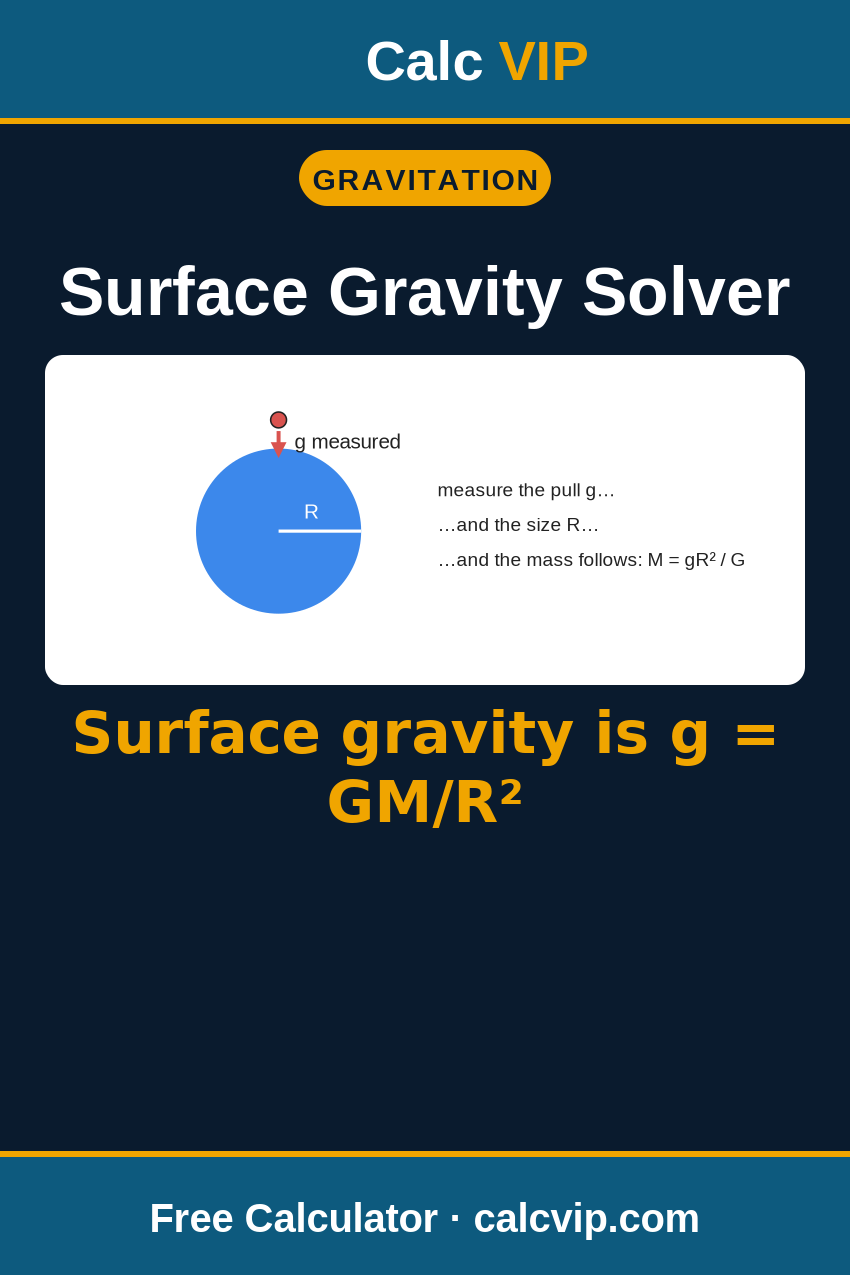
Presets cover Mars, the Moon, Earth and Jupiter. Choose Custom to weigh anything you can measure a pull and a size for — an exoplanet, an asteroid a spacecraft has visited, or an invented world whose mass you want to keep consistent with the gravity you have given it. The answer comes back in kilograms and in Earth masses, the unit in which planetary masses are most naturally compared.
Formula
Surface gravity is g = GM/R², so rearranging gives the mass: M = gR²/G • M in kg, g in m/s², R in metres (calculator accepts km), G = 6.674 × 10⁻¹¹ N·m²/kg².
The same relation rearranges the other ways. Given a mass and a radius, the gravity is g = GM/R² — the forward direction, used by the weight and impact-velocity calculators. Given a mass and a gravity, the radius at which that gravity is felt is R = √(GM/g) — useful for finding, say, the altitude at which a planet's gravity falls to half its surface value (answer: 0.414 R above the surface, since g falls with the square of the distance). You only need two measurements — how hard the surface pulls, and how big the planet is. One structural feature deserves attention before you trust any answer: because R is squared, the mass inherits radius errors doubled — a 3% radius error becomes a 6% mass error — while gravity errors pass through one-for-one. When astronomers quote an exoplanet's mass to ±20%, it is usually the radius, not the gravity, that is to blame.
| Symbol | Meaning | Units |
|---|---|---|
| M | mass of the planet or body | kg (also given in Earth masses) |
| g | surface gravity — acceleration at the surface | m/s² |
| R | radius of the body | km (calculator input) |
| G | gravitational constant | 6.674 × 10⁻¹¹ N·m²/kg² |
How do you measure the gravity of a world you have never touched?
The honest answer is that for most planets nobody measures surface gravity directly at all — they measure the combination GM, called the standard gravitational parameter, and it drops out of orbital motion with astonishing precision. A moon's period and orbital radius give GM through Kepler's third law; a spacecraft's radio signal, Doppler-shifted as the craft accelerates around a planet, maps GM to ten or more significant figures. Dividing by G yields the mass; measuring the radius by imaging or transit yields g at any altitude you like. This is why planetary tables list GM far more precisely than M: G itself is the least well-measured fundamental constant in physics, known to only about five significant figures, so every planetary mass in kilograms inherits that slight fuzziness — while the gravity a planet actually exerts, the thing that bends trajectories, is known almost exactly.
Where no moon and no spacecraft exist, astronomers improvise. Binary asteroids betray each other's masses through their mutual orbits. Passing stars and gravitational microlensing weigh isolated worlds statistically. And for exoplanets, the star's radial-velocity wobble measures the planet's mass almost directly (up to the unknown tilt of the orbit), while the transit measures the radius — whereupon this solver's rearrangement can be run in reverse to predict the surface gravity a future lander would feel, a number that mission studies for interstellar probes already trade in.
How to use
- Pick a preset planet — Mars, Moon, Earth or Jupiter — to fill in its surface gravity and radius, or choose Custom and enter any values.
- Enter g in m/s² (Earth 9.82, Moon 1.62, Mars 3.71) and the radius in kilometres, using the same radius convention as the gravity value — see the Jupiter example for why this matters on flattened, fast-spinning worlds.
- Click "Solve for Mass" to get the mass in kilograms and in Earth masses.
- Cross-check against a known value if you can: the solver run on Earth (9.82, 6,371 km) must return ≈ 5.97 × 10²⁴ kg. If it does not, a digit has slipped in the inputs.
- Carry the uncertainty honestly: double any percentage error in R when you quote the mass, and add the percentage error in g on top.
Worked examples
Example 1 — weighing Mars. Mars has a measured surface gravity of g = 3.71 m/s² and a radius of R = 3,389.5 km:
M = 3.71 × (3.3895 × 10⁶)² / 6.674 × 10⁻¹¹ ≈ 6.39 × 10²³ kg.
The accepted value is 6.417 × 10²³ kg — the small difference comes from the rounded value of g used here. Mars is about 0.107 Earth masses.
Example 2 — checking Earth. g = 9.82 m/s², R = 6,371 km.
M = 9.82 × (6.371 × 10⁶)² / 6.674 × 10⁻¹¹ ≈ 5.97 × 10²⁴ kg — 1.00 Earth masses, as it must be.
This is the calibration run: the method, fed Earth's own numbers, returns Earth's accepted mass to three significant figures.
Example 3 — weighing the Moon. g = 1.62 m/s², R = 1,737.4 km.
M = 1.62 × (1.7374 × 10⁶)² / 6.674 × 10⁻¹¹ ≈ 7.33 × 10²² kg ≈ 0.0123 Earth masses.
The accepted value is 7.348 × 10²² kg; again the tiny gap is the rounding of g to three figures. Historically the Moon's mass was the hardest in the solar system to pin down, precisely because the Moon has no moon of its own to betray it.
Example 4 — Jupiter and the radius trap. Jupiter's quoted surface gravity is g = 24.79 m/s². With the mean radius 69,911 km the solver returns M ≈ 1.82 × 10²⁷ kg — 4% short of the accepted 1.898 × 10²⁷ kg.
Use the equatorial radius, 71,492 km — the radius at the equator where that g value is defined, on a planet flattened by its 10-hour spin — and the solver returns 1.898 × 10²⁷ kg exactly. Lesson: g and R are a matched pair; mixing conventions quietly corrupts the mass.
Example 5 — a heavy exoplanet. A super-Earth with measured g = 15 m/s² and R = 9,000 km.
M = 15 × (9 × 10⁶)² / 6.674 × 10⁻¹¹ ≈ 1.82 × 10²⁵ kg ≈ 3.05 Earth masses.
Run its density (companion calculator) and you get about 5,950 kg/m³ — a rocky, iron-rich world, consistent with a planet that formed close to its star where only heavy ingredients condensed.
Example 6 — weighing a neutron star. Surface gravity g = 1 × 10¹² m/s² (a trillion Earth gravities is the right neighbourhood), R = 10 km.
M = 10¹² × (10⁴)² / 6.674 × 10⁻¹¹ ≈ 1.50 × 10³⁰ kg ≈ 0.75 solar masses.
Newton's formula is being stretched past its comfort zone here — general relativity corrects the details — but the scale is right: neutron stars pack of order a Sun's mass into a city-sized ball, which is why their gravity bends light and slows time so dramatically.
Surface gravity in real life
Spacecraft navigation runs on it. Every gravity-assist manoeuvre — Voyager's slingshots, Cassini's tour of Saturn, BepiColombo's looping road to Mercury — is computed from GM values measured exactly this way, by watching how a planet's gravity bends a probe's path and Doppler-shifts its radio carrier. The mass is never an input from a table of guesses; it is measured fresh by each visiting spacecraft.
It decides whether a planet keeps its air. Surface gravity, through escape velocity, sets which gases a world can hold: the Moon's 1.62 m/s² could not retain nitrogen or oxygen against thermal escape over geological time, while Titan, with a similar 1.35 m/s² but far colder temperatures, keeps a thick nitrogen atmosphere. Gravity is half the atmospheric-retention equation; temperature is the other half.
Rovers and landers are designed against it. A lander's structure, its landing legs and its crane cables are sized for the destination's g — and the mass of the planet, derived from g and R, is what mission planners actually use to compute entry, descent and landing dynamics years before arrival.
It shapes imagined worlds. Science-fiction writers and game designers who want a believable planet pick a radius and a gravity their characters can walk in; this solver then fixes the mass, and the density calculator checks the recipe. A world with Earth's radius and half Earth's gravity must mass a quarter as much — and average half Earth's density, an ice-and-rock mix, not familiar geology.
Asteroid prospectors use it in miniature. For a kilometre-sized asteroid, "surface gravity" is a few ten-thousandths of a m/s² and the mass comes from a companion moonlet or from a visiting spacecraft's orbit. OSIRIS-REx weighed Bennu this way before daring to touch it — essential knowledge when the "landing" is more like docking with a mountain that pulls weaker than a magnet.
It calibrates the search for Earth twins. A planet with Earth's radius and a measured mass within a few percent of Earth's — found by running this arithmetic on transit and wobble data — is the closest thing astronomy has to a confirmed Earth analogue. Several candidates in nearby systems are being refined toward exactly that verdict.
Where the simple formula bends: rotation, shape and depth
The solver assumes a spherical, non-rotating planet, and real worlds cheat on both counts. Rotation subtracts a centrifugal contribution that is largest at the equator: on Earth it removes about 0.034 m/s² of the measured 9.82, and on fast-spinning Saturn it removes far more — which is why quoted "surface gravity" values for gas giants are specified at a stated latitude and pressure level, and why Jupiter's example above needed the equatorial radius. Shape matters too: an oblate planet's polar gravity exceeds its equatorial gravity both because the poles are closer to the centre and because they escape the centrifugal discount. Finally, g does not peak at the surface of a real planet and fall steadily inward — inside Earth it actually rises slightly through the mantle, peaking at the core boundary near 10.7 m/s², because the dense core keeps pulling hard while the shell above stops contributing. The formula M = gR²/G remains the right first answer everywhere; these are the corrections professionals apply next.
Quick reference: weighing the planets from g and R
| Body | g (m/s²) | Radius | Solved mass |
|---|---|---|---|
| Mercury | 3.70 | 2,439.7 km | 3.30 × 10²³ kg |
| Venus | 8.87 | 6,051.8 km | 4.87 × 10²⁴ kg |
| Earth | 9.82 | 6,371 km | 5.97 × 10²⁴ kg |
| Moon | 1.62 | 1,737.4 km | 7.35 × 10²² kg |
| Mars | 3.73 | 3,389.5 km | 6.42 × 10²³ kg |
| Jupiter | 25.92* | 69,911 km | 1.90 × 10²⁷ kg |
| Saturn | 11.19 | 58,232 km | 5.68 × 10²⁶ kg |
| Neptune | 11.27 | 24,622 km | 1.02 × 10²⁶ kg |
*Jupiter's row uses the gravity computed from its mass and mean radius; the commonly quoted 24.79 m/s² is the equatorial value and pairs with the equatorial radius 71,492 km, as Example 4 shows — both pairings return the same mass. Every solved mass in the table matches the accepted value to within rounding, which is the method's whole credential.
Common mistakes
- Pairing a gravity from one radius with a different radius. The Jupiter trap of Example 4: g quoted at the equator belongs with the equatorial radius. On spherical rocky worlds the distinction vanishes; on spinning giants it is worth 4% of the mass.
- Entering the radius in metres. The calculator expects kilometres. A radius typed as 6371000 instead of 6371 inflates the mass a millionfold — the Earth-mass readout (an absurd 1,000,000 M⊕) is the tell-tale.
- Expecting composition from mass alone. The solver returns mass, full stop. Two planets of identical mass and radius can still differ inside; add the density and moment of inertia before claiming a recipe.
- Forgetting the error doubling. Because R is squared, sloppy radii poison masses twice as fast. A mass quoted from a radius known to ±5% is a mass known to ±10%, however precise the gravity measurement.
- Using altitude gravity with the surface radius. If g was measured by an orbiting spacecraft at altitude h, the matching radius is R + h. Pairing orbit-altitude gravity with the surface radius understates the mass — sometimes by tens of percent for high orbits.
FAQ
How do we measure a planet's surface gravity before landing?
By watching how its gravity bends the path of an orbiting spacecraft or a passing probe — the same tracking data gives the mass directly through Newton's laws.
Why does this give only the mass, not the composition?
Mass alone doesn't say what a planet is made of. Combine it with the radius to get the average density, and the density hints at rock, metal, ice or gas fractions.
Can this work for a star?
The same formula applies, but for stars the mass is usually found from binary orbits instead, because a star's "surface" gravity is harder to measure directly.
How accurate is the mass this solver gives?
Exactly as accurate as its inputs, with the radius error doubled. Feed it three-significant-figure values, as in the Mars example, and expect the mass to about a percent. The formula itself, for a spherical non-rotating body, is exact Newtonian physics.
Why do tables list GM instead of just M?
Because orbits measure the product GM directly and exquisitely, while splitting it into M requires dividing by G — the worst-measured constant in physics. Planetary masses in kilograms all carry G's small uncertainty; the gravity those planets exert is known far better than their kilogram values suggest.
What gravity would a planet need to weigh as much as the Sun?
It could not be a planet at that point — but the arithmetic is instructive: at Earth's radius, a solar mass would need g = GM/R² ≈ 3.3 × 10⁶ m/s². Real solar-mass objects are stars with radii near 700,000 km, where the same formula gives the Sun's stately 274 m/s².
Does the planet's spin change the solved mass?
Only if the g you enter was measured at the equator of a fast spinner, where centrifugal effect discounts the reading. Correct the reading to the pure gravitational value (or use a polar g) and the solver returns the true mass; Jupiter's example shows the size of the trap.
Can I weigh an asteroid this way?
Yes, if you can measure its feeble g and its radius — in practice done by orbiting it or by tracking a moonlet. Asteroid masses from this method revealed that many are rubble piles with densities barely above water ice, a fact of great interest to both miners and planetary-defence planners.
How did Cavendish "weigh the Earth" in 1798?
He measured G itself, with a torsion balance and lead spheres in a shed. Once G was known, Earth's already-known surface gravity and radius gave its mass through exactly this formula — the first time humanity knew the mass of its own planet, and the template for every weighing since.
What if I only know the mass and want the gravity?
Run the formula forward: g = GM/R². That is what the Weight on a Custom Body and Impact Velocity calculators on this site do — the same Newtonian coin, spent from the other side.