 Calc
Weight on a Custom Body Calculator – Invent a Planet, Find Your Weight
 Created by Rachel Novak · Senior Editor · All Topics · Last updated: November 2026
Use this free Weight on a Custom Body Calculator to invent your own planet: give it any mass and radius, and find out what you would weigh standing on it — compared with your weight on Earth.
Every "your weight on Mars" chart answers a question about a world that already exists. This calculator inverts it: you are the world-builder. Dial in any mass and any radius — a super-Earth twice our size, a dense iron marble, a puffy giant shrunk to a ball — and the page computes the surface gravity your world would have and what a traveller of a given mass would weigh there, side by side with their Earth weight and the percentage difference. It is the fastest way to develop intuition for the single most important trade in planetary design: gravity grows with mass but weakens with the square of radius, so size and heaviness pull in opposite directions, and the winner is decided by density.
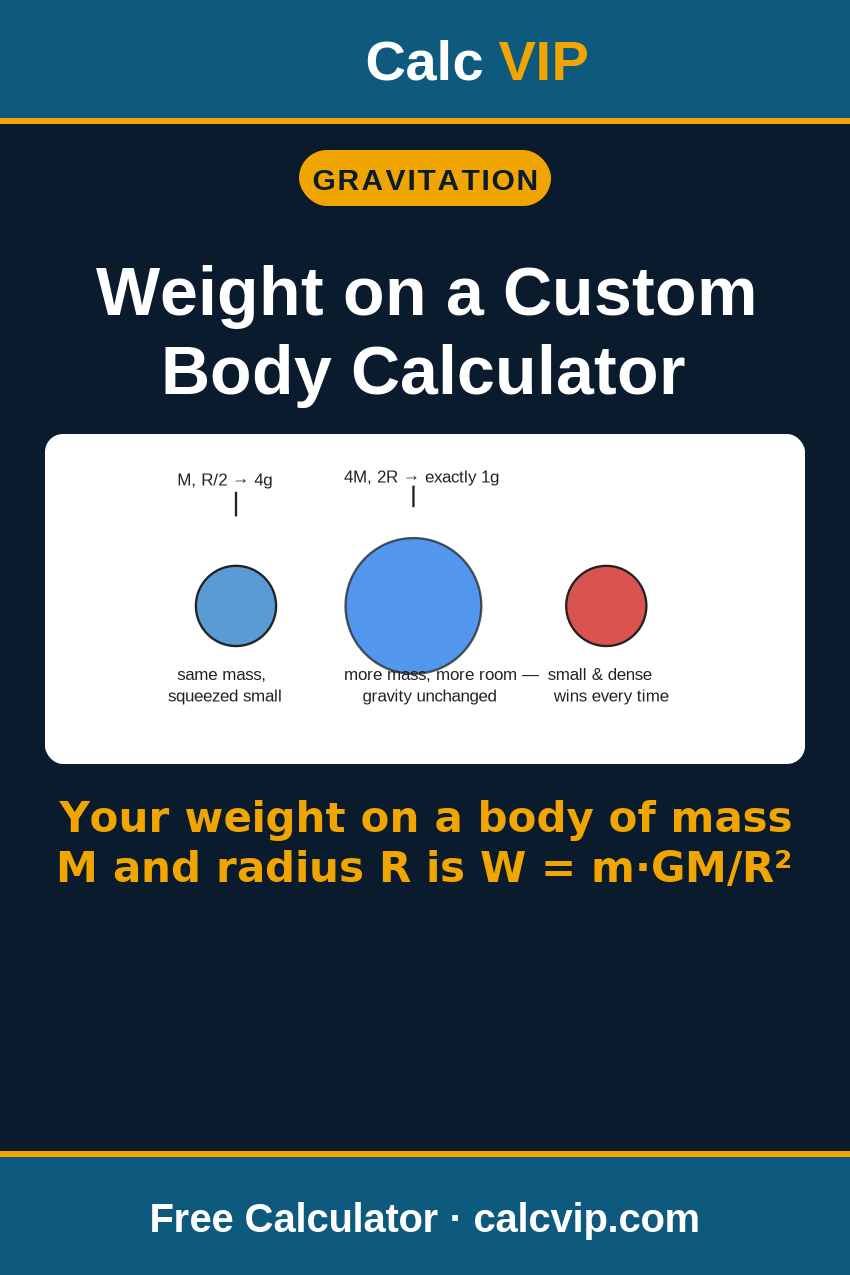
The results regularly ambush intuition. Build a planet with four times Earth's mass spread over twice Earth's radius — a world that sounds crushingly heavy — and the surface gravity comes out exactly Earth-normal: the fourfold mass and the fourfold area of the inverse-square law cancel. Build one with Earth's mass but half its radius and gravity quadruples. Saturn, a hundred times Earth's mass, would let you weigh almost exactly what you weigh at home if you could stand on its cloud tops, because its bulk is spread so wide. Mass impresses; density decides.
Enter your own mass once and the world's mass and radius, and read off the local g, your weight in newtons, and the percentage of your Earth weight. One honest caution before the examples: a world is only stand-on-able if it can exist — pair an enormous mass with a tiny radius and the calculator will happily report the gravity of what is really a neutron star wearing a planet's name tag. The concept section shows how to spot the impossible combinations.
Formula
Your weight on a body of mass M and radius R is W = m·GM/R², with the local gravity g = GM/R² • W in newtons, m = your mass in kg, M in kg, R in metres (calculator accepts km), G = 6.674 × 10⁻¹¹ N·m²/kg².
The percentage the calculator shows is simply the ratio of gravities: since your mass m is the same on both worlds, W/WEarth = g/gEarth — the percentage is the new gravity measured in Earth units. The design rearrangements matter more than the forward formula. Want a target gravity g from a chosen radius? The required mass is M = gR²/G. Want a chosen mass to deliver a target gravity? The radius must be R = √(GM/g). And because density ρ = 3M/(4πR³), the gravity can be rewritten entirely in terms of density and size: g = (4/3)πGρR — for worlds of the same stuff, gravity grows in direct proportion to radius, which is why the rocky planets' gravities rank almost exactly by their sizes while the gas giants, made of light material, break the pattern.
| Symbol | Meaning | Units |
|---|---|---|
| W | your weight on the custom body | N |
| m | your mass (the same everywhere) | kg |
| g | surface gravity of the custom body | m/s² |
| M, R | mass and radius of the body you design | kg; km (calculator input) |
| G | gravitational constant | 6.674 × 10⁻¹¹ N·m²/kg² |
Density is destiny: designing worlds that could exist
Not every (M, R) pair describes a possible planet. Divide the mass by the volume and the density tells you what the world would have to be made of — and nature's menu is short. Below about 1,000 kg/m³ you are asking for something lighter than water ice under its own gravity, which compression forbids for large bodies. Between 1,000 and 2,500 kg/m³ lies the territory of ice and water worlds. Rocky material gives 3,000–5,500 kg/m³ — the Moon at 3,344, Earth at 5,513, the densest planet known because its size compresses its interior. Iron-rich bodies reach toward 8,000 kg/m³, and beyond roughly 13,000 kg/m³ (Earth's own core density) no planet-sized object made of ordinary matter can go; higher densities belong to white dwarfs and neutron stars, where atoms themselves collapse. The calculator computes faithfully for any input — checking that your world is buildable is the designer's job, and density is the check.
There is a second, quieter design constraint: your world must also hold together against its own spin and, if it is small, against simply being a potato. Below a few hundred kilometres of radius, material strength beats gravity and bodies keep the irregular shapes of their assembly — your weight there would vary from hill to valley, and "surface gravity" becomes a local weather report rather than a planetary constant. Above that threshold gravity wins, spheres form, and this page's clean arithmetic takes over. Every stand-on-able world in the universe lives between those two regimes — and its inhabitants' knees, bones and architecture are all sized by the single number g that this calculator returns.
How to use
- Enter your own mass in kilograms — this is your mass, which never changes; only weight varies between worlds.
- Enter the custom body's mass in kilograms (scientific notation like 1e24 works) and its radius in kilometres.
- Click "Calculate My Weight" to get the body's surface gravity, your weight there in newtons, and that weight as a percentage of your Earth weight.
- Sanity-check your world: divide its mass by (4/3)πR³ to get its density, and compare with the guide in the concept section — 3,000–5,500 kg/m³ for a believable rocky planet.
- To design for a target gravity, use M = gR²/G: pick the radius you want, set g (9.82 for Earth-normal), and the required mass falls out — then check the density before declaring the world open for settlement.
Worked examples
Example 1 — a custom world. Your mass 70 kg; body mass 1 × 10²⁴ kg, radius 5,000 km.
g = GM/R² = 6.674 × 10⁻¹¹ × 1 × 10²⁴ / (5 × 10⁶)² ≈ 2.67 m/s².
Your weight there = 70 × 2.67 ≈ 186.9 N, compared with 687.4 N on Earth — only 27.2% of your Earth weight. On this light-gravity world you would feel Moon-like bounce with every step, able to leap several metres and lift loads that would defeat you at home — while your muscles and bones slowly adapted downwards to the easier life.
Example 2 — the Moon, as a check. M = 7.348 × 10²² kg, R = 1,737.4 km, your mass 70 kg.
g ≈ 1.62 m/s²; weight ≈ 113.7 N, or 16.5% of Earth weight.
The calculator reproduces the famous one-sixth gravity. Apollo astronauts, in suits that roughly doubled their Earth-trained mass, experienced something like Earth-normal total weight on the Moon — one reason their hopping gait worked at all.
Example 3 — Mars. M = 6.417 × 10²³ kg, R = 3,389.5 km.
g ≈ 3.73 m/s²; a 70 kg traveller weighs 260.9 N — 38.0% of Earth weight.
Mars is the solar system's middleweight: heavy enough to feel substantial, light enough that a fit person could jump clear of a chair's height. Whether 0.38 g preserves human health across years is one of the great unanswered questions of space medicine — no experiment can be run until someone goes.
Example 4 — the super-Earth that weighs the same. M = 4 × Earth's mass (2.389 × 10²⁵ kg), R = 2 × Earth's radius (12,742 km).
g = G(4M)/(2R)² = GM/R² = 9.82 m/s² — exactly Earth's.
Weight: 687.4 N, 100.00%. Four times the planet, the same knees. This is the cleanest demonstration that surface gravity is a ratio, not a size: what matters is how much mass sits how far beneath your feet, and doubling both dimensions leaves the answer untouched.
Example 5 — a heavy invented world. M = 2 × 10²⁵ kg, R = 8,000 km, your mass 70 kg.
g = 6.674 × 10⁻¹¹ × 2 × 10²⁵ / (8 × 10⁶)² ≈ 20.86 m/s²; weight ≈ 1,460 N — about 212% of Earth weight.
Its density works out to about 9,320 kg/m³ — iron-rich but conceivable, an overgrown Mercury. Standing there, you would feel as if carrying another adult on your back, permanently; sitting down would be easy, standing up a workout, and a fall genuinely dangerous.
Example 6 — a small asteroid. M = 1 × 10¹⁵ kg, R = 10 km.
g ≈ 6.67 × 10⁻⁴ m/s²; a 70 kg visitor weighs 0.047 N — the Earth-weight of about five grams.
"Weighing" almost nothing, you could not walk: a single careless step exceeds escape velocity's neighbourhood, and astronauts on such worlds anchor themselves rather than stand. The calculator's arithmetic still holds — it is the human activity of standing that gives out first.
Custom gravity in real life
Exoplanet triage. Thousands of known exoplanets come with a mass (from radial velocity) and a radius (from transits) and nothing else. This exact computation converts those two numbers into a surface gravity and a density, the first sort of the catalogue into rocky worlds, water worlds and puffballs — the shortlist for every atmospheric follow-up observation is built this way.
Science fiction, done honestly. World-builders who want their planets to feel real run this check: choose the gravity the story needs, solve for the mass–radius pairs that deliver it, then verify the density is buildable from rock, ice or iron. The invented worlds in the examples above were designed and vetted in exactly this order.
Spacecraft and lander design. A lander's legs, a rover's wheels and a sample-return rocket's thrust are all sized by the destination's g. When the target is a comet or asteroid whose mass is known from tracking and whose radius is known from imaging, this formula is what converts those observations into the number the engineers design against.
Human-factors research. Parabolic flights and centrifuges explore partial gravity, but the mission questions — can a crew work in 0.38 g, sleep in 0.17 g, stay healthy for years — are framed in exactly this page's outputs. Every Mars architecture study carries a table like the quick reference below, computed the same way.
Video games and simulators. Any game with multiple planets quietly implements W = mGM/R² per world; the good ones also implement the density check, so their "heavy" planets are dense iron worlds rather than merely large ones. Players feel the difference as jump height, fall damage and vehicle handling.
Teaching the mass–weight distinction. Nothing cures the confusion between mass and weight like holding one fixed and watching the other swing from 0.007% (asteroid) to 264% (Jupiter, computed with its mean radius) as the world changes around it. The kilogram never moves; the newton does all the travelling.
What living at another g would actually feel like
Weight is not an abstract number to a body; it is the load every bone, muscle and blood vessel was engineered around. At lunar gravity (0.17 g) astronauts bounded rather than walked, and even six days of it began the deconditioning — bone density loss, muscle wasting — that months of weightlessness completes; whether Mars gravity (0.38 g) is enough to arrest that decline is genuinely unknown. At the other end, sustained 2 g doubles every load: hearts labour to lift blood to the brain, joints wear at twice the design rate, and a stumble becomes an injury. Fighter pilots endure 9 g for seconds with training and pressure suits; a planet that asked it permanently would be uninhabitable regardless of its air and water. World-builders take note: the habitable band for creatures built like us is probably 0.3–1.5 g, and this calculator's percentage output is, read properly, a habitability gauge.
Quick reference: a 70 kg traveller across the solar system
| Body | g (m/s²) | Weight (N) | % of Earth |
|---|---|---|---|
| Moon | 1.62 | 113.7 | 16.5% |
| Mars | 3.73 | 260.9 | 38.0% |
| Custom light world (Ex. 1) | 2.67 | 186.9 | 27.2% |
| Earth | 9.82 | 687.4 | 100% |
| Super-Earth 4M⊕/2R⊕ (Ex. 4) | 9.82 | 687.4 | 100% |
| Custom heavy world (Ex. 5) | 20.86 | 1,460 | 212% |
| Jupiter (mean radius) | 25.92 | 1,814 | 264% |
| Asteroid (Ex. 6) | 0.000667 | 0.047 | 0.007% |
Jupiter's row carries a convention worth knowing: computed with its mean radius (69,911 km) the gravity is 25.92 m/s², while the commonly quoted 24.79 m/s² uses the larger equatorial radius of the fast-spinning planet. Both are "Jupiter's gravity" — the difference is which radius you stand on, and on an oblate world the answer genuinely depends on latitude.
Common mistakes
- Entering your weight where your mass belongs. The first input is your mass in kilograms — the number a scale shows on Earth, used as a mass. Entering newtons (687) instead of kilograms (70) inflates every answer tenfold.
- Assuming a bigger planet always means heavier. Gravity is M/R², not M. Saturn outweighs Earth 95-fold yet its cloud-top gravity is within a few percent of Earth's, because its radius is 9.4 times larger and the square of that nearly cancels the mass. Always run the numbers.
- Designing impossible worlds. A mass and radius whose density falls outside roughly 500–13,000 kg/m³ cannot be built from ordinary matter at planet scale. The calculator will still answer — physical possibility is the designer's check, and the density test in the concept section is how to run it.
- Radius in metres or diameter in place of radius. The input is radius in kilometres. A diameter slip quarters the gravity (the square again), and a metres slip divides it by a million — if your custom Earth reports microgravity, the units are the culprit.
- Reading the percentage as a mass change. The percentage compares weights — equivalently, gravities. Your mass is 70 kg on every row of every table on this page; what changes is the force with which each world holds you down.
FAQ
Would my mass change on another planet?
No. Mass is the amount of matter in your body and stays the same everywhere. Weight is a force — it depends on the local gravity, which is why it changes from world to world.
What mass and radius give exactly Earth gravity?
Any combination with M/R² equal to Earth's value works: for example, 4 times Earth's mass with 2 times Earth's radius gives the same 9.82 m/s² — such a "super-Earth" would feel exactly like home at the surface.
Why would I weigh so much on Jupiter?
Jupiter's mass is enormous, and even though its radius is also large, g works out to about 24.79 m/s² — a 70 kg person would weigh about 1,735 N, roughly 2.5 times their Earth weight.
Can I model a real exoplanet?
Yes — many exoplanets have measured masses and radii from radial-velocity and transit surveys. Enter those values to estimate surface gravity, a key habitability clue.
Does the calculator work for stars?
The arithmetic does — enter the Sun's mass and radius and a 70 kg traveller "weighs" about 19,200 N in its 274 m/s² gravity — but no one stands on a star: there is no surface, and the temperature objects. Treat stellar results as gravity values, not destinations.
What is the lightest gravity a person could walk in?
There is no sharp line, but below a few percent of Earth's gravity, walking fails mechanically — each step launches you — and anchoring, hopping or crawling take over, as on the asteroid of Example 6. The Moon's 17% proved comfortably walkable (with a bounce); Mars's 38% should feel almost natural.
How dense is the densest world I can design?
For ordinary matter at planet scale, around 13,000 kg/m³ — the density of Earth's own compressed core — is the practical ceiling; Mercury and Earth are the natural champions at about 5,400–5,500 kg/m³ average. Designs denser than the ceiling are white dwarfs or neutron stars, not planets, whatever their radius.
Would I weigh the same at the poles and equator of my custom world?
Not if it spins. Rotation flings the equator outward, reducing effective gravity there — by 0.3% on Earth and by about 10% on Jupiter, whose fast spin is also why its equatorial and mean-radius gravities differ so much. This calculator gives the still-world value; spin is the traveller's small correction.
Can a world have high gravity but be easy to leave?
Yes — gravity and escape velocity are different quantities. A small, dense world can have fierce surface gravity yet a modest escape velocity, because escape depends on √(M/R) while gravity depends on M/R². Leaving is about the depth of the whole well, not just the steepness at its rim.
What gravity would a flat-out impossible world give?
Try Earth's mass in a 100 km radius: the formula returns about 9,800 m/s² — and a density of 1.4 × 10⁹ kg/m³, beyond any ordinary matter, which is the calculator's way of saying the world cannot exist to stand on. The arithmetic never refuses; the density check is the refusal, and it is yours to apply.