 Calc
Young's Modulus Calculator – E = FL/(AΔL) with Stress & Strain
 Created by Yuki Tanaka · Physics Editor · Modern Physics · Last updated: November 2026
Use this free Young's Modulus Calculator to measure how stiff a wire material is. Hang a load on a wire, enter its length, diameter and extension, and the calculator gives Young's modulus E together with the stress and strain in the wire.
Stretch a wire and it fights back with a stiffness that is a fingerprint of its material. Double the force and the stretch doubles; double the length and the stretch doubles; double the thickness and the stretch quarters — and through all that proportionality sits one number that belongs to the material alone: Young's modulus, E. It is the exchange rate between stress (force per unit area) and strain (stretch per unit length), and at roughly 200 GPa for steel, 120 for copper, 69 for aluminium and under 1 for nylon, it sorts the material world from the rigid to the rubbery. This calculator extracts E from the classic wire experiment — load, original length, diameter and measured stretch — and reports the stress and strain alongside it.
The experiment is disarmingly simple and surprisingly delicate. The stretches involved are millimetres over metres — a strain of a few ten-thousandths — because metals in their elastic range barely move before the forces become enormous or the wire gives up and deforms permanently. Measuring a 1.27 mm extension on a 2 m wire, as in Example 1, was historically done with optical levers, vernier microscopes and Searle's apparatus, all inventions for magnifying the nearly invisible. Modern labs use extensometers and strain gauges; the physics being measured is unchanged since Thomas Young described the modulus in 1807.
One warning belongs at the top: E is a property of the elastic regime only. Stretch a wire past its elastic limit and it stops obeying the proportionality — it yields, necks and eventually snaps, and the "modulus" computed from such a stretch is a meaningless average of two different behaviours. The calculator assumes the stretch you enter was elastic (the wire returned to its original length when unloaded). Within that regime, E is among the most reliable numbers in engineering: the same for a wire, a bridge girder or a turbine blade of the same alloy, which is precisely what makes it worth measuring on a bench.
Formula
Young's modulus is stress divided by strain, each defined from the raw measurements:
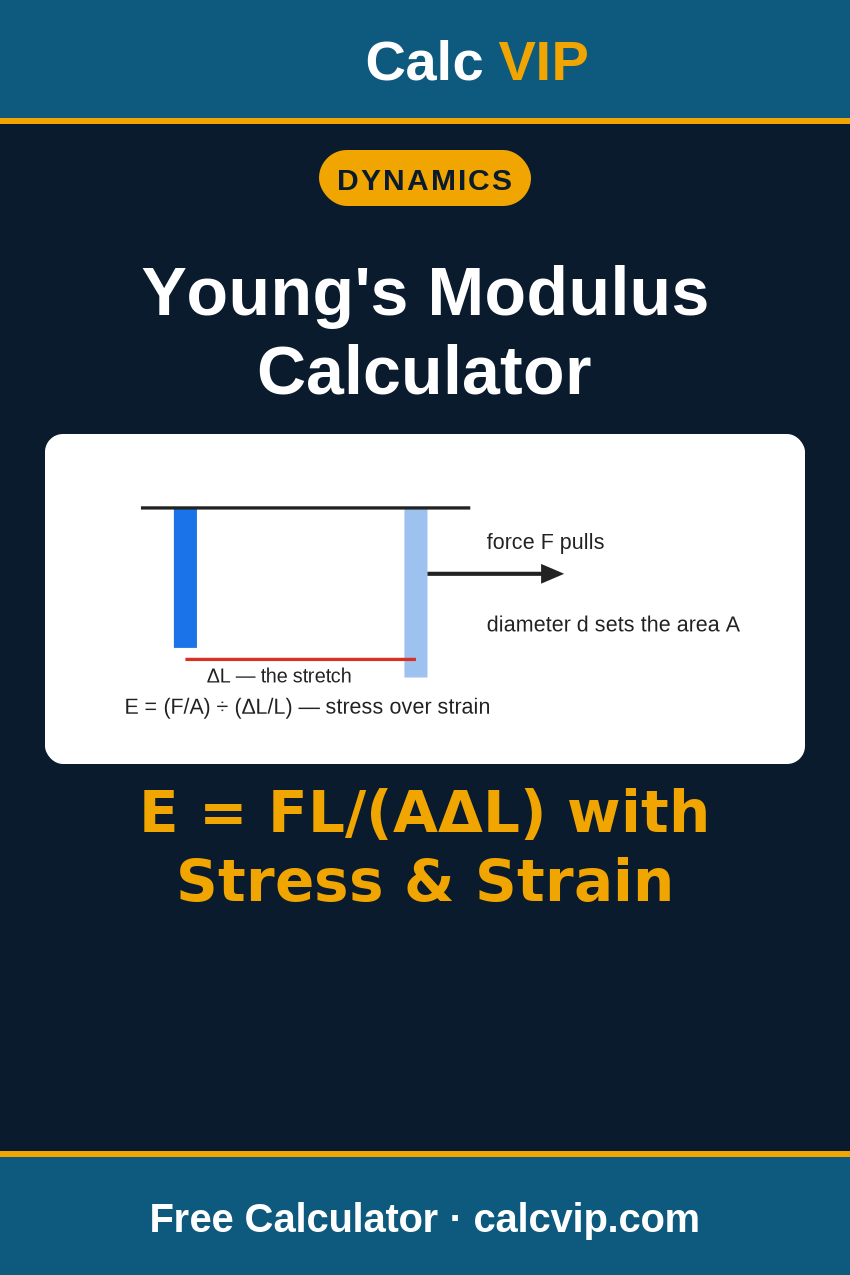
Stress σ = F ÷ A • Strain ε = ΔL ÷ L • E = σ ÷ ε = F × L ÷ (A × ΔL)
with the wire's circular area A = π × (d ÷ 2)². The units conspire kindly: stress in pascals (N/m²), strain dimensionless (a pure ratio), so E emerges in pascals — reported here also in GPa, the unit of the engineering tables. The formula rearranges into the design forms: the stretch a known member will suffer, ΔL = F × L ÷ (A × E), and the force a given stretch implies, F = E × A × ΔL ÷ L. Note where the sensitivity lives: the diameter enters squared, through A — a 5 percent error in measuring a thin wire's diameter becomes a 10 percent error in E, which is why micrometer practice (measure at several points, average, distrust the first reading) dominates the error budget of this experiment.
| Symbol | Meaning | Units |
|---|---|---|
| E | Young's modulus — stiffness of the material | Pa (reported in GPa) |
| F | applied tensile force | N |
| L, ΔL | original length; extension under load | m (ΔL entered in mm) |
| d, A | wire diameter; cross-sectional area π(d/2)² | mm (entered); m² |
| σ, ε | stress F/A; strain ΔL/L | Pa (reported in MPa); dimensionless |
What E really measures: the stiffness of atomic bonds
Pull on a wire and you are, atom by atom, stretching the bonds between its atoms against their electromagnetic springs. Young's modulus is the macroscopic shadow of those microscopic springs — which explains its personality. It barely depends on how the metal was processed: hard-drawn and annealed copper have nearly the same E, because the bonds are the same even when the crystal defects that govern strength have been rearranged wholesale. Strength, hardness and toughness can be engineered over wide ranges by alloying and heat treatment; stiffness mostly cannot — steel is 200 GPa in a paperclip and in a suspension bridge alike. Engineers therefore choose alloys for strength and geometry for stiffness: if a part flexes too much, the fix is a thicker section or a different shape, not a "stronger" steel, because no stronger steel is stiffer.
The values themselves tell a materials story. Diamond, whose carbon bonds form a rigid three-dimensional lattice, tops the chart near 1,100 GPa. Metals cluster at 45–400 GPa, set by their bond energies and atomic spacings. Polymers slump to 0.1–5 GPa because their chains are held by weak intermolecular forces and can uncoil — a mechanism metals do not have. And E falls as temperature rises (bonds soften as atoms vibrate farther apart), a few percent per hundred degrees for steels — the slow sag of a turbine blade's stiffness at working temperature is this effect, budgeted for in every hot-end design.
How to use
- Enter the applied force in newtons (a hanging mass of m kilograms applies m × 9.81 N).
- Enter the wire's original length in metres — the length between the fixed support and the measuring mark, unloaded.
- Enter the diameter in millimetres, measured with a micrometer at several places along the wire and averaged.
- Enter the extension ΔL in millimetres under that force — ideally averaged over loading and unloading runs, which exposes any slip or creep.
- Click "Calculate Young's Modulus" to see the area, stress, strain and E in Pa and GPa; compare with the tables (steel ≈ 200, copper ≈ 120, aluminium ≈ 69 GPa).
Worked examples
Example 1 — the reference wire (steel). F = 100 N, L = 2 m, d = 1 mm, ΔL = 1.27 mm.
A = π × (0.0005)² = 7.854 × 10⁻⁷ m²; stress = 100 ÷ A = 127.3 MPa; strain = 0.00127 ÷ 2 = 6.35 × 10⁻⁴; E = 100 × 2 ÷ (A × 0.00127) = 2.005 × 10¹¹ Pa = 200.5 GPa — steel, textbook-perfect.
Example 2 — a bridge cable in miniature. F = 20,000 N, L = 20 m, d = 10 mm, measured ΔL = 25.5 mm.
A = 7.854 × 10⁻⁵ m²; stress = 254.6 MPa; strain = 1.275 × 10⁻³; E = 1.997 × 10¹¹ Pa = 199.7 GPa. A 20-tonne load stretches a 20-metre steel cable by the width of two fingers — bridge decks ride on arithmetic exactly this size.
Example 3 — copper wire. F = 20 N, L = 1 m, d = 0.5 mm, ΔL = 0.85 mm.
A = 1.963 × 10⁻⁷ m²; stress = 101.9 MPa; strain = 8.50 × 10⁻⁴; E = 1.198 × 10¹¹ Pa = 119.8 GPa — copper's tabulated 120 GPa, recovered from a wire thinner than a pencil lead.
Example 4 — an aluminium rod. F = 5,000 N, L = 0.5 m, d = 5 mm, ΔL = 1.85 mm.
A = 1.963 × 10⁻⁵ m²; stress = 254.6 MPa; strain = 3.70 × 10⁻³; E = 6.882 × 10¹⁰ Pa = 68.8 GPa — aluminium (69 GPa). Note the strain: aluminium's lower stiffness lets it stretch nearly six times farther than steel at the same stress, which aircraft designers must forgive in every flexing wing skin.
Example 5 — a nylon filament. F = 50 N, L = 0.3 m, d = 2 mm, ΔL = 6 mm.
A = 3.142 × 10⁻⁶ m²; stress = 15.9 MPa; strain = 2.00 × 10⁻²; E = 7.958 × 10⁸ Pa = 0.8 GPa. The strain — two whole percent, thirty times the steel examples — is the polymer signature: chains uncoiling and sliding, not bonds stretching, which is why nylon's "modulus" also drifts with time and loading rate in ways a metal's never does.
Example 6 — a guitar string. F = 70 N (a tuned string's tension), L = 0.65 m, d = 0.25 mm, ΔL = 4.6 mm.
A = 4.909 × 10⁻⁸ m²; stress = 1,426 MPa; strain = 7.08 × 10⁻³; E = 2.015 × 10¹¹ Pa = 201.5 GPa — music wire is steel, and lives astonishingly close to its limits: that 1,426 MPa stress is most of the way to the wire's tensile strength, which is why strings snap at the tuning peg and not politely in the middle of the scale.
Young's modulus in real life
Bridges and buildings. Every deflection calculation — how much a beam sags, a floor bounces, a tower sways — runs through E. The numbers in this page's table are the ones in the structural codes; a bridge is, in part, a Young's modulus with a view.
Musical instruments. String pitch depends on tension, length and mass per unit length, but the string's stiffness (E) sets how far pitch bends when a string is pushed sideways, and piano scaling — the choice of wire gauges across the compass — is applied modulus management.
Aircraft and spacecraft. Aluminium's E is a third of steel's at a third of the density — the same stiffness per kilogram — which is the deep reason airframes are aluminium and landing-gear legs (where volume, not weight, is scarce) are steel.
Medical implants and stents. Bone has E ≈ 10–20 GPa; a titanium implant at 110 GPa already shields bone from stress enough to matter ("stress shielding"), driving research into lower-modulus alloys that flex more like the skeleton they join.
Sports equipment. Tennis strings, golf shafts, pole-vault poles and bicycle frames are all stiffness-tuned: the vault pole is a spring whose E and geometry are chosen to store the vaulter's run-up energy and return it as height.
Everyday springs and cables. Lift cables stretch measurably under load (Example 2's arithmetic decides whether the car floor levels correctly), and a climbing rope's dynamic elongation — its life-saving give — is E and construction working together.
Beyond the elastic line: yield, and why the calculator stops there
Plot stress against strain and every metal tells the same three-act story. Act one is the elastic line — slope E, fully reversible. Act two begins at the yield point (about 250 MPa for mild steel, over 1,500 MPa for music wire), where the material starts to deform permanently: unload it now and it keeps a souvenir stretch. Act three is work-hardening, necking and fracture at the tensile strength. The modulus belongs wholly to act one, and the wire experiment is designed to stay inside it — loads are kept to a fraction of yield, and a careful experimenter loads and unloads repeatedly, checking that the extension returns to zero each time. The moment it does not, the measurement is over and the wire has become a specimen of a different science. Knowing where your formula's jurisdiction ends is not a limitation of this calculator; it is the definition of using it correctly.
Quick reference: Young's modulus of common materials
| Material | E (GPa) | Note |
|---|---|---|
| rubber | 0.01–0.1 | strains of hundreds of percent — barely a "modulus" at all |
| nylon | ≈ 0.8–3 | Example 5 measured 0.8 |
| wood (along grain) | ≈ 10–15 | ten times stiffer along the grain than across it |
| bone | ≈ 10–20 | the implant-matching target |
| aluminium | 69 | |
| glass | ≈ 70 | as stiff as aluminium — its weakness is flaws, not stiffness |
| copper | 120 | |
| titanium | ≈ 110 | |
| steel | ≈ 200 | nearly identical for almost all steels |
| tungsten | ≈ 400 | stiffest common metal |
| diamond | ≈ 1,100 | the top of the chart |
The steel row deserves its fame: carbon steel, stainless, spring steel and rail steel all sit within a few percent of 200 GPa, which is why "use a stronger steel" never fixes a flexing part — only more steel, or a cleverer shape, does.
Common mistakes
- Measuring the diameter once, casually. E inherits the diameter's error twice over (A ∝ d²). A 1 mm wire measured as 0.95 mm flatters E by 11 percent. Micrometer, several positions, both axes, average.
- Including the slip and the sag. Extensions measured at the load hanger include knot slip, chuck settling and the straightening of a slightly kinked wire. Preload the wire, cycle it a few times, and measure extension between two marks on the wire itself.
- Loading past the elastic limit. Once the wire yields, ΔL includes permanent deformation and the computed E collapses. Check reversibility: unload, and confirm the wire returns to its original length.
- Confusing stiffness with strength. E says nothing about when the wire breaks. Glass and steel can share a modulus while differing wildly in strength; a high E is not a promise of toughness.
- Unit slips on ΔL and d. The calculator takes d and ΔL in millimetres and L in metres. Feeding ΔL in metres (0.00127) where millimetres are expected shrinks E a thousandfold — an answer in MPa where GPa belong is the tell-tale.
FAQ
What does a high Young's modulus mean?
The material is stiff: it stretches very little under load. Diamond (~1050 GPa) and steel (~200 GPa) are stiff; rubber (~0.05 GPa) is not. E depends on the material, not on the wire's size — a thicker steel wire stretches less because of its area, but its E is the same.
Why must the extension be measured so carefully?
Extensions are tiny — often around a millimetre over metres of wire — so experiments use a travelling microscope, a vernier scale or a long optical lever. A small error in ΔL becomes a large error in E, because E is inversely proportional to ΔL.
When does the formula stop working?
Young's modulus is defined only in the elastic region, where the wire returns to its original length when unloaded. Beyond the elastic limit the wire deforms permanently and eventually reaches its breaking stress.
Why is Young's modulus the same for all steels?
Because it is set by the iron atoms' bonds, which alloying barely disturbs: carbon and chromium change how dislocations move (strength, hardness) far more than how bonds stretch. Steels span 190–210 GPa — a ±5 percent family, against strengths that vary fivefold.
Can E be measured by bending instead of stretching?
Yes — a beam's deflection under a known load yields the same E (the basis of many school experiments and of the resonant "ping" test: a bar's ringing frequency is set by √(E/ρ), which is how turbine blades are batch-tested without breaking any).
What is the speed of sound in a rod, in terms of E?
v = √(E ÷ ρ). For steel: √(2 × 10¹¹ ÷ 7,850) ≈ 5,050 m/s — the speed at which a hammer's message travels down a rail, and the reason you can hear a distant train through the track before through the air.
Does a thicker wire have a higher Young's modulus?
No — thickness changes the wire's stiffness (how much it stretches under a given force) but not the material's modulus, because E is built from stress and strain, both of which already divide the geometry out. That division is the entire point of the quantity.
Why do polymers creep while metals (mostly) do not?
Polymer chains slide past one another over time under load, so the strain keeps growing — the measured "modulus" depends on how long the load has been applied. Metals at room temperature keep their dislocations pinned; creep in metals is a high-temperature phenomenon, and a design driver in turbines precisely because it appears there.
What does a negative or absurd E in my result mean?
A unit slip (ΔL or d in the wrong unit), a slipped measurement, or a wire that yielded. Genuine materials span 0.01 GPa (rubber) to 1,100 GPa (diamond); an answer outside that range is the experiment confessing, and the confession should be believed.
Who was Young?
Thomas Young (1773–1829) — physician, physicist and decipherer of hieroglyphs — who also established the wave theory of light's interference pattern. The modulus appeared in his 1807 lectures, defined in words rather than symbols; the crisp E = stress ÷ strain form came later, but the idea, and the name, are his.