 Calc
Apparent Weight Calculator – Elevator Weight m(g ± a)
 Created by James Carter · Physics Writer · Forces & Motion · Last updated: November 2026
Use this free Apparent Weight Calculator to find what a scale would read for a person in an accelerating lift. Enter the mass, the lift's acceleration and its direction, and the calculator returns the apparent weight in newtons and the equivalent scale reading in kilograms.
Stand on a bathroom scale in a lift and watch the display as the lift starts and stops: the number climbs when the lift surges upwards, dips when it sinks, and settles at the truth only while the lift cruises or stands still. Your mass never changes, and neither does gravity's pull on you. What changes is the floor's push — the normal force — and that push, not gravity, is what a scale measures and what your body feels as weight. The name for the push in an accelerating setting is apparent weight.
The rule is one line: apparent weight W = m(g + a) when the acceleration points up, and W = m(g − a) when it points down. A lift accelerating up at 2 m/s² makes every kilogram of you about 20% heavier to its floor; accelerating down at the same rate makes you 20% lighter; and at the limit — a = g downwards, free fall — the floor's push vanishes altogether and apparent weight is zero. Weightlessness is not the absence of gravity; it is the absence of anything pushing back.
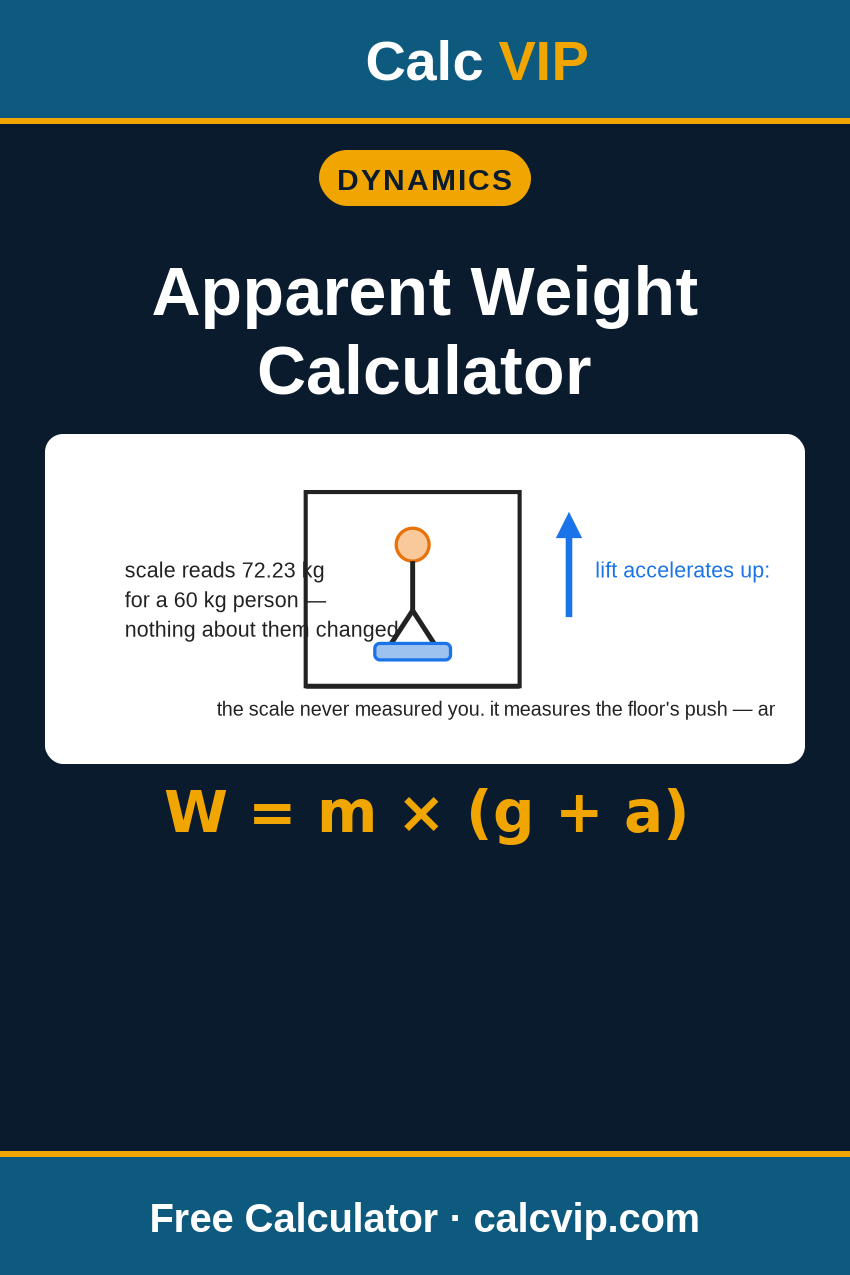
This calculator takes mass, acceleration, direction and g, and returns both the apparent weight in newtons and the friendlier number — what a scale would display, in kilograms. It is the fastest way to make lift rides, rollercoasters and rocket launches quantitatively honest.
Formula
Accelerating up: W = m × (g + a) • Accelerating down: W = m × (g − a) • Free fall (a = g down): W = 0 • Scale reading = W ÷ g
The formula is Newton's Second Law solved for the floor's push. Standing in a lift, two forces act on you: gravity mg downwards and the floor's normal force N upwards. If the lift accelerates up at a, the net force must be ma upwards, so N − mg = ma, giving N = m(g + a) — and N is the apparent weight, the force the scale's spring actually feels. Accelerating down flips the sign of the required net force and N = m(g − a). The scale-reading conversion simply asks "what mass would produce this force at rest on Earth?" — W ÷ g — which is why the display is in kilograms even though no mass changed. Rearranged, the formula also yields the acceleration from a scale's behaviour: a = W ÷ m − g, the trick behind measuring lift acceleration with a bathroom scale and a phone camera.
| Symbol | Meaning | Units |
|---|---|---|
| W | apparent weight — the supporting force (normal force) | newtons (N) |
| m | mass of the person or object (unchanged) | kilograms (kg) |
| a | acceleration of the lift / vehicle | m/s² |
| g | gravitational field strength (Earth ≈ 9.81) | m/s² |
You never feel gravity — you feel the floor
Here is the deepest fact on this page: the human body cannot sense gravity directly. What you sense, moment to moment, is the compression of your tissues by surfaces pushing on them — the floor through your feet, the chair through your back. In free fall, gravity acts on every atom of you equally and nothing compresses anything, so you feel nothing at all: weightlessness, even though gravity is nearly as strong in orbit as on the ground. Standing still, the floor compresses you from below at exactly mg, and you call that feeling "weight". A lift accelerating upwards compresses you harder; the extra squeeze is the apparent weight gain, and it is indistinguishable — by your body, by a scale, by any experiment inside the lift — from gravity itself having strengthened.
Einstein built general relativity on that indistinguishability. His "happiest thought" was that a person in free fall does not feel their own weight, and that a closed room accelerating in deep space at 9.81 m/s² is, from inside, a room standing on Earth. Apparent weight is the everyday face of the equivalence principle: acceleration and gravity produce the same local physics. The lift in a tower block is thus a relativity demonstration you ride daily — heavier as it launches you up (acceleration imitating stronger gravity), lighter as it drops (acceleration cancelling gravity), honest only in between.
Notice, too, that direction of motion is irrelevant — only acceleration matters. A lift moving up but slowing down (accelerating downwards) makes you lighter, even as you rise; a lift moving down but braking (accelerating upwards) makes you heavier, even as you descend. The four combinations confuse everyone once; the formula never confuses them at all, because it asks only: which way is a?
A final subtlety separates the careful from the confused: the acceleration in the formula is the acceleration of the person, which in a lift is the lift's acceleration only while contact holds. Jump inside a lift — briefly airborne — and your apparent weight is zero mid-jump whatever the lift is doing, because nothing supports you. Land, and the floor must not only resume supporting you but also cancel your downward velocity, producing a spike of apparent weight well above m(g + a) for a fraction of a second. Every landing, from a parachutist's flare to a cat's drop onto a windowsill, contains that spike; knees, ankles and undercarriages are all, in the end, spike-management devices.
How to use
- Enter the mass in kilograms.
- Enter the lift's acceleration in m/s² (a brisk lift: 1–2 m/s²; a rocket: 20–30 m/s²).
- Choose the direction of the acceleration — upwards (feel heavier) or downwards (feel lighter). Remember: a lift rising but slowing down is accelerating downwards.
- Click "Calculate" for the apparent weight in newtons and the scale reading in kilograms, alongside the true weight for comparison.
Worked examples
Example 1 — the standard lift ride. A 60 kg person, true weight 60 × 9.81 = 588.6 N, in a lift accelerating at 2 m/s².
Upwards: W = 60 × (9.81 + 2) = 60 × 11.81 = 708.6 N — the scale reads 708.6 ÷ 9.81 = 72.23 kg.
Downwards: W = 60 × (9.81 − 2) = 60 × 7.81 = 468.6 N — the scale reads 47.77 kg.
A 24.5 kg swing in the display, from a mass that never varied by a gram. The knees, which are excellent force meters, report the same numbers qualitatively.
Example 2 — a heavier passenger, a brisker lift. An 80 kg person in a lift accelerating at 3 m/s²: upwards, W = 80 × 12.81 = 1,024.8 N (scale: 104.46 kg); downwards, W = 80 × 6.81 = 544.8 N (scale: 55.54 kg). The percentage change is the same as Example 1's — a ÷ g ≈ 31% — because apparent weight scales with mass; the proportion belongs to the lift, the size to the passenger.
Example 3 — the rocket launch. A 70 kg astronaut accelerating upwards at 25 m/s²: W = 70 × (9.81 + 25) = 70 × 34.81 = 2,436.7 N — an apparent weight 3.55 times the true 686.7 N, conventionally quoted as "3.55 g". Astronaut couches are moulded and reclined precisely to spread this multiplied push across the back, where the body tolerates it best; the same acceleration eyeballs-forward would be dangerous at half the size.
Example 4 — the broken cable (thought experiment). Let the lift fall freely: a = 9.81 m/s² downwards. W = 60 × (9.81 − 9.81) = 0 N. The scale reads zero, a dropped pen hovers, and the passenger floats — for exactly as long as the fall lasts. This is the astronauts' condition, achieved not by escaping gravity but by falling with it, and it is why the thought experiment matters more than its drama suggests.
Example 5 — half-weight. A 60 kg person in a lift accelerating downwards at 4.905 m/s² — exactly g/2: W = 60 × (9.81 − 4.905) = 60 × 4.905 = 294.3 N, half the true weight, scale reading 30 kg. Parabolic-flight aircraft use precisely this dial: fly a downward arc at partial g and passengers get Moon-weight or Mars-weight rehearsals, 20 seconds at a time.
Example 6 — the child in the descending lift. A 50 kg child in a lift accelerating downwards at 1.2 m/s²: W = 50 × (9.81 − 1.2) = 50 × 8.61 = 430.5 N, scale reading 430.5 ÷ 9.81 = 43.88 kg. The 6 kg "loss" is why descending lifts make stomachs float — the floor is retreating from the feet almost as fast as gravity can follow, and the body's compression gauge notices immediately.
Apparent weight in real life
Lift engineering. Cables, motors and brakes are specified from apparent weights, not true ones: a lift rated for 800 kg must haul m(g + a) at every start and survive m(g − a) unloading at every stop. The tension calculator and this one are the same physics read from opposite ends of the cable.
Rollercoasters. The industry's "g-force" is apparent weight divided by true weight. Airtime hills are engineered downward accelerations — apparent weight near zero, riders floating against their restraints; the bottoms of drops run 3–4 g apparent, pressing riders into seats exactly as the rocket couch does, briefly and for fun.
Astronaut training. Centrifuges reproduce launch apparent weights by rotation; parabolic flights reproduce weightlessness and partial g by falling along precise arcs. Both are apparent-weight machines — one turns the (g + a) dial up, the other turns (g − a) down to zero.
Weighing things that move. Truck scales, crane load cells and aircraft weight systems all read apparent weight, so all are fooled by acceleration: a crane's load cell over-reads as the load starts rising and under-reads as it stops. Operators who know the formula wait for steady motion before trusting the display.
The car over the crest. Driving fast over a hump-backed bridge is a downward-acceleration episode: apparent weight falls, stomachs lift, and at the extreme the tyres' normal force — the road's version of apparent weight — falls enough to cut steering grip. The sensation and the safety issue are one formula.
Bathroom-scale experiments. The scale-in-a-lift is a classic home experiment because the apparatus is free and the result is startling: film the display through a ride and you have measured the lift's acceleration profile, start surge and braking dip included, with a device designed for weighing potatoes.
Weightlessness is falling, not floating
The International Space Station orbits at an altitude where gravity is still about 8.7 m/s² — 89% of its surface value — yet its crew floats. The resolution is Example 4 scaled up: the station and everything in it are in continuous free fall around the Earth, so no surface inside needs to push on anything, and apparent weight is zero everywhere aboard. "Microgravity" is the engineers' honest term: tiny residual accelerations — drag, vibrations, the station's own rotation — leave apparent weights around a millionth of mg, small enough for crystal-growing and fluid experiments that floors would ruin. Whenever weightlessness appears in technology or physiology, look for the free fall underneath it; there is always one.
Quick reference: a 60 kg person's apparent weight
| Acceleration | Apparent weight | Scale reads |
|---|---|---|
| 9.81 m/s² down (free fall) | 0 N | 0 kg |
| 2 m/s² down | 468.6 N | 47.77 kg |
| 0 (rest or steady speed) | 588.6 N | 60 kg |
| 2 m/s² up | 708.6 N | 72.23 kg |
| 9.81 m/s² up ("2 g total") | 1,177.2 N | 120 kg |
| 25 m/s² up (rocket) | 2,088.6 N | 212.9 kg |
Read the scale column as "the mass the floor believes in". For the rocket row, a 60 kg person is briefly a 212.9 kg problem for the couch — which is why launches are flown lying down. The table also exposes the symmetry that makes the topic click: equal and opposite accelerations around the steady row produce equal and opposite changes in apparent weight, ±120 N for every ±2 m/s² at this mass. Apparent weight is true weight plus an acceleration surcharge, and the surcharge — m × a, signed — is the entire content of the subject.
Common mistakes
- Using the direction of motion instead of acceleration. Rising-but-slowing means accelerating downwards (lighter); sinking-but-braking means accelerating upwards (heavier). Ask what the velocity is doing, not where it points.
- Saying mass or gravity changed. Neither did. Only the supporting force changed. Apparent weight is a statement about floors and seats, not about the person or the planet.
- Forgetting the steady phases. At constant velocity — even fast upward velocity — a = 0 and apparent weight equals true weight. Most of a long lift ride is spent at the honest reading.
- Allowing negative apparent weight. If a downward acceleration exceeded g, the formula would go negative — but a floor cannot pull you down; you would simply leave it and free-fall at g. The floor's push bottoms out at zero.
- Mixing up the scale reading with mass. The kilogram figure on the scale is W ÷ g — a force wearing mass's clothing. On another planet the same trick misreports differently, as the planets calculator on this site shows.
FAQ
Does my mass change in a lift?
No. Your mass stays the same; only the normal force from the floor (which the scale measures) changes, and that is what you feel as weight.
What if the lift cable breaks?
Then the lift free-falls with a = g downwards, so W = m(g − g) = 0 — complete weightlessness, exactly like astronauts in orbit.
What about a lift moving at constant speed?
With no acceleration, a = 0 and the apparent weight equals the true weight mg, whether the lift moves up or down.
What is the difference between weight and apparent weight?
True weight is gravity's pull, mg, and changes only with mass or planet. Apparent weight is the support force — what surfaces push back with and scales measure — and it changes with acceleration. On a still floor the two coincide, which is why everyday language merges them.
Why do I feel heavier when the lift starts, but normal while it rises?
Because only the start involves acceleration. Once the lift reaches cruising speed, a = 0, the floor's push returns to mg, and the feeling normalises — until braking at the top gives you the opposite episode.
Can apparent weight be greater than twice the true weight?
Yes — whenever the upward acceleration exceeds g. Fighter pilots in hard turns and launches sustain 3–9 g of apparent weight; the body's limit, not the formula's, is what intervenes, as blood drainage towards the feet starves the brain.
Do astronauts on the ISS have no weight?
They have nearly full true weight — Earth's gravity up there is about 89% of surface strength — but zero apparent weight, because they and their station fall together continuously. The distinction is this entire page, orbiting.
Would a scale work on a trampoline bounce?
It would tell a wild story: enormous apparent weight at the bottom of the bounce (the mat decelerates you upward), zero at the top of the flight (free fall). Averaged over a full bounce, the readings return to mg — the mat must, on average, support your weight.
How do pilots and drivers quote "g-force"?
As apparent weight ÷ true weight, (g ± a) ÷ g. It is a ratio of support forces, which is why it can be measured by an accelerometer — a tiny internal scale — and why it is felt identically whether produced by acceleration or by an actual change in gravity.
Does apparent weight apply horizontally?
The same principle: accelerating cars press you into the seat back with m × a — a sideways "apparent weight" your back feels. The lift formula is the vertical case of a general truth: support forces always equal m × (field − acceleration), in whatever direction you examine.