 Calc
Uncertainty Principle Calculator – Δx from Δp (Heisenberg)
 Created by Yuki Tanaka · Physics Editor · Modern Physics · Last updated: November 2026
Use this free Heisenberg Uncertainty Principle Calculator to find the minimum position uncertainty Δx of a particle from its momentum uncertainty Δp. You can also work with a classic textbook case: an electron whose speed is known only within a range Δv.
The two quantities in the principle are spreads, not mistakes. Δx is the spread of results you get when you measure the position of many identically prepared particles; Δp is the same kind of spread for momentum. Heisenberg's discovery of 1927 is that these two spreads are chained together: their product can never fall below ħ/2, a floor set by Planck's constant. Squeeze one spread down and the other is forced up, exactly as if the particle were a wave packet — which, at this scale, it is. A tightly localised packet is built from a wide mixture of wavelengths, and wavelength is momentum (p = h/λ), so a narrow packet automatically carries a wide spread of momenta.
This calculator works at the boundary of what nature permits: it gives the smallest position uncertainty compatible with a stated momentum uncertainty, Δx = ħ/(2Δp). Real experiments always land above the line, never below it. The second mode does the same job for the classic textbook setup — an electron whose speed is known only to within Δv — by first converting the speed spread into a momentum spread with Δp = meΔv.
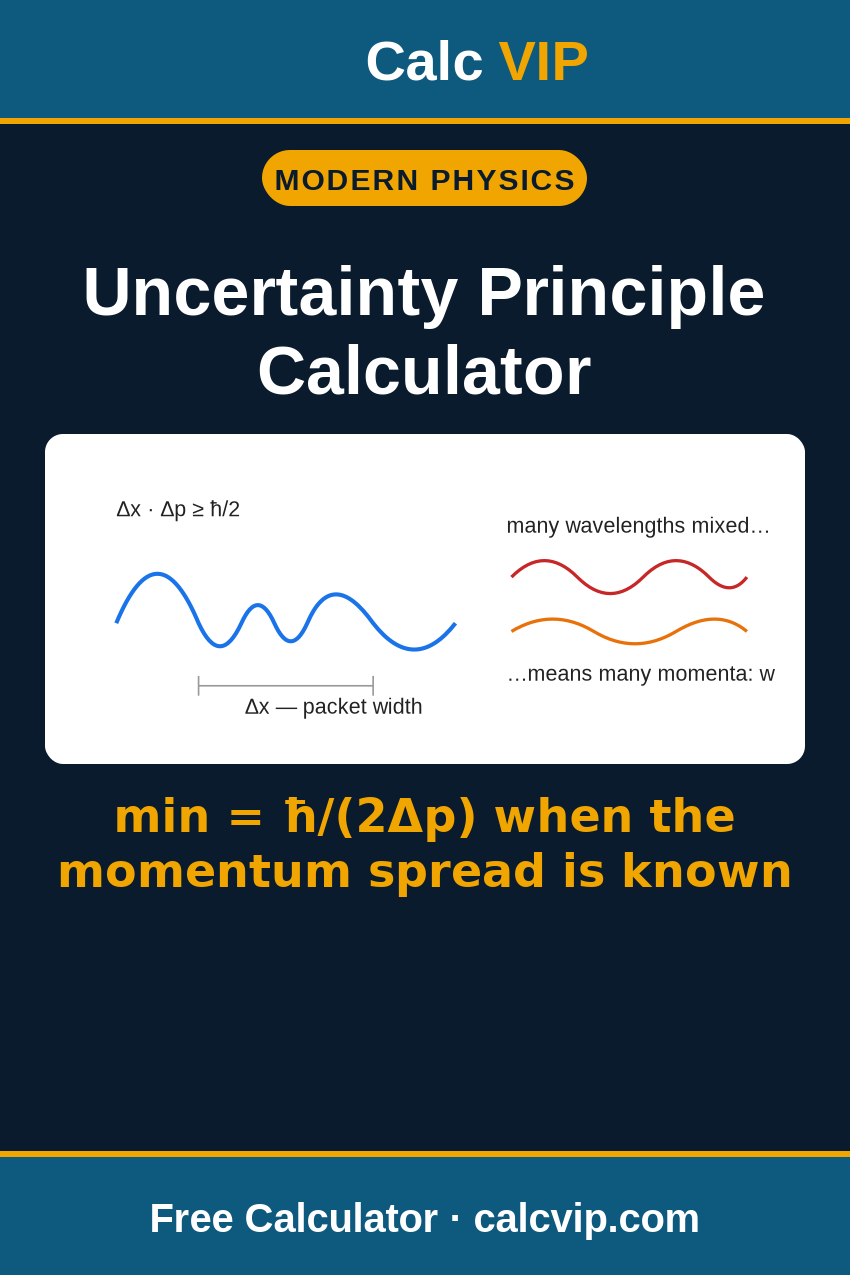
The reason you have never noticed any of this is the size of ħ: 1.055 × 10⁻³⁴ J·s is so small that for anything heavier than an atom the allowed uncertainties are buried far beneath any conceivable measurement. The principle only steps into view where masses are tiny and distances are atomic — inside atoms, microscopes, lasers and quantum devices — which is precisely where this calculator's answers, in metres and nanometres, become the numbers that design real instruments.
Formula
Heisenberg uncertainty principle: Δx · Δp ≥ ħ/2, with ħ = 1.055 × 10⁻³⁴ J·s. The calculator evaluates the limiting case, and the formula rearranges three useful ways: Δxmin = ħ/(2Δp) when the momentum spread is known, Δpmin = ħ/(2Δx) when the position spread is known, and — for the electron mode — Δxmin = ħ/(2meΔv) after substituting Δp = meΔv with me = 9.11 × 10⁻³¹ kg. Note the constant is ħ (h divided by 2π), not h itself: using h by mistake inflates every answer by a factor of 2π ≈ 6.28. The units police themselves: ħ carries J·s = kg·m²/s, so dividing by Δp (kg·m/s) leaves metres, as a position uncertainty must.
| Symbol | Meaning | Units |
|---|---|---|
| Δx | position uncertainty (spread of position measurements) | m (often nm) |
| Δp | momentum uncertainty (spread of momentum measurements) | kg·m/s |
| ħ | reduced Planck constant, h/2π = 1.055 × 10⁻³⁴ | J·s |
| Δv | speed uncertainty of the particle | m/s |
| me | electron mass, 9.11 × 10⁻³¹ | kg |
Not clumsiness — the particle does not possess both values
The most stubborn misunderstanding of this principle is to read it as a complaint about instruments: that the particle has an exact position and momentum, and our clumsy probes merely fail to read them. Quantum mechanics says something stronger and stranger. A particle prepared with a sharply defined momentum is described by a wave of one wavelength stretching through all space — its position is not unknown-but-exact, it is genuinely spread out. Conversely, a particle pinned to a tiny region is a packet built from many wavelengths at once, so its momentum is genuinely a range, not a hidden single value. The uncertainties are properties of the state itself, which is why no improvement in apparatus — not in 1927, not ever — can push the product below ħ/2.
Heisenberg's own illustration was a microscope: to locate an electron you must bounce light off it, and light fine enough to pin the position (short wavelength) carries momentum large enough to kick the electron unpredictably. The modern view keeps the moral but drops the machinery — even a perfectly gentle, idealised measurement faces the same wall, because the wall is in the mathematics of waves. Anything that behaves as a wave obeys a bandwidth theorem like this one: a short pulse of sound cannot have a pure pitch, and a particle cannot have a short "pulse" of position and a pure momentum either. The uncertainty principle is the wave nature of matter, stated as an accounting rule.
How to use
- Choose whether you know Δp directly, or the speed uncertainty Δv of an electron.
- Enter the value — scientific notation such as 1e-24 is accepted for Δp.
- Click "Calculate Δx" to get the minimum position uncertainty in metres and nanometres.
- Read the answer as a floor, not a forecast: the true spread in any real experiment is this size or larger, never smaller.
Worked examples
Example 1 — the textbook momentum spread. A particle's momentum is uncertain by Δp = 1 × 10⁻²⁴ kg·m/s.
Δx = ħ/(2Δp) = 1.055 × 10⁻³⁴ / (2 × 10⁻²⁴) = 5.28 × 10⁻¹¹ m = 0.053 nm. Even with momentum known that loosely, position cannot be pinned tighter than about half an atom's width.
Example 2 — an electron with a fuzzy speed. An electron's speed is known only within Δv = 1 × 10⁵ m/s.
Δp = meΔv = 9.11 × 10⁻³¹ × 10⁵ = 9.11 × 10⁻²⁶ kg·m/s, so Δx = 1.055 × 10⁻³⁴ / (2 × 9.11 × 10⁻²⁶) = 5.79 × 10⁻¹⁰ m = 0.579 nm — the electron is smeared over several atomic diameters.
Example 3 — running the formula backwards. How well must an electron's speed be known if it is localised to Δx = 0.1 nm (one atomic width)?
Δp ≥ ħ/(2Δx) = 1.055 × 10⁻³⁴ / (2 × 10⁻¹⁰) = 5.28 × 10⁻²⁵ kg·m/s, so Δv = Δp/me = 5.79 × 10⁵ m/s. Confining an electron to an atom forces its speed to be uncertain by hundreds of kilometres per second.
Example 4 — a proton instead. A proton's speed is known within Δv = 1 × 10³ m/s.
Δp = 1.673 × 10⁻²⁷ × 10³ = 1.673 × 10⁻²⁴ kg·m/s, giving Δx = 1.055 × 10⁻³⁴ / (2 × 1.673 × 10⁻²⁴) = 3.15 × 10⁻¹¹ m. The proton's larger mass buys a tighter position for the same speed spread — mass is uncertainty's enemy.
Example 5 — a dust grain. A dust particle of mass 10⁻¹² kg drifts with speed known within Δv = 1 mm/s.
Δp = 10⁻¹² × 10⁻³ = 10⁻¹⁵ kg·m/s, so Δx = 1.055 × 10⁻³⁴ / (2 × 10⁻¹⁵) = 5.28 × 10⁻²⁰ m — a hundred-millionth of an atom's width. Quantum fuzziness is already irrelevant for dust.
Example 6 — a baseball. A 0.145 kg baseball's speed is measured to within 1 mm/s.
Δp = 0.145 × 10⁻³ = 1.45 × 10⁻⁴ kg·m/s, so Δx = 1.055 × 10⁻³⁴ / (2 × 1.45 × 10⁻⁴) = 3.64 × 10⁻³¹ m. The ball's position is uncertain by vastly less than the size of a proton — which is why the everyday world looks sharp-edged and classical.
The uncertainty principle in real life
Why atoms do not collapse. If an electron sat still at the nucleus, Δx would be tiny and Δp enormous, and its kinetic energy would soar. Squeezing an electron into the Bohr radius (Δx ≈ 5.3 × 10⁻¹¹ m) already forces Δp ≥ 9.95 × 10⁻²⁵ kg·m/s, a kinetic energy of roughly 3.4 eV — the right ballpark for hydrogen's actual 13.6 eV binding. Atoms are stable because uncertainty makes total confinement too expensive.
Electron microscope design. Imaging finer detail means localising electrons more tightly at the specimen, which by this formula spreads their momenta — and blurs the image from the other side. Microscope optics are a negotiated settlement with ħ.
Spectral linewidths. Atoms hold excited states only briefly, and the energy–time cousin of this principle (below) smears the emitted light over a range of frequencies. Every spectral line has a natural width that no spectrometer can sharpen away.
Quantum computing. Trapped-ion and superconducting qubits live exactly in the regime where Δx and Δp of single particles are engineered quantities; the ground-state spread of a trapped ion is set by this same ħ/2 product.
Gravitational-wave detectors. LIGO's mirrors are massive, yet at its sensitivity the uncertainty principle's quantum noise is a real design limit — beaten only by injecting "squeezed" light that trades Δx against Δp deliberately.
Semiconductor nanostructures. In quantum dots a few nanometres across, confinement spreads the electron's momentum and pushes its energy levels apart — the effect that tunes the colour of quantum-dot displays.
The energy–time version: ΔE · Δt ≥ ħ/2
The same trade-off pairs energy with time. A state that exists only for a short lifetime Δt cannot have a sharply defined energy: its energy is spread by at least ΔE = ħ/(2Δt). Take an atomic excited state living Δt = 10 ns (10⁻⁸ s): ΔE = 1.055 × 10⁻³⁴ / (2 × 10⁻⁸) = 5.28 × 10⁻²⁷ J ≈ 3.3 × 10⁻⁸ eV, and the light it emits is smeared over Δf = ΔE/h ≈ 8 × 10⁶ Hz — about 8 MHz of unavoidable linewidth. Particle physicists use the identical arithmetic in reverse: the measured energy width of a short-lived particle reveals its lifetime, which is how the lifetimes of particles that decay in 10⁻²³ s are "measured" at all.
Quick reference: momentum spread versus position spread
| Δp (kg·m/s) | Minimum Δx | Scale |
|---|---|---|
| 10⁻²⁰ | 5.28 × 10⁻¹⁵ m | a few proton widths |
| 10⁻²² | 5.28 × 10⁻¹³ m | inside an atomic nucleus |
| 10⁻²⁴ | 5.28 × 10⁻¹¹ m = 0.053 nm | about one atom |
| 10⁻²⁶ | 5.28 × 10⁻⁹ m = 5.28 nm | a small virus |
| 10⁻²⁸ | 5.28 × 10⁻⁷ m | a bacterium |
| 10⁻³⁰ | 5.28 × 10⁻⁵ m | a hair's width |
For an electron specifically, the speed spread maps onto position spread just as steeply: Δv = 10⁴ m/s allows Δx = 5.79 nm, Δv = 10⁵ m/s allows 0.579 nm, and Δv = 10⁶ m/s allows only 0.058 nm. Every factor of ten in one spread buys — or costs — a factor of ten in the other.
The principle caught in the act: diffraction through a slit
The uncertainty principle is not only a formula — you can watch it operate in the oldest wave experiment there is. Send the 100 V electrons of the companion calculator (λ = 0.123 nm) through a slit of width a = 0.5 µm. Passing the slit localises each electron to Δx ≈ a = 5 × 10⁻⁷ m. But a wave through a slit diffracts, spreading into a fan of half-angle θ ≈ λ/a = 0.123 × 10⁻⁹/(0.5 × 10⁻⁶) ≈ 2.45 × 10⁻⁴ rad. The electron's momentum, originally all forward, acquires a sideways component spread of order Δp ≈ p × θ = (h/λ) × (λ/a) = h/a. Multiply the two spreads: Δx × Δp ≈ a × (h/a) = h — the slit width cancels, and the product lands at h, a factor of about 12.6 above the ħ/2 floor (the exact bound depends on how the spreads are defined, but the order of magnitude is the principle's signature). Narrower slit, better position, worse momentum: the trade is not a defect of the apparatus but the wave nature of the electron, invoiced at the slit.
Heisenberg's microscope, made quantitative, tells the same story. Image an electron with 100 nm ultraviolet light and you localise it to roughly the wavelength, Δx ~ 100 nm; but the imaging photon carries momentum h/λ = 6.63 × 10⁻²⁷ kg·m/s, and its recoil kicks the electron's speed by up to Δv = 6.63 × 10⁻²⁷/9.11 × 10⁻³¹ ≈ 7,270 m/s in an unknown direction. Use shorter light for a sharper position and the kick grows in exact proportion — the microscope and the formula are the same statement in different clothing, which is why modern treatments derive the principle from wave mathematics rather than from kicks: the kicks are a symptom, the wave is the cause.
Squeezed states: obeying the law while bending its shape
The principle fixes only the product Δx·Δp, not the individual factors — and that loophole is a technology. A squeezed state deliberately inflates one uncertainty to shrink the other below the symmetric split, keeping the product at ħ/2. Gravitational-wave detectors exploit this in the position–momentum's optical cousins: LIGO injects squeezed vacuum light into its interferometers, reducing the quantum noise in the measured quadrature at the price of more noise in the unmeasured one, and gains real sensitivity to ripples in spacetime. Laser cooling and precision atomic clocks use related redistributions. None of this evades Heisenberg — the product never dips below ħ/2 — but it demonstrates that the principle is a budget constraint, not a pair of individual limits, and that clever physics spends the budget where it matters.
Common mistakes
- Reading Δx as the exact error. The formula returns the minimum possible spread. Real measurements are worse, never better; quoting ħ/(2Δp) as "the" uncertainty overstates your precision.
- Using h instead of ħ. The principle is written with ħ = h/2π. Substituting h = 6.626 × 10⁻³⁴ inflates Δx by 2π ≈ 6.28 — the single most common arithmetic slip with this calculator.
- Blaming the instruments. Better apparatus cannot beat the limit, because the particle does not possess exact position and momentum simultaneously. It is a property of the state, not of the laboratory.
- Forgetting the mass in Δp = mΔv. The same Δv gives wildly different Δx for an electron and a proton (Examples 2 and 4). The electron mode of this calculator uses me; for other particles, convert Δv with their own mass first.
- Expecting visible effects for big objects. For dust grains and baseballs Δx collapses to 10⁻²⁰ m and below. If a "quantum uncertainty" claim involves everyday objects moving perceptibly, the numbers have gone wrong somewhere.
FAQ
Does the uncertainty principle mean our instruments are just not good enough?
No. The uncertainty is built into nature itself: a particle simply does not have an exact position and an exact momentum at the same time, no matter how perfect the measuring device is.
Why don't we notice this for everyday objects?
ħ is extremely small, so for a cricket ball or a car the allowed uncertainties are far below anything measurable. The effect only matters at atomic scales.
Is Δx the exact position error?
No — the formula gives the MINIMUM possible uncertainty. The real uncertainty in any experiment can be larger, but never smaller than ħ/(2Δp).
What is ħ, and how is it related to h?
ħ ("h-bar") is the reduced Planck constant, ħ = h/2π = 1.055 × 10⁻³⁴ J·s, built from Planck's constant h = 6.626 × 10⁻³⁴ J·s. The uncertainty principle is conventionally written with ħ because wave mathematics naturally produces the 2π.
Can Δx ever be exactly zero?
No. Δx = 0 would demand Δp = infinity — a particle with completely unlimited momentum spread, requiring unlimited energy. States can approach sharp position, but only at the price of an ever-wider momentum spread.
Is there an uncertainty relation for energy and time too?
Yes: ΔE · Δt ≥ ħ/2. It is why short-lived excited states emit spectrally broad lines and why the masses of very short-lived particles are measured as widths rather than sharp values.
Why doesn't the electron just fall into the nucleus?
Because confinement is expensive. Localising the electron to nuclear size (Δx ~ 10⁻¹⁴ m) would force Δp so large that its kinetic energy would vastly exceed the electrical attraction. The atom settles at the size where the uncertainty cost balances the pull — that balance is the atom's radius.
Does the uncertainty principle limit electron microscopes?
It is one of their fundamental limits. Resolving a feature means localising the probing electron to about that feature's size; the momentum spread that follows scatters the beam and blurs the image, alongside the de Broglie wavelength limit.
Does it apply to photons as well?
Yes. A photon confined to a small region — by a narrow slit, for instance — emerges with a spread of momenta, which is exactly the spreading seen in single-slit diffraction. The relation Δx · Δp ≥ ħ/2 holds for light just as for matter.
Is uncertainty the same as measurement disturbance?
They are related but not identical. Measurement does disturb a quantum system, but the ħ/2 floor exists in the prepared state before anyone measures anything: identically prepared particles genuinely give a spread of results, and that spread is what the principle bounds.