 Calc
Wien's Law Calculator – Peak Wavelength & Temperature of a Blackbody
 Created by Yuki Tanaka · Physics Editor · Modern Physics · Last updated: November 2026
Use this free Wien's Law Calculator to find the peak emission wavelength λmax of a hot object from its temperature — or work backwards and find the temperature from the peak wavelength. This is how astronomers measure the temperature of stars from their colour.
Everything warm glows — not metaphorically but literally, across a broad hump of wavelengths whose summit sits at one special wavelength, λmax. Wien's displacement law says that summit moves in strict inverse proportion to temperature: λmax × T = b, with b = 2.898 × 10⁻³ m·K. Double the absolute temperature and the peak halves its wavelength. This calculator runs the law in both directions — temperature to peak wavelength, or peak wavelength back to temperature — which makes it, in effect, a thermometer that works on anything glowing, from a furnace to a star, without touching it.
The law is one face of the blackbody spectrum, the universal glow curve Planck's quantum theory first explained. A blackbody at temperature T emits at every wavelength, but the emission rises steeply from zero, crests at λmax, and tails away slowly toward longer wavelengths. Wien's constant b is not a separate empirical fudge: it falls out of Planck's law as the solution of a maximisation, b = hc/(4.965 k) with k Boltzmann's constant — the 4.965 is a pure number the calculus supplies. Measure the peak and you have the temperature; that is the entire operating principle of the radiation pyrometer and of stellar temperature classification.
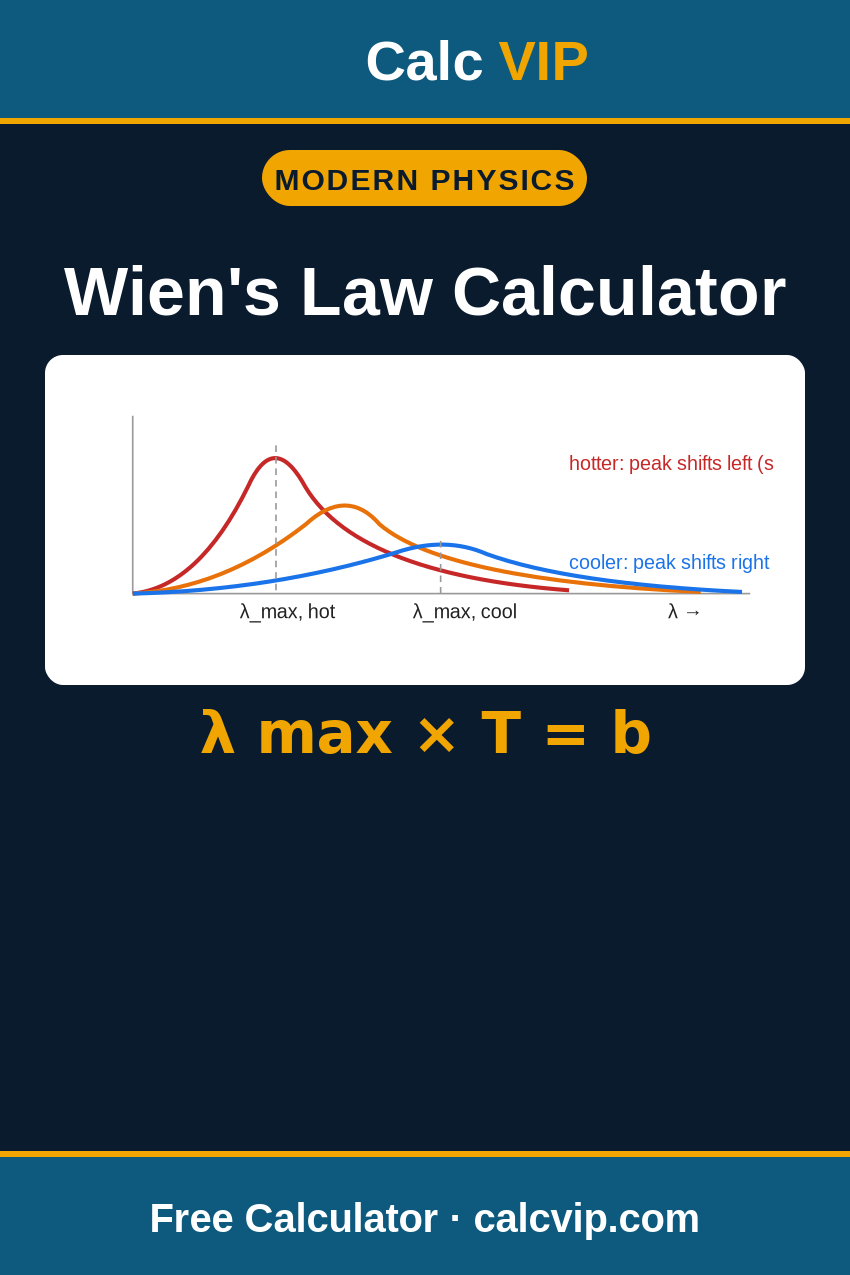
The numbers span creation. The cosmic microwave background, the cooled fireball of the Big Bang, peaks at 1.06 mm for its 2.725 K. Your skin, at 310 K, peaks at 9.3 µm in the thermal infrared — invisible, but exactly where thermal cameras look. An iron bar at 1,000 K peaks at 2.9 µm yet betrays itself with the short-wavelength tail of its curve creeping into visible red: the blacksmith's "red hot" is a Wien tail, not a Wien peak. And the Sun, at 5,800 K, peaks at 500 nm in the green — sunlight's summit sits mid-spectrum, and eyes evolved under it. One multiplication constant, b, organises all of it.
Formula
Wien's displacement law: λmax × T = b, where b = 2.898 × 10⁻³ m·K is Wien's constant. So λmax = b/T and T = b/λmax. In the units of daily use this becomes λmax(µm) = 2898/T(K) and T(K) = 2.898 × 10⁶/λmax(nm). The temperature must be absolute — kelvin, measured from absolute zero; a Celsius input silently wrecks the answer, since 5,800 K and "5,800 °C" differ by the 273 offset that matters enormously at room temperature (a 27 °C room is 300 K, not 27 K — a factor of eleven). The hotter the object, the shorter the wavelength at which it glows most strongly — which is why a heating metal goes red, then orange, then white, as its rising peak drags the spectrum's weight across the visible band.
| Symbol | Meaning | Units |
|---|---|---|
| λmax | wavelength where emission peaks | nm, µm or mm |
| T | absolute temperature of the emitter | kelvin (K) |
| b | Wien's displacement constant, 2.898 × 10⁻³ | m·K |
Colour is a thermometer — if you read the peak, not the tail
The oldest use of this law predates it: smiths and potters have judged furnace temperatures by colour for millennia. But colour is a subtle instrument, because what the eye reports is not the peak — it is the short-wavelength tail of the curve overlapping the visible band. At 1,000 K the peak is at 2.9 µm, far into the infrared, yet the bar glows dull red because the tail's extreme edge just reaches 700 nm. At 1,200 K the tail fattens into orange; by 5,800 K the peak itself stands at 500 nm and the whole visible band is flooded, which we read as white. "Red hot", "orange hot" and "white hot" are the tail's progress across the spectrum, and the calculator's λmax tells you where the invisible bulk of the radiation actually sits at each stage.
For astronomers the same logic, instrumented, is the primary thermometer of the universe. A star's spectrum is recorded, its peak located, and Wien's law returns the surface (effective) temperature: blue-white stars peak in the ultraviolet at tens of thousands of kelvin, red giants peak in the near-infrared at 3,000–3,500 K, and the coolest brown dwarfs peak beyond 2 µm at little more than 1,000 K. Combined with the Stefan–Boltzmann law — which turns temperature and size into total power — the peak measurement becomes a complete physical description of a star's surface from nothing but its light.
How to use
- Choose whether you know the temperature or the peak wavelength.
- Enter the temperature in kelvin, or the peak wavelength in nanometres.
- Click "Calculate with Wien's Law" for the matching value in both directions.
- Convert Celsius first if needed: K = °C + 273. Entering Celsius directly is the one error that ruins this calculation silently.
Worked examples
Example 1 — the Sun. The Sun's surface temperature is about T = 5800 K.
λmax = b/T = 2.898 × 10⁻³ / 5800 = 499.7 nm ≈ 500 nm — right in the middle of the visible spectrum, which is no coincidence: our eyes evolved to match sunlight.
Reverse check: an object peaking at 500 nm has T = 2.898 × 10⁻³ / (500 × 10⁻⁹) = 5796 K.
Example 2 — a human body. Skin temperature is about T = 310 K.
λmax = 2.898 × 10⁻³/310 = 9.3 µm — thermal infrared. You glow brightly, just not in wavelengths your eyes accept; thermal cameras are built for exactly this peak.
Example 3 — an incandescent filament. A bulb filament runs near T = 2700 K.
λmax = 2.898 × 10⁻³/2700 = 1073 nm — in the infrared, not the visible. Most of the bulb's radiation is heat, not light: Wien's law is the one-line explanation of the incandescent bulb's inefficiency and the LED's triumph.
Example 4 — Sirius, the brightest star. Sirius has a surface temperature near T = 9940 K.
λmax = 2.898 × 10⁻³/9940 = 291.5 nm — ultraviolet. Its peak is invisible, but the strong blue end of its tail makes it shine blue-white, the signature of a hot star.
Example 5 — Betelgeuse, the red supergiant. At T = 3500 K: λmax = 2.898 × 10⁻³/3500 = 828 nm.
The peak sits just beyond the visible red, and the tail through the visible band is heavily red-weighted — a cool star by stellar standards, wearing its temperature as a colour.
Example 6 — the cosmic microwave background. The universe's relic glow is at T = 2.725 K.
λmax = 2.898 × 10⁻³/2.725 = 1.06 mm — microwaves, which is why the CMB was discovered with a radio antenna. The same law that reads a star reads the temperature of the entire cosmos.
Wien's law in real life
Stellar classification. The O-B-A-F-G-K-M sequence of star types is a temperature sequence read off spectral peaks and colours — Wien's law with a spectrograph.
Thermal imaging. Cameras for firefighting, building inspection and fever screening are tuned to the 8–14 µm band because 300 K objects peak near 9–10 µm. The band choice is this calculator's output.
Industrial pyrometry. Steel mills and glass works measure melt temperatures optically; two-colour pyrometers refine the peak method so emissivity errors cancel.
Lighting design. "Colour temperature" of lamps — 2700 K warm white, 6500 K daylight — is defined by matching the lamp's spectrum to a blackbody of that temperature. The kelvin on the bulb box is Wien's law as a product label.
Earth's energy balance. The planet at ~288 K peaks at 10.06 µm; greenhouse gases absorb precisely in that infrared band. Climate physics begins with the Sun peaking at 500 nm (incoming) and Earth at 10 µm (outgoing).
Infrared astronomy. Cool objects — protostars, dust clouds, brown dwarfs — are invisible optically but glow at their Wien peaks in the infrared, the hunting ground of telescopes like JWST.
Wien meets Stefan–Boltzmann: the complete blackbody toolkit
Wien's law locates the peak; the Stefan–Boltzmann law, P = εσAT⁴, totals the power. Together they describe a glowing body completely. Note how differently they scale: heat something twice as hot and the peak merely halves in wavelength, while the radiated power multiplies sixteenfold — the peak position is a lazy thermometer but the brightness is a frantic one. The two laws also cross-check each other beautifully: apply Wien to the Sun (peak 500 nm → 5,796 K) and Stefan–Boltzmann to its luminosity and size (next calculator in this batch: T ≈ 5,770 K), and the agreement of two independent routes on one number is the signature of a correct theory. Where they disagree for a real object, the culprit is usually emissivity — real surfaces are grey, not black — or a peak distorted by absorption in an atmosphere, the Sun's included.
Quick reference: temperature and its peak
| Object | T (K) | λmax | Band |
|---|---|---|---|
| Cosmic microwave background | 2.725 | 1.06 mm | microwave |
| Earth (average surface) | 288 | 10.06 µm | thermal IR |
| Human skin | 310 | 9.3 µm | thermal IR |
| Red-hot iron | 1,000 | 2.90 µm | near IR |
| Lava | 1,200 | 2.42 µm | near IR |
| Bulb filament | 2,700 | 1.07 µm | near IR |
| Sun | 5,800 | 500 nm | visible (green) |
| Sirius | 9,940 | 291.5 nm | ultraviolet |
| Hot O-type star | 30,000 | 96.6 nm | far UV |
The frequency form: a different peak for the same glow
There is a trap built into blackbody curves, and this page's common-mistakes list flags it: the spectrum peaks at one place when plotted against wavelength and at another when plotted against frequency, because the two plots parcel the same energy into different bin widths. The frequency form obeys its own Wien law, νmax = 5.879 × 10¹⁰ × T Hz. For the Sun at 5,800 K the frequency peak is 3.41 × 10¹⁴ Hz — which corresponds to a wavelength of c/ν = 880 nm, not 500 nm. Both peaks are correct descriptions of one curve; neither is "the" peak until the axis is named. This calculator uses the wavelength convention (λmaxT = b), the standard for astronomy and thermal imaging. For a 310 K body the frequency peak sits at 1.82 × 10¹³ Hz, equivalent to 16.5 µm — again, not the 9.3 µm of the wavelength peak. Whenever a source quotes a blackbody peak, the first question is "per unit wavelength, or per unit frequency?" — the answers differ by nearly a factor of two in wavelength, and confusing them has embarrassed real analyses.
Colour indices: Wien's law as astronomers actually use it
Astronomers rarely fit a full spectrum to find the peak; they sample the curve at two wavelengths and take the ratio, a colour index. The Johnson B−V index compares blue light (440 nm) with visual (550 nm): the bluer the star — the further its Wien peak has slid toward the ultraviolet — the smaller (even negative) the index. The Sun's B−V is +0.65, consistent with its 5,800 K peak at 500 nm; Betelgeuse, peaking at 828 nm, shows B−V ≈ +1.85; hot blue-white stars like Sirius (peak 291.5 nm) sit near 0.00, and the hottest O stars reach −0.3. A single subtraction of two brightness measurements thus functions as a remote thermometer for millions of catalogued stars — Wien's displacement law industrialised. Dust between the stars reddens colours and must be corrected for, which is why the method pairs naturally with spectroscopy: the spectrum gives the peak directly, the colour index gives it cheaply, and the two together give it reliably.
The Draper point: where heat first becomes visible
Every solid, heated steadily, crosses the same threshold of visibility at about 798 K (525 °C) — the Draper point, named for John William Draper, who noted in 1847 that all materials begin to glow dull red at the same temperature. Wien's law explains the coincidence: at 798 K the spectrum peaks at λmax = 2.898 × 10⁻³/798 = 3.63 µm, deep in the infrared, but the curve's short-wavelength tail has just reached into the visible red with enough photons to register on a dark-adapted eye. The temperature is universal because it is a property of the blackbody curve's shape, not of the material — emissivity scales the brightness but the tail's relative reach is set by T alone. Kiln operators, blacksmiths and glassblowers read this tail by eye, a Wien thermometer grown in the visual cortex; the calculator merely writes down what their colour judgement already knows.
Common mistakes
- Entering Celsius. Wien's law is built on absolute temperature. 100 °C is 373 K; typing 100 gives λmax = 29 µm instead of 7.8 µm. Convert first, always.
- Confusing the peak with the colour. A 1,000 K bar peaks at 2.9 µm but looks red, because the eye sees the spectrum's tail, not its peak. Peak wavelength and perceived colour coincide only near solar temperatures.
- Assuming all radiation is at λmax. The peak is the summit of a broad curve; a blackbody emits substantially across decades of wavelength around it. Filters and detectors must be designed for the curve, not the point.
- Forgetting emissivity for real objects. Wien's law assumes a blackbody. Real surfaces emit the same-shaped curve scaled by emissivity — the peak stays put (a gift), but brightness-based inferences fail if ε is ignored.
- Using the frequency form's peak as the wavelength peak. The blackbody curve peaks at different places when plotted against frequency versus wavelength — a notorious subtlety. This calculator uses the wavelength form, λmaxT = b; the frequency peak obeys a different constant.
FAQ
Why does the peak move to shorter wavelengths when heated?
Higher temperature means the particles vibrate more energetically, so the emitted photons have higher energies and frequencies — and higher frequency means shorter wavelength.
What is the peak wavelength of a human body?
At about 310 K, λmax = 2.898 × 10⁻³/310 ≈ 9.3 µm — deep infrared. That is why thermal cameras and night-vision goggles can "see" people in the dark.
Does Wien's law give the only wavelength emitted?
No. A hot body emits a whole spread of wavelengths; λmax is just where the emission curve reaches its peak.
Why is the Sun's peak in the green, yet sunlight looks white-yellow?
Because the Sun emits strongly across the whole visible band, not only at its 500 nm summit; the mixture of all colours registers as white, tinted yellow after the atmosphere scatters some blue away. The peak is a property of the curve, not a paint colour.
What is Wien's constant made of?
b = hc/(4.965 k), built from Planck's constant, the speed of light and Boltzmann's constant. The 4.965 is the root of a transcendental equation from maximising Planck's spectrum — pure mathematics, measured once and valid everywhere.
Can Wien's law measure the temperature of a flame?
Approximately. Flames are not perfect blackbodies — their spectra carry emission lines from excited molecules — but the continuum's peak still tracks temperature usefully, and industrial sensors exploit exactly that.
Why do thermal cameras use the 8–14 µm window?
Two reasons coincide: objects near 300 K peak inside it (9.3 µm for skin), and the atmosphere is transparent there, so the radiation actually reaches the camera. Wien's law picks the band; the atmosphere permits it.
Does a hotter object always look bluer?
Its peak always moves to shorter wavelengths, yes — but the perceived colour saturates at blue-white: once the peak passes into the ultraviolet (above ~10,000 K), the visible tail's balance changes little, so the hottest stars look similar in colour despite very different temperatures.
What temperature peaks exactly at the red edge, 700 nm?
T = 2.898 × 10⁶/700 ≈ 4,140 K. Objects cooler than this peak beyond the visible; objects hotter peak inside or short of it — a useful dividing line for lamp and star classification.
How was the law found before quantum theory?
Wien derived it in 1893 from thermodynamics and the Doppler effect on cavity radiation — an empirical triumph that Planck's 1900 quantum law later explained and absorbed. The constant b was measured long before anyone knew it contained h.