 Calc
Atomic Mass Unit Converter – u to MeV, Joules & kg (E = mc²)
 Created by Yuki Tanaka · Physics Editor · Modern Physics · Last updated: November 2026
Use this free Atomic Mass Unit Energy Converter to turn a mass into its energy equivalent — and back — in atomic mass units (u), mega-electronvolts (MeV), joules (J) and kilograms (kg). It is built on Einstein's E = mc² with the standard values 1 u = 931.5 MeV/c² = 1.6605 × 10⁻²⁷ kg.
The atomic mass unit is the natural currency of the atomic world. A single proton weighs about 1.007 u, a carbon-12 atom exactly 12 u, and even the heaviest known atoms come in under 300 u — numbers a human can hold in their head. Kilograms, by contrast, describe the same objects with punishing strings of zeros: one u is just 1.6605 × 10⁻²⁷ kg, a decimal point followed by 26 zeros before the digits begin. Chemistry and nuclear physics would be unreadable without a unit sized to the things they study, and the u (also called the dalton, symbol Da) is that unit.
What makes this converter more than a change of units is the equation behind it. Einstein's E = mc² says that mass and energy are not two separate ingredients of the universe but two book-keeping systems for the same quantity, with the speed of light squared as the exchange rate. Because c² is enormous — 9 × 10¹⁶ in SI units — the exchange rate is wildly lopsided: a speck of mass corresponds to a fortune of energy. One atomic mass unit, converted completely, yields 931.5 MeV, and that single conversion factor quietly powers everything from nuclear reactor design to the mass tables of particle physics.
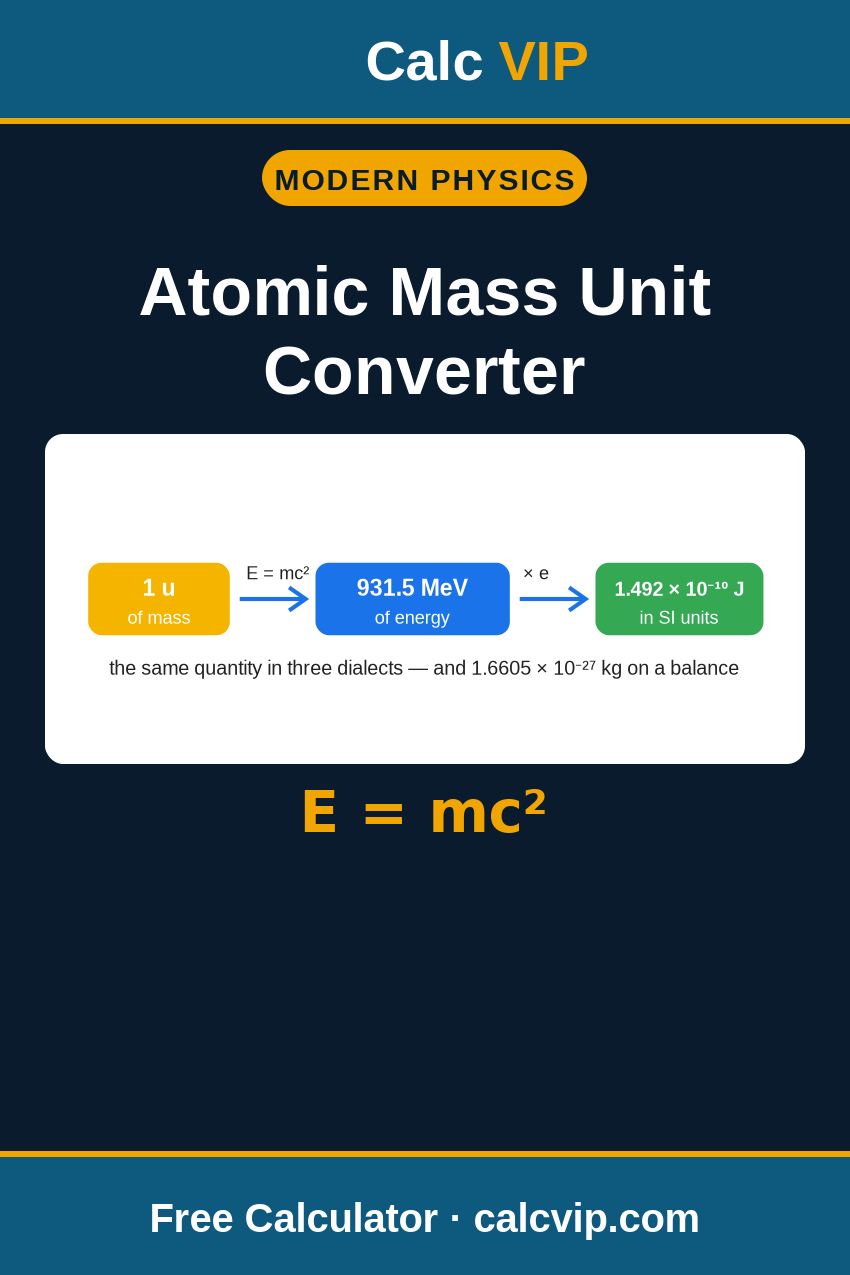
The four units in this calculator are the four dialects in which that one fact gets spoken. Kilograms are the language of the laboratory balance. Atomic mass units are the language of mass spectrometers and nuclear data tables. Mega-electronvolts are the working currency of nuclear and particle physics, where energies per particle are what matter. Joules are the language of engineers who must cool, shield or harness the result. Moving fluently between the four — which is what this page does in one click — is a genuine professional skill in every field that touches the atomic world.
Formula
E = mc² • E in joules, m in kilograms, c = 3 × 10⁸ m/s • worked through the atomic mass unit: 1 u = 931.5 MeV = 1.492 × 10⁻¹⁰ J = 1.6605 × 10⁻²⁷ kg
The equation rearranges to run the conversion backwards: m = E / c² recovers the mass that corresponds to any energy, which is how physicists can quote a particle's mass as an energy (its rest energy) and mean it literally. In practice nobody multiplies by c² directly at atomic scales. Instead, every conversion routes through the atomic mass unit, exactly as this calculator does: first express your quantity in u, then multiply by 931.5 for MeV, by 1.492 × 10⁻¹⁰ for joules, or by 1.6605 × 10⁻²⁷ for kilograms. The MeV factor is the one to memorise — 931.5 — because it turns the mass printed in any nuclear data table into an energy with a single multiplication. The joule factor itself is built from the others: 931.5 MeV × 10⁶ × 1.602 × 10−19 J per electronvolt = 1.492 × 10⁻¹⁰ J, which is why the electronvolt family and the joule family never disagree.
| Symbol | Meaning | Units |
|---|---|---|
| u | atomic mass unit — 1/12 of a carbon-12 atom | 1.6605 × 10⁻²⁷ kg |
| E | energy equivalent of the mass | J or MeV |
| m | mass | kg or u |
| c | speed of light, 3 × 10⁸ m/s (c² = 9 × 10¹⁶) | m/s |
| MeV | mega-electronvolt — energy of an electron charge through 10⁶ volts | 1.602 × 10⁻¹³ J |
Mass defect: where the converted mass actually goes
If mass and energy were truly separate ledgers, a helium nucleus would weigh exactly as much as the two protons and two neutrons that compose it. It does not. Add up two hydrogen-1 atoms (1.007825 u each) and two neutrons (1.008665 u each) and the ingredients total 4.032980 u — but a helium-4 atom weighs only 4.002603 u. The missing 0.030377 u is the mass defect, and E = mc² tells you precisely where it went: 0.030377 × 931.5 = 28.30 MeV of energy was carried away when the nucleus formed. That energy is the nucleus's binding energy — the price, in energy, that you would have to repay to tear the helium nucleus apart again.
This is not a rounding curiosity; it is the engine of the nuclear age. Every exothermic nuclear reaction is a trade in which the products sit deeper in mass defect than the reactants, and the difference leaves as kinetic energy, light and heat. Divided by the number of nucleons, helium-4's binding energy is 28.30 ÷ 4 ≈ 7.07 MeV per nucleon — the standard figure of merit for how tightly a nucleus is bound, and the quantity plotted in the famous binding-energy curve further down this page. Mass spectrometers measure atomic masses to nine significant figures largely so that this arithmetic — defect in u, times 931.5 — can predict, before any experiment, whether a proposed reaction will release energy or consume it, and exactly how much.
How to use
- Type the value you want to convert — a mass from a data table, or an energy you want expressed as a mass.
- Choose the unit that value is measured in: atomic mass units (u), MeV, joules (J) or kilograms (kg).
- Click "Convert" to see the same quantity in all four units at once: mass in u and kg, energy equivalent in MeV and J.
- Sanity-check with the anchor values: 1 u must return 931.5 MeV, and the proton (1.007276 u) must return about 938.3 MeV. If your result is wildly different, the starting unit was probably chosen wrongly.
Worked examples
Example 1 — the proton. The proton has a mass of 1.007276 u. Converting:
Energy = 1.007276 × 931.5 = 938.278 MeV
In joules = 1.007276 × 1.492263 × 10−10 = 1.503 × 10⁻¹⁰ J
In kilograms = 1.007276 × 1.6605 × 10−27 = 1.673 × 10⁻²⁷ kg
This is why physicists quote the proton's rest energy as about 938.3 MeV.
Example 2 — the neutron. A free neutron masses 1.008665 u: energy = 1.008665 × 931.5 = 939.571 MeV; in joules, 1.008665 × 1.492 × 10−10 = 1.505 × 10⁻¹⁰ J; in kilograms, 1.675 × 10⁻²⁷ kg. The neutron outweighs the proton by 939.571 − 938.278 = 1.293 MeV — a small difference with enormous consequences, since it is exactly what makes free neutrons decay into protons while protons in stable nuclei do not decay back.
Example 3 — the electron. The lightest familiar particle masses just 0.00054858 u: energy = 0.00054858 × 931.5 = 0.511 MeV; in kilograms, 9.109 × 10⁻³¹ kg; in joules, 8.186 × 10⁻¹⁴ J. That 0.511 MeV is one of the most measured numbers in physics — it is the energy of each photon produced when an electron meets a positron, and the signal hospital PET scanners are built to detect.
Example 4 — a whole atom: carbon-12. By definition the carbon-12 atom is exactly 12 u: energy = 12 × 931.5 = 11,178 MeV (11.178 GeV); mass in kilograms = 12 × 1.6605 × 10−27 = 1.993 × 10⁻²⁶ kg; in joules, 1.791 × 10⁻⁹ J. Whole atoms run to thousands of MeV, which is why particle physicists switch to GeV for anything nucleus-sized and reserve MeV for single nucleons and reaction energies.
Example 5 — running the converter backwards: one joule. Enter 1 J and ask what mass it corresponds to: 1 ÷ (1.492 × 10⁻¹⁰) = 6.701 × 10⁹ u, and 6.701 × 10⁹ × 1.6605 × 10−27 = 1.113 × 10⁻¹⁷ kg. A joule of pure energy — a litre of water lifted a few centimetres — "weighs" about ten millionths of a trillionth of a kilogram. This is why mass–energy conversion is invisible in everyday life and why chemistry's mass changes went unnoticed for centuries.
Example 6 — the alpha particle. A helium-4 nucleus (two protons, two neutrons, no electrons) masses 4.001506 u: energy = 4.001506 × 931.5 = 3,727.4 MeV; in joules 5.971 × 10⁻¹⁰ J; in kilograms 6.645 × 10⁻²⁷ kg. Note the alpha particle is lighter than the helium-4 atom discussed in the mass-defect section above (4.002603 u) by almost exactly two electron masses — the atom carries two electrons, the bare nucleus none. Keeping "atom" and "nucleus" masses straight is the commonest source of error in this whole subject.
Mass–energy conversion in real life
Nuclear power and weapons. A fissioning uranium-235 nucleus releases about 200 MeV — roughly 0.2 u of mass defect per event, read straight off this converter's arithmetic. Reactor engineers scale that single-nucleus figure by Avogadro-scale numbers of nuclei to size fuel loads, cooling systems and yields.
The Sun's fuel gauge. The Sun radiates 3.83 × 10²⁶ joules every second, so by m = E/c² it converts 3.83 × 10²⁶ ÷ 9 × 10¹⁶ ≈ 4.26 × 10⁹ kg of mass into light every second — over four million tonnes a second, and yet such a trickle against its total mass that it can shine for billions of years.
Particle physics bookkeeping. Accelerators quote every particle mass in MeV/c² or GeV/c²: electron 0.511, proton 938.3, Higgs boson about 125,000 MeV. The "per c²" is this page's conversion worn openly — mass and energy are the same ledger, and 931.5 MeV per u is the exchange rate pinned to the wall.
Medical imaging. PET scans run on the electron's rest energy: a positron from a tracer annihilates with an electron, and the two resulting photons carry 0.511 MeV each — a number that comes straight from converting 0.00054858 u. Detector crystals and timing electronics are all specified around that energy.
Chemistry's mole. The u is welded to everyday chemistry through Avogadro's number: one mole of carbon-12 atoms is exactly 12 g because one atom is 12 u and a mole contains 6.022 × 10²³ of them, with 1 u × NA = 1 g/mol. Every molar mass on every reagent bottle is this converter's smallest unit, scaled up.
The gram that ended a war's physics debate. The Hiroshima bomb released about 6.3 × 10¹³ J. Dividing by c² gives 6.3 × 10¹³ ÷ 9 × 10¹⁶ = 0.0007 kg — roughly 0.7 grams of mass converted, less than a paperclip, from a device containing kilograms of uranium. No calculation makes the lopsidedness of E = mc² more vivid.
The binding-energy curve: why iron is the ash of the universe
Divide each nucleus's binding energy by its nucleon count and plot the result, and a landscape emerges that dictates the fate of stars. The curve climbs steeply from hydrogen, crests near iron-56 at about 8.79 MeV per nucleon — computed with this page's tools: iron-56's mass defect is (26 × 1.007825 + 30 × 1.008665 − 55.934937) = 0.528463 u, worth 0.528463 × 931.5 ≈ 492.3 MeV, or 492.3 ÷ 56 ≈ 8.79 MeV per nucleon — and then declines gently towards uranium. Nuclei release energy by moving uphill on this curve, towards iron. Light nuclei do it by fusing (the Sun climbing from hydrogen towards helium and beyond); heavy nuclei do it by fissioning (uranium sliding down towards the iron peak from above). Iron itself can do neither profitably — it is nuclear ash. When a massive star's core has fused its way to iron, no further energy is available, the core collapses, and the star dies as a supernova. The entire drama is legible from a table of masses in u and one multiplication by 931.5.
Quick reference: rest energies of familiar particles and atoms
| Particle / atom | Mass (u) | Rest energy (MeV) |
|---|---|---|
| electron | 0.00054858 | 0.511 |
| proton | 1.007276 | 938.278 |
| neutron | 1.008665 | 939.571 |
| hydrogen-1 atom | 1.007825 | 938.789 |
| alpha particle | 4.001506 | 3,727.4 |
| carbon-12 atom | 12 (exact) | 11,178 |
| oxygen-16 atom | 15.994915 | 14,899 |
| iron-56 atom | 55.934937 | 52,103 |
| uranium-238 atom | 238.050788 | 221,744 |
Read the table as a menu of possible reactions: any rearrangement of these particles whose products total less mass than its reactants releases the difference, in MeV, at 931.5 MeV per missing u. Nuclear physics, at the planning stage, is genuinely that simple — the converter above is the only arithmetic required.
Common mistakes
- Quoting an energy as a mass without the c². "The proton masses 938 MeV" is shorthand for 938 MeV/c². Drop the c² in a calculation rather than just in speech and every number that follows is wrong by 9 × 10¹⁶.
- Mixing atomic and nuclear masses. Data tables list atomic masses, electrons included. A helium atom (4.002603 u) and an alpha particle (4.001506 u) differ by two electron masses, 0.001097 u ≈ 1.02 MeV — enough to wreck a careful binding-energy calculation.
- Saying mass is "destroyed" in a reaction. Nothing vanishes: the mass defect leaves as energy carried by photons and moving particles, and if you weighed the sealed reaction vessel afterwards, energy included, it would balance exactly. Mass–energy is conserved; only its form changes.
- Slipping powers of ten with kilograms. 1 u is 1.6605 × 10⁻²⁷ kg, not 10−24 (that is roughly a kilodalton-scale molecule) and not 10−30. Anchoring on the proton — about 1.67 × 10⁻²⁷ kg — catches most slips.
- Expecting chemical reactions to show no mass change at all. Burning obeys E = mc² too: burning a kilogram of petrol releases about 4.4 × 10⁷ J, a mass change of roughly 5 × 10⁻¹⁰ kg. It is real, just ten orders of magnitude below any balance's reach — nuclear changes are millions of times larger per atom, which is why only they were ever noticed.
FAQ
What is an atomic mass unit?
One u is defined as exactly 1/12 of the mass of a carbon-12 atom. It is the natural mass scale for atoms and nuclei, roughly the mass of one proton or neutron.
Why do physicists use MeV instead of joules?
Atomic energies are tiny in joules (around 10⁻¹⁰ J) but convenient in MeV. Since 1 u ↔ 931.5 MeV, a mass in u converts to an energy in MeV with one multiplication.
Is mass really converted into energy?
Yes — E = mc² says mass and energy are two measures of the same thing. In nuclear reactions the products weigh slightly less than the reactants, and the missing mass appears as released energy.
How many joules of energy are in 1 u?
1.492 × 10⁻¹⁰ J. That is the 931.5 MeV figure converted: 931.5 × 10⁶ electronvolts × 1.602 × 10⁻¹⁹ J per electronvolt. Per single particle it is a whisper of energy; per mole of particles it is about 9 × 10¹³ J, which is why nuclear fuels are so dense.
Where does the number 931.5 come from?
It is simply 1 u expressed through E = mc²: (1.6605 × 10⁻²⁷ kg) × (3 × 10⁸ m/s)² = 1.492 × 10⁻¹⁰ J, divided by the 1.602 × 10⁻¹³ J in one MeV. Nothing about it is adjustable — change any defining constant and it follows.
What is the electron's mass in u?
0.00054858 u — about 1/1836 of a proton. It is small enough to ignore in rough nuclear arithmetic and large enough that precision mass tables never do; the atom-versus-nucleus distinction in the mistakes section above is entirely this number at work.
Is a dalton the same as an atomic mass unit?
Yes. Dalton (Da) and u are the same unit, defined as 1/12 of the mass of a carbon-12 atom. Biochemists prefer daltons and kilodaltons (kDa) for proteins; physicists prefer u. A 50 kDa protein masses 50,000 u.
Can energy be converted back into mass?
Yes — the equation is symmetric, and the process is called pair production: a photon of at least 1.022 MeV passing a nucleus can materialise as an electron–positron pair, turning light into 2 × 0.00054858 u of matter. Accelerators do the equivalent routinely when collision energy condenses into new particles.
Does a photon have a mass in u?
No. A photon's rest mass is zero, which is why it must travel at c. It carries energy and momentum, and that energy has a mass equivalent (E/c²), but assigning the photon a rest mass in u would contradict relativity's most tested prediction.
Why is 1 u not exactly the mass of a proton or neutron?
Because it is defined by carbon-12, not by either nucleon — and carbon-12's nucleons are bound, so each averages 12 ÷ 12 = 1 u including its share of binding energy. Free protons (1.007276 u) and neutrons (1.008665 u) are both slightly heavier than 1 u precisely because they are unbound.