 Calc
Ballistic Pendulum Calculator – Projectile Speed From Swing Height
 Created by James Carter · Physics Writer · Forces & Motion · Last updated: November 2026
Use this free Ballistic Pendulum Calculator to find a projectile's speed from how high a pendulum block swings after catching it. This classic experiment combines momentum conservation (the impact) with energy conservation (the swing).
Ballistic Pendulum
The ballistic pendulum is one of the great measurement hacks in the history of physics. It was described by Benjamin Robins in 1742, in an age with no electronics, no photography and no clock that could time a musket ball crossing a room — yet it measured that ball's speed to within a few percent using nothing but a swinging block of wood, a ruler and two conservation laws. The trick is a relay: the projectile's momentum is handed to a heavy block in an impact too fast to time, and the block then converts that momentum into a slow, stately swing whose height can be measured at leisure. Speed becomes height; the unmeasurable becomes a ruler reading.
The relay works because each of its two stages is governed by a different conservation law, and the method's whole elegance lies in never asking a law to work where it does not hold. During the impact — a perfectly inelastic collision in which the projectile embeds — kinetic energy is destroyed wholesale (in Example 1 below, 99.5% of it), but momentum is conserved exactly, so momentum alone carries the information across the impact. During the swing, the situation reverses: gravity acts throughout, so momentum is not conserved, but mechanical energy is, so energy alone carries the information from the swing's speed to its height. This calculator performs the relay in reverse, the way the experimenter does: from the measured height, back through energy to the post-impact speed, then back through momentum to the projectile's speed.
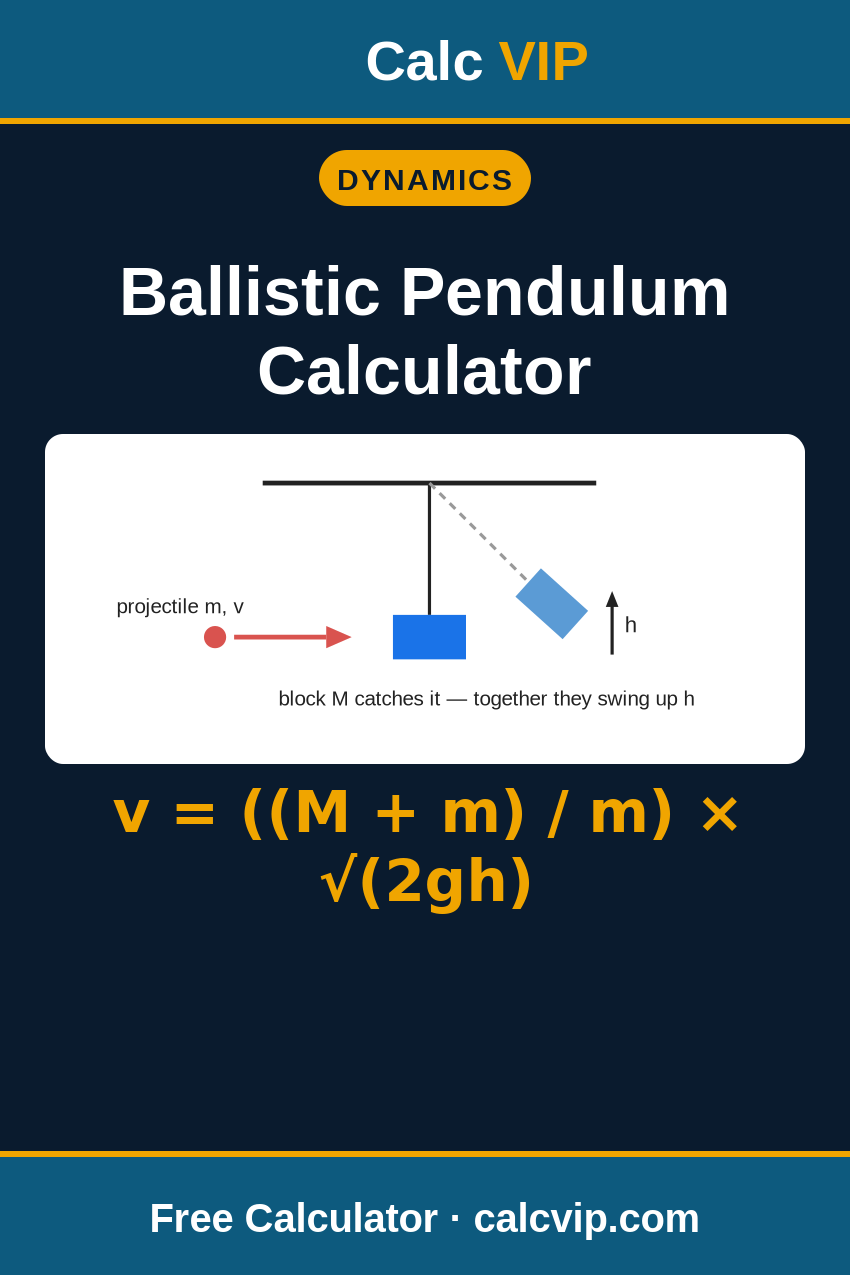
Enter the projectile mass, the block mass and the vertical rise of the block's centre of mass, and the calculator returns the projectile's speed before impact, together with the pair's speed just after it. The assumptions are written on the tin: the projectile must embed and stay embedded, the block must swing freely, and h must be the rise of the centre of mass — not the distance travelled along the arc, a distinction the depth section below makes precise.
Formula
v = ((M + m) / m) × √(2gh), with g = 9.81 m/s². Step 1 (swing): the combined speed just after impact is √(2gh), from energy conservation. Step 2 (impact): momentum conservation, mv = (M + m) × that speed, gives the projectile's original speed v.
Read the formula as an amplifier and a converter in series. The converter, √(2gh), turns the measured height into the pair's speed just after impact — the swing-up is the block trading kinetic energy ½(M + m)V² for potential energy (M + m)gh, and the masses cancel, leaving V dependent on height alone. The amplifier, (M + m) / m, then scales that modest speed up to the projectile's: because the light projectile had to supply the whole pair's momentum by itself, its speed exceeds the pair's by exactly the mass ratio. With a 2 kg block and a 10 g projectile the ratio is 200 — a swing of under 1 m/s becomes a projectile speed near 200 m/s. Rearranged, the formula also designs experiments: the rise produced by a known projectile is h = (m v / (M + m))² / (2g), which is how you choose a block heavy enough to keep the swing measurable but safe.
| Symbol | Meaning | Units |
|---|---|---|
| m | mass of the projectile | kg |
| M | mass of the pendulum block | kg |
| h | vertical rise of the block's centre of mass | m |
| V | speed of block + projectile just after impact, √(2gh) | m/s |
| v | projectile speed before impact (the answer) | m/s |
| g | gravitational acceleration, 9.81 | m/s² |
Two stages, two laws — and why neither can do the other's job
Students meeting this experiment often ask why the whole thing cannot be done with energy alone: equate the projectile's kinetic energy to the block's potential energy at the top and solve. Try it on Example 1 and it gives a speed near 14 m/s instead of 198 m/s — wrong by a factor of fourteen, because the impact stage is a bonfire of kinetic energy: 99.5% of the projectile's energy is spent shredding and heating the block before the swing even begins. Energy conservation is simply false across the impact, and using it there is the classic error this experiment exists to teach against. Momentum, by contrast, crosses the impact untouched: the internal forces of embedding, however violent, cancel in the total.
The swing stage reverses the verdicts. As the block rises, gravity steadily drains its momentum — momentum conservation is false across the swing — but gravity is a conservative force, so the mechanical energy ledger balances exactly: kinetic energy at the bottom becomes potential energy at the top, joule for joule. Each stage, then, is analysed with the one law that survives it, and the post-impact speed V is the baton passed between them. That baton-pass is the deep pattern: many real systems — collisions followed by climbs, explosions followed by coasting — decompose into stages, each with its own valid conservation law, joined at shared quantities like V.
How to use
- Enter the projectile mass and the block mass in kg — the projectile must stick in the block; if it bounces off or passes through, this method does not apply.
- Enter how high the block's centre of mass rises, in metres — the vertical rise, not the distance along the swing's arc.
- Click "Calculate Projectile Speed" to get the projectile's speed before impact.
- Note the second result line: the speed of block + projectile just after impact. It is the checkable intermediate — a slow, measurable speed from which the fast one was amplified.
Worked examples
Example 1 — the classic setup. A projectile of mass 0.01 kg embeds in a block of mass 1.99 kg, and together they swing up 0.05 m.
Speed just after impact = √(2 × 9.81 × 0.05) = √0.981 = 0.99 m/s.
Projectile speed v = ((1.99 + 0.01) / 0.01) × 0.99 = 200 × 0.99 = 198.09 m/s. A swing slower than walking pace, amplified two-hundredfold by the mass ratio into a rifle-class velocity.
Example 2 — an air-rifle pellet. A 0.0005 kg (0.5 g) pellet embeds in a light 0.4995 kg block, raising it just 0.003 m — three millimetres, measured with a ruler and a pointer. V = √(2 × 9.81 × 0.003) = √0.0589 ≈ 0.24 m/s. The mass ratio is (0.5 / 0.0005) = 1,000, so v = 1,000 × 0.24 ≈ 242.6 m/s — a plausible figure for a powerful air rifle, extracted from a three-millimetre rise. The lighter the projectile, the heavier the amplification, and the smaller the swing that suffices.
Example 3 — a paintball. A 0.003 kg paintball splats into (and sticks to) a 0.297 kg block, lifting it 0.03 m. V = √(2 × 9.81 × 0.03) = √0.5886 ≈ 0.77 m/s; mass ratio = 0.3 / 0.003 = 100; v = 100 × 0.77 ≈ 76.7 m/s — right in the regulated paintball range, which is why pendulum chronographs were genuinely used to check marker velocities before electronic ones became cheap.
Example 4 — the forensic scale. An 0.008 kg (8 g) bullet embeds in a heavy 3.992 kg block, which rises 0.025 m. V = √(2 × 9.81 × 0.025) = √0.4905 ≈ 0.70 m/s; mass ratio = 4 / 0.008 = 500; v = 500 × 0.70 ≈ 350.2 m/s — handgun territory. Robins's original apparatus worked at exactly this scale, with a massive iron-faced pendulum catching musket balls, and it produced the first reliable muzzle velocities in history.
Example 5 — designing the experiment backwards. You expect a projectile of 0.01 kg at about 300 m/s and want a swing you can measure safely. Choose a block of 4.99 kg: after impact the pair moves at V = (0.01 × 300) / 5 = 0.6 m/s, and the rise will be h = V² / (2g) = 0.36 / 19.62 ≈ 0.0183 m — about 1.8 cm. Too small to read precisely? Halve the block and the rise quadruples (h grows with V²), at the price of a livelier swing. The rearranged formula is the experimenter's dial.
Example 6 — auditing the energy. Where did the projectile's energy actually go in Example 1? Before impact it carried ½ × 0.01 × 198.09² ≈ 196.2 J. Just after impact the pair carries ½ × 2 × 0.99² ≈ 0.98 J — and that 0.98 J is exactly what becomes the potential energy at the top of the swing. The other 99.5% was spent in the block: splintering, friction and heat. The fraction surviving an embedding impact is always m / (M + m) — here 0.01 / 2 = 0.5% — a result worth remembering whenever a fast, light object meets a slow, heavy catcher.
The ballistic pendulum in real life
Robins and the musket era. Benjamin Robins's 1742 measurements with this device founded scientific ballistics: for the first time, gunners knew muzzle velocities numerically, could measure air resistance by comparing speeds downrange, and discovered that drag at high speed was far fiercer than theory assumed. Artillery science starts here.
University laboratories. The experiment survives in teaching labs worldwide because it compresses two conservation laws, one classic error (using energy across the impact) and a dramatic amplification into a single afternoon's work — and because its result can be checked against electronic chronographs to a percent or two.
Chronograph-free velocity checks. Paintball fields, archery clubs and airgun enthusiasts have all used pendulum rigs to verify projectile speeds where electronics were unavailable or untrusted. An arrow or pellet that embeds in a foam block on a string is a ballistic pendulum whether or not anyone calls it one.
The Charpy test, a close cousin. Materials engineers measure a metal's toughness with a swinging pendulum hammer that breaks a notched sample: the pendulum's loss of height after breaking the sample reports the energy the material absorbed. The swing-to-energy conversion is this page's stage 2, run as an audit rather than a measurement of speed.
Impact and crash research. Before high-speed cameras and accelerometers, pendulum rigs were the standard way to deliver a known, repeatable impact — the ancestor of the pendulum impactors still used in helmet and vehicle-interior testing, where a swinging mass of known energy strikes the test piece.
Reading the swing: height from angle
In practice, few experimenters measure h directly; they measure the swing's angle, or the horizontal displacement, and convert. For a pendulum of length L (pivot to the block's centre of mass) swinging through angle θ, the vertical rise is h = L × (1 − cos θ). With L = 1 m and θ = 18°, h = 1 × (1 − 0.9511) ≈ 0.0489 m — about 4.9 cm, which with Example 1's masses would report a projectile near 196 m/s. The angle form is why long pendulums are prized: a longer string turns the same rise into a larger, more readable horizontal excursion. It also explains the calculator's appetite for the rise of the centre of mass specifically — the block rotates as it swings, and points above or below its centre rise by different amounts; only the centre's rise belongs in √(2gh).
Capturing the top of the swing is its own small art, because the block pauses there only for an instant. Robins's successors fitted the pendulum with a light pointer that dragged along a graduated scale and stayed at the furthest point reached, or let the block push a sliding marker it could not pull back — mechanical memories for a fleeting maximum. The same trick survives wherever a peak must be recorded without electronics, from maximum-reading thermometers to the tell-tale needles on pressure gauges. Precision versions go further still, treating the apparatus honestly as a rigid pendulum: they measure its period and moment of inertia and work with angular momentum, correcting the simple formula's small fictions — a massless string, a point block — into the background where they belong.
Quick reference: rise height vs projectile speed (Example 1's masses: m = 0.01 kg, M = 1.99 kg)
| Rise h | Pair speed V = √(2gh) | Projectile speed v (× 200) |
|---|---|---|
| 0.01 m | 0.44 m/s | 88.6 m/s |
| 0.02 m | 0.63 m/s | 125.3 m/s |
| 0.05 m | 0.99 m/s | 198.1 m/s |
| 0.10 m | 1.40 m/s | 280.1 m/s |
| 0.20 m | 1.98 m/s | 396.2 m/s |
Note the square-root mercy in the table: quadrupling the rise only doubles the speed, which means measurement errors are softened too — a 4% error in reading h becomes a 2% error in v. Instruments that forgive their own imprecision are rare, and it is one reason this 280-year-old design stayed in service so long.
Common mistakes
- Using energy conservation across the impact. The fatal classic. The impact destroys most of the kinetic energy; equating the projectile's KE to the block's final potential energy understates the speed by roughly the square root of the mass ratio — a factor of fourteen in Example 1.
- Measuring the arc instead of the rise. h is the vertical rise of the centre of mass. The distance travelled along the swing's curve is longer than the rise, and feeding it into √(2gh) overstates the speed.
- Forgetting the projectile's mass in the pair. The amplifier is (M + m) / m, not M / m. With a heavy block the difference is small — which is exactly why it slips through unchecked and quietly biases careful work.
- Letting the projectile bounce or pass through. The method's contract is embedding. A projectile that rebounds carries momentum away unaccounted; one that exits takes energy and momentum both. If it does not stay in the block, the formula does not apply.
- Reading the rise of the wrong point. The block rotates as it swings; its top and bottom rise by different amounts than its centre of mass. Mark the centre, or correct for the geometry — precision versions of the apparatus use a rigid pendulum and its moment of inertia for exactly this reason.
FAQ
Why are two different conservation laws used?
The impact is inelastic, so kinetic energy is not conserved during the collision — but momentum is. During the swing afterwards, mechanical energy is conserved. Each step uses the law that actually holds for it.
Does the pendulum string length matter?
Only through the height: what enters the formula is the vertical rise h of the centre of mass. A longer string just makes the same rise easier to measure accurately.
What if the projectile passes through the block?
Then the method fails — the formula assumes the projectile stays embedded so the pair moves together with one shared speed.
Why can't momentum conservation be used for the swing stage?
Because gravity and the pivot's tension are external forces acting over the whole duration of the swing, so the pair's momentum steadily changes as it rises and falls. Momentum conservation is a superb approximation only for the brief impact, where those external impulses have no time to accumulate.
How accurate is the ballistic pendulum?
Careful versions reach a percent or two. The square root in V = √(2gh) halves the effect of height-reading errors, and the main corrections are for the string's mass, pivot friction and the block's rotation — all small beside the method's basic soundness.
Who invented the ballistic pendulum?
Benjamin Robins, a British mathematician, published it in his 1742 "New Principles of Gunnery". It gave the first trustworthy muzzle velocities and, with them, the first real measurements of air resistance on fast projectiles — the founding experiments of ballistics as a science.
What happens to all the kinetic energy the impact destroys?
It becomes internal energy of the block and projectile: splintered or deformed material, friction heat along the projectile's path, and sound. In Example 6's audit, 99.5% of the energy takes this route — the swing is powered by the surviving half of one percent.
Can the method measure slow projectiles too?
Yes — anything that embeds: arrows, darts, paintballs, even thrown balls into a sufficiently sticky catcher. The mass ratio should be chosen so the swing is readable; very slow projectiles need light blocks, which is a design choice the rearranged formula guides.
Why does the block need to be so much heavier than the projectile?
Two reasons: a heavy block keeps the post-impact speed — and hence the swing — gentle and safe, and it makes the amplification ratio large, which is what turns a small, readable rise into a precise speed. The trade is sensitivity: too heavy a block and the rise shrinks below what a ruler can resolve.
Is the ballistic pendulum still used today?
Electronic chronographs have replaced it for routine work, but it remains a staple of physics teaching and a conceptual ancestor of pendulum impact testers in materials and safety engineering. It also needs no power, no calibration electronics and no line of sight — virtues that keep it in field kits and textbooks alike.