 Calc
Banked Curve Angle Calculator – Required Banking Angle θ = tan⁻¹(v²/rg)
 Created by James Carter · Physics Writer · Forces & Motion · Last updated: November 2026
Use this free Banked Curve Angle Calculator to find the banking angle a road or track needs so a vehicle can take a curve of a given radius at a given speed with no friction at all.
Every curved road is a compromise between geometry and grip. On a flat bend, the only thing pulling a car towards the centre of the turn is friction between the tyres and the road — and friction is a fair-weather friend that shrinks on wet, icy or oily surfaces. Banking the road tilts the surface so that part of the road's own push on the car points towards the centre of the curve. At one special angle, that tilted push supplies the entire centripetal force by itself, and the car rounds the bend even if the surface were polished ice. This calculator finds that angle from the two numbers that fix it: the speed the curve is designed for and the radius of the bend.
The angle matters far beyond motorway slip roads. Velodrome designers bank their oval tracks so steeply that riders would slide down them standing still, railway engineers tilt — "cant" — their tracks on bends, bobsleigh runs are walled with near-vertical ice, and aircraft turn by banking their wings so that a component of lift does the turning. In every case the same balance is at work: tilt the supporting force until its horizontal component equals mv²/r, and the motion follows the curve with nothing left over to slide sideways.
The formula also carries a warning. Because the speed enters squared, doubling the design speed quadruples the required tan θ. A bend that needs a gentle 4° of banking at 30 km/h needs far more at motorway pace, and a curve designed for one speed is only truly frictionless at that speed: travel slower and the car tends to slip down the bank, travel faster and it tends to climb it, with friction quietly making up the difference in both directions. Knowing the ideal angle tells an engineer how much banking to build and tells a driver how much of the cornering job the road itself is doing.
Formula
Banking angle for the ideal speed: θ = tan⁻¹( v² / ( r g ) )
This is the angle at which the normal force alone provides exactly the centripetal force needed at speed v.
The same balance rearranges to answer the designer's other questions: v = √( r g tan θ ) gives the ideal (frictionless) speed for a curve already banked at θ; r = v² / ( g tan θ ) gives the radius a given speed and angle demand; and tan θ = v² / ( r g ) is the form to reach for when comparing designs, because it shows the angle growing with the square of the speed and shrinking in direct proportion to the radius. All angles here come out of the inverse tangent in degrees — if your own calculator is in radian mode, multiply its answer by 180/π. Speeds must be in metres per second (divide km/h by 3.6) so that the units cancel cleanly against g in m/s².
| Symbol | Meaning | Units |
|---|---|---|
| θ | banking angle of the surface above the horizontal | degrees (°) |
| v | design speed — the speed at which no friction is needed | m/s |
| r | radius of the curve, measured to the vehicle's path | m |
| g | gravitational field strength (9.81 on Earth) | m/s² |
| N | normal force — the road's push, perpendicular to its surface | N |
Where the formula comes from: tilting the normal force
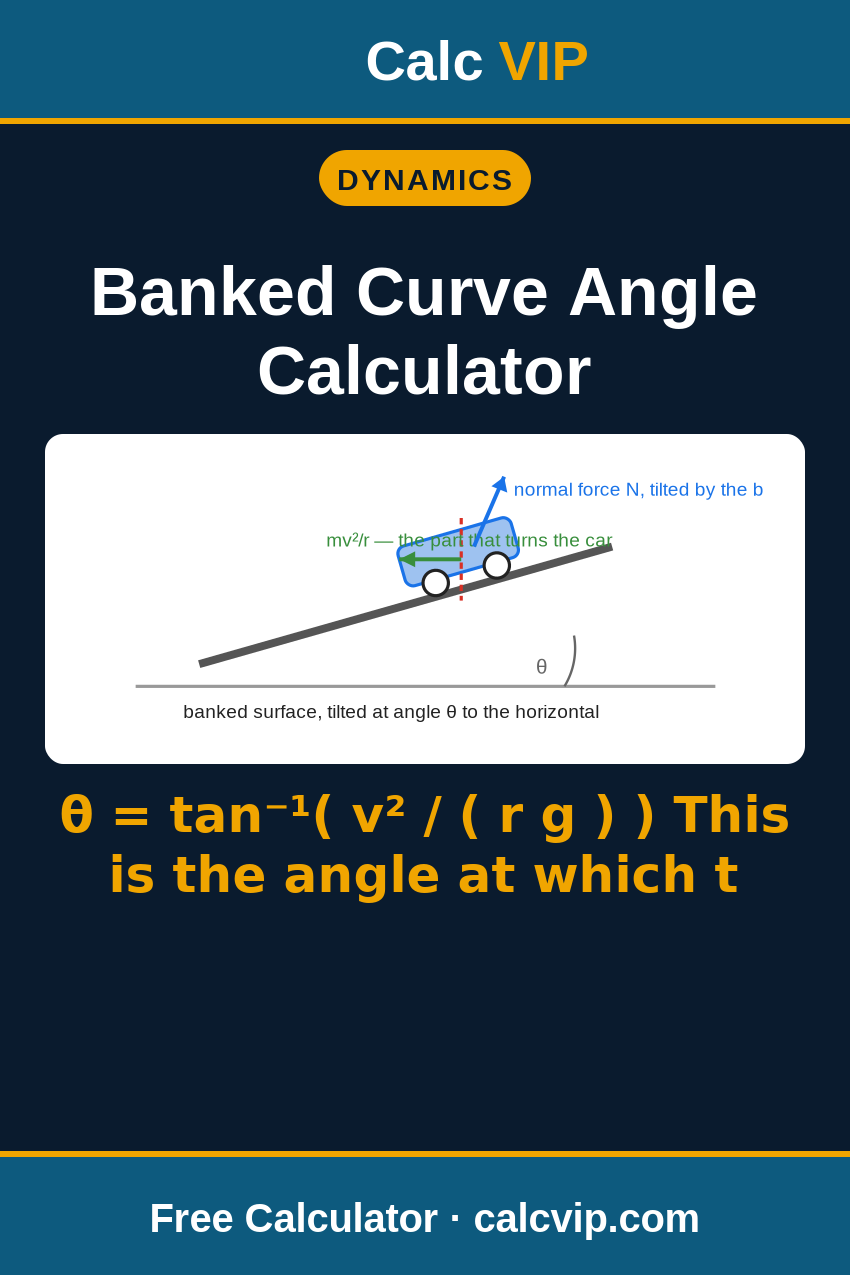
On a flat road the normal force points straight up and can only cancel weight; friction must do all the turning. Bank the road by θ and the normal force tilts with it, leaning towards the centre of the curve. That one tilted force now has two jobs, and it splits into two components. Vertically, N cos θ must still hold the car up against its weight mg. Horizontally, N sin θ points at the centre of the circle — and a force towards the centre is exactly what circular motion consumes, so N sin θ must equal mv²/r. Divide the second equation by the first and both N and the mass cancel, leaving tan θ = v²/(rg). The cancellation of mass is the formula's quiet gift: the ideal angle is the same for a bicycle, a family car and a loaded truck, which is why one banked bend can serve every vehicle that uses it.
The derivation also shows what banking cannot do. The normal force grows as the bank steepens — at the ideal angle N = mg / cos θ — but the relationship is a bargain struck for exactly one speed. Below it, gravity's component down the slope exceeds what the turn requires and friction must act up the slope to stop the vehicle sliding inwards; above it, the horizontal component of N is no longer enough and friction must act down the slope, adding its grip to the turn. Real roads are therefore banked modestly and rely on friction for the rest, reserving extreme banking for velodromes and racetracks where speeds are high, radii are tight and the surface is kept grippy and dry.
How to use
- Enter the design speed in metres per second (divide km/h by 3.6 to convert).
- Enter the radius of the curve — a tighter bend means a smaller radius.
- Leave g at 9.81 for Earth, or change it for another planet or for a tilted-track problem set elsewhere.
- Click "Calculate" to get the required banking angle in degrees — the angle at which a vehicle at that speed needs no friction at all.
Worked examples
Example 1 — a highway curve. A highway curve of radius 100 m is designed for traffic moving at 20 m/s (72 km/h).
θ = tan⁻¹(20² / (100 × 9.81)) = tan⁻¹(400 / 981) = tan⁻¹(0.4077) = 22.18°.
Bank the road at about 22° and cars at the design speed need no friction to stay in lane.
Example 2 — a city corner. A city junction turns through a radius of 40 m at a cautious 10 m/s (36 km/h): θ = tan⁻¹(100 / (40 × 9.81)) = tan⁻¹(0.2548) = 14.30°. Even this modest corner would ideally want noticeable banking — a reminder of how hard friction works on the flat streets we actually build, and why those streets flood the tyres with tread patterns and the surface with texture.
Example 3 — a velodrome. Track cyclists race at 15 m/s (54 km/h) around bends of radius 25 m: θ = tan⁻¹(225 / (25 × 9.81)) = tan⁻¹(0.9174) = 42.54°. Real velodromes are indeed banked around 42–47° on the turns — so steep that walking up them is a scramble, yet at racing speed the riders sit squarely on the surface as if it were flat.
Example 4 — a motorway sweeper. A fast, gentle motorway curve of radius 300 m designed for 30 m/s (108 km/h): θ = tan⁻¹(900 / (300 × 9.81)) = tan⁻¹(0.3058) = 17.00°. Real motorways use far less banking than this and let friction do the rest — one reason motorway bends feel gentle but still demand respect on ice, when the friction share of the job suddenly goes missing.
Example 5 — banking on the Moon. A lunar rover track of radius 50 m driven at 10 m/s, with g = 1.62 m/s²: θ = tan⁻¹(100 / (50 × 1.62)) = tan⁻¹(1.2346) = 50.99°. Weaker gravity needs dramatically steeper banking for the same turn, because gravity is what presses the vehicle onto the tilted surface in the first place.
Example 6 — a rural bend. A country road bends with radius 80 m and a design speed of 15 m/s (54 km/h): θ = tan⁻¹(225 / (80 × 9.81)) = tan⁻¹(0.2867) = 16.00°. Compare Example 2: the same speed over double the radius halved the tangent of the angle — radius and speed trade against each other exactly as the formula promises.
Banking in real life
Motorway and highway design. Road engineers combine modest banking (often called superelevation, typically a few percent of tilt) with generous radii, so that at the posted speed friction is a backup rather than the whole story — and a skidding vehicle slides up the bank, away from oncoming traffic, rather than down into it.
Velodromes and speedway tracks. Where speeds are high and radii small, banking becomes architecture: velodrome turns exceed 40°, and the steepest NASCAR ovals bank above 30°, letting cars corner at speeds that would be impossible on the flat without enormous aerodynamic downforce.
Railway cant. Trains cannot rely on tyre-style friction for guidance, so tracks are canted — the outer rail raised — on curves. The cant is chosen for the line's typical speed; faster and slower trains on the same curve lean into or out of the tilt, which passengers feel as a gentle sideways press.
Aircraft turns. A plane banks its wings so a horizontal component of lift supplies the centripetal force: tan θ = v²/(rg) with lift in place of the normal force. Airliners limit the bank to about 25–30° so passengers' drinks stay put, which is why big jets turn in such wide, stately circles.
Bobsleigh and luge tracks. The walled curves of an ice track are banking taken to its limit — nearly vertical walls that redirect a sled travelling at 130 km/h. The wall's normal force is almost entirely horizontal, supplying a centripetal force many times the sled's weight.
Road safety on ice. Banking explains a classic winter hazard: on a banked bend taken too slowly on ice, a car can slide down the bank towards the inside of the curve even at a crawl, because at low speed gravity's downslope component wins and friction — the only thing that could stop it — has vanished.
Too fast, too slow: what friction does on a real banked road
The ideal angle is a knife-edge only in the frictionless idealisation. Add friction back and the banked curve gains a comfortable working range. Travel faster than the ideal speed and the car tries to run up the bank; friction, acting down the slope, adds to the normal force's horizontal component, so the curve can be taken — up to a maximum speed set by the friction limit, roughly v²max = rg (tan θ + μ) / (1 − μ tan θ). Travel slower and the car tries to slump down the bank; friction reverses, acting up the slope, holding the car until the speed falls so low that even maximum friction cannot stop the slide — which is why a stationary car on a steeply banked icy track simply will not stay put. Designers exploit the range: bank for a speed near the middle of the expected traffic, and friction covers the spread on either side.
Quick reference: ideal angle for a 50 m radius curve
| Speed | Speed | Ideal angle θ (r = 50 m) |
|---|---|---|
| 5 m/s | 18 km/h | 2.92° |
| 10 m/s | 36 km/h | 11.52° |
| 15 m/s | 54 km/h | 24.64° |
| 20 m/s | 72 km/h | 39.20° |
| 25 m/s | 90 km/h | 51.88° |
| 30 m/s | 108 km/h | 61.41° |
Read the table as a design warning: on a tight 50 m bend, every extra 5 m/s of design speed demands a dramatically steeper bank. That is why real roads answer high speeds with large radii instead — geometry is cheaper than concrete tilted at 60°.
Superelevation: how engineers actually specify the bank
Highway engineers rarely talk about banking angles at all. They specify superelevation — the cross-slope of the road surface, quoted as a percentage: the height the outer edge sits above the inner edge, divided by the road's width, times 100. The percentage is tan θ expressed another way, so a 7% superelevation is an angle of about 4.0°, and the steep 22.18° of Example 1 would be a 41% cross-slope — unheard of on a public road. Design codes cap superelevation at roughly 4–12% depending on climate, precisely because of the slow-vehicle problem: on an icy, heavily banked road, stopped traffic slides sideways into the ditch. Engineers therefore meet most of the centripetal demand with radius and friction, and treat superelevation as a modest assist. The calculator's frictionless angle remains the reference point for the whole design: it shows how the total cornering demand splits, at any chosen tilt, between the road's geometry and the tyres' grip — and how much safety margin the friction share must carry on the worst wet night of the year.
Common mistakes
- Entering the speed in km/h. The formula needs m/s. Feeding in 72 instead of 20 inflates v² by a factor of 13 and returns an absurd angle near 79°. Divide km/h by 3.6 first.
- Confusing banking angle with slope gradient. Road signs quote gradient as a percentage (rise over run), which is tan θ × 100, not θ itself. A 10% superelevation is an angle of only about 5.7°.
- Thinking mass matters. It cancels in the derivation, so a motorcycle and a truck share the same ideal angle at the same speed. If your answer changes when you change the vehicle, an extra force has crept in.
- Assuming the ideal angle works at every speed. It is exact at one speed only. Slower traffic slides down-bank, faster traffic climbs it, and friction covers the difference — until it cannot.
- Measuring the radius to the wrong lane line. r is the radius of the vehicle's own path around the curve, roughly the centre of its lane — using the inner kerb's radius overstates the angle for traffic in outer lanes.
FAQ
How does this differ from the Banked Curve (ideal speed) calculator?
That one starts from a known angle and finds the speed; this one starts from a known speed and finds the angle a designer should build. They are the same formula rearranged.
Why are velodrome and racetrack banks so steep?
Track cyclists and race cars go very fast on tight curves, and v² grows quickly — a velodrome can be banked at more than 40° so riders do not slide down at speed.
Does the vehicle's mass matter?
No — mass cancels out, so the same angle suits a small car and a heavy truck at the design speed.
What happens if I drive the banked curve faster than the design speed?
The normal force's horizontal component is no longer enough, so friction acts down the slope to make up the difference. Beyond the friction limit the vehicle runs up the bank and off the outside of the curve.
And if I drive much more slowly — or stop?
Gravity's component down the slope takes over and friction must act up the slope to hold you. On a steep, slippery bank a stopped vehicle can slide down to the inside of the bend, which is why velodrome riders keep moving or clip in at the top.
Why is the speed squared in the formula?
Because the centripetal force needed for circular motion is mv²/r. Double the speed and the turn demands four times the inward force, so tan θ must quadruple — banking requirements escalate fast.
How much banking do real roads actually use?
Far less than the frictionless ideal — typically a tilt of a few percent (a few degrees at most). Real design shares the cornering job between modest banking and tyre friction, keeping the road usable at the wide range of speeds real traffic travels.
Does the same formula work for a banked railway or an aircraft?
Yes. Replace the road's normal force with the track's reaction or the wing's lift and the balance is identical: tan θ = v²/(rg). Only the source of the tilted force changes.
Can the angle ever reach 90°?
Only in the limit of infinite speed or zero radius — tan θ would have to be infinite. Practical banking tops out around 60–70° on bobsleigh walls, where the "road" has effectively become a wall and the vehicle presses against it horizontally.
Why does the calculator ask for g?
Because gravity is what loads the surface: weaker gravity means the same speed and radius need a steeper bank (Example 5's Moon track needed 51°). On Earth, leave it at 9.81 m/s².