 Calc
Beat Frequency Calculator – Beats Between Two Frequencies
 Created by David Okafor · Physics Writer · Waves & Light · Last updated: November 2026
Use this free Beat Frequency Calculator to find the beat frequency produced when two sounds of slightly different frequencies play together — the effect piano tuners listen for. Enter the two frequencies to get the beats per second and the pitch you actually hear.
Play two notes that are almost, but not quite, in tune with each other and the combined sound does something strange: instead of a steady tone you hear a slow wobbling — the sound swells, fades, swells, fades, in a regular pulse. Those pulses are beats. They happen because the two waves drift in and out of step with each other: when their peaks arrive together the sound is loud, and half a cycle of drift later one wave's peak meets the other's trough and the sound nearly cancels. The rate of that swelling is the beat frequency, and it equals nothing more mysterious than the difference between the two frequencies.
That simplicity makes beats one of the most useful measuring tools in acoustics. Your ear cannot directly judge that a string is at 441 Hz rather than 440 Hz — a difference of a quarter of one percent — but it can count one slow pulse per second with ease. Beats turn an impossibly fine frequency comparison into a slow counting exercise. Piano tuners have built a whole profession on it, and the same trick measures unknown frequencies in laboratories, synchronises aircraft engines, and sits inside every radio receiver ever built, as the sections below explain.
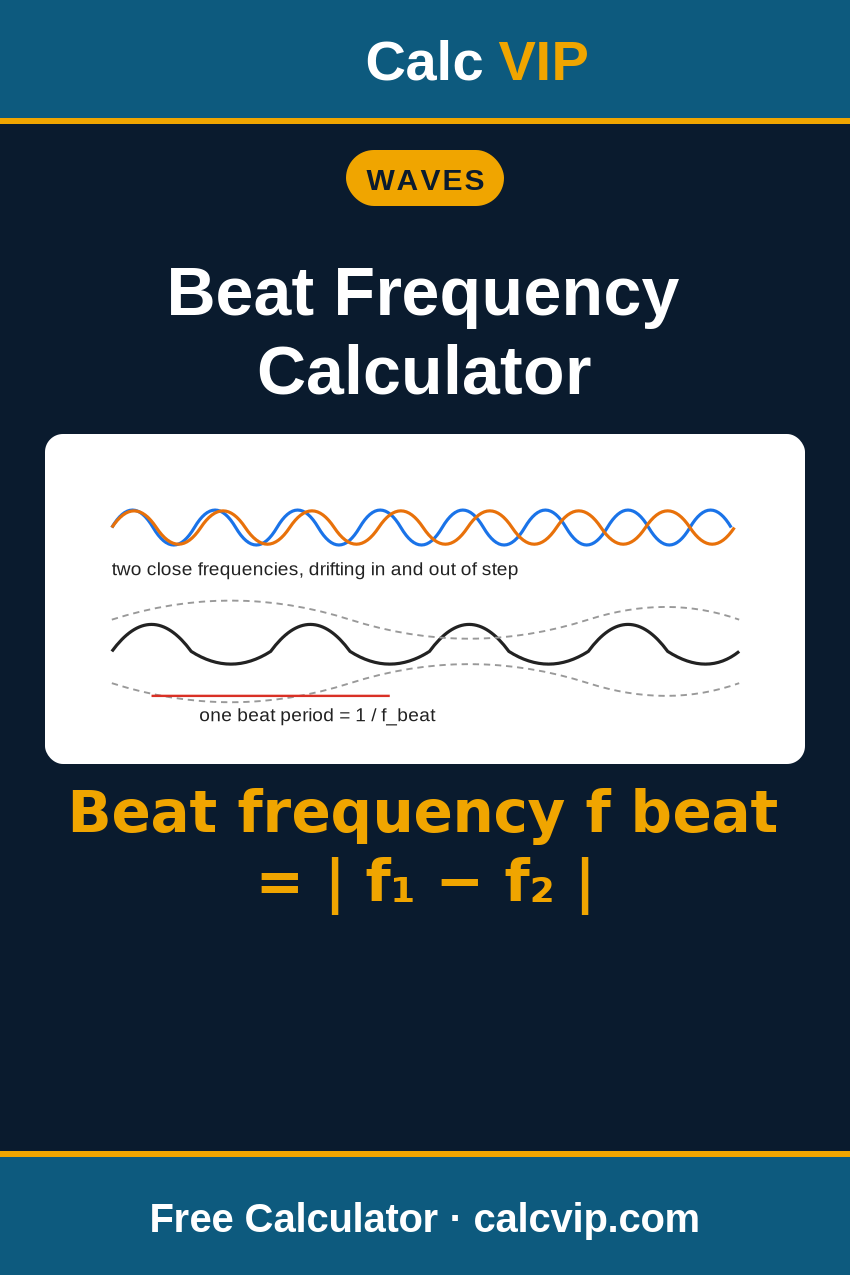
The pitch of the combined sound, meanwhile, is the average of the two frequencies — your ear fuses the pair into a single tone at (f₁ + f₂)/2, with the beats riding on top as a trembling of loudness. This calculator gives you both numbers: enter any two frequencies and it returns the beat rate and the heard pitch, and tells you whether the pair is close enough for the pulses to be heard as beats at all.
Formula
Beat frequency fbeat = | f₁ − f₂ | • heard pitch = (f₁ + f₂) / 2 • beat period Tbeat = 1 / fbeat
The absolute-value signs matter: the beat rate is always positive, whichever frequency is larger, because the waves drift out of step at the same speed in either direction. The reason the difference — not some average or ratio — appears is easy to see in cycles. If one source completes 444 cycles per second and the other 440, the faster one gains exactly 4 whole cycles on the slower one every second. Each time it gains a full cycle, the pair passes once through perfect alignment (loud) and once through perfect opposition (quiet): one beat. Gain 4 cycles per second and you hear 4 beats per second. The beat period, the time from one swell to the next, is the reciprocal — for slow beats near perfect tuning it stretches to seconds, which is what makes counting them so practical.
| Symbol | Meaning | Units |
|---|---|---|
| fbeat | beat frequency — loudness pulses per second | hertz (Hz) |
| f₁, f₂ | the two source frequencies | Hz |
| (f₁ + f₂)/2 | the pitch the ear assigns to the combined sound | Hz |
| Tbeat | time between successive loud swells, 1/fbeat | seconds (s) |
Why the sound swells and fades
Add two waves of slightly different frequency and the sum has a split personality, which a little trigonometry exposes exactly: the combined wave equals a fast oscillation at the average frequency, multiplied by a slow envelope at half the difference frequency. Your ear hears the fast part as the pitch — the average — and the slow envelope as the swelling loudness. The envelope itself completes a full loud–quiet–loud cycle at the difference frequency: when the two waves are in step, their amplitudes add and the sound peaks; as they drift, the sum shrinks; when they are exactly out of step, equal amplitudes cancel almost to silence; then they drift back into step and the sound returns.
Two limits of this behaviour are worth knowing. If the frequencies are identical, the drift never happens — the envelope is frozen at full volume and there are no beats at all, which is precisely the tuner's target. If the difference grows beyond roughly 15–20 Hz, the pulses come too fast for the ear to follow as separate swells; the sensation turns into a roughness or rattle, and for still larger differences the ear gives up fusing the pair and simply hears two separate tones. Beats are therefore a small-difference phenomenon: the calculator will happily subtract any two frequencies you give it, but nature only performs the result as audible pulses when the pair is close.
How to use
- Enter the frequency of the first sound in hertz (Hz).
- Enter the frequency of the second sound in hertz (Hz).
- Click "Calculate Beat Frequency" to see how many loud–soft pulses (beats) you hear each second, and the average pitch of the combined sound.
- To use beats for tuning or measurement, work the other way round: count the pulses per second against a stopwatch — that count is the frequency difference, so the unknown frequency is the known one plus or minus that count.
Worked examples
Example 1 — the tuning fork test. A tuning fork at 440 Hz sounds together with a slightly sharp instrument at 444 Hz.
fbeat = |440 − 444| = 4 Hz — you hear 4 pulses per second. Heard pitch = (440 + 444) / 2 = 442 Hz.
Example 2 — two mistuned oscillators. Sources at 256 Hz and 250 Hz give fbeat = |256 − 250| = 6 Hz, six swells per second, at a heard pitch of (256 + 250) / 2 = 253 Hz. Six pulses a second is near the fastest the ear can still count comfortably — a clearly restless, wobbling tone.
Example 3 — nearly in tune. A guitar string sounds against a 329.6 Hz reference and produces beats of just 0.4 Hz: the string must be at 330 Hz (or 329.2 Hz). The beat period is 1 / 0.4 = 2.5 s — one slow swell every two and a half seconds. Beats this slow are the signature of an instrument within a whisker of perfect tune.
Example 4 — identifying an unknown fork. An unmarked fork sounded with a 512 Hz reference gives 3 beats per second, so the unknown frequency is 512 ± 3: either 509 Hz or 515 Hz. The classic way to settle the ambiguity is to load the reference fork with a lump of wax, which lowers its frequency slightly: if the beats speed up, the unknown fork was the lower one (509 Hz); if they slow down, it was 515 Hz.
Example 5 — organ pipes in a cold church. Two organ pipes meant to sound together sit at 196 Hz and 198 Hz on a cold morning. They beat at 2 Hz — a slow, seasick undulation in what should be a steady chord, and a audible announcement that the rank needs the tuner's attention (or the church needs heating: pipes drift with the temperature-dependent speed of sound).
Example 6 — timing the beats. A pair at 440 Hz and 443 Hz beats at 3 Hz, so the time between swells is Tbeat = 1 / 3 = 0.33 s. If you count 30 swells in 10 seconds you have measured a 3 Hz difference — and pinned one frequency to within 3 Hz of the other — with nothing but a stopwatch and your ears.
Beats in real life
Piano and instrument tuning. Tuners do not judge pitch directly; they set pairs of strings and intervals by their beats, slowing the pulses to zero for unisons and to precise counted rates for the tempered intervals in between. A whole piano is tuned as a web of beat rates.
Measuring an unknown frequency. As Example 4 shows, beats against a known reference turn a frequency measurement into counting — historically the most accurate way to calibrate oscillators before electronic counters existed.
Radio receivers (heterodyning). Every radio mixes the incoming signal with a locally generated frequency; the difference — a beat frequency in the electrical sense — becomes the intermediate frequency the rest of the set works with. "Beat" electronics is the same subtraction, done with circuits instead of air.
Twin-engine aircraft. Two propellers turning at slightly different rates produce a slow, throbbing beat in the cabin noise. Pilots synchronise the engines by ear, adjusting until the throbbing stretches out and disappears — zero beats, matched speeds.
Speed guns and Doppler radar. A radar speed gun mixes its transmitted wave with the reflection from a moving car; the beat between the two frequencies is proportional to the car's speed. The officer is, in effect, reading a beat frequency.
Choirs and orchestras. Singers slightly off a unison produce audible beats, and good choirs instinctively adjust until the beats vanish — one reason a well-tuned chord seems to "lock" and ring with unusual stillness.
Quick reference: mistuning a 440 Hz note
| Second frequency | Beat frequency | Beat period | What you hear |
|---|---|---|---|
| 440 Hz | 0 Hz | — | perfectly steady — in tune |
| 441 Hz | 1 Hz | 1 s | one gentle swell per second |
| 442 Hz | 2 Hz | 0.5 s | a clear slow wobble |
| 445 Hz | 5 Hz | 0.2 s | a restless trembling |
| 450 Hz | 10 Hz | 0.1 s | rough, hard to count |
| 460 Hz | 20 Hz | 0.05 s | pulses merge — two tones emerge |
The table doubles as a tuner's ruler: hold any instrument against a reference, count the row you are on, and you know the size of the error without any electronics at all.
Beats between harmonics: how tuners tune intervals
Real instrument notes are not single frequencies — each carries its harmonic series with it — and that multiplies the beat phenomenon into a tool for tuning intervals, not just unisons. When two notes form a perfect fifth, some of their harmonics coincide exactly: the lower note's 3rd harmonic lands on the upper note's 2nd. Mistune the interval slightly and those coincident harmonics no longer coincide — they beat against each other, audibly, inside the combined sound. A piano tuner setting the fifth from A4 (440 Hz) to E5 listens to exactly this: in equal temperament the E is 659.25 Hz, so the coincident pair sits at 3 × 440 = 1,320 Hz and 2 × 659.25 = 1,318.5 Hz, beating at 1.5 Hz. That slow, deliberate beat is not an error — it is the definition of the tempered fifth, narrowed by a whisker from purity so that all twelve keys can share one keyboard.
The same logic explains why some intervals sound restful and others tense. In a perfectly tuned major third or fifth, the coincident harmonics align and the beat pattern between them falls silent or slows to a gentle roll; mistune the interval and roughness creeps in as the partials beat at rates in the unpleasant 5–30 Hz zone. Consonance, in large part, is the absence of audible beating between harmonics — which is why an interval can be judged, and tuned, by ear alone, with no reference instrument beyond a single starting note. Beats begin as a fault in unisons and end as the organising principle of the whole tuning system.
When the difference becomes a tone of its own
Push the difference a little further and a curious extra appears. When two loud tones a few tens of hertz apart sound together, many listeners also hear a faint third tone at exactly the difference frequency — a difference tone, noticed by the violinist Tartini in the 1700s. It is generated by slight nonlinearity in the ear itself (and in loudspeakers driven hard), which manufactures frequencies that were never in the air. Organ builders exploit it deliberately: a huge 32-foot pipe for the deepest pedal notes is expensive, so a "resultant bass" stop sounds two smaller pipes a fifth apart — say 98 Hz and 147 Hz — and the listener's ear supplies the difference, 147 − 98 = 49 Hz, as a phantom pipe an octave below the lower real one. Beats shade into roughness, roughness into a ghost tone: one phenomenon, three costumes, all priced by the subtraction on this page.
Common mistakes
- Reporting the average as the beat frequency. The average (f₁ + f₂)/2 is the pitch you hum; the difference |f₁ − f₂| is the pulse rate. Swapping them turns a 4 Hz wobble into a claim of 442 beats per second.
- Expecting beats from any pair of tones. Beyond a difference of roughly 15–20 Hz the pulses blur into roughness, and wider still you simply hear two notes. A calculated "beat frequency" of 200 Hz is arithmetic, not a sound anyone perceives as beats.
- Forgetting the ± ambiguity in measurements. Beats give the size of the difference, never its direction: an unknown source beating 3 Hz against 512 Hz is 509 or 515 Hz until a second test (like the wax trick) settles which.
- Thinking zero beats means equal loudness. Zero beats means equal frequency. Two sources at the same frequency but different volumes add to a single steady tone of the combined loudness — no pulses, but not silence either.
- Counting swells over too short a time. Slow beats near perfect tune may take 2–3 seconds each; judging from a two-second listen can miss them entirely and pronounce a mistuned string "in tune". Count over ten seconds or more.
FAQ
How do piano tuners use beats?
The tuner plays a note together with a reference fork and adjusts the string until the beats slow down and disappear. Zero beats means the two frequencies are exactly equal — the string is in tune.
What happens if the two frequencies are far apart?
Beats are only heard as separate pulses when the difference is small (roughly below 15–20 Hz). For larger differences the ear hears two separate tones instead.
Can beats measure an unknown frequency?
Yes. Sound the unknown source with a known reference, count the beats per second, and the unknown frequency is the reference frequency plus or minus the beat frequency.
What is actually happening to the sound during a beat?
The two waves alternately reinforce and cancel as they drift in and out of step. The pitch stays at the average frequency throughout; only the loudness rises and falls, at the difference frequency. Nothing is switching on and off — the sources sound steadily, and the pulsing is created purely by their addition at your ear.
How slow can beats be?
Arbitrarily slow. A difference of 0.1 Hz gives one swell every ten seconds. Tuners working on long organ pipes or bass strings use exactly these glacial beats, waiting half a minute to confirm that a swell has truly stopped rather than merely slowed.
Do beats occur with waves other than sound?
Yes — beats are a property of adding any two oscillations of close frequency. Radio engineers use electrical beats (heterodyning), laser interferometers measure distance with optical beats, and two pendulums on a shared support exchange energy in a mechanical version of the same pattern.
Why do slightly out-of-tune voices sound so unpleasant?
Beat rates in the 5–30 Hz range fall in a zone where the ear perceives roughness rather than separate pulses or separate tones. Two singers a few hertz apart generate beats right in that zone, and the resulting rattle is a big part of what "out of tune" feels like.
What is the beat period, and why does it matter?
It is the time between successive swells, Tbeat = 1/fbeat. It matters because it is what you actually measure with a stopwatch: count swells or time them, convert with the reciprocal, and you have the frequency difference. A 2.5 s beat period means a difference of just 0.4 Hz.
Can beats tell me which of the two notes is higher?
Not by themselves — the rate gives only the size of the gap. Change one frequency slightly in a known direction and watch the beats: if they slow, you moved towards the other note; if they quicken, you moved away. That is the wax-on-the-fork trick of Example 4, and how tuners feel their way in.
Why does a tuned unison sound "still" compared with a single note?
Two sources at exactly the same frequency produce a steady combined tone with no envelope movement at all. The absence of beats removes a subtle restlessness the ear is very good at noticing, which is why the moment beats vanish feels like the sound clicking into place.