 Calc
Beat Frequency Solver – Find an Unknown Frequency from Beats
 Created by David Okafor · Physics Writer · Waves & Light · Last updated: November 2026
Use this free Beat Frequency Solver to work out an unknown frequency from the beats it makes with a known reference sound. Count the beats per second, enter the known frequency, and this tool shows both possible values of the unknown frequency — the beat count alone cannot tell you whether the unknown tone is higher or lower.
Beats are what you hear when two tones of slightly different frequency sound together: the combined sound swells and fades, swells and fades, in a regular pulse. The two waves drift in and out of step — reinforcing when their crests coincide, cancelling when a crest meets a trough — and the rate of that pulsing is exactly the difference between the two frequencies. That simple fact turns your ear into a precision instrument. A beat rate of one pulse per second means the two tones differ by exactly 1 Hz, and a patient listener can hear beats far slower than that, which is why piano tuners trusted this method for centuries before electronic tuners existed.
The solver on this page runs the reasoning backwards. In real life you rarely know both frequencies: you know the reference — a tuning fork, a tone generator, another string already in tune — and you can count the beats, but the unknown tone is the thing you are trying to measure. Adding and subtracting the beat rate from the known frequency gives the only two values the unknown can possibly have. Everything else about the craft of tuning is resolving that one ambiguity, and the worked examples below show the standard trick for doing it.
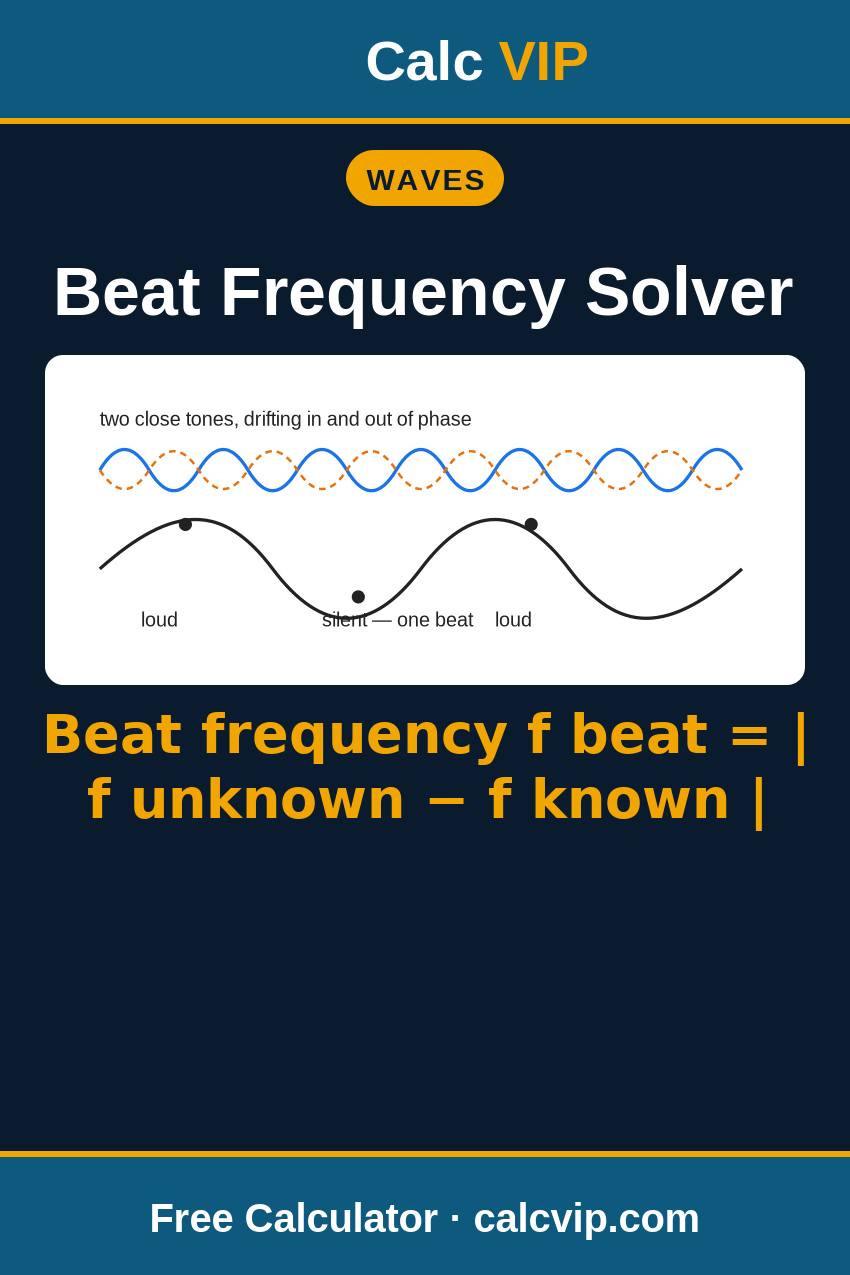
One caution before the numbers: the beat method works only when the two tones are close. Below about 15–20 beats per second the pulses are individually countable; faster than that they blur into a roughness, then into two separate tones with a ghostly third "difference tone" between them. That is no defect — it is the same physics at a different scale, and it is exploited deliberately in radio engineering, where mixing two frequencies to extract their difference is called heterodyning. But for tuning work, keep the pair close and the beats slow.
Formula
Beat frequency fbeat = | funknown − fknown | • solved for the unknown: funknown = fknown ± fbeat
The modulus sign is the whole story of this page: the beat rate measures the size of the gap between the two frequencies but carries no information about its direction, so the unknown sits either one beat-rate above the reference or one beat-rate below it. Musicians name the two cases: an unknown above the reference is sharp, one below is flat. Units are hertz throughout — beats per second is hertz, since one beat is one complete swell-and-fade cycle. A useful musical yardstick: at 440 Hz, one beat per second is a mistuning of about 3.9 cents (a cent is a hundredth of a semitone), so the 4 beats of the worked example below amount to roughly 16 cents — clearly audible to a trained ear, yet small enough that the two candidate answers, 436 and 444 Hz, sit well inside a semitone of each other.
| Symbol | Meaning | Units |
|---|---|---|
| fknown | reference frequency (fork, generator, tuned string) | hertz (Hz) |
| funknown | the frequency you are trying to find | hertz (Hz) |
| fbeat | beats counted per second | Hz (beats/s) |
Why two tones make a pulsing sound: the mathematics of beats
Add two sine waves of equal amplitude and slightly different frequencies and a small piece of trigonometry does the rest. The sum splits into two factors: a fast oscillation at the average frequency, (f₁ + f₂)/2 — this is the pitch you perceive — multiplied by a slow envelope, cos(π × (f₁ − f₂) × t), that rises and falls at the difference frequency. Each time the envelope passes through zero the sound dies away; each time it peaks, the two waves are adding crest-to-crest and the sound is at its loudest. Because loudness follows the envelope's magnitude, you get one swell per envelope cycle: |f₁ − f₂| swells per second, no more and no fewer. The beat rate is not approximately the difference — it is exactly the difference, which is what makes counting beats a measurement and not an estimate.
The phase picture is just as instructive. Suppose the unknown tone gains on the reference by exactly one full cycle every second — that is what a 1 Hz difference means. Once per second the two waves fall back into step, produce a swell, and then drift apart again. A 4 Hz difference means the faster wave laps the slower four times a second. This is also why the method's precision is limited only by patience: wait ten seconds between swells and you are resolving a difference of 0.1 Hz, a relative precision of about 1 part in 4,400 at concert pitch, from nothing but a tuning fork and a count.
How to use
- Sound the unknown source together with a known reference — a tuning fork, a tone generator app, or an already-tuned string.
- Count the loud–soft pulses in a timed interval. For slow beats, count for 10 seconds and divide by 10; that is the beat frequency in hertz.
- Enter the known frequency and the beat frequency, then click "Find the Unknown Frequency" to see the two possible values of the unknown.
- Resolve the ambiguity with the nudge test: change the unknown slightly in a known direction (tighten a string to raise it). Beats speeding up means you moved away from the reference; slowing down means you moved towards it.
Worked examples
Example 1 — the piano string and the fork. A piano string sounds with a 440 Hz tuning fork and you count 4 beats per second.
funknown = 440 + 4 = 444 Hz (string is sharp) — or 440 − 4 = 436 Hz (string is flat).
To decide which: tighten the string slightly. If the beats get faster, the string was already sharp (444 Hz); if they slow down, it was flat (436 Hz).
Example 2 — the violinist's A string. A violinist tunes against a 442 Hz fork (many orchestras tune slightly above 440) and hears 3 beats per second. The string is at 442 + 3 = 445 Hz or 442 − 3 = 439 Hz. She slackens the peg a touch and the beats slow down — she was moving towards the fork, so the string started above it: it was 445 Hz, sharp, and she keeps slackening until the beats vanish.
Example 3 — two flutes in a school band. One flute plays a steady C at 523.25 Hz; the second flute produces 2 beats per second against it. The second flute is at 525.25 Hz or 521.25 Hz. Because flute pitch rises as the instrument warms up, the player pulls the head joint out slightly to flatten it; the beats slow, confirming the flute was the sharp one at 525.25 Hz.
Example 4 — laboratory precision. Two organ pipes are compared in a teaching lab. Against a reference of 256 Hz the beats come once every 2 seconds — a beat frequency of just 0.5 Hz. The unknown pipe is at 256.5 Hz or 255.5 Hz: a match to within 0.2%, made with no electronics at all, simply by counting slowly and patiently.
Example 5 — a guitar string well out of tune. A guitar's top E string should match a 330 Hz reference, but it beats at 6 per second. The string is at 336 Hz or 324 Hz — nearly a third of a semitone out either way (6 beats at 330 Hz is about 31 cents). Beats this fast are still countable, but only just; the player first tunes by ear to the right neighbourhood, then uses the slowing beats for the final approach.
Example 6 — the piano tuner's unison. Most piano notes are struck by two or three strings that must agree exactly. A tuner sets one string to 262 Hz and hears the second string beat against it at 0.8 per second: it sits at 262.8 Hz or 261.2 Hz. She nudges its pin, listens for the beats to stretch out towards one every several seconds, and stops when a full ten seconds pass in silence — the unison is then matched to better than 0.1 Hz.
Beats in real life
Piano tuning. The entire traditional craft runs on this solver. Tuners set the temperament by counting beats between harmonics of different notes — specified rates such as "just under 1 beat per second" for a given fifth — then tune every unison to zero beats. A concert piano tuned this way has its frequencies placed to a fraction of a hertz by ear alone.
Tuning by harmonics on guitar and violin. Players sound a harmonic on one string against a harmonic on the next and listen for beats between the coincident overtones. The beats reveal mistuning magnified: a small error in the fundamental becomes a clearly countable beat rate in the shared harmonic, which is why the method beats (literally) tuning note-to-note.
Orchestral tuning. When the oboe gives the A, every player who hears slow beats against their own A knows they are within a hertz or two. Sections that tune to zero beats against the oboe converge on a common pitch standard far more reliably than players trusting individual electronic tuners set to different references.
Synchronising aircraft propellers. In a twin-engine propeller aircraft, slightly mismatched engine speeds produce a slow, fatiguing "wah-wah" beat in the cabin — the difference frequency of the two propeller sounds. Pilots trim the throttles until the beats stretch out and disappear, which is precisely this calculation flown at altitude: zero beats means matched rpm.
Heterodyne radio receivers. Every radio exploits beats deliberately: the incoming signal is mixed with a locally generated frequency, and the difference — the beat note — is extracted as an intermediate frequency that is easy to amplify and filter. The theremin goes further and makes music from two radio-frequency oscillators whose beat note is the audible pitch itself.
Comparing frequencies in the laboratory. Before digital counters, beats were the standard way to compare an unknown oscillator against a reference standard, and the method still appears in acoustics practicals: an unknown fork near 512 Hz beating 2 times a second against a standard is certified as 510 or 514 Hz by the nudge test, with an accuracy cheap electronics struggle to beat.
When beats stop sounding like beats
The solver assumes you can count the pulses, and human hearing sets the limits of that. Up to roughly 15 beats per second the swells are distinct events. Between about 15 and 30 per second they fuse into a sensation musicians call roughness — the characteristic harshness of a slightly mistuned interval, and a big part of why a mistuned unison sounds unpleasant rather than merely "two notes". Faster still, the ear gives up on the envelope entirely and hears two separate tones, sometimes with a faint third presence, the difference tone, which is a product of the ear's own nonlinearity rather than anything in the air. This progression is why the nudge-and-listen method is always done in two stages: get close by ear until the roughness dissolves into countable beats, then count your way to zero.
There is a precision ceiling at the other end too. Beats slower than about one every ten seconds are hard to certify, because few sound sources hold a steady frequency that long — strings drift as they warm, breath pressure wavers, rooms echo. In practice the beat method tops out around a tenth of a hertz, which at 440 Hz is about 0.4 cents: finer than the tolerance of any musical performance, and the reason the technique survived the arrival of electronic tuners in professional workshops.
Quick reference: beat rates and what they mean at 440 Hz
| Beat rate | Frequency gap | Musical size | What you hear |
|---|---|---|---|
| 0 | 0 Hz | 0 cents | perfectly in tune |
| 0.25 /s | 0.25 Hz | ≈ 1 cent | a swell every 4 seconds — concert standard |
| 1 /s | 1 Hz | ≈ 3.9 cents | gentle, easily counted pulsing |
| 4 /s | 4 Hz | ≈ 15.7 cents | obvious wobble — clearly out of tune |
| 10 /s | 10 Hz | ≈ 39 cents | fast flutter, hard to count |
| 20+ /s | 20+ Hz | ≈ 77+ cents | roughness, then two separate tones |
Read the table as a working method: wherever you start, adjust until the beat rate falls a row, then another, and treat the last row you can still count as your measurement. The beat rate you count is the frequency error — this solver simply adds it to, or subtracts it from, the reference you trust.
Common mistakes
- Counting for one second only. A single second's count of a 4-per-second beat can easily be off by one beat — a 25% error. Count over 10 seconds and divide; the error shrinks by the same factor of ten.
- Assuming the unknown must be the higher answer. The beat count alone gives two equally valid candidates. Skipping the nudge test and picking one at random is wrong half the time — and tuning in the wrong direction from there makes the beats faster, which is your warning.
- Trying to use beats between distant tones. A 440 Hz string against a 460 Hz reference does not give countable beats; it gives roughness. Bring the unknown close by ear first, then switch to counting.
- Confusing beats with vibrato or tremolo. Beats need two sources sounding together. A single instrument pulsing on its own is tremolo (amplitude wobble built into the sound), and its rate tells you nothing about any frequency difference.
- Trusting a drifting reference. The solver's answer is only as good as the known frequency. A phone app playing through a pitch-shifted recording, or a fork measured in a hot room, quietly moves both candidate answers by the same error.
FAQ
Why are there always two possible answers?
Beats measure only the size of the difference between the two frequencies, not its direction. A tone 4 Hz above and a tone 4 Hz below the reference both produce exactly 4 beats per second.
How can I tell which of the two answers is right?
Change the unknown frequency a little in a known direction — for example, tighten a string to raise its pitch. If the beats speed up, you moved away from the reference; if they slow down, you moved towards it. That tells you which side you started on.
How accurate is the beat method?
Very. A patient listener can detect beats as slow as one every few seconds, so frequencies can be matched to within a fraction of a hertz — this is exactly how professional piano tuners work without electronics.
How many beats per second is one semitone?
It depends on the pitch, because a semitone is a ratio (×1.0595), not a fixed gap. At 440 Hz a semitone is about 26 Hz — far too fast to count as beats. At 110 Hz it is about 6.5 Hz, and the same mistuning that produced 4 countable beats at 440 Hz (about 16 cents) would produce only 1 beat per second down at 110 Hz, where 4 beats means a much larger error of about 62 cents.
Can beats measure a frequency with no reference at all?
No — beats are inherently a comparison. The method always needs one trusted frequency. What it offers is a way to transfer that trust to an unknown source with extreme precision, using nothing but counting.
Why do the beats disappear completely at perfect tuning instead of just getting very slow?
They do get very slow — infinitely slow. At exactly zero difference the envelope never cycles, the waves stay locked in step, and there is no pulsing left to hear. "No beats" and "beats too slow to notice" meet smoothly at the same place: agreement to within a small fraction of a hertz.
Do beats happen with light or radio waves too?
Yes — the mathematics is identical for any two waves. Radio engineers call the difference signal heterodyning, and optical physicists measure tiny frequency differences between lasers as beat notes on fast photodiodes. Only the counters change: electronics instead of ears.
What if the beat frequency is larger than the known frequency?
Then the lower candidate would be zero or negative, which is physically impossible for a frequency — so the unknown must be the higher value, fknown + fbeat. The calculator flags this case for you. In practice it also means the tones were far too far apart for the beat method to be the right tool.
Why do two identical notes from different instruments beat even when "in tune"?
Because "in tune" usually means matched to within a hertz or so, and their harmonics differ in strength. Even with fundamentals locked, a strong harmonic of one instrument can beat against a slightly different harmonic of the other — one reason unisons between different instrument families never sound as still as a single instrument's unison.
How did tuners work before tuning forks were common?
With reference pipes, monochords and each other — but always with beats. The fork (invented in 1711) standardised the reference; the counting method itself is far older, and organ builders were specifying beat rates for temperaments in writing by the 1500s.